
Vous êtes-vous déjà retrouvé au milieu de nulle part avec une batterie auxiliaire déchargée et aucun moyen de faire fonctionner vos lumières ou votre réfrigérateur ? C'est un cauchemar que tout propriétaire de camping-car veut éviter.
Obtenir votre dimensionnement de batterie de camping-car correct n'est pas seulement une question de spécifications techniques, c'est aussi une question de liberté de rester hors réseau sans « anxiété liée à l'alimentation ». Que vous planifiiez votre premier voyage en camping sauvage ou que vous passiez à une LiFePO4 technologie
à haut rendement, vous avez besoin d'un système qui corresponde réellement à votre style de vie. Dans ce guide, je vais vous montrer exactement comment effectuer un audit de puissance et calculer votre capacité de batterie au lithium pour camping-car
étape par étape.
Allons droit au but.
J'ai simplifié les calculs pour que vous puissiez arrêter de deviner et commencer à vivre des aventures.
Batteries au lithium vs batteries au plomb pour camping-cars
Lorsque j'ai commencé à améliorer les installations, j'ai réalisé que le cœur de toute installation hors réseau est la batterie auxiliaire. Choisir entre le plomb-acide traditionnel et le lithium moderne n'est pas seulement une question de prix ; il s'agit de savoir combien de frustration vous êtes prêt à tolérer en camping.
Limitations des batteries inondées, AGM et gel Les installations traditionnelles de batteries à décharge profonde pour camping-car
- reposent généralement sur la technologie plomb-acide. Bien qu'elles soient abordables au départ, elles présentent des inconvénients importants : Nécessite des vérifications régulières du liquide et une fixation verticale pour éviter les fuites d'acide. Ils doivent être ventilés pour prévenir l'accumulation de gaz.
- AGM et Gel : Ce sont des batteries « sans entretien » et antidéversement, mais elles restent extrêmement lourdes et sensibles à la surcharge.
- La règle 50% : Vous ne pouvez utiliser que la moitié de leur capacité nominale. Les décharger davantage cause des dommages chimiques permanents, doublant effectivement le poids et la taille à transporter.
LiFePO4 : le choix supérieur pour les camping-cars
D'après mon expérience, passer à la taille de batterie pour camping-car LiFePO4 est la meilleure amélioration possible. Le phosphate de fer lithium est la norme en matière de sécurité et de performance sur le marché français.
| Caractéristique | Plomb-acide (AGM / Éclaté) | Keheng LiFePO4 |
|---|---|---|
| Capacité utilisable | 50% | 90% – 100% |
| Durée de vie du cycle | 300 – 500 cycles | 3 000 – 7 000 cycles |
| Poids | 27–36 kg (Groupe 27) | 11–14 kg |
| Vitesse de charge | Lente (heures de « bulk/absorption ») | Rapide (acceptant un courant élevé) |
| Chute de tension | S'effondre sous de lourdes charges | Puissance constante et stable |
Explication de la profondeur de décharge (DoD)
Comprendre profondeur de décharge des batteries de camping-car est essentielle pour votre audit énergétique. Elle indique la quantité d'énergie que vous pouvez extraire avant de devoir recharger.
- DoD des batteries au plomb-acide : Pour maintenir une batterie au plomb-acide en bonne santé, vous vous arrêtez à 50 % de DoD. Si vous avez un banc de 200Ah, vous disposez seulement de 100Ah d'énergie utilisable.
- DoD des batteries au lithium : Vous pouvez en toute sécurité tirer de 90 % à 100 % de la capacité sans endommager la batterie. Une batterie lithium de 100Ah fournit plus de puissance réelle qu'une batterie au plomb-acide de 200Ah, avec une fraction du poids.
Lorsque je calcule et calculer votre, je regarde la valeur à long terme. Le lithium offre une courbe de tension constante, ce qui signifie que vos lumières ne s'atténueront pas et que vos ventilateurs ne ralentiront pas à mesure que la batterie se décharge. C’est la différence entre “gérer” votre énergie et réellement profiter de votre voyage.
Cartographie de la consommation électrique de vos appareils de camping-car
Pour obtenir votre Guide ultime pour la taille de la batterie de camping-car | Keheng stratégie, vous devez savoir exactement ce qui tire de l'énergie de votre banque. Nous recommandons de commencer par un graphique clair de consommation en watts de vos appareils de camping-car pour estimer votre charge quotidienne. Les petits appareils comme les lampes LED ou les chargeurs de téléphone consomment très peu, mais les appareils puissants comme les micro-ondes, les sèche-cheveux et les climatiseurs nécessitent une banque de batteries capable de décharges continues élevées.
Estimation des besoins en énergie hors réseau pour camping-car
Différents appareils impactent votre calcul d'ampères-heures pour camping-car planification de différentes manières. Certaines sont des tirages constants, tandis que d'autres sont des charges de « pic » :
- Charges continues : Réfrigérateurs 12V, ventilateurs et lumières LED.
- Poussées de haute puissance : Micro-ondes, cafetières et mixeurs.
- Contrôle climatique : Unités de climatisation de toit et radiateurs d'appoint (les plus gros consommateurs d'énergie).
Mesurer la consommation réelle :
Bien que les graphiques fournissent une ligne de base, nous suggérons d'utiliser un wattmètre pour des mesures précises. Cet outil vous permet de voir la consommation d'énergie réelle de vos appareils spécifiques, éliminant les suppositions qui conduisent souvent à des systèmes sous-dimensionnés. Parce que notre technologie LiFePO4 est conçue pour la protection de l'environnement et une efficacité extrême, connaître votre consommation exacte vous assure de ne pas transporter plus de poids que nécessaire.
Prendre en compte l'efficacité et les charges fantômes :
Lors du calcul de vos besoins, ne supposez jamais une efficacité de 100%. Vous devez tenir compte de :
- Efficacité de l'onduleur : La plupart des onduleurs perdent entre 10% et 15% de puissance lors de la conversion du courant continu en courant alternatif.
- Charges fantômes : Ce sont de petites consommations « cachées » provenant de détecteurs de monoxyde de carbone, d'horloges d'appareils électroménagers et d'électronique en veille qui fonctionnent 24/7.
- Chute de tension : Les batteries traditionnelles souffrent de chutes de tension sous charge, mais nos cellules LiFePO4 maintiennent une tension stable, garantissant que vos appareils fonctionnent efficacement jusqu'à ce que la batterie soit presque vide.
Cartographier précisément ces tirages est la seule façon de garantir que votre banque de batteries correspond à votre mode de vie sans vous laisser dans le noir.
Comment calculer la capacité de votre batterie pour camping-car

Calculer la bonne taille pour votre banque de batteries fait la différence entre profiter d'une nuit tranquille hors réseau et se réveiller avec un système à plat. Pour obtenir une guide d'audit électrique pour camping-car, nous suivons un processus en quatre étapes conçu pour vous assurer de ne jamais manquer d'énergie. Contrairement aux anciennes batteries au plomb-acide que vous ne pouvez décharger qu'à moitié, notre la taille de batterie pour camping-car LiFePO4 logique utilise une capacité utilisable de 100%, permettant une configuration plus compacte et efficace.
Étape 1 : Réaliser un audit électrique quotidien
Listez chaque appareil que vous prévoyez d'utiliser. Pour chaque élément, multipliez sa puissance en watts par le nombre d'heures d'utilisation quotidienne.
- Lumières (LED) : 10W x 5 heures = 50Wh
- Réfrigérateur : 60W x 24 heures (cycle) = 700Wh
- Ordinateur portable / Téléphones : 100W x 3 heures = 300Wh
- Total quotidien : 1 050Wh
Étape 2 : Convertir les watt-heures en ampères-heures
La plupart des systèmes pour camping-cars fonctionnent en 12V, 24V ou 48V. Pour déterminer les calcul d'ampères-heures pour camping-car besoins, divisez votre total de watt-heures par la tension du système.
- Formule : Watt-heure total / Volts = Ampères-heures (Ah)
- Exemple : 1 050Wh / 12,8V = 82Ah par jour
Étape 3 : Déterminer vos jours d'autonomie
« Autonomie » fait référence au nombre de jours pendant lesquels vous souhaitez survivre sans aucune entrée de charge (pas de solaire, pas d'alternateur, pas de générateur).
- Voyage de week-end : Habituellement 1-2 jours d'autonomie.
- Camping sauvage sérieux : Recommandé 3+ jours d'autonomie.
- Calcul : 82Ah x 3 jours = Capacité totale nécessaire de 246Ah.
Étape 4 : Appliquer des marges de sécurité et des facteurs d'efficacité
Les onduleurs ne sont pas efficaces à 100 % ; ils perdent généralement environ 10-15 % de leur énergie sous forme de chaleur. Nous recommandons d'ajouter une marge de sécurité de 20 % à vos besoins en énergie pour camping autonome pour tenir compte de ces pertes et des « charges fantômes » inattendues.
- Dimensionnement ajusté : 246Ah x 1,2 = 295Ah
Exemples de calculs pour les modes de vie en camping-car
| Mode de vie | Utilisation quotidienne (Wh) | Tension | Capacité recommandée LiFePO4 |
|---|---|---|---|
| Guerrier du week-end | 1 200Wh | 12V | 200Ah (Norme Nuranu) |
| Hors réseau à temps plein | 3 500Wh | 12V ou 24V | 400Ah – 600Ah |
| Utilisateurs intensifs de technologie/AC | 6 000Wh+ | 48V | 800Ah+ |
Lors de l'utilisation d'un calculateur de banque de batteries pour camping-car, rappelez-vous que et calculer votre est supérieur en raison de la courbe de décharge plate. Nos cellules de qualité A maintiennent une tension stable jusqu'à ce qu'elles soient presque vides, garantissant que vos appareils électroniques sensibles et ventilateurs fonctionnent à pleine vitesse jusqu'à la dernière ampère utilisée. Cette efficacité signifie que vous pouvez souvent installer une banque de batteries physiquement plus petite tout en bénéficiant d'une autonomie nettement supérieure à celle d'une batterie au plomb-acide volumineuse et lourde.
Limites physiques et dimensionnement pratique des batteries pour camping-car
Lorsque nous parlons de Guide ultime pour la taille de la batterie de camping-car | Keheng, nous devons regarder au-delà des chiffres et nous concentrer sur la réalité physique de votre véhicule. Votre compartiment à batteries a des dimensions fixes, souvent conçues autour des tailles standard du groupe BCI comme le Groupe 24, 27 ou 31. La beauté de la taille de batterie pour camping-car LiFePO4 est que vous obtenez une densité d'énergie nettement plus élevée dans la même empreinte, vous permettant d'échanger une banque de batteries au plomb-acide encombrante contre une configuration lithium à haute capacité sans réduire votre espace de stockage.
Impact sur le poids et la PTAC
Pour de nombreux voyageurs en France, rester en dessous de la Masse Maximale Autorisée (MMA) est une lutte constante. Les batteries au plomb-acide traditionnelles sont incroyablement lourdes et réduisent votre capacité de chargement. Nos solutions lithium résolvent cela instantanément :
- 1/3 du poids : Passer au lithium peut économiser plusieurs centaines de kilogrammes.
- Capacité supérieure : Obtenez plus d'énergie utilisable sans l'encombrement physique.
- Efficacité énergétique : Un poids d'attelage ou une charge sur l'essieu arrière plus faible améliore la maniabilité et la consommation de carburant.
Câblage et résilience à la température
Votre Considérations sur le poids de la batterie pour camping-car ne sont qu'une partie du puzzle ; la façon dont vous les câbler détermine l'efficacité de votre système. Que vous utilisiez une configuration parallèle 12V pour des besoins standard ou une configuration en série pour des onduleurs haute tension 24V ou 48V, nous veillons à ce que nos batteries soient conçues pour la tâche. Parce que nos cellules sont étanches IP65/IP67 et sans entretien, elles peuvent être montées dans n'importe quelle orientation — même dans des endroits difficiles où une batterie au plomb-acide fuirait.
Les températures de fonctionnement sont tout aussi critiques pour besoins en énergie pour camping autonome. Nos batteries sont conçues pour supporter les extrêmes du paysage français, du chaud désertique au froid montagnard, avec une plage de fonctionnement de -20°C à 60°C. Pour des configurations spécialisées ou des installations uniques, nous proposons une gamme de produits pour d'autres applications pour garantir que votre système d'alimentation soit aussi robuste que votre destination.
Facteurs clés d'installation
- Orientation : Conception étanche à la fuite permettant un montage flexible.
- Protection BMS : Les dispositifs de sécurité intégrés gèrent les vibrations et les routes accidentées.
- Durabilité : Une construction de haute qualité garantit une durée de vie de 10 ans indépendamment des conditions routières.
Intégration de la charge et du solaire pour batteries au lithium pour camping-car
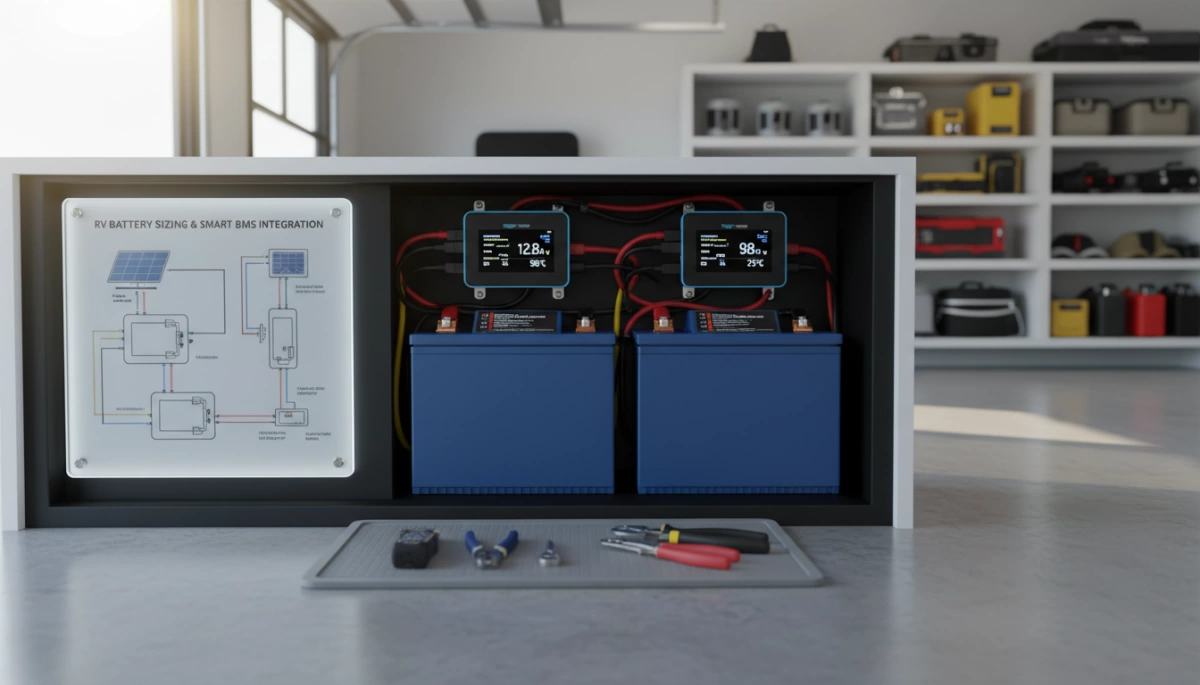
Associer correctement votre panneau solaire à votre banque de batteries est la seule façon de s'assurer de ne jamais manquer d'énergie lors du camping sauvage. D'après mon expérience, une banque de batteries solaires pour camping-car équilibrée taille de la banque de batteries solaires pour camping-car nécessite généralement 200 watts de panneaux solaires pour chaque 100Ah de capacité LiFePO4 afin d'assurer une recharge complète pendant les heures de forte luminosité.
Optimisation de la production solaire et de la capacité
- Le ratio 2:1 : Visez 200W de solaire par 100Ah de lithium pour gérer la consommation quotidienne typique des appareils.
- Efficacité de charge :
Lithium vs batteries au plomb-acide pour camping-car : le vrai coût de l'énergie
En ce qui concerne Lithium vs batteries au plomb-acide pour camping-car, le prix initial n'est qu'une partie de l'histoire. Les batteries au plomb-acide traditionnelles, y compris AGM et Gel, sont limitées par une profondeur de décharge (DoD) de 50%. Si vous les déchargez davantage, vous endommagez définitivement les cellules. Notre technologie LiFePO4 permet une capacité utilisable de 100%, ce qui signifie qu'une batterie au lithium de 100 Ah offre la même autonomie qu'un banc de batteries au plomb de 200 Ah.
Tableau comparatif des performances
| Caractéristique | Plomb-acide traditionnel (AGM/Gel) | Nuranu Lithium LiFePO4 |
|---|---|---|
| Durée de vie du cycle | 300 – 500 cycles | 4 000 – 6 000+ cycles |
| Capacité utilisable | 50% (pour éviter les dommages) | 100% (Décharge complète) |
| Poids | Très lourd (environ 29-34 kg) | Ultra-léger (environ 11-14 kg) |
| Durée de vie du service | 2 – 3 ans | Plus de 10 ans |
| Entretien | Ventilation/vérification régulière nécessaire | Sans entretien |
Gain de poids et vitesse de charge
L'un des principaux avantages pour votre PTAC (Poids Total Autorisé en Charge) est la réduction de poids. Les batteries au lithium représentent environ 1/3 du poids du poids des batteries au plomb. Cela vous permet d'augmenter votre et calculer votre sans ajouter des centaines de kilos à votre châssis. De plus, le lithium accepte une charge beaucoup plus rapidement, ce qui réduit considérablement le temps de charge de votre générateur ou de votre système solaire.
Analyse coût-bénéfice à long terme
Bien que le coût initial soit plus élevé, le lithium est le choix le plus économique à long terme. Étant donné que nos batteries durent plus de 4 000 cycles, vous devriez acheter et remplacer 10 batteries au plomb pour égaler la durée de vie d'une seule unité Nuranu. Lorsque vous tenez compte de la conception sans entretien et du BMS intelligent intégré qui empêche la surcharge et les courts-circuits, l'investissement est amorti dès les premières années d'utilisation en autonomie. Tout comme les batteries rechargeables de haute qualité ont remplacé les options jetables dans les petits appareils électroniques, le LiFePO4 est la solution permanente pour le camping-car moderne.
- Zéro chute de tension : Maintient une puissance constante jusqu'à ce que la batterie soit presque vide.
- Cellules de qualité A : Fiabilité maximale pour la vie hors réseau.
- Résilience à la température : Plage de fonctionnement de -20°C à 60°C.
Recommandations professionnelles pour la dimensionnement des batteries pour camping-car : Le guide ultime | Keheng
Choisir la bonne et calculer votre dépend entièrement de votre style de voyage et de la durée pendant laquelle vous prévoyez de rester déconnecté du courant de quai. Parce que notre technologie LiFePO4 offre une capacité utilisable de 100% et une durée de vie en cycles profonds de 4 000 à 6 000+, vous pouvez atteindre une densité d'énergie beaucoup plus élevée dans une empreinte plus petite que les configurations au plomb-acide traditionnelles.
Le Guerrier du Week-end (200Ah – 400Ah)
Si vous passez généralement les week-ends dans des parcs d'État avec des arrêts occasionnels en camping sans raccordements, un banc de 200Ah à 400Ah est l'option idéale.
- Idéal pour : éclairage LED, pompes à eau, chargement d'appareils mobiles et fonctionnement d'un ventilateur d'aération.
- Configuration standard : Deux à quatre batteries LiFePO4 de 100Ah 12V.
- L'avantage : À un tiers du poids du plomb-acide, cette configuration n'impactera pas votre capacité de chargement de cargaison.
Exigences sérieuses pour le camping sauvage (400Ah – 600Ah)
Pour ceux qui préfèrent les terrains isolés BLM ou les forêts nationales pendant 3 à 5 jours, ces exigences de batteries pour camping sauvage exigent un stockage plus robuste.
- Idéal pour : Faire fonctionner un réfrigérateur à compresseur 12V, des cafetières et des ordinateurs portables.
- Configuration standard : Un banc de 200Ah ou 300Ah d'unités à haute capacité.
- L'avantage : Une haute efficacité et des capacités de charge rapide signifient que vous passez moins de temps à faire fonctionner un générateur et plus de temps à profiter du silence.
Vie hors réseau à temps plein (600Ah+)
Lorsque votre camping-car est votre résidence principale, votre Dimensionnement de la batterie domestique 12V pour camping-car doit tenir compte d’un mode de vie résidentiel et d’une utilisation intensive d’appareils électroménagers.
- Idéal pour : Alimenter les climatiseurs, micro-ondes et plaques à induction via de grands onduleurs.
- Configuration standard : Systèmes 12V à haute capacité ou configurations avancées 24V/48V pour les camping-cars plus grands.
- L'avantage : Aucune maintenance et une durée de vie de 10 ans garantissent que votre maison sur roues reste alimentée de manière fiable toute l’année.
Erreurs courantes de dimensionnement à éviter
- Suralimentation basée sur la logique des batteries au plomb-acide : De nombreux propriétaires doublent à tort leurs besoins en capacité car ils sont habitués à la limite de décharge de 50% des batteries AGM. Avec nos cellules LiFePO4, vous obtenez 100% de la capacité nominale en Ah.
- Ignorer la décharge de pointe : Assurez-vous que la capacité de décharge continue de votre batterie (contrôlée par le BMS) correspond à la consommation maximale de votre onduleur.
- Oublier les extrêmes de température : Alors que nos batteries fonctionnent de -20°C à 60°C, la charge par temps froid nécessite des chauffages internes ou des compartiments isolés.
- Mauvaises habitudes d’entretien : Une gestion appropriée l’utilisation et l’entretien des batteries au lithium sont essentiels pour maximiser la durée de vie de 6 000 cycles et garantir que le BMS intelligent intégré puisse protéger efficacement contre la décharge profonde.
Que vous construisiez une banque de batteries personnalisée pour camping-car ou en effectuant un simple échange, concentrez-vous sur votre consommation réelle en watt-heures quotidienne plutôt que sur l'espace physique disponible. Cela garantit votre besoins en énergie pour camping autonome sont respectées sans transporter de poids inutile.





 French
  English
  German
  Spanish
  Italian
  Dutch
Dutch  Polish
  Russian
  Thai
Thai  Turkish