

Best Battery Vacuum Cleaner Guide from Van4NU Battery Experts
You’re tired of dragging a cord around, but you’re terrified of a vacuum that dies halfway through the living room.
Searching for what is the best battery vacuum cleaner?
Most reviews obsess over attachments, bin size, and fancy LCD screens.
But as battery experts, we know the uncomfortable truth: The power source defines the performance. A vacuum is only as good as the lithium cells driving it.
In this guide, we are cutting through the marketing fluff to focus on what actually matters: Voltage, Cell Chemistry, and Real-World Runtime.
We’ll help you spot the difference between a gadget that fades after six months and a powerful tool engineered to last for years.
Ready to cut the cord with confidence?
Let’s dive in.
The 3 Pillars of a Top-Tier Battery Vacuum
When you ask, “What is the best battery vacuum cleaner?”, you aren’t just looking for a brand name; you are looking for reliability. As experts in manufacturing custom lithium battery systems, we know that the “best” vacuum is only as good as the power plant inside it. We strip away the marketing fluff to focus on the three technical pillars that actually determine performance: chemistry, efficiency, and modularity.
Battery Chemistry & Voltage (The Engine)
The heart of any high suction power cordless vacuum is its cell chemistry. We utilize premium Lithium-Ion (18650 and 21700 cells) and LiFePO4 technology to balance weight with raw power.
- Voltage Matters: Higher voltage platforms (typically 24V or 36V) generally translate to higher Air Watts (AW) and stronger suction for deep cleaning.
- Chemistry Choice: Lithium-Ion offers the best energy density for lightweight handheld vacuums, while LiFePO4 provides superior safety and cycle life.
- Consistency: A top-tier battery maintains steady voltage output even as the charge depletes, ensuring your vacuum doesn’t lose suction halfway through the job.
Runtime vs. Charge Time Realities
A common frustration is a vacuum that dies in 15 minutes but takes 4 hours to charge. The lithium-ion vacuum battery life is dictated by the quality of the cells and the efficiency of the Battery Management System (BMS).
- Cycle Life: We engineer batteries designed for thousands of charge cycles, ensuring the appliance runs like new for years, not just months.
- Fast Charging: A fast charging vacuum cleaner requires robust thermal management to prevent overheating while accepting energy quickly.
- The Trade-off: High capacity (longer runtime) usually means a heavier battery. We work with OEMs to find the perfect “Goldilocks” zone—enough power to clean a whole floor without weighing down your wrist.
The “Swappable” Factor for Longevity
One of the most critical features to look for is a removable battery vacuum cleaner. Batteries are consumables; they eventually degrade. If the battery is sealed inside the unit, a dead battery means a dead appliance.
- Extended Cleaning: With a rechargeable battery pack replacement system, you can swap in a fresh pack to double your runtime immediately.
- Sustainability: Swappable designs reduce e-waste. You replace the power source, not the entire machine.
- Future-Proofing: A removable interface allows for easy upgrades if battery technology improves during the vacuum’s lifespan.
Which Battery Vacuum Fits Your Lifestyle?
Selecting the best battery vacuum cleaner isn’t just about picking the brand with the flashiest marketing; it’s about matching the power plant—the battery—to your specific daily routine. As a manufacturer of custom lithium systems, I know that different cleaning demands require different cell configurations. Whether you are managing a sprawling suburban home or a compact city apartment, the battery architecture dictates performance.
Best for Large Homes (High Capacity Options)
If you have over 2,000 square feet of floor space, runtime per charge is your most critical metric. You cannot afford to run out of juice halfway through the living room. For these environments, we recommend vacuums powered by high-capacity 21700 cells or dual-battery systems. These setups often utilize a removable battery vacuum cleaner design, allowing you to swap a depleted pack for a fresh one instantly.
- Look for: 25.2V to 36V systems.
- Key Feature: “Swappable” or “Click-in” battery packs.
- Benefit: Infinite runtime (as long as you have a second pack charged).
Best for Quick Cleanups (Lightweight Stick Vacuums)
For quick messes or smaller apartments, a heavy-duty battery is overkill and adds unnecessary weight. You want a lightweight handheld vacuum that is easy to maneuver. These devices typically rely on compact, efficient power sources, similar to our 7.4V lithium battery packs for specialized vacuums, which provide ample power without the bulk. The goal here is agility; the battery should be light enough that lifting the unit to clean blinds or shelves doesn’t strain your wrist.
Best for Pet Owners (High Suction & Filtration)
Pet hair is notoriously difficult to remove from carpets, requiring a high suction power cordless vacuum driven by a high-torque brushless digital motor. This demands a battery with a high discharge rate to sustain peak power without voltage sag. Additionally, these units must power a motorized brush bar and often a HEPA filtration system, which adds to the energy draw.
| Lifestyle | Priority Feature | Recommended Battery Tech |
|---|---|---|
| Large Home | Extended Runtime | High-capacity 21700 cells (Swappable) |
| Quick Cleanups | Lightweight/Agility | Compact 18650 packs (Lower Voltage) |
| Pet Owner | Max Suction Power | High-discharge Lithium-ion cells |
Pro Tip: Always check the Lithium-ion vacuum battery life ratings on “Max” mode. Most manufacturers advertise runtime on “Eco” mode, but pet owners will need the battery to perform under high stress.
Why the Battery Management System (BMS) Matters
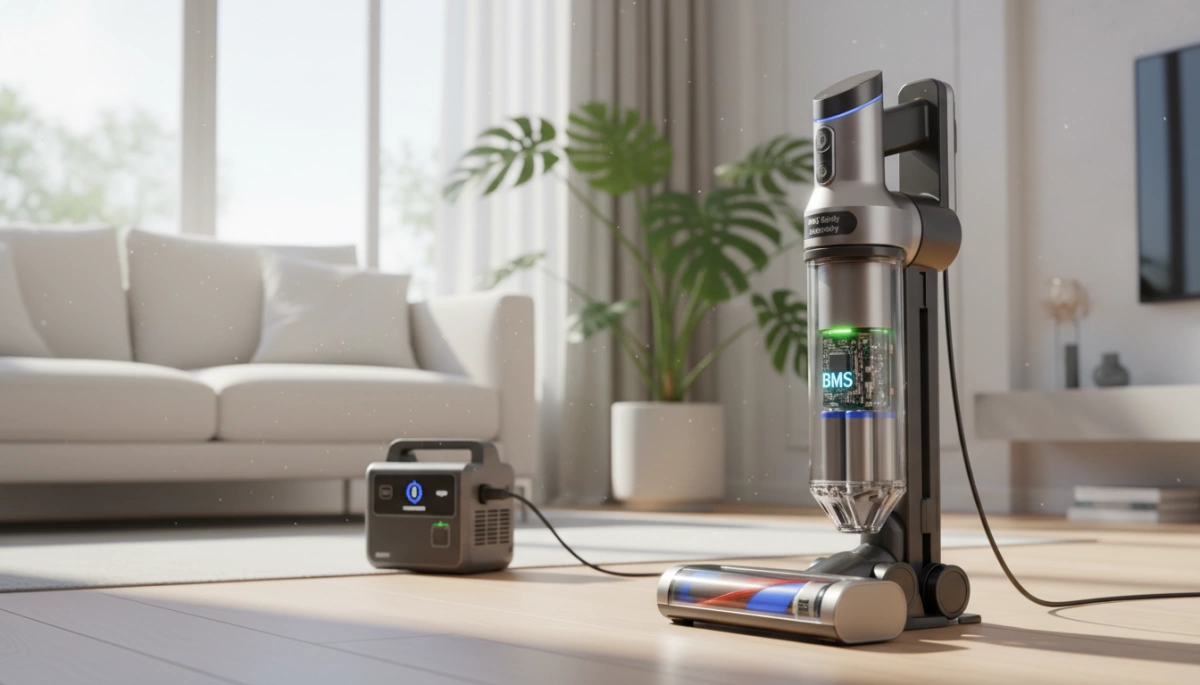
The difference between a cheap knockoff and the best battery vacuum cleaner isn’t just the suction power; it’s the brain controlling the energy. We call this the Battery Management System (BMS). As manufacturers, we know that without a smart BMS, even the highest-quality lithium-ion cells will fail prematurely. The BMS is the unseen guardian that dictates safety, performance, and how many years your appliance will last.
Safety Features: Overheating and Overcharging
Safety is our non-negotiable priority. A robust BMS constantly monitors voltage, current, and temperature in real-time. When you leave your vacuum on the dock, the BMS cuts off the current once the cells reach capacity, preventing the dangerous chemical instability caused by overcharging.
During operation, high-suction modes generate significant heat. Our systems utilize thermal management protocols to detect rapid temperature spikes. If the pack gets too hot, the BMS throttles power or shuts down the unit to prevent thermal runaway, ensuring your cordless cleaning solution remains safe to handle.
Longevity: Balancing Cells for 500+ Cycles
Vacuum battery packs consist of multiple cells working in series. If one cell degrades faster than the others, it drags down the performance of the entire pack. A premium BMS performs active cell balancing, ensuring every individual cell charges and discharges at the exact same rate.
This balancing act is crucial regardless of the cell form factor, whether we are engineering packs with standard 18650 cells or managing the larger size of 32650 battery configurations often found in heavy-duty industrial equipment. By keeping the cells in sync, we can extend the lithium-ion vacuum battery life significantly, often exceeding 500 charge cycles.
The Van4NU Standard in Battery Engineering
At Nuranu, we don’t just assemble battery packs; we engineer the logic that drives them. The Van4NU standard means integrating predictive diagnostics directly into the circuit board. This allows the vacuum to communicate with the user—flashing a red light before a battery is critically low or indicating a filter blockage that is causing motor strain.
BMS Capability Comparison:
| Feature | Generic BMS | Van4NU Advanced BMS |
|---|---|---|
| Overcharge Protection | Basic Cut-off | Precision Voltage Monitoring |
| Thermal Safety | Fuse Only | Real-time Thermal Sensors |
| Cell Balancing | Passive/None | Active Dynamic Balancing |
| Short Circuit Protection | Standard | Fast-Response Electronic Fuse |
We design these systems to solve power challenges before they ever impact your cleaning routine, ensuring that your vacuum is ready to go the moment you pull it off the wall.
How to Keep Your Battery Vacuum Running Like New
As manufacturers of the power systems driving top-tier appliances, we know that Lithium-ion vacuum battery life depends heavily on how the device is treated after it leaves the factory. While we engineer our packs with advanced protection, a few simple habits can significantly extend the lifespan of your cordless cleaning solution.
The 20-80 Charging Rule
To get the most out of your battery, avoid keeping it at 100% or letting it drop to 0% constantly. Lithium-ion cells are happiest when kept between 20% and 80% charge.
- Don’t drain it dry: Deep discharges cause chemical stress that reduces capacity over time.
- Unplug when full: While a good Battery Management System (BMS) prevents overcharging, keeping the battery at maximum voltage for weeks generates excess heat and degrades the cells.
Temperature Control and Storage Tips
Heat is the number one enemy of battery longevity. Storing your vacuum or battery pack in a hot garage or direct sunlight can permanently damage the internal chemistry. Conversely, charging a battery in freezing conditions can be dangerous. Proper storage is essential for maintaining performance and understanding if 18650 batteries are safe during long-term use.
- Store batteries at room temperature (around 68°F / 20°C).
- If you aren’t using the vacuum for a month, charge the battery to about 50% before storing it.
Filter Cleaning to Protect Battery Life
Many users don’t realize that a clogged HEPA filtration system directly impacts the battery. When airflow is restricted, the vacuum’s motor has to work harder to maintain suction.
- Increased Load: A blocked filter forces the motor to draw more current (amps).
- Heat Buildup: This extra energy draw creates heat, which stresses the battery pack.
- Premature Failure: Consistently running a vacuum with dirty filters will lead to an early need for a rechargeable battery pack replacement.
Keep the airways clear, and your battery won’t have to fight to provide the power you need.
Frequently Asked Questions About Battery Vacuums
How long do cordless vacuum batteries actually last?
Most standard lithium-ion vacuum batteries are rated for about 300 to 500 charge cycles before they start losing significant capacity. In real-world terms, that usually means 3 to 4 years of regular use. However, the industry is shifting toward more durable solutions. For example, appliances utilizing LiFePO4 battery technology can handle thousands of cycles, meaning the battery pack could outlast the vacuum itself. If you notice your runtime dropping significantly after a year, it might be due to heat damage or poor storage habits rather than just age.
Can I leave my vacuum on the charger all the time?
Yes, you generally can. Modern cordless stick vacuums are equipped with a Battery Management System (BMS) that prevents overcharging. Once the battery hits 100%, the system stops drawing current to protect the cells. That said, heat is the enemy of lithium batteries. If your docking station is in a hot spot—like direct sunlight or a non-ventilated utility closet—it can degrade the battery chemistry over time. For the best longevity, keep the charger in a cool, dry place.
Is higher voltage better for suction power?
In most cases, yes. A higher voltage platform (like 24V or 36V) allows the vacuum’s brushless digital motor to generate more torque and higher Air Watts (AW) without overheating the wires. This is crucial for deep cleaning carpets where high suction is non-negotiable. However, voltage is just one part of the equation. We verify the true capability of a power system using rigorous battery load testing methods to ensure the pack can deliver consistent power output without sagging, ensuring your vacuum sucks just as hard at 20% charge as it does at 100%.



 English
  German
  Spanish
  French
  Italian
  Polish
  Russian
  Thai
Thai  Turkish
  Japanese
  Korean