
You might already own a high-performance flashlight, but are you getting the lumens you actually paid for?
Here is the hard truth: putting a cheap battery in a premium light is like putting regular gas in a Ferrari.
You kill the performance.
Whether you are confused by the difference between 18650 and 21700 cells, or trying to decide between rechargeable AA and CR123A backups, you are in the right place.
In this guide, you’re going to learn exactly how to choose the best flashlight batteries to maximize runtime, safety, and brightness.
No more guessing. Just raw power.
Let’s dive in.
The Heavy Hitters: Lithium-Ion Rechargeables (18650 & 21700)
When identifying the Best Flashlight Batteries: AA, AAA, 18650, 21700 and CR123A, we must start with the high-performance engines driving modern illumination: Lithium-Ion (Li-ion) rechargeables. Traditional alkaline chemistries simply cannot sustain the high current draw required by today\’s professional-grade LEDs. To achieve blinding \”Turbo\” modes and extended runtimes, we rely on the superior energy density and voltage stability of Li-ion technology.
Why Li-Ion is the Standard for Modern LEDs
We engineer our tactical and EDC lights to push the boundaries of brightness. A standard alkaline battery drops in voltage rapidly under load, causing lights to dim quickly. In contrast, a high-drain rechargeable battery maintains a consistent 3.6V or 3.7V output, ensuring your light performs at peak intensity for longer durations.
21700 Batteries: The Powerhouse for High-Lumen Turbo Modes
The 21700 battery represents the cutting edge of flashlight power. slightly larger than the older 18650 standard, these cells offer a massive leap in performance.
- Capacity: Up to 5000mAh, providing significantly longer runtimes.
- Discharge Rate: Capable of handling higher amperage, which is critical for sustaining maximum output in high-lumen tactical lights.
- Application: Ideal for duty lights and outdoor searchlights where power density is paramount.
18650 Batteries: The Perfect Balance for Everyday Carry (EDC)
While the 21700 is a powerhouse, the 18650 battery remains the gold standard for compact versatility. We view the 18650 as the \”sweet spot\” for Everyday Carry (EDC) because it balances substantial power with a slimmer profile that fits comfortably in a pocket.
- Versatility: Compatible with the widest range of modern high-performance flashlights.
- Size-to-Power Ratio: Excellent energy density without the bulk of larger cells.
USB-C Rechargeable Cells vs. Standard Cells
One of the most significant conveniences we offer is the integration of charging technology directly into the battery.
- Standard Cells: Require a separate external charger or a flashlight with a magnetic/rubber-flap charging port.
- USB-C Rechargeable Cells: Feature a built-in USB-C port directly on the battery casing.
Benefits of Built-in USB-C Charging:
- Travel Friendly: No need to carry a bulky external charger; just use your phone cable.
- Redundancy: If the flashlight\’s charging port is damaged, the battery can still be charged independently.
- Simplicity: LED indicators on the battery anode clearly show charging status (Red for charging, Green for full).
Traditional and Backup Power: AA, AAA, and CR123A
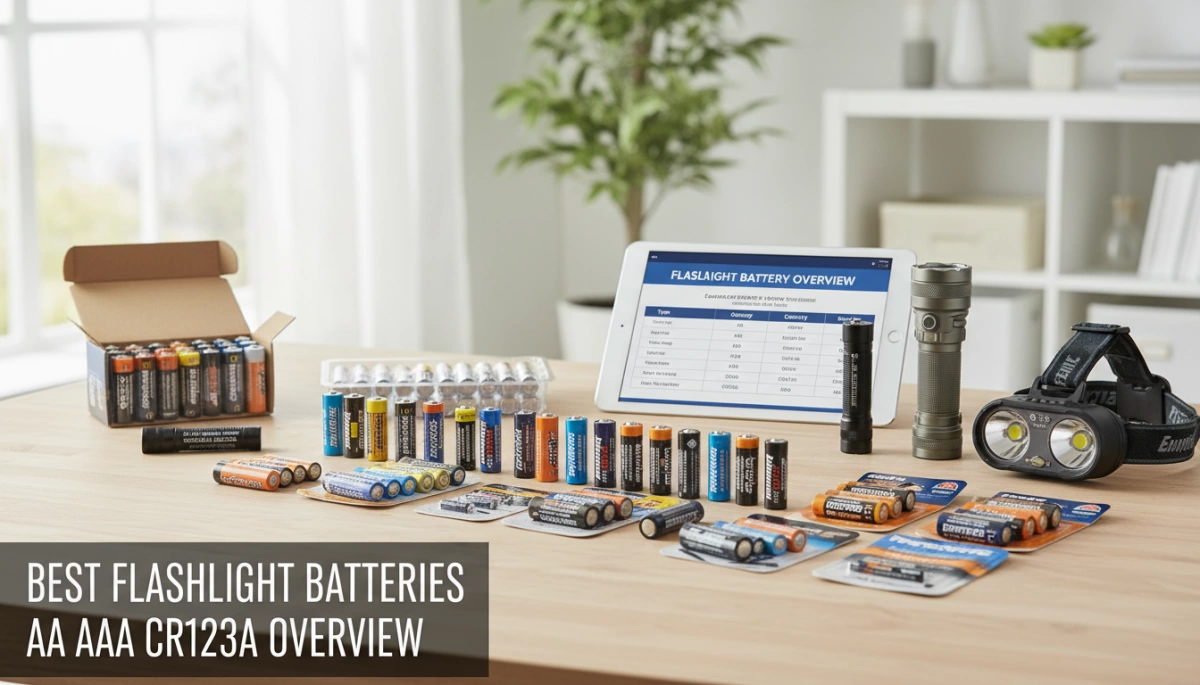
While the industry is shifting toward rechargeable lithium-ion standards, traditional cell sizes still play a critical role in backup scenarios and compact EDC (Everyday Carry) gear. Understanding the chemistry differences here is vital because putting the wrong cell in your light can either result in poor performance or a fried circuit board.
CR123A Lithium Primary: The Cold Weather and Storage King
If you are building an emergency kit for your car or a \”bug-out\” bag, the CR123A is widely considered the best flashlight battery for the job. Unlike rechargeable cells that self-discharge over time, CR123A shelf life can exceed 10 years, meaning they are ready to fire up even after sitting in a drawer for a decade.
Furthermore, cold weather battery performance is where lithium primaries shine. Standard alkaline and even some NiMH batteries struggle to output power when temperatures drop below freezing. CR123A cells maintain voltage stability in extreme cold, making them essential for winter carry. While we often engineer specialized solutions like low-temperature lithium batteries for industrial robotics, for a standard consumer handheld light, the CR123A remains the go-to disposable option for harsh environments.
The Danger of Alkaline AA/AAA Batteries
I cannot stress this enough: do not use alkaline batteries in high-end flashlights unless it is an absolute emergency. Alkaline batteries are prone to leaking corrosive potassium hydroxide, which will destroy the internal contacts and springs of your expensive light. Additionally, they have high internal resistance, meaning they cannot provide the current needed for modern high-output LEDs. You will likely see your light dim rapidly or fail to access higher brightness modes entirely.
NiMH Rechargeables: The Safe Alternative
For lights that require AA or AAA sizing, Nickel-Metal Hydride (NiMH) is the superior choice. Brands like Eneloop offer NiMH low self-discharge technology, which solves the old problem of dead batteries after a week of non-use. They don\’t leak, they maintain a flatter discharge curve than alkalines, and they can handle the current draw of modern EDC lights much better.
14500 Lithium-Ion: The High-Voltage Warning
This is where things get dangerous for the uninitiated. A 14500 lithium battery is identical in physical size to a standard AA battery, but it operates at 3.7V to 4.2V, whereas a standard AA is 1.5V.
- Voltage Mismatch: Putting a 14500 into a light designed only for 1.5V AA batteries will instantly burn out the driver and LED.
- Identification: Always check the label. If it says \”Li-ion\” or \”3.7V,\” it is not a standard AA.
It is crucial to know what you are handling. Just as you need to know how to identify an 18650 battery to avoid counterfeits or mismatched specs, you must verify if your AA-sized battery is actually a high-voltage lithium cell before inserting it into your device.
Decoding Battery Specs: How to Read the Label
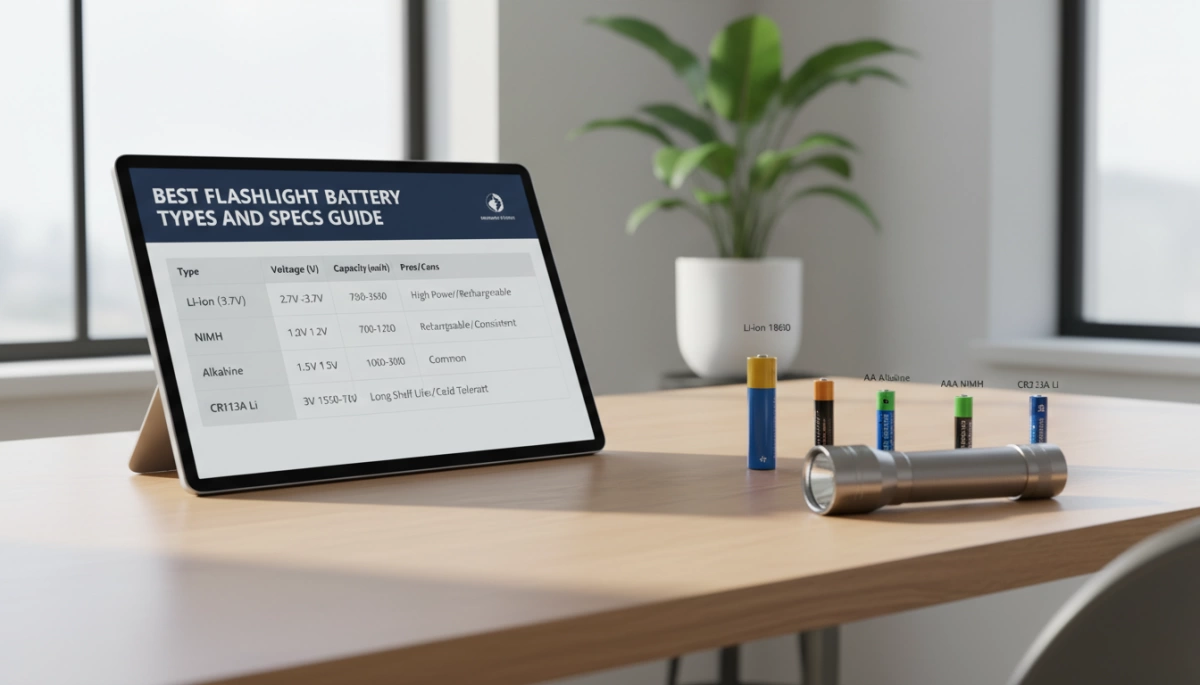
When you pick up a battery for your high-performance flashlight, the numbers on the wrapper can look like a secret code. Understanding these specifications is critical because putting the wrong cell in a tactical light isn\’t just about poor performance—it can be a safety hazard. Here is the breakdown of what actually matters when you are looking at the label.
Capacity (mAh) vs. Discharge Rate (Amps)
There is often a trade-off between how long a battery lasts and how much raw power it can deliver at once. You have to balance two main metrics:
- Capacity (mAh): Measured in milliamp-hours, this indicates the \”fuel tank\” size. A higher number, like 5000mAh on a 21700 cell, means longer runtimes on lower settings.
- Discharge Rate (Amps): This is the Continuous Discharge Current (CDR). It measures how much current the battery can push out without overheating.
If your flashlight has a massive 4,000-lumen \”Turbo\” mode, it requires a high-drain rechargeable battery capable of delivering high amperage instantly. Often, batteries with the highest capacity (mAh) have lower discharge rates, while high-discharge cells might have slightly less capacity. You need to match the battery\’s CDR to your light\’s maximum draw.
Protected vs. Unprotected Cells: Understanding the Safety Circuit
This is the most critical distinction for your safety. Lithium-ion chemistry is volatile if mishandled.
- Protected Cells: These feature an integrated Protection Circuit Board (PCB) or BMS. This small chip acts as a safety guard, preventing overcharge, over-discharge, and short circuits. For loose batteries used in flashlights, we almost always recommend protected cells.
- Unprotected Cells: These are raw cells usually intended for building battery packs where an external BMS handles safety. They are shorter and cheaper but carry a higher risk of fire if shorted or over-drained.
It is vital to understand the difference to prevent accidents. For a deeper dive into selecting the right power source, check our guide on how to choose a high-quality and safe 18650 battery to ensure your equipment remains reliable.
Button Top vs. Flat Top: Ensuring Physical Connection
Even if the voltage and chemistry are correct, the physical shape of the battery determines if it will fit in your light.
- Button Top: These look like standard AA batteries with a protruding positive pole. Most consumer flashlights and series-connected lights require button tops to make proper contact.
- Flat Top: The positive end is flush with the casing. These are common in vaping devices and some compact lights, but they often fail to make contact in flashlights that have physical reverse polarity protection mechanisms.
Always check your flashlight\’s manual. If it requires a button top, a flat top cell simply won\’t work because it won\’t touch the positive terminal.
Brand Synergy and Safety Protocols
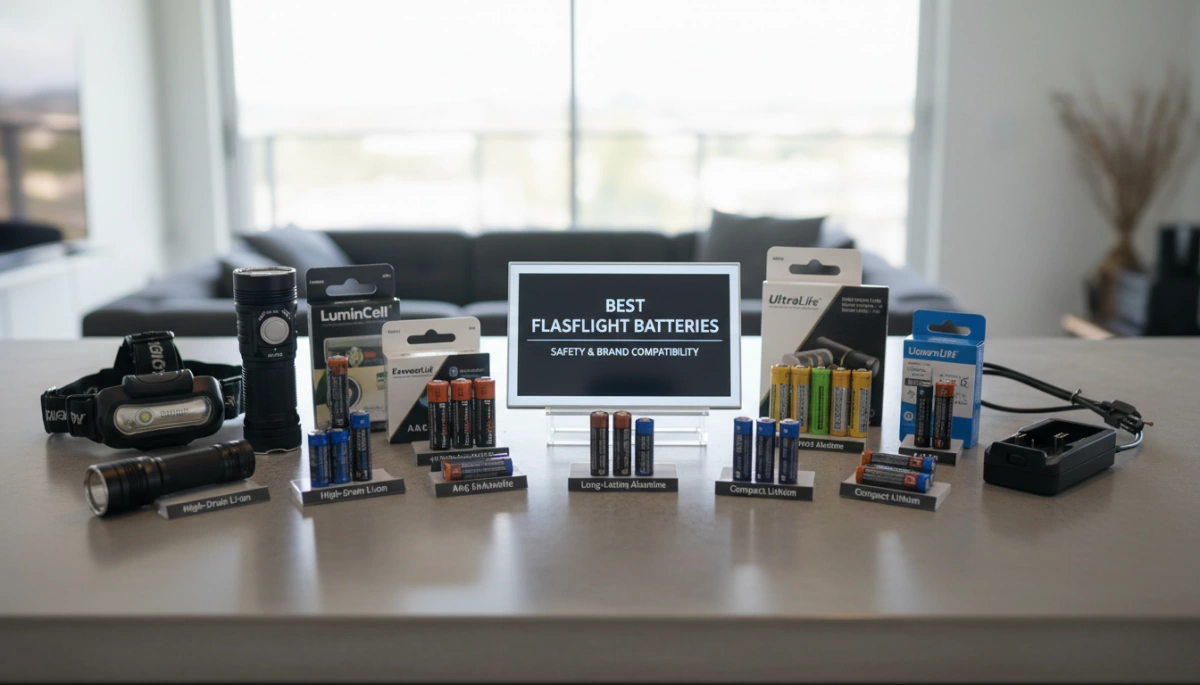
When dealing with high-performance illumination tools, the power source is just as critical as the LED emitter itself. Using sub-par power sources in professional-grade lights isn\’t just a performance bottleneck; it can be a safety hazard.
Why Generic Batteries Fail on \”Turbo\” Mode
You might wonder why a generic cell from a discount bin causes your flashlight to flicker or drop output immediately after activating \”Turbo\” mode. The answer lies in the Continuous Discharge Current (CDR). Modern tactical lights require a massive, instantaneous surge of amperage to reach peak lumens.
- High Internal Resistance: Cheap cells cannot dump power fast enough, causing voltage sag.
- Tripped Circuits: If the battery isn\’t a high-drain rechargeable battery, the sudden draw might trip its internal safety fuse, shutting the light off completely.
- Heat Buildup: Inefficient power delivery generates excessive heat, wasting energy and potentially damaging the flashlight\’s driver.
The Importance of Matching Brands
We engineer our power solutions to match the specific physical and electrical tolerances of our lights. A standard 18650 might fit, but small variations in length—often due to the addition of a protection circuit or a built-in USB-C port—can prevent the tail cap from closing or cause rattling.
Furthermore, voltage matching is crucial. Using a dedicated 7V 2600mAh lithium-ion battery pack for light ensures that the driver receives steady voltage without overstressing the components. Mixing mismatched brands often leads to poor contact conductivity, especially if the cells lack the gold-plated contact points found on premium units.
Identifying Counterfeit Lithium Cells and Fire Risks
The market is flooded with re-wrapped batteries claiming impossible specs. If you see an 18650 claiming 9,000mAh capacity, it is a counterfeit. These fakes often lack an overcharge protection circuit (PCB) and proper thermal vents.
- Weight Test: Quality lithium cells are dense. Fakes often feel suspiciously light.
- Wrapper Quality: Look for misaligned labels or typos.
- The Risk: Without thermal regulation and pressure relief valves, a short-circuited counterfeit cell can vent aggressively or catch fire, especially when pushed by a high-output flashlight. Always prioritize safety and verified specs over cheap pricing.
Frequently Asked Questions About Flashlight Batteries
Can I use a 21700 battery in an 18650 flashlight?
No, they won\’t fit. The numbers in the battery name refer to physical dimensions: a 21700 cell is 21mm wide and 70mm long, whereas an 18650 is 18mm wide and 65mm long. A 21700 is simply too thick to slide into a tube machined for the smaller 18650 standard. However, the reverse is often possible; many 21700 flashlights include a plastic sleeve adapter that allows you to use an 18650 as a backup power source.
What is the shelf life of a CR123A battery?
CR123A lithium primary batteries are the kings of storage. A high-quality cell typically offers a 10-year shelf life with minimal self-discharge. Unlike alkaline batteries that are prone to leaking and destroying electronics over time, CR123As remain stable and ready to fire even after sitting in a drawer or emergency kit for a decade. This reliability makes them the preferred choice for tactical applications and emergency backup lights.
Why do high-drain batteries get hot?
Heat is a byproduct of power. When you activate \”Turbo\” mode on a modern LED light, the driver pulls a massive amount of current—often exceeding 15 amps—from the high-drain rechargeable battery. This rapid energy transfer creates internal resistance, which generates heat. While our cells are engineered to handle high temperatures, your flashlight\’s thermal regulation system should step down the brightness to protect both the electronics and your hands.
Is it safe to leave lithium-ion batteries in the charger?
While quality chargers and protected cells feature an overcharge protection circuit to stop current flow once the battery hits 4.2V, we do not recommend leaving them on the charger indefinitely. Continuous \”topping off\” or micro-cycles can degrade the battery chemistry over time. To maximize the lifespan of your cells, remove them once the indicator turns green. Understanding the nuances of how to trickle charge a 18650 battery pack can help you maintain optimal performance and safety for your power sources.





 English
  German
  Spanish
  French
  Italian
  Polish
  Russian
  Thai
Thai  Turkish
  Japanese
  Korean