
You’ve likely stood in the electronics aisle, staring at a confusing wall of silver discs, wondering if a CR2032 is actually interchangeable with a CR2025.
It’s a common headache.
But here is the truth: those alphanumeric codes aren\’t random. They are a precise formula for chemistry and dimensions.
In this guide, you’re going to learn exactly how to decode button battery sizes so you never buy the wrong replacement again.
We’ll break down the critical differences between lithium vs alkaline coin cells, explain the IEC battery naming standards, and show you how to read the \”secret code\” hidden in the numbers.
Ready to ensure your devices get the precise power they need?
Let’s dive right in.
Decoding the Alphanumeric Codes: What Do They Mean?
When you look at the back of a blister pack or the face of a coin cell, the string of letters and numbers can look like a secret code. As experts in battery supply, we know that these codes aren\’t random—they are precise descriptors of the battery\’s chemistry and physical dimensions. Understanding this logic is the first step to ensuring you never buy the wrong size again.
Understanding the IEC Standard Naming Convention
The International Electrotechnical Commission (IEC) established the IEC battery naming standards to create a universal language for power cells. This system ensures that a battery bought in the United States fits a device manufactured in Japan or Germany. The code is broken down into two distinct parts: the prefix (letters), which indicates the chemical composition, and the suffix (numbers), which defines the physical coin cell battery dimensions.
Breaking Down the Letters: CR vs. LR vs. SR Chemistries
The first letter in the code tells you exactly what is happening inside the metal casing. This determines the voltage and the ideal use case for the battery. Here is how we categorize the most common chemistries:
| Prefix | Chemistry | Voltage | Typical Application |
|---|---|---|---|
| C | Lithium | 3V | Key fobs, medical devices, motherboards |
| L | Alkaline | 1.5V | Toys, laser pointers, calculators |
| S | Silver Oxide | 1.55V | Precision watches, medical instruments |
| P | Zinc Air | 1.45V | Hearing aids (our specialty at Nuranu) |
Cracking the Number Code: The Diameter and Height Formula
Once you know the chemistry, the numbers tell you the size. This is critical because button cell battery dimensions are measured in millimeters. The numbering system usually follows a four-digit format (like the ubiquitous CR2032):
- First two digits (20): Represent the diameter in millimeters. A \”20\” means the battery is 20mm wide.
- Last two digits (32): Represent the height (thickness) in tenths of a millimeter. A \”32\” means the battery is 3.2mm thick.
Example:
- CR2016: 20mm wide, 1.6mm thick.
- CR2032: 20mm wide, 3.2mm thick.
Why a 0.1mm Difference Matters for Connectivity
Precision is non-negotiable. While two batteries might look similar in diameter, a slight variance in thickness can prevent your device from functioning.
- Too Thick: If you force a thicker battery (like a CR2032) into a slot designed for a thinner one (like a CR2026), you risk damaging the battery contacts or cracking the device casing.
- Too Thin: Using a thinner battery in a deep slot results in a loose connection. This leads to intermittent power failure, causing devices like watches to lose time or hearing aids to cut out unexpectedly.
We always recommend matching the exact code to your device\’s manual to ensure the contacts engage with the correct pressure.
Deep Dive into Lithium Coin Cells (The CR Series)
When you look at 3V lithium battery sizes, you are almost always dealing with the CR series. These are the flat, silver discs found in everything from car key fobs to motherboard CMOS slots. The \”CR\” stands for a specific chemistry: Lithium Manganese Dioxide. Unlike the zinc-air batteries we use for hearing aids that rely on outside air, these cells are self-contained powerhouses designed for long-term reliability.
The Big Three Explained: CR2032, CR2026, and CR2016
The most confusing part for customers is often the similarity between the three most popular sizes. They all look like identical silver coins, but their dimensions dictate their capacity. The secret is in the name: the first two digits represent the diameter in millimeters, and the last two digits represent the height (thickness) in tenths of a millimeter.
Here is a quick breakdown of the coin cell battery dimensions:
| Battery Code | Diameter | Height (Thickness) | Typical Capacity | Common Uses |
|---|---|---|---|---|
| CR2032 | 20mm | 3.2mm | ~220-240 mAh | Motherboards, Car Keys, Toys |
| CR2026 | 20mm | 2.5mm | ~160-170 mAh | Calculators, Watches, Remotes |
| CR2016 | 20mm | 1.6mm | ~90 mAh | LED Lights, Fitness Trackers |
Interchangeability: Can I Use a CR2026 in a CR2032 Slot?
This is the most frequent question we get regarding CR2032 vs CR2026 compatibility. Since both batteries share the exact same 20mm diameter and 3V output, a CR2026 will physically slide into a slot designed for a CR2032. However, it is thinner by 0.7mm.
- CR2026 in a CR2032 Slot: It often works in a pinch, but the connection may be loose. If the device relies on spring tension to hold the battery, a sudden movement could break the circuit.
- CR2032 in a CR2026 Slot: This usually does not work. The extra thickness prevents the battery compartment from closing or puts dangerous pressure on the device\’s internal components.
- Stacking CR2016s: Never stack two CR2016 batteries to replace a CR2032 unless the device is specifically designed for it. Stacking them doubles the voltage to 6V, which will fry most 3V electronics instantly.
Voltage Differences and Device Compatibility
While the physical size varies, the voltage across the CR series remains a standard 3 volts. The primary difference lies in the capacity (mAh) and internal resistance. A thicker battery like the CR2032 contains more chemical material, allowing it to sustain power delivery for longer periods compared to the thinner CR2016. Understanding the relationship between lithium battery voltage and power capacity is crucial when selecting a cell for high-drain devices like security sensors or medical equipment. Using a thinner battery with lower capacity will simply result in the device dying much faster.
Why We Recommend High Energy Density Options
For critical devices, we always recommend sticking to the exact size specified by the manufacturer to ensure maximum energy density. While it might be tempting to buy a multi-pack of mixed sizes, a high-drain device like a modern car key fob requires the sustained current that only the correct form factor can provide. Using a smaller capacity battery might save you a trip to the store today, but it will likely fail when you need it most.
Alkaline vs. Silver Oxide: Choosing the Right Small Button Cell
When you look beyond our specialized hearing aid batteries, you will likely encounter a confusing array of smaller button cells used in household electronics. The most common confusion lies between Alkaline (LR) and Silver Oxide (SR) chemistries. While they often share the same physical dimensions, their performance characteristics differ significantly, and choosing the wrong one can lead to poor device performance or frequent replacements.
Visual Distinctions: Tall Cylinders vs. Flat Coins
Unlike the wide, flat lithium coin cells (like the CR2032) that resemble a nickel, standard button cells often look more like squat cylinders. They typically feature a smaller diameter but a taller height. If you place a standard LR44 vs AG13 equivalent side-by-side, you will notice they are physically identical in shape, despite the different chemical compositions inside. This shared form factor is why understanding the chemistry is critical—physically fitting into the slot doesn\’t guarantee it\’s the best power source for the job.
The Alkaline (LR) Use Case: Toys and High-Drain Bursts
Batteries with the prefix \”LR\” utilize alkaline chemistry. These are generally more affordable and are best suited for devices that don\’t require a constant, precision voltage for long periods.
- Best For: Children\’s toys, small LED flashlights, and laser pointers.
- Behavior: The voltage drops gradually as the battery drains.
- Trade-off: While cost-effective, they may leak if left in devices for too long after depletion.
The Silver Oxide (SR) Advantage: Precision for Watches
For precision electronics, Silver Oxide battery benefits become clear. Identified by the \”SR\” prefix, these cells utilize a silver-zinc chemistry that offers a higher energy density and, crucially, a very flat discharge curve. This means the battery maintains a steady voltage until the very end of its life, rather than tapering off like alkaline cells.
- Best For: Wristwatches, medical instruments, and digital calipers.
- Why Upgrade: In a watch, an alkaline battery might cause the time to lag as power fades, whereas a silver oxide cell ensures accuracy until it is fully exhausted.
Common Equivalents: LR44, AG13, and A76
Navigating the naming conventions is the hardest part of buying replacements. Manufacturers often use proprietary codes for the exact same standard size. The most ubiquitous size in this category is the 11.6mm x 5.4mm cell. Here is a quick breakdown of the interchangeable names you will see on packaging:
| Chemistry | Common Names | Application |
|---|---|---|
| Alkaline | LR44, AG13, A76, L1154 | Toys, Calculators |
| Silver Oxide | SR44, SR44W, 357, 303 | Watches, Medical Devices |
When in doubt, check your device manual. While you can usually swap an SR battery into a slot meant for an LR (to get longer life), putting an alkaline battery into a precision watch is generally not recommended due to button cell voltage differences over time.
Hearing Aid Battery Sizes and Color Codes
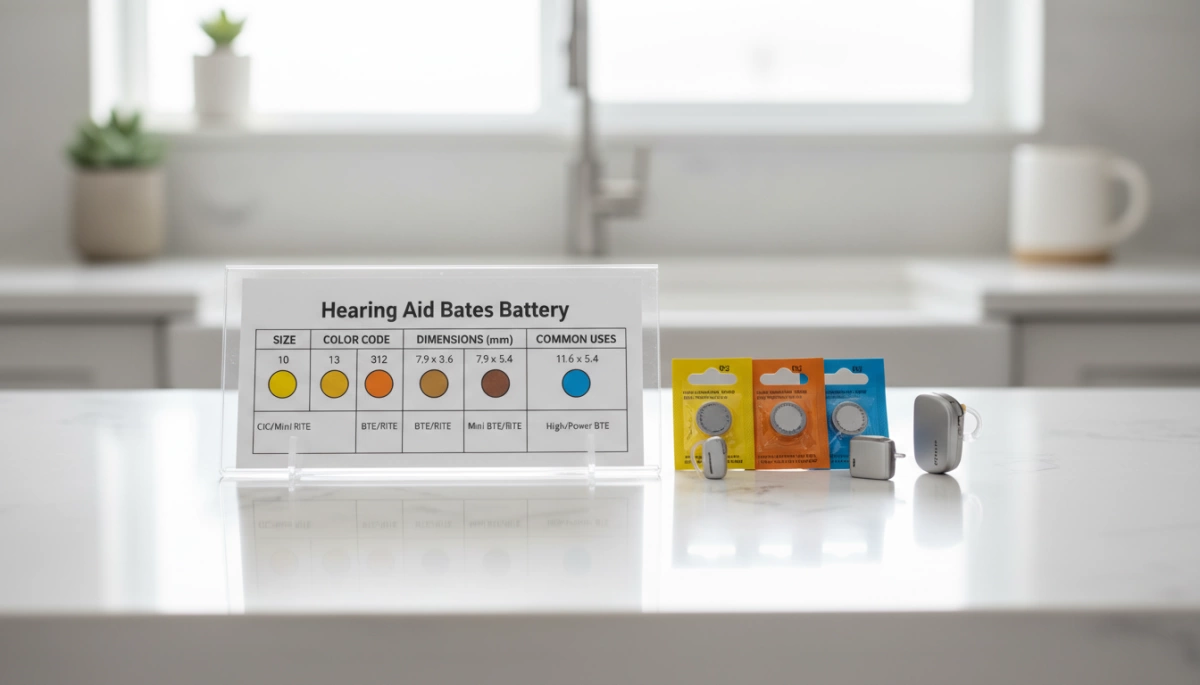
When you start to learn about button battery sizes specifically for hearing instruments, you will notice the industry operates on a strict standard. Unlike the confusing array of watch battery codes, hearing aid batteries use a universal color and number system. At Nuranu, we stock all the major players—Rayovac, Power One, Duracell, Signia, and Widex—and they all adhere to this four-color code to make your life easier.
Understanding Zinc Air Technology
Hearing aid batteries are unique because they typically use Zinc Air technology. These cells are air-activated, meaning they remain dormant until you remove the colored sticky tab on the back. Once that tab is peeled, oxygen enters through tiny holes in the casing to interact with the zinc inside, generating a steady 1.45V.
This is a crucial distinction from other power sources. Unlike the sealed chemistry found when analyzing the four key properties of rechargeable lithium polymer batteries, Zinc Air cells require constant airflow to function correctly.
- Pro Tip: After removing the tab, let the battery sit for one full minute before inserting it into your device. This \”airing out\” period allows the voltage to ramp up fully, ensuring you get the maximum lifespan out of every cell.
The Universal Color Tab System
To simplify replacements, manufacturers use specific colors on the packaging and the pull-tabs. If you know your color, you know your size.
- Size 10 (Yellow): Smallest standard size.
- Size 312 (Brown): Slim profile, very common.
- Size 13 (Orange): Medium thickness.
- Size 675 (Blue): Largest and most powerful.
Size 675 (Blue) vs. Size 13 (Orange)
These two sizes handle the heavy lifting for larger devices.
- Size 675 (Blue): This is the powerhouse of the group. It is physically the largest button battery in this category and is designed for high-power Behind-the-Ear (BTE) hearing aids and cochlear implants. Because these devices draw significant power, the 675 offers the highest capacity to keep them running longer.
- Size 13 (Orange): While slightly smaller than the blue tab, the Size 13 is a workhorse for standard BTE and In-the-Ear (ITE) devices. It balances size with energy density, making it a reliable choice for users who need moderate power without the bulk of a 675.
Size 312 (Brown) vs. Size 10 (Yellow)
As devices get smaller, the batteries must follow suit.
- Size 312 (Brown): This is one of the most popular sizes we sell. It is thinner than a Size 13 but has the same diameter. You will typically find these in Receiver-in-Canal (RIC) and In-the-Canal (ITC) hearing aids where a slim profile is essential for comfort.
- Size 10 (Yellow): The smallest of the \”Big Four.\” These are used in Completely-in-Canal (CIC) aids that sit deep inside the ear. Because they are tiny, they have less capacity than the others, so we always recommend buying these in our 60-pack or 120-pack bundles to ensure you never run short.
We prioritize freshness in every shipment. Since Zinc Air batteries have a long shelf life as long as the tab stays on, stocking up with our bulk options or subscription service is the smartest way to manage your hearing health costs.
Master Cross-Reference Guide for Battery Equivalents

Navigating the aisle for replacements can feel like cracking a secret code. You might have an old battery in your hand that says \”AG13,\” but the pack on the shelf says \”LR44.\” Are they the same? Yes. Manufacturers often use proprietary prefixes, but the underlying button battery cross reference chart relies on standardized dimensions and chemistry. Whether you are looking for a watch battery replacement guide or power for a hearing aid, understanding these equivalents saves you from buying the wrong size.
Decoding Brand-Specific Prefixes (DL, ECR, etc.)
Big brands love to put their stamp on standard sizes. If you see a prefix like DL (Duracell) or ECR (Energizer) followed by a number, simply ignore the letters to find the standard IEC size. For example, a DL2032 is identical to a standard CR2032. They are interchangeable. We stock major brands like Rayovac, Power One, and Duracell, and while the packaging might look different, a Size 312 hearing aid battery is always a Size 312, regardless of the letters before it.
Converting AG Series to Standard LR Numbers
The \”AG\” series is commonly found in toys, laser pointers, and calculators, often imported. These are alkaline batteries. The most common confusion we see is the LR44 vs AG13 equivalent. Here is the simple rule: AG13 is the same as LR44. They are also compatible with A76 and 357 (though 357 is silver oxide and lasts longer). Knowing this conversion helps you grab the right pack without hesitation.
Quick Lookup Chart for Common Replacements
To make your life easier, here is a quick breakdown of the most common swaps we encounter.
-
Hearing Aid Batteries (Zinc Air):
- Size 10 (Yellow): ZA10, PR70, 7005ZD
- Size 312 (Brown): ZA312, PR41, 7002ZD
- Size 13 (Orange): ZA13, PR48, 7000ZD
- Size 675 (Blue): ZA675, PR44, 7003ZD
-
General Button Cells:
- CR2032: DL2032, ECR2032, 5004LC
- LR44: AG13, A76, 357 (Silver Oxide upgrade), L1154
- LR41: AG3, 192, 392 (Silver Oxide upgrade)
Always check the diameter and voltage if you are unsure, but generally, if the numbers match, the battery fits.
Critical Safety, Handling, and Storage Best Practices
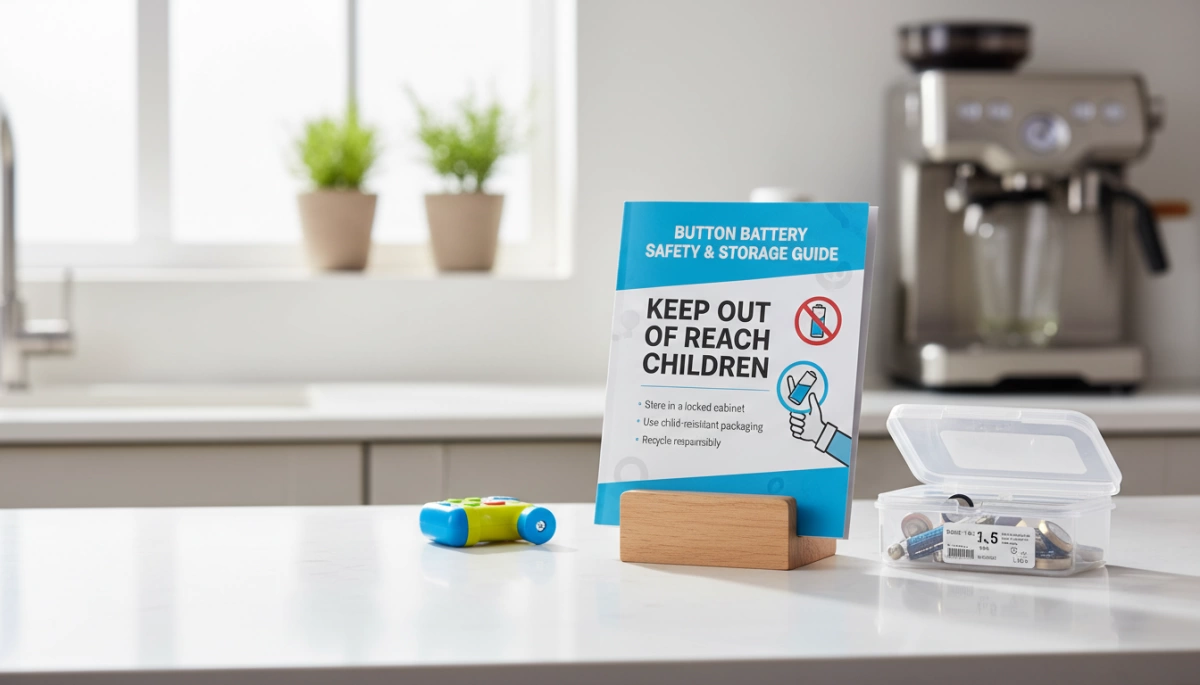
The Swallowing Hazard: Protecting Kids and Pets
We cannot stress this enough: button batteries pose a serious risk if mishandled. Their small, shiny appearance makes them look like candy to toddlers or interesting toys to pets. Beyond the obvious choking hazard, a swallowed battery can trigger a chemical reaction with saliva, causing severe internal burns in as little as two hours. This is why we prioritize stocking brands that utilize child safety battery packaging, often requiring scissors to open. Always store your spare packs in a high, locked cabinet and dispose of used cells immediately in a secure bin.
Handling Tips: Why You Shouldn\’t Touch Battery Faces
You might not realize it, but how you pick up a battery affects its performance. I always advise customers to handle these cells by the edges, never by touching the flat top and bottom surfaces simultaneously. Touching both sides can create a circuit through your skin, slightly draining the battery before it even enters your device. Furthermore, natural oils from your fingers can increase electrical resistance.
For those using Zinc Air hearing aid batteries, keeping the colored tab on until the exact moment of use is vital. If you are exploring different form factors, our guide to coin cells vs cylinders breaks down how physical design impacts handling and usage.
Proper Storage Techniques to Maximize Shelf Life
A common myth is that storing batteries in the refrigerator preserves them. For button batteries, especially Zinc Air types, this is actually harmful. The moisture and condensation inside a fridge can corrode the seal or activate the chemistry prematurely. To ensure you get the most out of long shelf life button batteries, keep them at room temperature in a dry environment. At Nuranu, we maintain a strict inventory rotation to guarantee that every pack we ship has a distant \”best-before\” date, ensuring the power is there when you need it.
Frequently Asked Questions About Button Battery Sizes
Navigating the world of miniature power sources can be tricky. Here are the answers to the most common questions we get from customers trying to learn about button battery sizes and specifications.
Are All Button Batteries the Same Voltage?
No, and assuming they are can damage your device. Button cell voltage differences are determined by the chemistry inside the casing:
- Zinc Air (Hearing Aids): Standard 1.45V. These rely on air flow to activate.
- Alkaline & Silver Oxide: Typically 1.5V to 1.55V. Common in watches and toys.
- Lithium Coin Cells (CR Series): Rated at 3V. These are twice as powerful as standard button cells.
Always check your device manual. Putting a 3V lithium cell into a slot designed for a 1.5V alkaline battery can fry the electronics instantly.
How Can I Measure a Battery If the Code Is Worn Off?
If the alphanumeric code is illegible, you can identify the battery by measuring its physical dimensions. You will need a caliper for precision.
- Measure the Diameter: Measure across the widest part of the circle.
- Measure the Height: Measure the thickness from top to bottom.
- Match to a Chart: Use the measurements to find the corresponding coin cell battery dimensions.
For example, if you measure a diameter of 20mm and a height of 3.2mm, you have a CR2032.
What Is the Difference Between a Coin Cell and a Button Cell?
While people often use the terms interchangeably, there is a visual distinction based on shape and chemistry:
- Coin Cells: Usually refer to Lithium batteries (like the CR2032). They are wider and thinner, resembling a nickel or quarter.
- Button Cells: Usually refer to Alkaline, Silver Oxide, or Zinc Air batteries. They have a smaller diameter but a taller profile, looking more like a traditional shirt button.
How Do I Safely Dispose of Used Lithium Batteries?
Never throw button or coin batteries in the regular household trash. Even \”dead\” batteries can hold enough residual charge to cause a short circuit if they touch other metal objects, creating a fire hazard. To dispose of them safely:
- Tape the Terminals: Place a piece of non-conductive tape (like electrical or duct tape) over both sides of the battery.
- Recycle: Take them to a designated battery recycling drop-off center or a hazardous waste collection site.
Proper handling prevents accidents; understanding how to manage lithium battery fire risks is essential for keeping your home safe, as lithium chemistries can be volatile if mishandled or punctured.






 English
  German
  Spanish
  French
  Italian
  Polish
  Russian
  Thai
Thai  Turkish
  Japanese
  Korean