
You’re likely asking the question: How long will a 12V 5Ah battery actually last?
Whether you’re powering a portable fish finder, a kid’s ride-on car, or a backup alarm system, you need a precise answer, not a guess.
Here is the hard truth: Not all 5Ah batteries are created equal.
While the label might say \”5Ah,\” the real-world runtime depends entirely on the battery chemistry and your specific power draw. If you are using standard lead-acid, you might be losing half your power before you even start.
In this guide, I’m going to give you the exact runtime calculator formula you need to plan your day.
I’ll also show you why upgrading to Nuranu LiFePO4 technology can instantly double your usage time compared to traditional Sealed Lead Acid (SLA) batteries.
Ready to do the math?
Let’s dive in.
How Long Will a 12V 5Ah Battery Last? The Honest Answer
When you ask, \”How long will a 12V 5Ah battery last?\”, the honest answer is: it depends entirely on what you are powering.
There is no single magic number because a battery is a fuel tank, not a timer. If you sip the power slowly with a small LED light, it could last all night. If you gulp it down with a high-draw motor, it might only last an hour. However, by understanding the basic math and chemistry, you can predict your runtime with high accuracy.
The \”Rule of Thumb\” Answer
For a quick estimate without grabbing a calculator, think of \”Amp-hours\” (Ah) literally. A 5Ah battery is theoretically designed to provide:
- 1 Amp of current for 5 hours.
- 5 Amps of current for 1 hour.
- 0.5 Amps of current for 10 hours.
While this gives you a ballpark figure, real-world physics—specifically the type of battery chemistry you use—will dictate the actual results.
The Two Definitions of \”Last\”: Runtime vs. Lifespan
Confusion often arises because \”how long it lasts\” has two very different meanings in the battery world. We need to distinguish between them immediately:
- Runtime (Hours per Charge): This is how many hours your device will run before the battery hits 0% and needs a recharge. This is strictly about capacity (Amp-hours and Watt-hours).
- Lifespan (Total Service Life): This is how many years the battery will survive before it degrades and needs to be thrown in the recycling bin. This is about cycle life.
The Nuranu Difference
Here is where our engineering changes the game. Most generic 12V 5Ah batteries are Sealed Lead Acid (SLA). They suffer from voltage sag and can only safely use about 50% of their rated capacity.
Nuranu LiFePO4 batteries are different. We utilize Lithium Iron Phosphate chemistry with a nominal voltage of 12.8V. This provides distinct advantages:
- 100% Depth of Discharge (DoD): You get the full 5Ah capacity, not just half.
- Higher Voltage Stability: Our batteries maintain steady power (above 12V) right until the end, whereas lead-acid drops quickly.
- Massive Cycle Life: While a standard SLA dies after 300-500 cycles, a Nuranu battery is built for 2,000 to 5,000+ cycles.
| Feature | Standard Lead-Acid (SLA) | Nuranu LiFePO4 |
|---|---|---|
| Usable Capacity | ~2.5Ah (50% DoD) | 5Ah (100% DoD) |
| Voltage | Drops steadily under load | Constant ~12.8V |
| Lifespan | 2-3 Years | 10+ Years |
| Weight | Heavy | ~1/3 the weight |
When you choose Nuranu, \”lasting longer\” means getting double the runtime per charge and ten times the service life compared to old-school lead batteries.
The Math: How to Calculate Your Battery Runtime
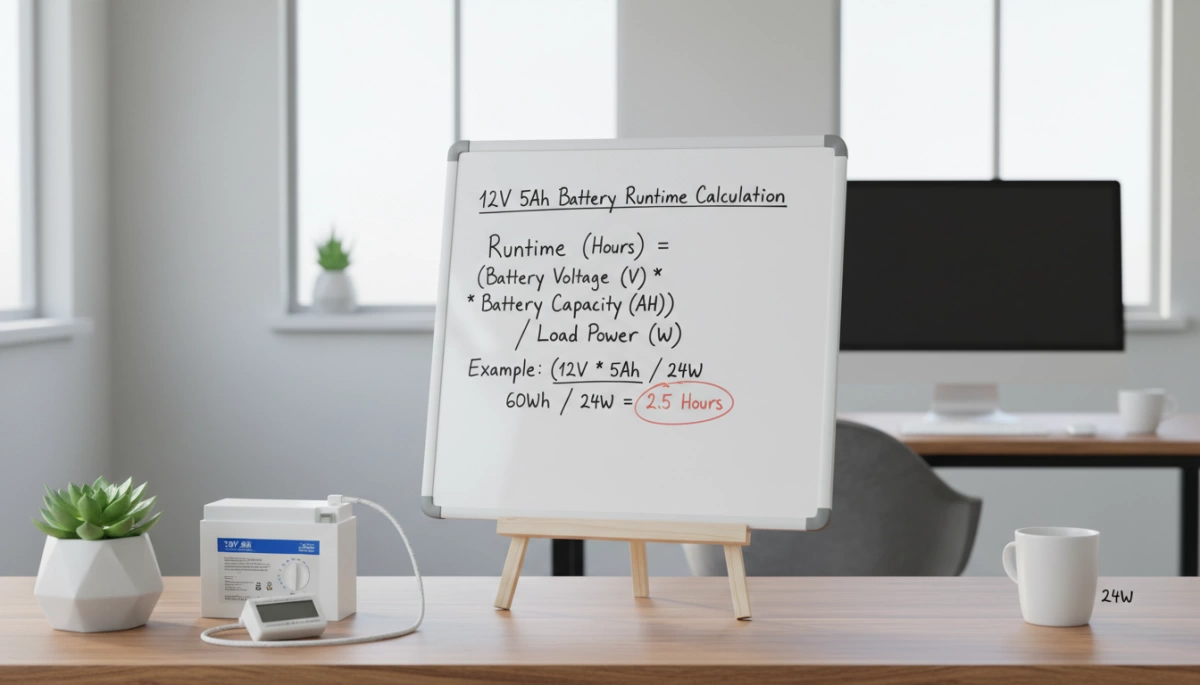
Stop guessing and start calculating. While environmental factors play a role, we can get a very accurate estimate of how long your gear will run using a simple equation. This method works whether you are powering a fish finder, a small fan, or LED lights.
The Magic Formula: Battery Capacity / Load = Runtime
To figure out your battery runtime, you just need to know how much energy is in the \”tank\” and how fast your device is draining it.
The basic equation looks like this:
$$ text{Total Watt-Hours} div text{Device Wattage} = text{Estimated Hours of Runtime} $$
Step 1: Convert to Watt-Hours
Most people look at Amp-hours (Ah), but that only tells half the story. To get the true energy capacity, we need Watt-hours (Wh). This accounts for the voltage, giving you a standardized measure of energy.
For a Nuranu 12V 5Ah battery, the math is straightforward:
12 Volts × 5 Amp-hours = 60 Watt-hours (Wh)
Think of this as having 60 \”units\” of energy available to spend. If you are looking to understand the deeper engineering behind capacity or want to build a LiFePO4 battery pack yourself, mastering this conversion is the foundation of all system design.
Step 2: Know Your Load
Next, check the power draw of the device you want to run. This is usually printed on a sticker on the back or bottom of the device.
- If it lists Watts (W): You are ready to go.
- If it lists Amps (A): Multiply the Amps by 12V to get the Watts. (e.g., 2 Amps × 12V = 24 Watts).
Step 3: Apply the Efficiency Factor
This is where the real world differs from paper calculations. No battery system is 100% efficient, but the chemistry you choose dictates how much energy you actually get to use.
- Lead-Acid (SLA/AGM): You must apply a 50% efficiency factor. If you drain these batteries below 50%, you damage them permanently. So, a 60Wh lead-acid battery only gives you 30Wh of usable power.
- Nuranu LiFePO4: Our lithium iron phosphate chemistry allows for a significantly higher depth of discharge. You can safely calculate using 95-100% efficiency. That means you get virtually the full 60Wh of energy to power your devices.
The Result:
If you have a 10-Watt LED light:
- Lead-Acid: 30Wh usable / 10W = 3 Hours
- Nuranu LiFePO4: 60Wh usable / 10W = 6 Hours
By switching to Nuranu, you effectively double your runtime without changing the physical size of the battery.
The Hidden Variable: Depth of Discharge (DoD)
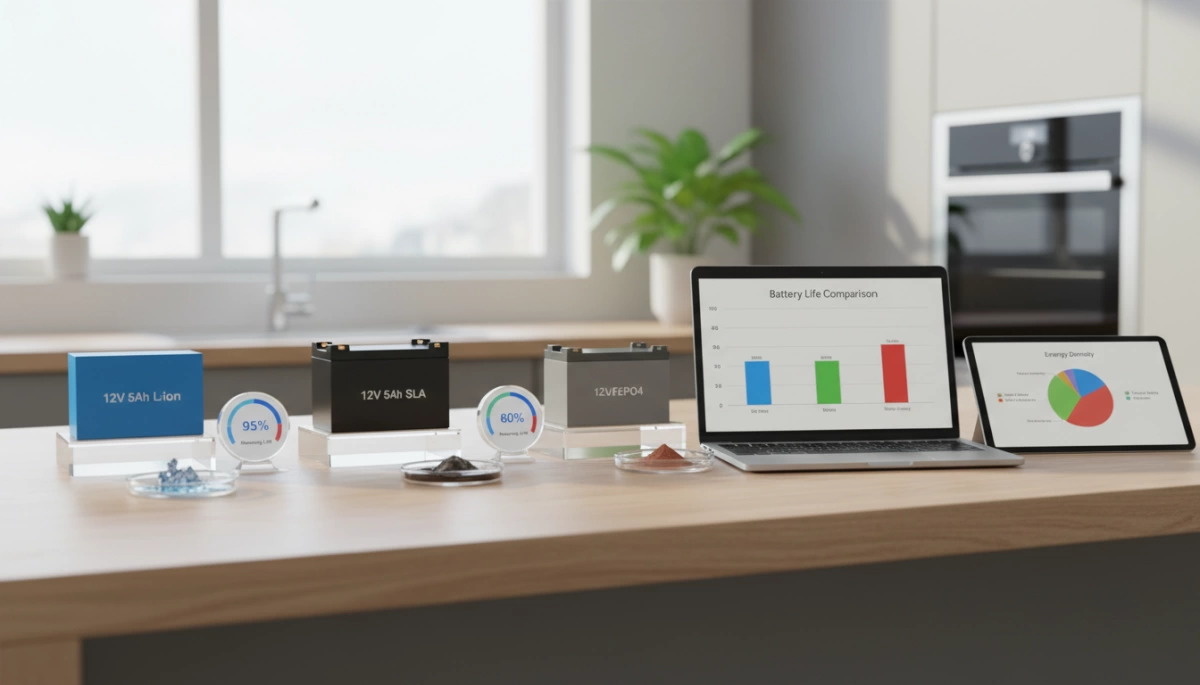
When calculating runtime, the number printed on the battery label is often misleading. This is due to a factor called Depth of Discharge (DoD), which determines how much of the battery\’s total capacity you can actually use without causing damage.
The Lead-Acid Limitation
If you are using a traditional Sealed Lead Acid (SLA) battery, you are effectively paying for capacity you cannot touch. While the label might say \”12V 5Ah,\” SLA batteries should generally not be discharged below 50%. Going deeper than that significantly shortens their lifespan and can cause permanent failure.
In practical terms, a 5Ah lead-acid battery only provides about 2.5Ah of usable power. Once the voltage drops under load, the device often shuts off prematurely. If you are still weighing your options, our Gel vs. Lithium battery showdown explains why older chemistries just can\’t keep up with modern demands.
The Nuranu LiFePO4 Advantage
We built our Nuranu LiFePO4 batteries to solve this efficiency problem. Our Lithium Iron Phosphate chemistry allows for 100% Depth of Discharge. This means when you buy a 5Ah battery from us, you get the full 5Ah of energy to run your fish finder or LED lights.
Thanks to our integrated Battery Management System (BMS), you can safely drain the battery down to nearly empty. The BMS monitors cell health and cuts power only when necessary to protect the internal components, ensuring you get maximum runtime every single cycle.
Comparison Table: SLA vs. Nuranu LiFePO4
Here is a breakdown of why lithium iron phosphate efficiency beats traditional lead-acid every time:
| Feature | Standard SLA (Lead-Acid) | Nuranu LiFePO4 |
|---|---|---|
| Labeled Capacity | 5Ah | 5Ah |
| Usable Capacity | ~2.5Ah (50% DoD) | ~5Ah (100% DoD) |
| Voltage Stability | Drops steadily during use | Constant ~12.8V until empty |
| Weight | Heavy (~4-5 lbs) | Lightweight (~1/3 of SLA) |
| Cycle Life | 300 – 500 cycles | 2,000 – 5,000+ cycles |
| Maintenance | Vulnerable to sulfation | Maintenance-free |
Real-World Runtime Scenarios
Calculating Watt-hours is great for theory, but you need to know how this translates to your actual gear. We know that lab conditions rarely match the outdoors, so here is a breakdown of what you can expect from a Nuranu 12V 5Ah LiFePO4 battery in common US applications.
Fish Finders (Small/Portable)
For kayak anglers and ice fishermen, weight is everything. A standard 4-inch to 5-inch fish finder (like a Garmin Striker or Lowrance Hook) typically draws between 0.25A and 0.5A.
- Estimated Runtime: 10 to 20 hours.
- The Nuranu Edge: Unlike lead-acid batteries that drop voltage as they drain—causing your screen to flicker or shut off prematurely—our LiFePO4 chemistry maintains a steady voltage. You get clear sonar readings right up until the battery is empty.
Kids\’ Ride-On Toys (Power Wheels)
Upgrading a Power Wheels or similar ride-on toy is one of the most popular uses for this size battery. These motors have a high amp draw, often pulling 3A to 5A depending on the terrain and the weight of the rider.
- Estimated Runtime: 45 minutes to 1.5 hours of continuous driving.
- Performance Note: With standard batteries, the car gets slower as the battery drains. With Nuranu, your kid gets full speed until the very end. Since safety is a priority when powering children\’s vehicles, it is important to know are LiFePO4 batteries safe for these applications? Absolutely—our built-in BMS protects against overheating and short circuits.
LED Strip Lights (Camping/RV)
A 12V 5Ah battery is a perfect portable power supply for camping lighting. A typical 16-foot (5 meter) roll of LED strip lights draws about 1.5A to 2A on full brightness.
- Estimated Runtime: 2.5 to 3.5 hours on full brightness.
- Efficiency Tip: If you use a dimmer and run the lights at 50%, you can easily extend this to 6+ hours, providing light for an entire evening at the campsite.
Home Alarm Systems/CCTV
Most home alarm panels use a 12V battery for backup power during outages. These systems are designed to be efficient, usually drawing a very low standby current of around 0.1A to 0.2A.
- Estimated Runtime: 25 to 50 hours.
- Reliability: In this application, the 12V 5Ah battery capacity ensures your security system stays online for days, not just hours, during a blackout. Because our batteries have a low self-discharge rate, they remain ready to work even after sitting idle in the panel for months.
Lifespan: How Many Years Will the Battery Survive?
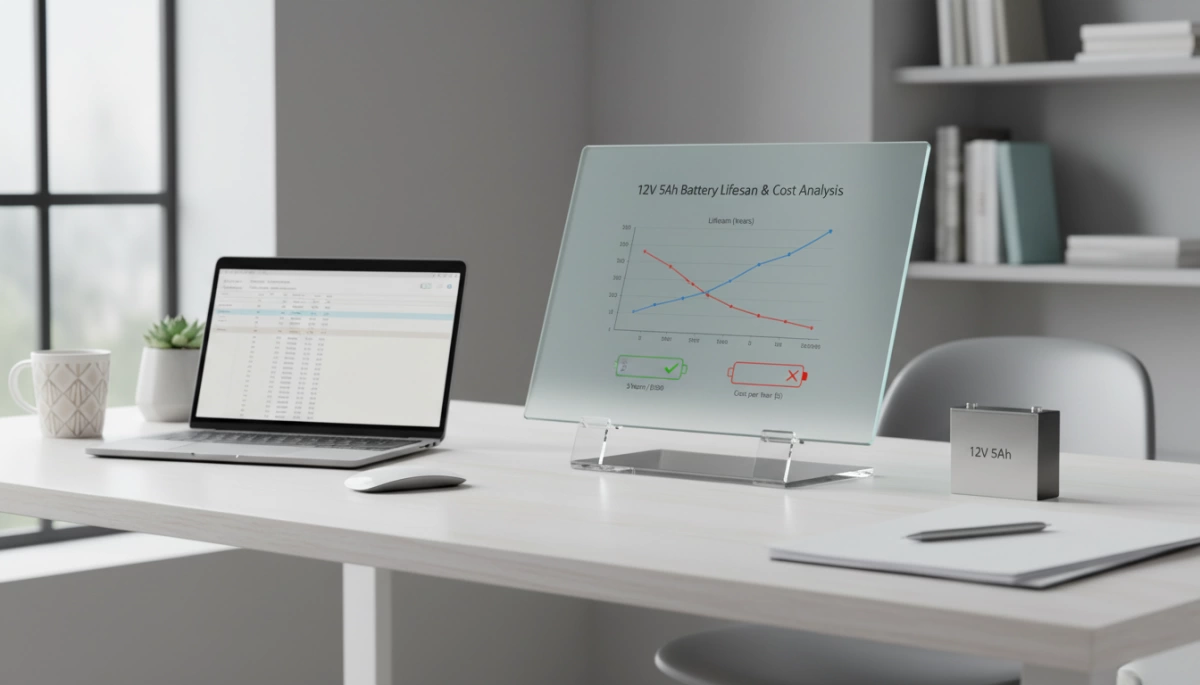
When asking \”how long,\” smart buyers look beyond daily runtime to the total service life of the unit. The lifespan of a battery is technically measured in cycles—one full discharge followed by a full recharge. This metric defines exactly when your battery will need to be replaced, and it is where the chemistry difference becomes undeniable.
Cycle Life Explained
Every time you drain a battery and charge it back up, the internal chemistry degrades slightly. Eventually, the battery loses the ability to hold a useful charge. Battery cycle life is the total number of these charge/discharge rounds a battery can handle before its capacity drops below 80% of its original rating.
SLA Expectancy vs Nuranu LiFePO4 Expectancy
The difference in longevity between traditional lead-acid and our lithium technology is drastic.
- Sealed Lead Acid (SLA): Typically rated for 300 to 500 cycles. If you cycle the battery daily, you will likely need a replacement in 1 to 2 years.
- Nuranu LiFePO4: Engineered for 2,000 to 5,000+ cycles. Even with rigorous daily use, this translates to 5 to 10 years of service life.
Cost Per Cycle Analysis
While a lead-acid battery has a lower sticker price, it is often a \”false economy.\” You would need to purchase roughly 10 lead-acid batteries to match the lifespan of a single Nuranu LiFePO4 unit. When you calculate the cost per cycle, lithium is significantly cheaper over the long term. Understanding the relationship between lithium battery voltage and power capacity helps explain why our chemistry maintains performance for years while lead-acid degrades rapidly. Investing in Nuranu means buying a power solution once, rather than renting it repeatedly through constant replacements.
Factors That Kill Your Battery Runtime
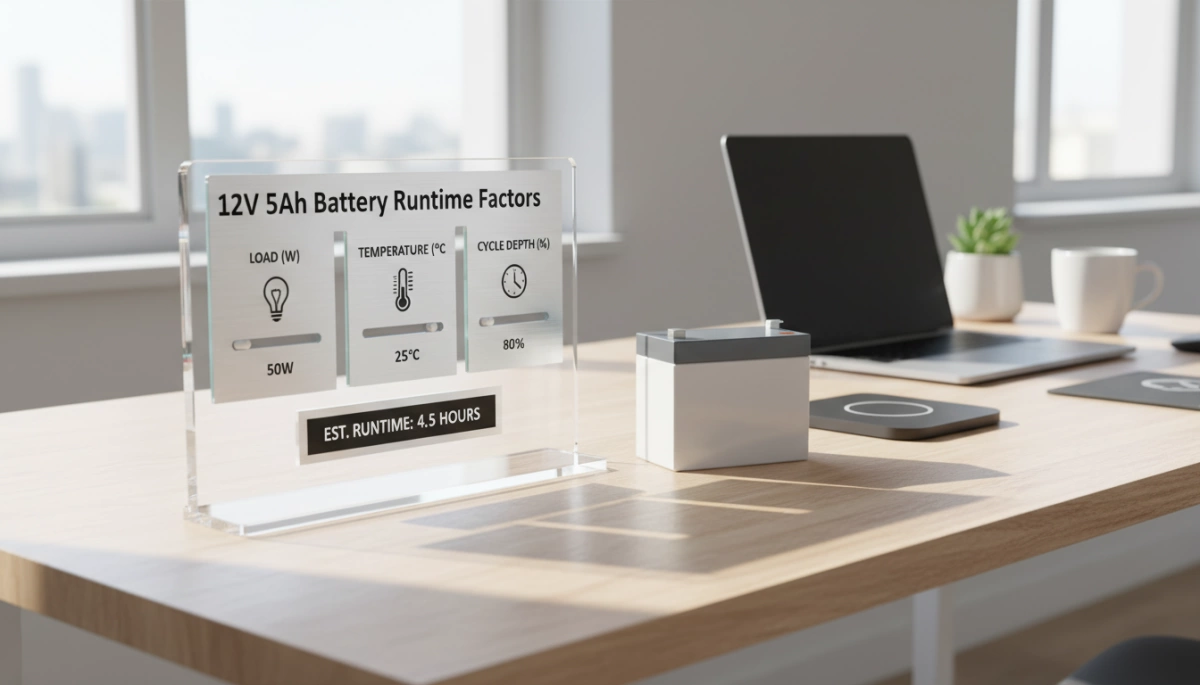
Even with the best battery runtime calculator, real-world conditions can skew the numbers. The environment and how you use the power source play a massive role in whether you get the full 5Ah or come up short. Here is what drains your energy reserves faster than expected.
Temperature and Cold Weather Impact
Batteries rely on chemical reactions to release energy, and cold weather slows those reactions down. If you are using your 12V 5Ah battery for ice fishing or winter camping, you will notice a drop in performance.
- Cold: Increases internal resistance. While our LiFePO4 chemistry handles the cold far better than lead-acid, freezing temperatures can still temporarily reduce usable capacity.
- Heat: Extreme heat improves performance temporarily but degrades the battery\’s internal components over time, shortening its overall life.
For the best portable power supply duration, try to keep the battery insulated or within a moderate temperature range (ideally above freezing and below 110°F).
High Current Draw (Peukert’s Effect)
This is a technical concept with a simple reality: the faster you drain a battery, the less total energy you get out of it. This is known as Peukert’s Effect.
- Lead-Acid: Suffers heavily here. If you pull a high amp draw (like starting a motor), the effective capacity plummets. A 5Ah SLA might only give you 3Ah of usable power under high load.
- Nuranu LiFePO4: Our lithium chemistry significantly minimizes this effect. We provide a consistent voltage and capacity even when powering demanding devices, ensuring your 12 volt battery discharge curve remains flat and efficient.
Self-Discharge and Storage Tips
If you grab your battery off the shelf after months of non-use, it might be empty. All batteries suffer from self-discharge, leaking energy even when disconnected.
- The Rate: Traditional lead-acid batteries lose charge quickly (up to 15% per month) and can suffer permanent damage if left flat. Nuranu LiFePO4 batteries have a very low self-discharge rate (<3% per month).
- Storage: Store your battery at roughly 50% charge in a cool, dry place. Neglecting storage maintenance is the main reason users end up wondering how often to replace their battery sooner than the warranty period.
Why Choose Nuranu 12V 5Ah for Your Portable Power?
When you switch to a Nuranu LiFePO4 battery, you aren\’t just buying a battery; you are investing in a premium power solution designed to outperform traditional lead-acid options in every metric. Whether you are powering a kayak fish finder, a remote sensor, or a portable lighting rig, our Nuranu 12V 5Ah specs deliver reliability that old-school chemistry simply cannot match.
Lightweight Advantages
Portability is king when you are on the move. A standard sealed lead-acid (SLA) battery is heavy and cumbersome, often weighing three times more than our lithium equivalent. Our 12V 5Ah LiFePO4 battery is featherlight, making it the ideal choice for applications where every ounce counts, such as hiking with ham radio gear or rigging a small boat. You get the same energy capacity without the \”brick\” weighing you down.
BMS Protection: The Brain of the Battery
Safety and longevity are non-negotiable. Every Nuranu battery features a built-in Battery Management System (BMS). This intelligent circuit board monitors the battery\’s health in real-time, protecting against common killers like overcharging, deep discharging, overloading, and short circuits. This level of protection ensures that your portable power supply duration isn\’t cut short by accidental misuse. Our safety standards are rigorous, making our technology reliable enough even for medical equipments where failure isn\’t an option.
Constant Voltage Performance
One of the biggest frustrations with lead-acid batteries is the voltage sag. As you use them, the voltage drops, causing lights to dim or motors to slow down long before the battery is actually empty. Nuranu LiFePO4 batteries maintain a steady ~12.8V output throughout nearly the entire discharge cycle. Your devices run at peak efficiency—lights stay bright and fish finders stay accurate—right up until the battery is depleted.
Nuranu Advantage
| Feature | Standard Lead-Acid (SLA) | Nuranu LiFePO4 |
|---|---|---|
| Weight | Heavy / Bulky | ~1/3 the Weight |
| Usable Capacity | ~50% (Safe Limit) | 100% (Full 5Ah) |
| Voltage Curve | Drops steadily during use | Flat / Constant 12.8V |
| Protection | None (Fuses required) | Integrated BMS |
| Lifespan | 300 – 500 Cycles | 2,000 – 5,000+ Cycles |






 English
  German
  Spanish
  French
  Italian
  Polish
  Russian
  Thai
Thai  Turkish
  Japanese
  Korean