
When analyzing battery ratings: mAh and mWh, the conversation with our OEM partners almost always starts with charge capacity. However, relying on the wrong metric during product development can lead to undersized packs and unexpected field failures. To get the specifications right, we first need to break down milliampere-hours (mAh).
At its core, a milliampere-hour is a strict measure of electric charge delivered over time. If a cell is rated at 4000 mAh, it can theoretically deliver 4000 milliamps for exactly one hour, or 400 milliamps for ten hours.
Why mAh Feels Intuitive
For devices operating on fixed, identical voltage platforms, using mAh is a straightforward way to gauge runtime. It works perfectly for:
- Single-cell applications: Such as individual 18650 cells.
- Standardized consumer tech: Smartphones and basic handheld electronics.
- Direct drop-in upgrades: Swapping a 2000 mAh cell for a 3000 mAh cell of the exact same chemistry and voltage.
The Limitations of mAh
The metric falls apart when nominal voltage varies or when you compare across different battery chemistries. A 5000 mAh rating on a 3.2V LiFePO4 cell delivers a completely different real-world energy profile than a 5000 mAh rating on a 12V system.
Take our standard 21700 Li-ion cells as a practical example. A single 21700 cell might feature an impressive mAh rating, making it look incredibly powerful on a raw datasheet. But if you are engineering a 24V or 36V system for e-mobility or robotics, looking at the mAh alone does not predict the total usable power your motor will draw under a heavy load. Without factoring in the voltage, mAh is only half the equation in your nominal voltage battery calculation.
Analyzing Battery Ratings: Why mWh is the True Energy Metric
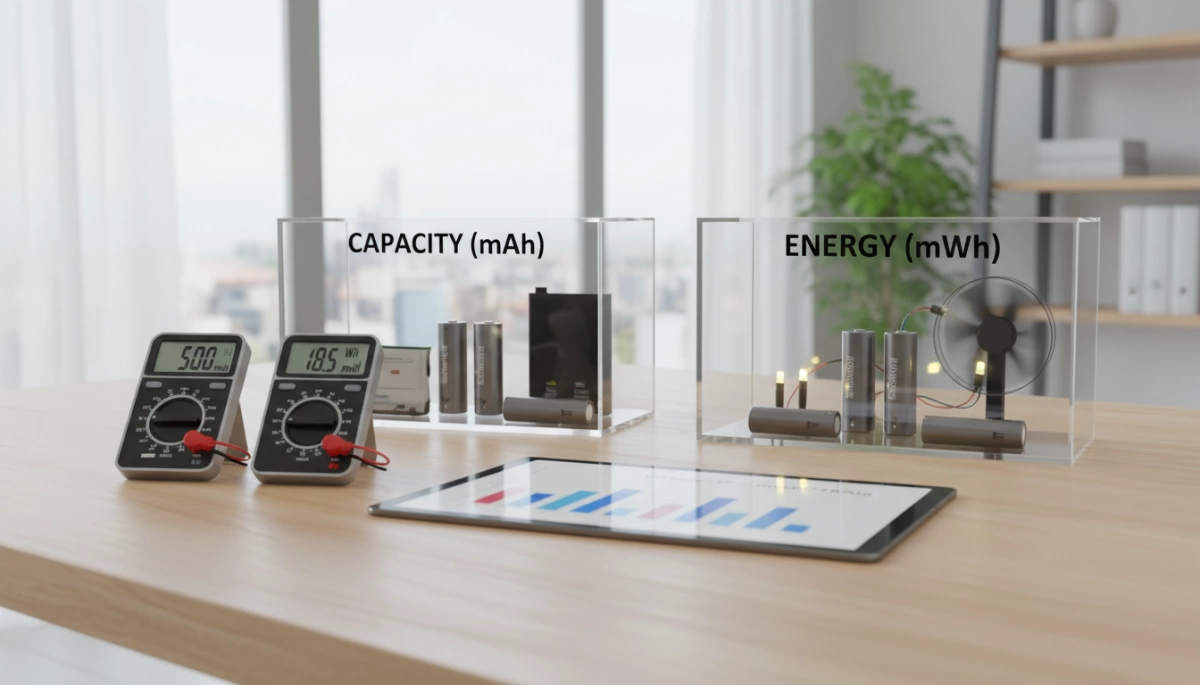
Milliwatt-hour (mWh) represents the actual energy stored in a battery. While mAh measures charge, mWh accounts for the force behind that charge by factoring in voltage. It is the product of nominal voltage and milliampere-hours (V × mAh = mWh). In short, mWh tells you how much total work a battery can perform.
Why mWh Provides an Apples-to-Apples Comparison
Using mWh or Wh is the only way to accurately compare batteries across different nominal voltages.
- Voltage Independence: It eliminates confusion when comparing 6V, 12V, 24V, or 36V systems.
- Energy Transparency: It reveals the true capacity of complex builds, such as an 11.1V lithium-ion battery pack for gas detectors, allowing you to see the total energy available for the hardware regardless of cell configuration.
- Runtime Correlation: mWh correlates directly with device runtime under real load conditions. If your equipment draws a specific wattage, the mWh rating tells you exactly how long it will stay powered.
The Reservoir Analogy for Technical Performance
To visualize the difference for technical applications, think of a water reservoir:
- mAh (Charge): This is the total volume of water in the tank.
- Voltage (Pressure): This is the pressure at which the water is released.
- mWh (Total Energy): This is the volume × pressure.
A large volume of water at zero pressure can’t turn a turbine; similarly, a high mAh rating at a low voltage might not meet the power demands of high-performance electronics. When we engineer solutions like a 25.9V lithium battery pack for electric scooters, we focus on the mWh/Wh rating to ensure the system delivers the necessary “pressure” and “volume” to handle high-torque hill climbing and sustained speeds.
The Core Relationship: Conversion Formula and Practical Calculation
To accurately compare different power systems, we rely on a standard mAh to mWh formula. This calculation is the backbone of our engineering process when we design custom packs for e-mobility or industrial robotics. By converting charge into energy, we ensure that the power delivery meets the specific demands of your application.
The Formula: milliwatt-hours (mWh) = milliampere-hours (mAh) × Nominal Voltage (V)
Step-by-Step Calculation Examples
When we evaluate a project, we look at the nominal voltage to determine the true energy capacity. Here is how that looks in practice:
- Standard 3.7V Cell: A high-capacity 21700 lithium-ion battery rated at 5,000 mAh provides 18,500 mWh (18.5 Wh) of energy.
- 12V Lead-Acid Replacement: A 100Ah (100,000 mAh) LiFePO4 pack at a 12.8V nominal rating delivers 1,280,000 mWh or 1,280 Wh.
- 24V E-Mobility System: A 20Ah (20,000 mAh) pack delivers 512,000 mWh (512 Wh) when operating at a 25.6V nominal voltage.
Quick-Reference Conversion Table
| System Voltage | Capacity (mAh) | Total Energy (mWh) | Total Energy (Wh) |
|---|---|---|---|
| 3.7V (Li-ion Cell) | 3,500 mAh | 12,950 mWh | 12.95 Wh |
| 12.8V (LiFePO4) | 10,000 mAh | 128,000 mWh | 128 Wh |
| 24V (Industrial) | 50,000 mAh | 1,200,000 mWh | 1,200 Wh |
| 36V (E-Bike/AGV) | 15,000 mAh | 540,000 mWh | 540 Wh |
Avoiding Common Calculation Pitfalls
A frequent mistake in nominal voltage battery calculation is using the “peak” or “fully charged” voltage instead of the nominal value. For example, using 4.2V for a lithium cell instead of 3.7V will artificially inflate your energy ratings by nearly 14%.
We always use the nominal voltage—the average voltage the battery maintains during discharge—to ensure the battery capacity conversion reflects real-world performance. This precision prevents power shortages in the field and ensures your device’s BMS accurately predicts remaining runtime. For long-term reliability, understanding these metrics is just as vital as knowing how to charge a battery pack correctly to maintain that capacity over hundreds of cycles.
Why mAh Can Mislead: Voltage, Chemistry, and Real-World Performance

In the battery industry, mAh is often used as a marketing hook rather than a technical reality. I see many manufacturers exploit high mAh numbers on lower-voltage cells to create a perceived sense of superiority. A battery labeled “20,000 mAh” sounds impressive, but if it’s running at a low nominal voltage, it might actually hold less total energy than a “10,000 mAh” pack running at a higher voltage.
The Marketing Trap: mAh vs. Voltage
The biggest issue with relying solely on mAh is that it ignores the lithium battery voltage impact. When comparing different chemistries, the discrepancy becomes even more obvious:
- Li-ion Cells: Maintain a relatively stable voltage (around 3.7V) throughout the discharge cycle, providing consistent energy.
- Alkaline/NiMH: These experience a sharp voltage decay. Even if the mAh rating is high, the “usable” energy drops off quickly as the voltage sags under load.
- Power Banks: A 20,000 mAh power bank is usually rated at 3.7V (74Wh). If you are comparing it to a high-voltage system, the mAh number is essentially useless for determining how many times it will charge your laptop.
Real-World Case Studies
We see this play out in two major categories:
- Portable Power: Two power banks can both claim 20,000 mAh, but if one uses higher-quality cells with a better energy density mWh comparison, the actual runtime under a 2A load will vary significantly. To get the truth, we always recommend a battery load test to measure the actual Wh delivered.
- E-Mobility: An e-bike battery’s mAh rating won’t tell you if you can make it up a steep hill. Hill-climbing capability is about power delivery (Watts), which is tied directly to voltage and mWh, not just the charge capacity.
Impact on BMS and Cell Balancing
From a manufacturing standpoint, focusing only on mAh can lead to poor BMS verified capacity rating results. If a Battery Management System (BMS) isn’t calibrated for the specific voltage curve of the chemistry, it can’t balance cells effectively. At Nuranu, we prioritize mWh because it ensures that every cell in a series string is contributing equally to the workload, preventing premature shutdowns and extending the overall life of the pack. Focusing on the total energy ensures that the performance we promise on the spec sheet is exactly what you get in the field.
Choosing the Right Metric: When mAh Isn’t Enough

I often get asked which number matters more when analyzing battery ratings: mAh and mWh. The truth is, it depends entirely on your application. While mAh is a common shorthand for consumer electronics, it doesn’t tell the whole story for high-stakes equipment.
Decision Matrix: mAh vs. mWh
To simplify your selection process, I’ve broken down when each metric should take the lead:
- Use mAh (milliampere-hour) for: Small consumer gadgets, single-cell devices (like standard smartphones), and basic 3.7V lithium-ion replacements where voltage is a constant.
- Use mWh/Wh (milliwatt-hour/Watt-hour) for: High-voltage industrial systems, e-mobility, robotics, and solar storage. In these fields, the watt-hour vs milliamp-hour debate ends quickly because Wh represents the actual work the battery can perform.
Aviation Compliance and Shipping Regulations
If you are involved in international trade or travel, mWh (specifically converted to Wh) is the only metric that matters. Regulatory bodies like the FAA, IATA, and DOT base their safety protocols on energy capacity, not charge.
- The 100Wh Limit: Most airlines cap carry-on power banks at 100Wh. A “27,000 mAh” battery might sound huge, but it stays under this limit because it’s rated at 3.7V (approx. 99.9Wh).
- UN38.3 Certification: Shipping lithium batteries requires strict adherence to energy density limits. Whether you are developing OEM vs ODM batteries for electric scooters or industrial packs, your labeling must clearly state the Wh rating to pass customs and safety inspections.
Real-World Work Output: Robotics and Power Tools
In high-torque applications like robotics or professional power tools, mWh is the superior metric. A battery might boast a high mAh, but if the voltage sags under load, the total energy delivered drops. For these “workhorse” applications, we prioritize mWh because it directly correlates to runtime and the ability to maintain power under heavy stress. When you’re wiring batteries in parallel, understanding the total energy capacity ensures your system doesn’t fail when the load peaks.
Pro Tip: Always look for the Wh rating on the datasheet first. It’s the most honest way to compare different battery chemistries and voltages side-by-side.
Accuracy in Manufacturing: From Cell Sorting to Verified Ratings
Inconsistent cell sorting and internal resistance variation are the primary reasons why many battery packs fail to meet their advertised mAh or mWh ratings. If cells are not perfectly matched, the weakest cell dictates the performance of the entire pack, leading to premature cutoff and reduced cycle life. At Nuranu, we eliminate these discrepancies through a rigorous, data-driven manufacturing process.
When evaluating electric scooter batteries suppliers in China, manufacturing precision is the factor that separates theoretical ratings from real-world performance. We utilize automated cell-matching technology to ensure every cell in a custom pack shares identical capacity and resistance profiles.
Our Quality Assurance Pillars
- Automated Cell Sorting: Every cell is tested for voltage and internal resistance before assembly.
- Advanced BMS Calibration: Our in-house BMS development ensures that the system accurately monitors energy levels, preventing over-discharge and maximizing usable mWh.
- 100% EOL Testing: We perform 100% End-of-Line testing on every pack to verify that the delivered capacity matches the engineering specifications.
- Thermal Management: Precision engineering ensures ratings remain stable even in extreme temperature environments.
| Feature | Standard Manufacturing | Nuranu Precision Process |
|---|---|---|
| Cell Matching | Manual/Batch Sampling | 100% Automated Sorting |
| Capacity Verification | Estimated based on cell data | Verified via 100% EOL Testing |
| BMS Integration | Generic Off-the-shelf | Custom-developed for specific loads |
| Rating Accuracy | High Variance (±10%) | Guaranteed Precision (98.5% Pass Rate) |
For our OEM partners, this level of accuracy translates directly to reduced field failures and consistent product specifications. Whether you are developing a lithium battery for vehicle applications or industrial robotics, our process ensures that the mAh and mWh ratings on the datasheet are exactly what your customers experience in the field. This reliability accelerates your time-to-market by removing the guesswork from power system integration.
Comparing mAh and mWh Across Power Systems
When we design custom battery solutions, we look beyond simple capacity numbers to ensure your device performs under real-world loads. Comparing mAh and mWh side-by-side reveals why high-voltage systems are often more efficient for industrial applications.
| Battery Type | Nominal Voltage | Capacity (mAh) | Total Energy (mWh) | Total Energy (Wh) |
|---|---|---|---|---|
| Standard Smartphone | 3.7V | 4,500 mAh | 16,650 mWh | 16.65 Wh |
| High-Capacity 18650 Cell | 3.6V | 3,500 mAh | 12,600 mWh | 12.6 Wh |
| Nuranu 12V LiFePO4 Pack | 12.8V | 100,000 mAh | 1,280,000 mWh | 1,280 Wh |
| Nuranu 36V E-Mobility Pack | 36V | 10,000 mAh | 360,000 mWh | 360 Wh |
Our 36v 10ah lg 18650 lithium ion battery pack is a prime example of how a lower mAh rating on a higher voltage platform provides significantly more “work” potential than a high-mAh, low-voltage alternative.
Runtime Estimation for Industrial Loads
To calculate how long your equipment will run, use the mWh / Wattage formula. This provides a more accurate field estimate than mAh alone, especially for robotics and AGVs.
- Example 1: Robotics Application
- System Draw: 50W
- Battery: 24V 10Ah (240,000 mWh)
- Runtime: 240 Wh / 50W = 4.8 Hours
- Example 2: Lead-Acid Replacement
- System Draw: 100W
- Battery: 12.8V 100Ah (1,280 Wh)
- Runtime: 1,280 Wh / 100W = 12.8 Hours
Quick Capacity Calculation Guide
When analyzing battery ratings: mAh and mWh, follow these three steps to verify your supplier’s data:
- Identify Nominal Voltage: Use the average operating voltage (e.g., 3.6V for Li-ion, 3.2V for LiFePO4).
- Convert mAh to Ah: Divide the mAh by 1,000.
- Calculate Wh: Multiply Ah by the Nominal Voltage.
We utilize 100% end-of-line testing to ensure every pack meets these calculated metrics. For smaller form factors, understanding how long a 21700 battery lasts depends entirely on matching these energy ratings to your specific discharge curve. By focusing on mWh, we help our OEM partners avoid the pitfalls of misleading marketing and deliver consistent power delivery to the end user.
Avoiding Marketing Traps in Battery Ratings
Don’t let big numbers on a label fool you. In my experience, the most common trick in the industry is using a high mAh rating to hide a low-voltage configuration. When analyzing battery ratings: mAh and mWh, you have to look past the marketing fluff to see the actual energy density.
Debunking Common Battery Myths
- Myth: Higher mAh always equals longer runtime.
This is only true if the voltage is identical. A 10,000 mAh battery at 3.7 V has significantly less energy than a 5,000 mAh battery at 12 V. Always calculate the mWh to see the real story. - Myth: mWh is too technical for average users.
Actually, mWh (or Wh) is the most “honest” metric. It tells you exactly how much work the battery can do, regardless of the internal cell arrangement. - Myth: All lithium packs are created equal.
The quality of the cells and the precision of the BMS make a massive difference. For instance, our 14.8V 8.8Ah 18650 lithium battery pack is engineered for high-stakes medical use, where consistent power delivery is non-negotiable compared to generic off-the-shelf alternatives.
How to Read a Battery Datasheet Like a Pro
To avoid getting burned by subpar hardware, I always recommend looking for these three things in a technical specification:
- Nominal Voltage vs. Peak Voltage: Ensure the mWh calculation is based on the nominal voltage (the average during discharge) rather than the peak charge voltage.
- Discharge Curves: A quality datasheet shows how the voltage drops over time. If the voltage sag is too steep, you won’t be able to use the full mAh capacity.
- Verified Third-Party Reports: Don’t just take the manufacturer’s word for it. Request UN38.3 or IEC test reports to verify that the capacity listed on the sticker is what the cells actually deliver under load.
By focusing on total energy (mWh) rather than just charge (mAh), you ensure your equipment gets the sustained power it needs without the marketing-induced headaches.








 English
  German
  Spanish
  French
  Italian
  Polish
  Russian
  Thai
Thai  Turkish
  Japanese
  Korean