
You might already know that Lithium batteries are superior to traditional Lead-Acid options…
But how long do they actually last?
Is it 3 years? 5 years? Or a decade?
Well, the answer isn\’t just about time—it lies in a metric most manufacturers hide in the fine print: Cycle Life.
The reality is that not all lithium is created equal. A phone battery and a marine battery are worlds apart.
In this post, I’m going to break down the critical difference between Calendar Life and Cycle Life, and explain why LiFePO4 chemistry is the only logical choice for deep-cycle applications.
If you are looking to maximize your ROI and get 10+ years of reliable power for your RV or boat, this guide is for you.
Let’s dive right in.
What Actually is \”Cycle Life\”?
When we discuss how long a battery lasts, we aren\’t just talking about years on a calendar. We are talking about Cycle Life—the total number of complete charge and discharge rounds a battery can handle before its capacity drops below 80% of its original rating.
Defining a Full Cycle
A single cycle is defined as discharging a battery from 100% State of Charge (SoC) down to 0% and charging it back up to 100%. However, in real-world applications like RVs or marine setups, you rarely drain your battery completely in one go.
Partial Cycles and Cumulative Usage
Most users operate in partial cycles. If you use 50% of your battery capacity today and recharge it, that is only half a cycle. You would need to do that twice to equal one full cycle.
This cumulative math is why lithium batteries are so efficient for solar energy storage. You can top them off daily without \”wasting\” a cycle or worrying about memory effects.
- Day 1: Discharge 20% → Recharge (0.2 cycles)
- Day 2: Discharge 30% → Recharge (0.3 cycles)
- Day 3: Discharge 50% → Recharge (0.5 cycles)
- Total: 1 Full Cycle completed over 3 days.
Calendar Life vs. Cycle Life
It is critical to distinguish between how old a battery is (time) and how much work it has done (usage).
| Feature | Calendar Life | Cycle Life |
|---|---|---|
| Definition | The lifespan of the battery based on time, regardless of use. | The lifespan based on the number of charge/discharge rounds. |
| Main Enemy | Heat, high storage voltage, and natural chemical aging. | Deep discharges, high currents, and extreme temperatures. |
| Nuranu Advantage | Low Self-Discharge: <3% per month, ensuring long shelf life. | High Throughput: Rated for 4,000–6,000+ cycles. |
For our customers, Cycle Life is the metric that matters most for ROI. While a lead-acid battery might physically exist for 5 years (Calendar Life), it may fail after only 300 cycles. In contrast, our LiFePO4 technology ensures the battery remains operational for thousands of cycles, often outlasting the equipment it powers.
Not All Lithium is Created Equal: NCM vs. LiFePO4
When people ask \”how long do lithium batteries last,\” they often confuse the battery in their smartphone with the battery in their RV or solar setup. It is crucial to understand that not all lithium chemistry is the same. The two main players you will encounter are Lithium Nickel Manganese Cobalt Oxide (NCM) and Lithium Iron Phosphate (LiFePO4).
NCM Chemistry Limitations
Most consumer electronics, like laptops and electric tools, use NCM chemistry. These batteries are lightweight and energy-dense, but they sacrifice longevity for size.
- Short Lifespan: NCM batteries typically offer only 500 to 800 cycles. This is why your phone battery starts dying quickly after just two years of daily charging.
- Volatility: They are more sensitive to heat and physical damage.
- Degradation: If you are curious why small electronics fail, understanding do 18650 batteries go bad reveals how standard lithium cells degrade much faster than industrial-grade options.
The LiFePO4 Longevity Advantage
At Nuranu, we exclusively use Lithium Iron Phosphate (LiFePO4) chemistry for our deep cycle batteries. This chemistry is specifically engineered for long-term energy storage rather than just being lightweight.
- Massive Cycle Life: Unlike NCM, LiFePO4 batteries are rated for 4,000 to 6,000+ cycles at 80% Depth of Discharge (DOD). That is roughly 10 times the lifespan of a standard lead-acid battery.
- Stable Chemistry: LiFePO4 has an extremely strong chemical bond. It is much harder to break down, meaning the battery retains its capacity for over a decade.
Safety and Stability for Deep-Cycle Use
Safety is just as important as lifespan, especially when you are sleeping in an RV or boat on top of your battery bank.
- Thermal Runaway Protection: NCM batteries can be prone to \”thermal runaway\” (catching fire) if punctured or overcharged. LiFePO4 is chemically incombustible and stable, making it the safest lithium technology available.
- High-Temp Tolerance: Our batteries handle heat much better, operating safely up to 140°F (60°C).
By choosing the right LiFePO4 battery manufacturer, you ensure you are getting Grade A cells that actually deliver on these safety and longevity promises, rather than cheap knock-offs that degrade like phone batteries.
The \”Depth of Discharge\” (DoD) Factor
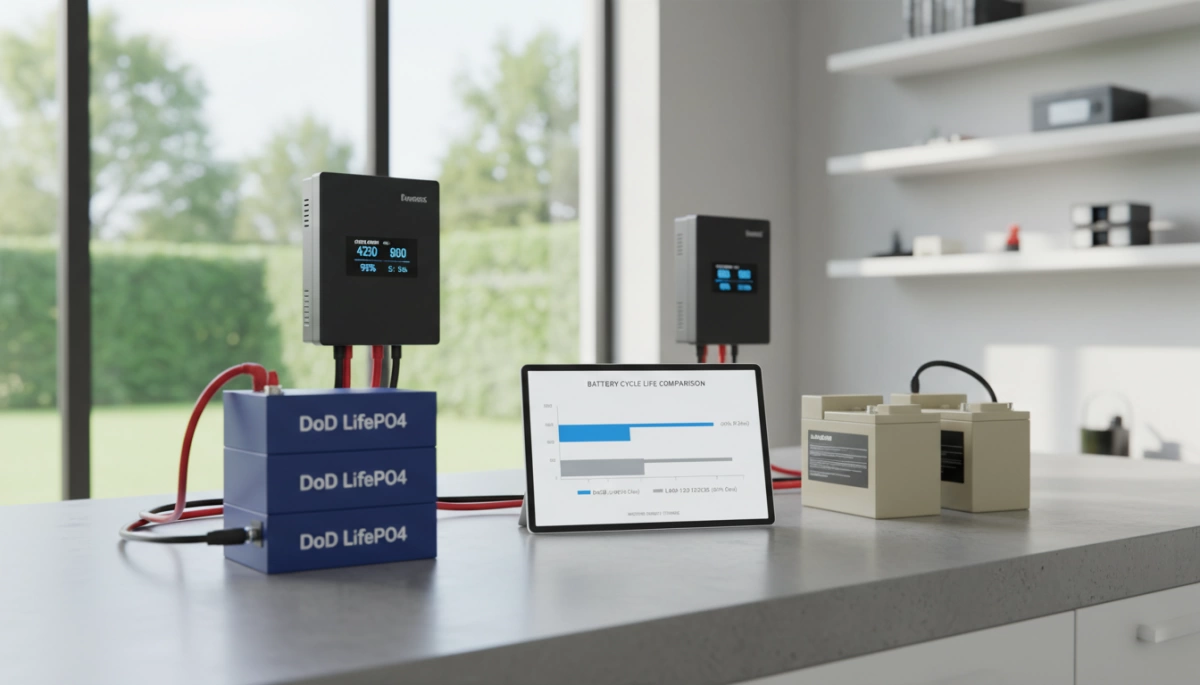
When we talk about battery longevity, Depth of Discharge (DoD) is the single most critical variable. Simply put, DoD refers to the percentage of the battery that has been discharged relative to its total capacity. Understanding this concept is the key to seeing why traditional batteries end up costing you more money in the long run compared to modern lithium technology.
Limitations of Lead-Acid Batteries
If you are still using traditional Lead-Acid or AGM batteries, you are effectively paying for capacity you cannot use. These batteries have a severe limitation: they should never be discharged below 50% DoD.
Once you dip below that 50% mark, the internal chemistry begins to degrade rapidly due to sulfation. This means a 100Ah lead-acid battery really only gives you 50Ah of usable power. Pushing them harder significantly shortens their lifespan, often reducing them to fewer than 300 cycles.
Nuranu LiFePO4 Capability
In contrast, our Nuranu LiFePO4 batteries are designed for deep cycling. Thanks to the high-quality Grade A cells we use, you can safely discharge these batteries to 80-100% DoD without causing damage. Our built-in Battery Management System (BMS) ensures the cells remain balanced and protected even during deep discharge cycles.
This efficiency means a 100Ah Nuranu battery actually provides nearly 100Ah of usable power. You can explore our full range of lithium-ion battery products to find the right capacity for your setup. We engineer them to handle the heavy lifting that would destroy a standard flooded battery.
Cycle Life Math: Lead Acid vs. Lithium
The difference in cycle life becomes obvious when you look at the numbers side-by-side. Here is how the math works out when you compare the two chemistries under real-world usage conditions:
-
Lead-Acid / AGM:
- Usable Capacity: ~50%
- Cycle Life: 300 – 500 cycles
- Result: Frequent replacements (every 2-3 years).
-
Nuranu LiFePO4:
- Usable Capacity: ~80% to 100%
- Cycle Life: 4,000 – 6,000+ cycles
- Result: Long-term reliability (10+ years).
By switching to lithium, you aren\’t just getting more power per charge; you are investing in a system that lasts 10x longer than the competition. Whether for marine, RV, or solar applications, the ability to utilize the full depth of the battery changes the economics of your power system entirely.
What Kills a Lithium Battery? (And How to Prevent It)
Even though our LiFePO4 batteries are built like tanks compared to fragile lead-acid units, they aren\’t invincible. To get that massive cycle life we promised, you need to avoid a few specific scenarios that can degrade the internal chemistry or trigger safety mechanisms. Lithium battery maintenance is mostly hands-off, but ignoring these environmental factors will kill your investment fast.
Temperature Extremes and Internal Chemistry
Heat is the silent killer of battery longevity. Operating consistently above 115°F (45°C) accelerates chemical degradation and can lead to capacity fade. In extreme cases of abuse or manufacturing defects, excessive heat can even be a precursor to thermal runaway. If you notice your battery casing looking distorted, it is crucial to understand what causes lithium-ion battery swelling so you can remove it from service immediately.
On the flip side, cold weather requires a different approach. While you can discharge (use) the battery in freezing temps, never charge a lithium battery below freezing (32°F / 0°C). Doing so causes Lithium Plating, where metallic lithium builds up on the anode. This is permanent damage that reduces capacity and increases the risk of short circuits. Our Nuranu batteries feature a smart Battery Management System (BMS) that usually blocks charging in these conditions to protect you, but it is a rule you must live by.
The Danger of Lead-Acid Chargers
One of the most common mistakes we see is RV owners plugging a modern lithium bank into an old \”dumb\” charger. Specifically, chargers with a \”Desulfation\” or \”Equalization\” mode are dangerous. These modes spike the voltage way above the safe limit for LiFePO4 cells (often over 15V). This can fry the BMS or damage the cells. Always use a dedicated lithium charger or a programmable unit set to the correct lithium profile.
Best Practices for Long-Term Storage
If you are parking your boat or RV for the winter, do not leave your batteries at 100% State of Charge (SoC), and definitely don\’t leave them dead at 0%.
- The Sweet Spot: Store them at 40-60% SoC. This keeps the internal chemistry stable.
- Disconnect Loads: Even small phantom draws can drain a battery over months.
- Check Voltage: Every 3-6 months, give it a quick check.
Following these basic precautions for the use of lithium batteries ensures that when you pull your rig out of storage, your power system is ready to go without any nasty surprises.
The Economics of Longevity: Cost Per Cycle
When you look at the price tag of a premium LiFePO4 battery compared to a standard flooded lead-acid or AGM battery, the difference is obvious. Lithium requires a higher initial investment. However, smart energy management isn\’t about the purchase price; it\’s about the Cost Per Cycle.
We approach battery power as a long-term asset, not a disposable consumable. When you calculate the Return on Investment (ROI) based on usable energy and lifespan, LiFePO4 vs Lead Acid becomes a simple math problem where lithium wins every time.
Upfront Cost vs. 10-Year Ownership
A standard lead-acid battery typically lasts 300 to 500 cycles before its capacity drops below useful levels. In a daily use scenario—like full-time RV living or off-grid solar—you will likely replace that lead-acid battery every 2 to 3 years. Over a decade, you are buying that \”cheaper\” battery three or four times.
In contrast, a Nuranu LiFePO4 battery is rated for 4,000 to 6,000+ cycles. You buy it once, and it serves you for 10 years or more.
The 10-Year Cost Breakdown:
- Lead-Acid/AGM: Low upfront cost $times$ 4 replacements + maintenance costs = High Total Cost of Ownership.
- Nuranu LiFePO4: Higher upfront cost $times$ 1 purchase + zero maintenance = Lowest Cost Per Cycle.
Why Nuranu Offers Better Long-Term Value
Not all lithium batteries deliver on their ROI promises. The market is flooded with budget options using \”Grade B\” or recycled cells that degrade quickly, ruining your cost-per-cycle calculations.
We strictly use Grade A prismatic cells and a robust Battery Management System (BMS). This ensures our batteries actually reach that 10-year mark without significant capacity fade. When you invest in Nuranu, you are securing a reliable power source that costs significantly less per kilowatt-hour over its lifetime than any lead-acid alternative.
Why Nuranu Batteries Outlast the Competition
When we engineer our batteries, we aren\’t just looking at the first year of use; we are building for the next decade. The difference between a battery that fails after two seasons and one that lasts for 4,000+ cycles comes down to three critical components: the quality of the cells, the intelligence of the management system, and the durability of the casing.
Grade A Automotive Cells
Not all lithium is created equal. Many budget manufacturers cut costs by using Grade B cells or \”re-purposed\” cells that have already seen use in other applications. At Nuranu, we exclusively use UL-listed Grade A prismatic cells. These are the same high-quality components found in modern electric vehicles. By starting with premium chemistry, we ensure that the Li-Ion Cycle Life isn\’t just a theoretical number on a spec sheet—it is a reliable performance standard you can count on for years.
The Role of Our Smart BMS
The Battery Management System (BMS) is the brain of the operation. Without it, even the best cells can be ruined by a single accidental over-charge or temperature spike. Unlike unprotected cells that carry safety risks, our built-in Smart BMS actively monitors voltage, current, and temperature in real-time.
Our BMS delivers three layers of protection:
- Cell Balancing: Ensures every cell charges and discharges at the same rate, preventing capacity fade.
- Safety Cut-offs: Automatically disconnects the battery during short circuits, over-charging, or extreme temperatures to prevent thermal runaway.
- Optimization: Maximizes the usable energy from every charge cycle without stressing the internal chemistry.
Built for the Elements
We know our customers use these batteries in demanding environments, from pounding waves in a bass boat to the constant vibrations of an RV on a gravel road. We build our casings to be rugged and resistant to the elements. Whether you are powering a trolling motor or an off-grid solar setup, our design ensures that physical stress doesn\’t compromise the electrical integrity inside.
Frequently Asked Questions (FAQ)
Does fast charging reduce cycle life?
Yes, pushing maximum current constantly can generate excess heat, which is the enemy of any battery chemistry. While our LiFePO4 cells are designed to handle high-current demands better than lead-acid, sticking to recommended charging rates is the best way to maximize your Deep Cycle Battery Lifespan. Moderate charging keeps internal temperatures stable, ensuring the Grade A Battery Cells inside remain healthy for the long haul.
How many years will a 4,000-cycle battery last in an RV?
If you were to use a full cycle (100% to 0%) every single day, 4,000 cycles would last roughly 11 years. However, most RVers do not deplete their battery bank entirely every day. With typical usage involving partial cycles and seasonal downtime, a Nuranu battery can easily exceed 10 to 15 years of service. For a deeper dive into these calculations, check out our guide on how long lithium batteries last in professional setups.
Can I leave my Nuranu battery on the charger all winter?
Our built-in Battery Management System (BMS) prevents over-charging, making it safe to leave connected if you are using a compatible smart charger. However, for optimal Lithium Battery Maintenance, we recommend disconnecting the battery if you are storing your vehicle for several months. Since our batteries have an extremely low self-discharge rate (less than 3% per month), you can store them at a partial State of Charge (SoC) and they will be ready to go when spring arrives.





 English
  German
  Spanish
  French
  Italian
  Polish
  Russian
  Thai
Thai  Turkish
  Japanese
  Korean