
You might be asking yourself: How long does a cordless vacuum battery last, exactly?
It is the single most critical question for both frustrated homeowners and appliance engineers designing the next generation of cleaning tools.
The short answer is typically 3 to 5 years or roughly 500 to 1,000 charge cycles.
But as a manufacturer of high-performance lithium-ion battery packs, I know the reality is much more complex.
Real longevity isn’t just about time; it depends on cell chemistry, the efficiency of the Battery Management System (BMS), and precise thermal engineering.
In this guide, we’re going beyond the basics to reveal the technical factors that dictate your vacuum’s true lifespan and performance.
Let’s dive right in.
How Long Does a Cordless Vacuum Battery Last?
You invest in a high-end cordless vacuum, and for the first few months, it’s a powerhouse. But eventually, you start asking the big question: How long does a cordless vacuum battery last before it needs replacing? The answer isn’t just about how many years you own it; it comes down to the science inside the pack.
Generally, a standard lithium-ion vacuum battery lasts between 2 to 4 years, or roughly 300 to 500 charge cycles. However, this varies heavily based on the cell quality and how you treat the device.
Defining Lifespan: Cycles vs. Calendar Life
To understand battery longevity, we have to look at two distinct aging processes. A battery ages even when it isn’t being used.
- Cycle Life: This refers to the number of times you can drain and recharge the battery. One lithium-ion battery cycle life unit is defined as using 100% of the battery’s capacity (whether all at once or over several shorter sessions) and charging it back up.
- Calendar Life: Even if your vacuum sits in a closet for a year, the internal chemistry degrades over time. This is why buying “fresh” batteries matters.
The Shift to 18650 and 21700 Cells
Gone are the days of heavy, inefficient Nickel-Cadmium (NiCd) or NiMH batteries that suffered from the dreaded “memory effect.” Today, the industry standard relies on cylindrical lithium-ion cells.
- 18650 Cells: The long-time standard for cordless tools and vacuums. Reliable and compact.
- 21700 Cells: The modern upgrade. These are slightly larger but offer significantly higher capacity and power output, allowing for longer runtimes in high-suction modes.
Comparing 18650 vs 21700 battery cells is crucial for performance. The 21700 format handles heat better and delivers the high amperage modern digital motors demand without stressing the chemistry as much.
Why Van4NU Uses Premium Chemistries
At Van4NU, we don’t settle for generic cells. Cheap batteries often use inferior cathode materials that degrade rapidly under the high-drain stress of a vacuum motor. We focus on premium chemistries like NMC (Nickel Manganese Cobalt) or LiFePO4 for specific industrial applications.
These chemistries offer:
- Higher Energy Density: More power in a lighter package.
- Thermal Stability: Less risk of overheating during “Max Power” mode.
- Extended Cycle Life: Maintaining performance for longer than standard consumer cells.
Capacity Fade: The 80% Reality
When does a battery actually “die”? In our industry, “End of Life” (EOL) doesn’t mean the vacuum won’t turn on. It means the battery has hit capacity fading where it can only hold 80% of its original charge.
Once a pack drops below this 80% threshold, the degradation accelerates. You will notice the vacuum cutting out abruptly or the “Turbo” mode lasting only seconds. This is the inevitable chemical reality of rechargeable batteries, but starting with high-quality cells ensures you stay above that 80% line for years, not just months.
Critical Factors That Determine Battery Longevity
The lifespan of a cordless vacuum isn’t just about luck; it is a direct result of engineering decisions made during the design phase. While the chemistry sets the baseline, the electronics and physical construction determine whether a pack lasts two years or five. We focus on four specific areas that make or break battery performance in the US market.
The Role of the BMS: Monitoring Voltage, Current, and Temperature
The Battery Management System (BMS) protection is effectively the brain of the battery pack. In high-drain devices like vacuums, the motor pulls significant current instantly. Without a robust BMS, individual cells can become unbalanced, leading to premature failure. We engineer our BMS to constantly monitor the voltage of every series group, the total current flow, and the operating temperature. If any metric goes out of the safe zone, the system cuts power immediately to save the cells.
Predictive Diagnostics: Preventing Overcharging and Deep Discharging
Lithium-ion cells are volatile if mistreated. Two of the biggest killers of battery health are pushing voltage too high during charging or draining it too low during use. Our systems utilize deep discharge protection to cut off the vacuum motor before the cells drop below a critical voltage threshold (usually around 2.5V to 3.0V per cell). Similarly, predictive diagnostics ensure that charging stops the moment the pack hits 100%, preventing the chemical stress that causes capacity fading.
Thermal Management: Handling Motor Heat and Dissipation
Heat is the number one enemy of lithium batteries. In a stick vacuum, the battery is often positioned right next to a hot motor, creating a thermal challenge. Thermal management in battery packs involves using heat-conductive materials and spacing cells to allow for airflow. If a battery gets too hot during a “Max Power” cleaning session, the internal resistance rises, and degradation accelerates. We design our enclosures to dissipate heat away from the core cells, ensuring consistent runtime even under heavy load.
Cell Quality & Matching: The Importance of Automated Sorting
A battery pack is only as strong as its weakest cell. If one cell has a slightly higher internal resistance than the others, it will heat up faster and degrade sooner, dragging the whole pack down. We utilize high-discharge lithium cells that undergo rigorous automated sorting. This process groups cells by precise capacity and voltage characteristics before assembly. By ensuring every cell in our vacuum cleaner battery solutions is perfectly matched, we maximize cycle life and prevent the imbalance that plagues cheaper generic replacements.
Runtime Expectations by Voltage Platform
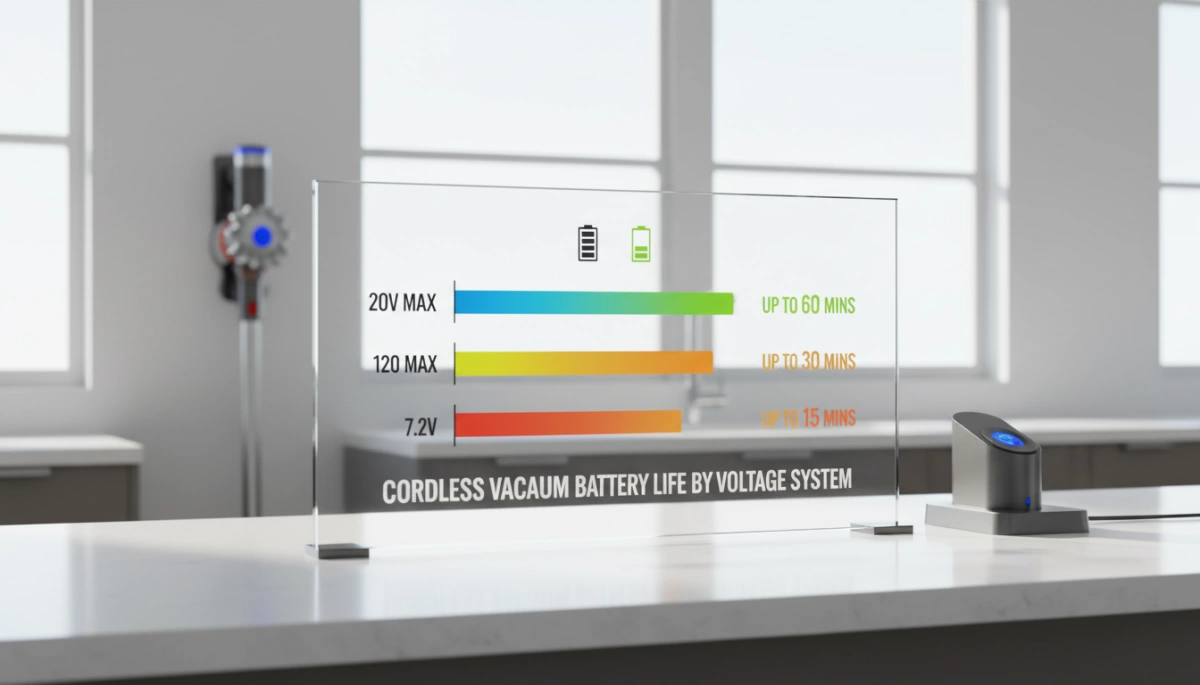
When customers ask, “How long does a cordless vacuum battery last?”, the answer hinges directly on the voltage configuration and the power settings used during operation. We engineer our battery packs to balance power delivery with duration, but the physics of the voltage platform dictates the baseline performance.
18V – 24V Systems: Stick Vacuum Performance
For the majority of residential stick vacuums found in US homes, we typically utilize an 18V to 24V lithium battery pack. These systems are designed for convenience and weight reduction, usually employing a 5S or 6S configuration of 18650 or 21700 cells.
The cordless vacuum runtime per charge for these systems generally falls into two brackets:
- Standard Mode: 20 to 40 minutes. This is efficient for hard floors and light dusting where the motor doesn’t face significant resistance.
- Turbo/Max Mode: 6 to 12 minutes. Activating high suction drastically increases the amp draw, depleting the energy reserves rapidly.
36V+ Systems: High-Power Commercial Units
For commercial applications or whole-home replacements, we step up to 36V systems (10S configurations) or higher. By utilizing more high-discharge lithium cells, these units can sustain higher power outputs without stressing the individual cells as much as lower voltage systems. Consequently, users can expect runtimes of 45 to 60+ minutes, providing enough duration to clean larger square footage without interruption.
Voltage Efficiency and Heat Generation Correlations
There is a direct relationship between voltage efficiency and the heat generated inside the pack. Lower voltage systems must draw higher current (amps) to achieve the same wattage as a higher voltage system. High current generates resistive heat, which is the primary enemy of lithium-ion longevity.
By increasing the voltage, we reduce the current required for the motor, resulting in cooler operation and longer overall lifespan. However, in these larger series-connected packs, precise manufacturing is vital. Understanding how to balance 18650 batteries ensures that every cell in the series charges and discharges at the same rate, preventing voltage drift that kills runtime efficiency.
Best Practices for Extending Battery Life
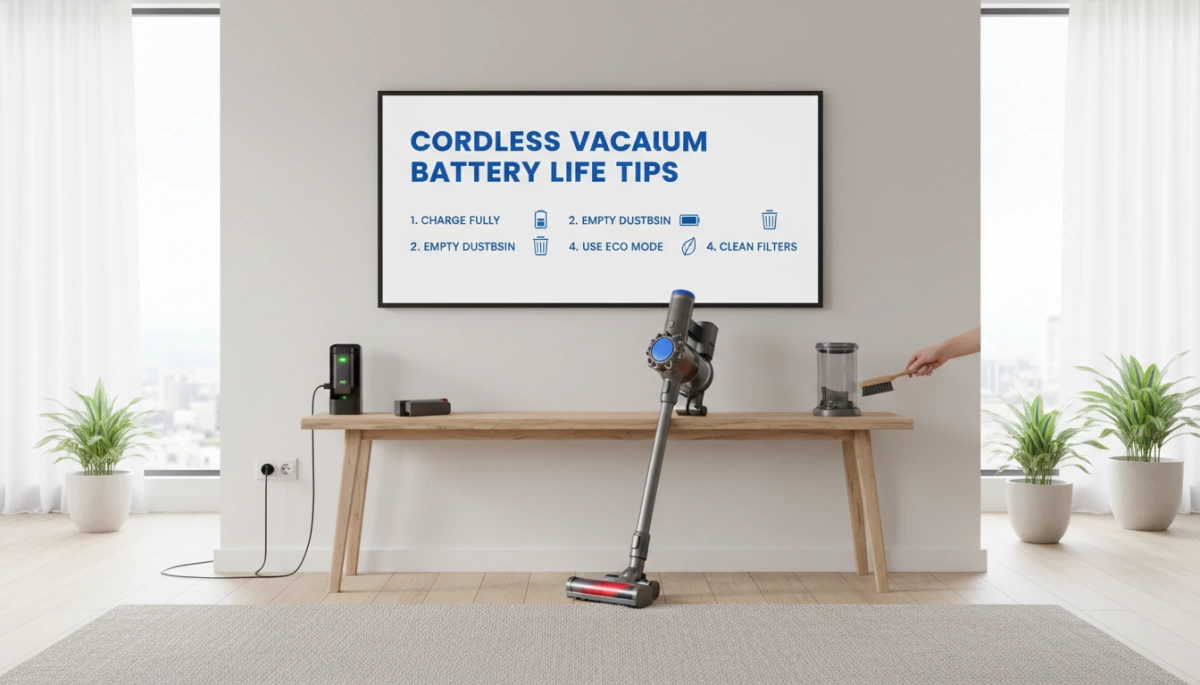
We know that the rechargeable battery degradation rate is inevitable, but how you treat the pack determines whether it lasts two years or five. As a manufacturer, I see perfectly good cells ruined simply because of poor daily habits. You don’t need to baby your tools, but following a few protocols will keep your vacuum running longer.
Storage Environment: Avoiding Extreme Heat and Cold
Lithium-ion chemistry is sensitive to temperature. Storing your vacuum or battery pack in an uninsulated garage, shed, or attic is a quick way to kill it.
- Heat: Temperatures above 80°F (26°C) accelerate internal chemical reactions that permanently reduce capacity.
- Cold: Freezing temperatures increase internal resistance. Charging a frozen battery can cause plating on the anode, leading to immediate failure.
Keep your equipment at room temperature (around 65°F–75°F). If you live in a region with extreme seasons, bring the battery inside the house, even if the vacuum stays in the garage.
Charging Habits: The Truth About Leaving Vacuums on Chargers
A common question we get is about leaving the unit docked 24/7. Modern packs feature Battery Management System (BMS) protection that cuts off current once the cells hit 100%, preventing dangerous overcharging. However, keeping a battery at 100% state-of-charge constantly causes higher stress on the internal chemistry than keeping it at 80%.
- Daily Use: It is fine to leave it on the charger if you use it multiple times a week.
- Long-Term Storage: If you are going on vacation or won’t use the vacuum for a month, discharge it to about 40-60% and unplug it.
If you have an older pack that seems dead from poor storage habits, learning how to revive a lithium-ion battery might save you the cost of a replacement, though prevention is always the best strategy.
Cleaning Filters: Reducing Motor Strain and Amp Draw
Most people don’t realize that a dirty filter kills batteries. When airflow is restricted by dust and debris, the vacuum motor has to work significantly harder to maintain suction. This forces the motor to pull more current (Amps) from the high-discharge lithium cells.
Increased amp draw generates excess heat within the battery pack. Since heat is the number one enemy of lithium-ion longevity, a clogged filter indirectly cooks your battery.
- Check filters monthly: Rinse or replace them according to the manual.
- Listen to the motor: A high-pitched whine usually indicates airflow blockage and high strain.
- Clear the brush roll: Tangled hair adds resistance, further draining power and reducing runtime per charge.
Why OEMs Choose Van4NU for Vacuum Applications
At Van4NU, we understand that a vacuum is only as good as its power source. As a dedicated OEM vacuum battery manufacturer, we partner directly with appliance brands to solve the complex challenges of cordless power. We don’t just supply off-the-shelf units; we integrate directly into your supply chain to deliver power solutions that enhance product performance and reliability.
Custom Engineering and Enclosure Designs
One size rarely fits all in the vacuum industry. Stick vacuums require slim, elongated packs to maintain balance, while wet/dry vacs might need blockier, high-capacity configurations. We specialize in custom battery pack design, engineering the physical architecture of the battery to fit seamless within your specific housing constraints.
We handle everything from the nickel strip welding pattern to the external plastic enclosure design. For example, we can engineer solutions similar to our 11.1V 4.4Ah 18650 lithium-ion battery pack for home vacuum cleaners, ensuring the voltage matches your motor requirements while the form factor fits the device ergonomics. We also prioritize thermal management in our designs, ensuring the enclosure allows for adequate heat dissipation during high-suction modes.
Rapid Prototyping Capabilities
In the fast-paced US consumer electronics market, speed to market is critical. We have streamlined our prototyping process to deliver functional samples rapidly. This allows your engineering teams to test fit, finish, and runtime performance in real-world scenarios without waiting months for a sample. We move quickly from concept to a working prototype, helping you validate your product design faster.
Global Compliance: UN38.3, IEC 62133, and UL Certifications
Navigating the regulatory landscape for lithium batteries is difficult, but we handle the heavy lifting. Safety and compliance are non-negotiable for products sold in the United States. We ensure our packs meet all necessary transport and safety standards before they ever leave the factory.
| Certification | Importance |
|---|---|
| UN38.3 | Essential for the legal transport of lithium batteries via air, sea, or ground. |
| IEC 62133 | The benchmark for safety requirements for portable sealed secondary cells. |
| UL Standards | Critical for acceptance by major US retailers and consumer safety assurance. |
Our commitment to IEC 62133 certification means your legal team can rest easy knowing the batteries meet rigorous international safety benchmarks.
Quality Assurance and End-of-Line Testing
We believe that reliability is the ultimate brand builder. To prevent dead-on-arrival units and warranty claims, we implement strict quality control protocols. Our end-of-line testing is comprehensive:
- Voltage Matching: Ensuring all cells within the pack are perfectly balanced.
- BMS Verification: Testing overcharge, deep discharge, and short-circuit protection circuits.
- Load Testing: Verifying the pack can sustain the high amp draw required by modern vacuum motors.
By strictly controlling these variables, we ensure that every battery pack delivers the longevity and power your customers expect.
FAQ: Frequently Asked Questions About Vacuum Batteries
We field questions every day from users trying to squeeze more life out of their appliances. Here are the straight answers to the most common concerns regarding how long does a cordless vacuum battery last and how to maintain it properly.
How do I know if my vacuum battery needs replacing?
The most obvious sign is a drastic drop in cordless vacuum runtime per charge. If your machine used to run for 30 minutes but now barely manages 5, the cells have likely hit high internal resistance. You might also notice the vacuum cutting out when you switch to “Max” or “Turbo” mode because the battery can no longer handle the amp draw. Understanding the factors affecting service life helps you distinguish between a dying battery and a simple clogged filter.
Is it bad to leave my cordless vacuum plugged in all the time?
For modern lithium-ion systems, it is generally fine. Our packs include Battery Management System (BMS) protection that cuts off the current once the cells reach 100%. You aren’t “overfilling” the battery. However, if the charging brick gets extremely hot, or if you plan to store the vacuum for a month without use, it is better to unplug it. Constant trickle charging in a hot environment accelerates the rechargeable battery degradation rate.
Can I upgrade my vacuum battery to a higher voltage?
No. Never put a higher voltage battery into a vacuum designed for a lower voltage (e.g., putting a 40V battery on an 18V tool). You will fry the motor and the control board instantly. However, you can often upgrade the capacity (Amp-hours). If you have a 2.0Ah pack, switching to a 4.0Ah pack of the same voltage gives you double the runtime without damaging the electronics.
What is the difference between runtime and cycle life?
Think of it like a gas tank versus the car’s total mileage limit.
- Runtime: How long the vacuum runs on a single charge (e.g., 40 minutes).
- Cycle Life: How many times you can charge and discharge the battery before it degrades permanently (e.g., 500 cycles).
High-quality lithium-ion battery cells are engineered to maximize both, ensuring you get enough power to clean the whole house today, and enough durability to keep doing it for years.




 English
  German
  Spanish
  French
  Italian
  Polish
  Russian
  Thai
Thai  Turkish
  Japanese
  Korean