
Are you tired of squinting at flat voltage-capacity (V-Q) curves trying to figure out why your cells are losing performance?
Standard cycling data often hides the most critical electrochemical shifts occurring inside the cell. That’s where interpreting dQ/dV graphs—or differential capacity analysis—becomes a game-changer. By transforming subtle voltage plateaus into sharp, identifiable peaks, this technique allows you to “see” inside the battery without opening it.
In this guide, you’re going to learn exactly how to use dQ/dV plots to pinpoint phase transitions, track battery degradation mechanisms, and quantify loss of lithium inventory (LLI) versus loss of active material (LAM).
If you are looking to turn noisy cycling data into precise battery health diagnostics, this deep dive is for you.
Let’s dive right in.
Differential Capacity Analysis Basics
Interpreting dQ/dV graphs for battery analysis allows us to look beyond standard charge/discharge curves. While a typical voltage profile often appears as a smooth slope, Differential Capacity Analysis (dQ/dV) acts as a magnifying glass, transforming subtle voltage plateaus into clear, identifiable peaks. These peaks represent the electrochemical phase transitions occurring within the electrodes.
At Nuranu, we process raw cycler data to generate these incremental capacity curves instantly. By plotting the change in capacity (dQ) over the change in voltage (dV), we can pinpoint exactly where lithium-ion intercalation is happening and, more importantly, how those processes shift as a cell ages.
dQ/dV vs. dV/dQ: Choosing the Right Curve
Both curves are essential tools in our diagnostic toolkit, but they serve different primary functions. Choosing the right derivative depends on the specific degradation mechanism we are trying to isolate.
| Analysis Type | Derivative | Best Use Case | Visual Feature |
|---|---|---|---|
| dQ/dV | $dQ/dV$ | Identifying Phase Transitions | Distinct Peaks |
| dV/dQ | $dV/dQ$ | Analyzing Ohmic Resistance | Sharp Spikes/Valleys |
- dQ/dV Analysis: We use this to track Loss of Lithium Inventory (LLI) and Loss of Active Material (LAM). It is the gold standard for visualizing electrode staging.
- dV/dQ Analysis: This is often referred to as “Differential Voltage” analysis. It is particularly effective for identifying shifts in the physical structure of the electrode and changes in internal resistance.
The Math Behind Derivative Cycling Data
The fundamental challenge with derivative data is the “noise” inherent in raw hardware files. Mathematically, dQ/dV is the slope of the capacity-voltage curve. In a perfect environment:
- Raw Data: We pull high-resolution voltage and capacity timestamps.
- The Derivative: We calculate the rate of change ($ΔQ / ΔV$).
- The Smoothing: Because raw data from testers like Arbin or BioLogic can be “noisy,” we apply automated smoothing algorithms to ensure the peaks are clean and interpretable without distorting the underlying chemistry.
By converting flat voltage plateaus into peak-based signatures, we provide engineers with a precise map of battery health, making it easier to diagnose battery degradation mechanisms before they lead to catastrophic failure.
Generating Accurate dQ/dV Graphs for Battery Analysis
Generating high-fidelity plots is the first step toward interpreting dq dv graphs for battery analysis. To see the subtle phase changes in an incremental capacity curve, low-rate Constant Current (CC) cycling is a non-negotiable requirement. If the C-rate is too high, the voltage plateaus blur together, and the “peaks” that define the battery’s internal state disappear.
Optimized Protocols for Clean Data
To get the resolution needed for professional differential capacity analysis, follow these technical guidelines:
- C-Rates: Use C/10, C/20, or even lower. Higher rates introduce overpotential that shifts and flattens peaks.
- Voltage Sampling: Ensure your cycler is set to record data at small voltage intervals (delta-V) rather than just fixed time intervals.
- Thermal Stability: Maintain a consistent temperature. Fluctuations can cause “fake” peaks or shifts that mimic degradation.
Noise Reduction in Cycling Data
Raw data from hardware like Arbin, Neware, or BioLogic is often too noisy for direct derivative calculations. Without effective noise reduction in cycling data, your dQ/dV curves will look jagged and unreadable. While many engineers struggle with manual Savitzky-Golay filters in Excel or custom Python scripts, we have automated this entire process.
We designed the Nuranu platform to ingest raw files (.res, .csv, .mpr) and instantly output smooth, high-resolution curves. This allows you to focus on the chemistry—such as determining how long do lithium-ion batteries last—rather than fighting with data cleaning. Our cloud-based tools ensure that your dQ/dV and dV/dQ plots are consistent across different battery testers and chemistries, providing a single source of truth for your R&D or production data.
Key Features of dQ/dV Graphs
When we perform differential capacity analysis, we are essentially looking for the “fingerprint” of the battery’s internal chemistry. In a standard voltage-capacity plot, phase changes often look like flat plateaus that are hard to distinguish. In a dQ/dV graph, these plateaus are transformed into clear peaks, making interpreting dq dv graphs for battery analysis much more effective for identifying specific electrochemical events.
Identifying Peaks and Electrode Phase Transitions
Each peak on the graph represents a specific phase transition in electrodes. These peaks tell us exactly at what voltage the battery is doing the most work.
- Graphite Anode Staging: You can see the distinct stages of lithium inserting into the graphite layers.
- NMC Cathode Reactions: Peaks at higher voltage ranges typically correspond to specific redox reactions within the cathode material.
- Voltage Plateau Analysis: By looking at the peak’s position, we can confirm if the battery is operating within its designed electrochemical windows.
Comparing Charge and Discharge Curves
Comparing the charge and discharge curves is the fastest way to check for efficiency and reversibility. In a perfect cell, these peaks would be mirror images. However, real-world factors cause shifts:
- Polarization: A horizontal shift between the charge peak and the discharge peak indicates internal resistance.
- Hysteresis: Significant gaps between peaks suggest energy loss during the cycle.
- Reversibility: Missing peaks on the discharge side can signal that certain chemical reactions are not fully reversible, which is a key step when you identify 18650 battery health and performance levels.
| dQ/dV Feature | What It Signals |
|---|---|
| Peak Position (V) | The specific potential of a chemical phase change. |
| Peak Height | The rate of capacity change; higher peaks mean more active material is reacting. |
| Peak Area | Total capacity associated with a specific phase transition. |
| Peak Symmetry | How well the battery handles the chemical transition during both charge and discharge. |
By using the Nuranu platform, we remove the guesswork from these features. Our tools automatically align these peaks and filter the noise, allowing you to focus on the chemistry rather than the data cleaning. This level of detail is essential for high-quality R&D and ensures that subtle changes in graphite anode staging or cathode stability are never missed.
Interpreting Peak Changes for Battery Health
When interpreting dq dv graphs for battery analysis, we focus on three primary markers: peak position, height, and area. These shifts serve as the “biometrics” of a cell, revealing internal degradation that standard voltage curves miss.
Peak Position and Internal Resistance
A horizontal shift in peak position along the voltage axis is a primary indicator of increased internal resistance. When peaks move to higher voltages during charging (or lower during discharge), it signifies growing polarization within the cell. We use these shifts to identify kinetic limitations before they lead to significant power loss.
Loss of Active Material (LAM)
We link the reduction in peak intensity directly to the structural health of the electrodes:
- Height Reduction: A shrinking peak height typically signals Loss of Active Material (LAM), meaning portions of the electrode are no longer electrochemically active.
- Structural Decay: For NMC and LFP chemistries, LAM often indicates particle cracking or loss of electrical contact within the electrode matrix.
Loss of Lithium Inventory (LLI)
The total area under a specific peak represents the capacity exchanged during a phase transition. A reduction in this area is the hallmark of Loss of Lithium Inventory (LLI). This often happens as lithium becomes trapped in the Solid Electrolyte Interphase (SEI) layer. For engineers evaluating a lithium ion battery pack, tracking LLI area is the most accurate way to quantify capacity fade over hundreds of cycles.
Chemistry Signatures: NMC vs. LFP
- NMC Cathodes: These exhibit broad, distinct peaks that correspond to various nickel-rich phase transitions. Tracking these helps us monitor cathode-specific aging.
- LFP Cathodes: Because LFP has a famously flat voltage plateau, its dQ/dV peaks are extremely sharp and narrow. Even a minor peak shifting in dQ/dV for LFP cells can indicate significant changes in the battery state of health (SOH).
- Graphite Anodes: The peaks reflect graphite anode staging, allowing us to see exactly which stage of lithiation is being impacted by degradation.
Diagnosing Degradation Mechanisms with dQ/dV

Effective battery R&D requires knowing exactly why a cell is losing capacity. Interpreting dQ/dV graphs for battery analysis allows us to pinpoint specific battery degradation mechanisms that are invisible on a standard voltage-capacity curve. By breaking down the voltage plateaus into distinct peaks, we can identify chemical shifts with high precision.
Distinguishing LLI vs. LAM in Aging Cells
We use dQ/dV to separate the two primary modes of lithium-ion battery aging:
- Loss of Lithium Inventory (LLI): Often caused by side reactions like SEI growth, LLI results in a relative shift (slippage) between the anode and cathode equilibrium potentials. This is seen as a horizontal shift in peak positions.
- Loss of Active Material (LAM): This occurs when electrode material becomes isolated or structurally degraded. On a dQ/dV plot, this manifests as a reduction in peak intensity and area, indicating the material can no longer contribute to the total capacity.
Tracking SEI Growth and Lithium Plating
The signature of a dQ/dV curve provides a direct window into the internal state of the cell without destructive physical analysis:
- SEI Layer Evolution: Consistent peak area reduction over time typically indicates the consumption of lithium ions into the solid electrolyte interphase.
- Lithium Plating Detection: Unusual peak shapes or “shoulders” during the beginning of discharge can signal that lithium has plated onto the anode surface rather than intercalating properly.
Environmental Impact on Battery Signatures
Temperature and cycling protocols significantly alter degradation pathways. High-temperature cycling often accelerates LLI due to electrolyte breakdown, while low-temperature charging increases the risk of plating.
By centralizing your data in Nuranu, you can instantly compare these signatures across different test conditions. Understanding how to correct use of 18650 lithium batteries is vital for longevity, and dQ/dV analysis provides the quantitative proof of whether your usage patterns are effectively protecting the cell’s chemistry.
- Automated Alignment: Nuranu’s platform automates the tracking of these peaks across thousands of cycles.
- Scalable Diagnostics: Transition from raw data to degradation identification in seconds, regardless of whether the data came from Arbin, Neware, or BioLogic hardware.
Solving Challenges in dQ/dV Interpretation
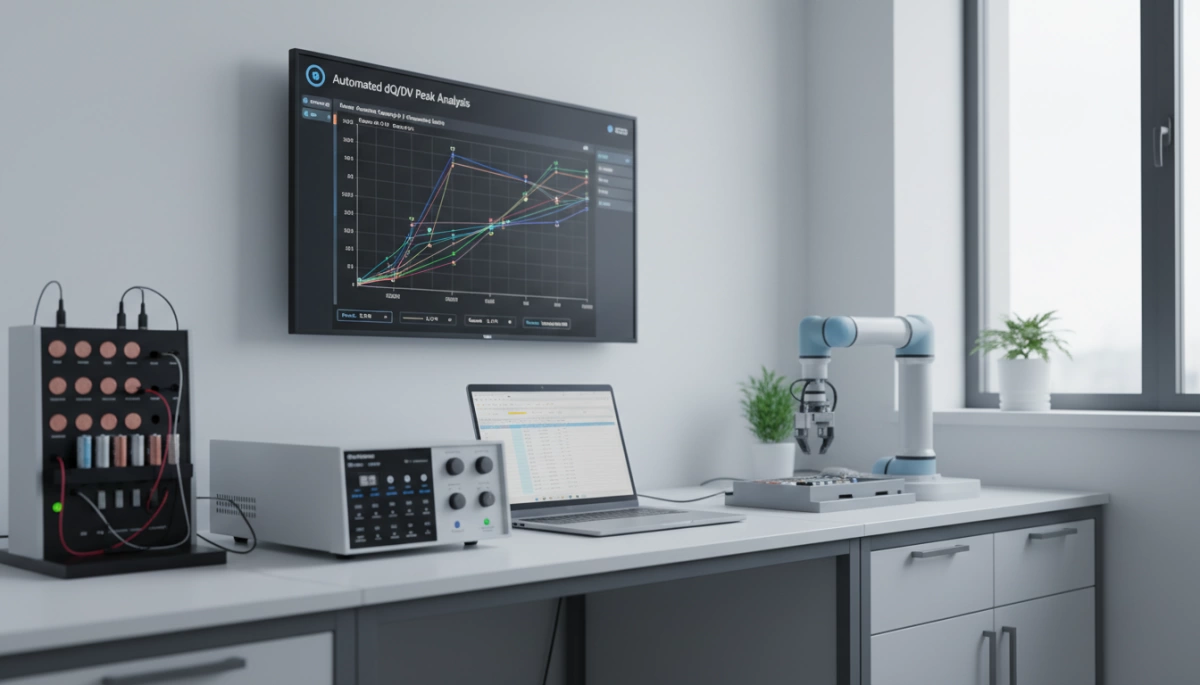
Raw battery data is notoriously messy. When you calculate the derivative for differential capacity analysis, any small bit of voltage noise is magnified, turning potentially useful peaks into unreadable “grass.” For engineers, the struggle is moving from raw, jagged data to a clean curve that actually reveals the battery state of health (SOH).
Overcoming Noise and Data Volume
Handling high-volume datasets from multiple cyclers often leads to a bottleneck. Manual noise reduction in cycling data using basic filters or Excel moving averages is usually insufficient for precision work. We focus on advanced smoothing algorithms that preserve peak height and position while stripping away the digital artifacts that obscure real chemical signals.
Why Manual Inspection Fails
Relying on a technician to manually eyeball peak shifts is a recipe for inconsistency. As a lithium-ion battery ages, the subtle changes in its electrochemical signature are too small for the naked eye to track reliably across hundreds of cycles.
| Challenge | Impact on Analysis | Automated Solution |
|---|---|---|
| Signal Noise | Distorts peak height and area | High-fidelity digital smoothing |
| Data Silos | Inconsistent formats between Arbin/BioLogic | Centralized cloud ingestion |
| Human Error | Subjective peak identification | Algorithmic peak tracking |
| Processing Time | Hours spent in Python or Excel | Instantaneous curve generation |
The Value of Automated Peak Tracking
Effective interpreting dq dv graphs for battery analysis requires speed and scale. By automating the alignment and tracking of peaks, you can instantly see where phase transitions are shifting or disappearing. This eliminates the guesswork in identifying degradation, allowing your team to focus on the chemistry rather than the data cleaning. Automated tools ensure that every peak—from graphite staging to cathode delithiation—is captured with mathematical certainty.
Automating Battery Analysis with Nuranu

We established Nuranu in 2012 to bridge the gap between complex raw cycler data and actionable engineering insights. Our cloud-based platform is specifically designed to handle the heavy lifting of interpreting dq dv graphs for battery analysis, transforming hours of manual data cleaning into seconds of automated visualization. Whether you are using Arbin, BioLogic, Neware, or Maccor hardware, our platform ingests raw files directly to deliver precise electrochemical diagnostics.
Streamlined R&D Workflows
By centralizing your data in a single hub, we eliminate the friction caused by inconsistent file formats and noisy signals. Our platform automates the most critical components of differential capacity analysis:
- Automated LLI/LAM Reporting: Get instant metrics on Loss of Lithium Inventory (LLI) and Loss of Active Material (LAM) without the need for manual Excel formulas or custom scripts.
- Peak Alignment and Tracking: Our algorithms automatically identify and track dQ/dV peaks interpretation and shifts across thousands of cycles to monitor lithium-ion battery aging.
- Hardware Agnostic Integration: We support direct ingestion of .res, .mpr, .csv, and .txt files, ensuring a consistent analysis workflow across your entire laboratory.
- Instant Scaling: Our cloud-native architecture is built to process high-volume R&D data, making it easy to compare lithium-ion battery performance across different chemistry batches.
We focus on speeding up the R&D cycle so your team can focus on innovation rather than data processing. By automating the generation of the incremental capacity curve, we ensure that your team can identify battery degradation mechanisms the moment they appear in the cycling data.
Practical Tips for Better Battery Diagnostics
To get the most out of interpreting dq dv graphs for battery analysis, we recommend treating them as one piece of a larger diagnostic puzzle. Relying solely on a single data point can lead to incomplete s about a cell’s internal state.
Enhancing dQ/dV with EIS and GITT
While dQ/dV is excellent for identifying thermodynamic shifts and phase transitions, combining it with other electrochemical diagnostics provides a complete picture of battery health:
- EIS (Electrochemical Impedance Spectroscopy): Use this to measure internal resistance and kinetic limitations that dQ/dV might miss.
- GITT (Galvanostatic Intermittent Titration Technique): Pair this with differential capacity to study diffusion coefficients across different states of charge.
Avoiding Common Interpretation Pitfalls
The most frequent mistake in battery analysis is ignoring the impact of external variables on the curve shape and peak position:
- Temperature Sensitivity: Ensure testing environments are strictly thermal-controlled. Even a small temperature shift can cause peak shifting in dQ/dV that looks like degradation but is actually just a change in kinetics.
- C-Rate Consistency: Comparing a curve at C/10 to one at C/20 will yield different peak resolutions. Always use consistent protocols for longitudinal studies.
- Data Noise: Raw data from cyclers often requires smoothing. Our platform handles this automatically so you don’t mistake hardware noise for chemical signatures.
Testing Parameters for Second-Life Assessment
When evaluating used cells, such as a salvaged 21700 lithium-ion battery, the goal is to determine the remaining battery state of health (SOH) accurately.
- Ultra-low C-rates: Use C/25 or lower to clearly identify if the capacity loss is due to Loss of Lithium Inventory (LLI) or Loss of Active Material (LAM).
- Baseline Comparison: Compare the peak area of the aged cell against a “golden” fresh cell profile to quantify capacity loss instantly.
- Anode Inspection: Focus on the graphite anode staging peaks to ensure the electrode hasn’t suffered significant structural damage before clearing a pack for second-life storage applications.





 English
  German
  Spanish
  French
  Italian
  Polish
  Russian
  Thai
Thai  Turkish
  Japanese
  Korean