
The 18650 cylindrical lithium battery is the bedrock of modern portable power. To understand its dominance, one must first look at its precise engineering nomenclature. The name is not arbitrary; it defines the cell’s physical dimensions:
- 18: Represents a 18mm diameter.
- 65: Represents a 65mm height.
- 0: Designates the cylindrical form factor.
This standardized sizing ensures cross-compatibility and has allowed the 18650 to become the most recognized lithium-ion cell globally.
The Industry Gold Standard for Lithium Transition
As global industries pivot from legacy lead-acid batteries to high-performance lithium solutions, the 18650 remains the preferred choice. Its popularity stems from a perfect balance of energy density, mechanical durability, and manufacturing maturity. Unlike older chemistries, the 18650 offers a compact footprint with significantly higher cycle life, making it the “gold standard” for everything from medical devices to industrial robotics.
Nuranu’s Engineering Perspective
At Nuranu, we specialize in harnessing the stability of 18650 technology to develop high-reliability power solutions. By utilizing these cells as the building blocks for our custom 6V to 36V battery systems, we provide our global partners with:
- Precision-engineered packs tailored for specific voltage and capacity requirements.
- Seamless lead-acid replacement modules that offer lower weight and higher efficiency.
- Scalable architecture designed to meet the rigorous demands of the United States and international markets.
Our approach focuses on maximizing the inherent strengths of the 18650 form factor while implementing advanced integration techniques to ensure peak performance in diverse operating environments.
Deep Dive: The Internal Structure of an 18650 Cell
To fully grasp the introduction to the internal structure and advantages and disadvantages of 18650 cylindrical lithium battery cells, we have to look under the hood. At Nuranu, we know that the performance of our custom battery systems depends entirely on what happens inside these individual cells.
The foundation of the 18650 is the jelly-roll structure. Instead of stacking flat plates, the internal layers are tightly wound into a continuous spiral. This spiral-wound architecture maximizes the active surface area within the small cylindrical space, delivering the high energy density these cells are famous for.
Core Components of Lithium-ion Cell Anatomy
Here is a breakdown of the active materials inside the cell:
| Component | Material & Function |
|---|---|
| Cathode (Positive) | Determines capacity and voltage. Common chemistries include LCO, NMC, and LiFePO4. Choosing between NMC vs. LiFePO4 18650 depends on whether you need maximum energy density or extended cycle life longevity. |
| Anode (Negative) | Typically made of graphite or advanced silicon-carbon blends to store lithium ions during charging. |
| Separator | A critical microporous membrane placed between the anode and cathode. It allows ions to pass through while physically separating the electrodes to prevent internal short circuits. |
| Electrolyte | The conductive liquid medium that enables the transport of lithium ions back and forth during charge and discharge cycles. |
Built-In Safety and Housing Features
The external and internal safety features are what make the 18650 a reliable choice for demanding applications.
- Steel/Aluminum Casing: The rigid metal cylinder provides structural integrity, resisting external mechanical stress and containing internal pressure.
- Current Interrupt Device (CID): A mechanical switch that permanently breaks the electrical connection if internal gas pressure reaches unsafe levels, preventing overpressure ruptures.
- Positive Temperature Coefficient (PTC): A thermal switch that rapidly increases electrical resistance if the cell gets too hot, cutting off current flow to protect against over-current conditions.
These integrated safeguards are your first line of defense for thermal runaway prevention. Without proper manufacturing and these essential safety valves, the risks increase significantly, which is exactly why 18650 lithium batteries are burning or exploding when sourced from unverified suppliers. We rely on these robust internal structures to ensure every custom battery pack we assemble meets strict global safety standards.
Key Advantages of 18650 Cylindrical Lithium Battery Cells
The 18650 cylindrical lithium battery cell is the backbone of the portable power industry for a reason. After decades of refinement, these cells offer a level of manufacturing maturity that other form factors simply can’t match. Because the production process is highly automated, we see incredibly low defect rates and superior cell consistency. When we build a 36V 6Ah 18650 lithium-ion battery pack for solar LED flood lights, the uniformity in voltage and internal resistance ensures the entire system lasts longer and performs reliably under heavy use.
Why the 18650 Design Wins
- High Manufacturing Maturity: Decades of mass production mean these cells are reliable, predictable, and virtually free of the “teething” issues found in newer formats.
- Structural Integrity: The rigid steel casing prevents the “swelling” common in pouch cells and provides excellent resistance to external mechanical stress.
- Excellent Energy Density: These cells maximize power in a compact footprint, making them ideal for high-performance applications.
- Cost-Effectiveness: Standardized sizes and massive global production volumes drive down costs, providing a significant advantage for large-scale battery pack assembly.
- Superior Consistency: Cylindrical cells offer much better uniformity in voltage and internal resistance compared to pouch cells, which simplifies the balancing process during pack manufacturing.
By utilizing these cells in our 7.4V 2.6Ah 18650 lithium battery packs, we leverage a proven architecture that balances high energy density with long-term durability. This structural stability is a major reason why the 18650 remains the industry gold standard for everything from robotics to portable energy storage.
Disadvantages and Technical Challenges of 18650 Cells
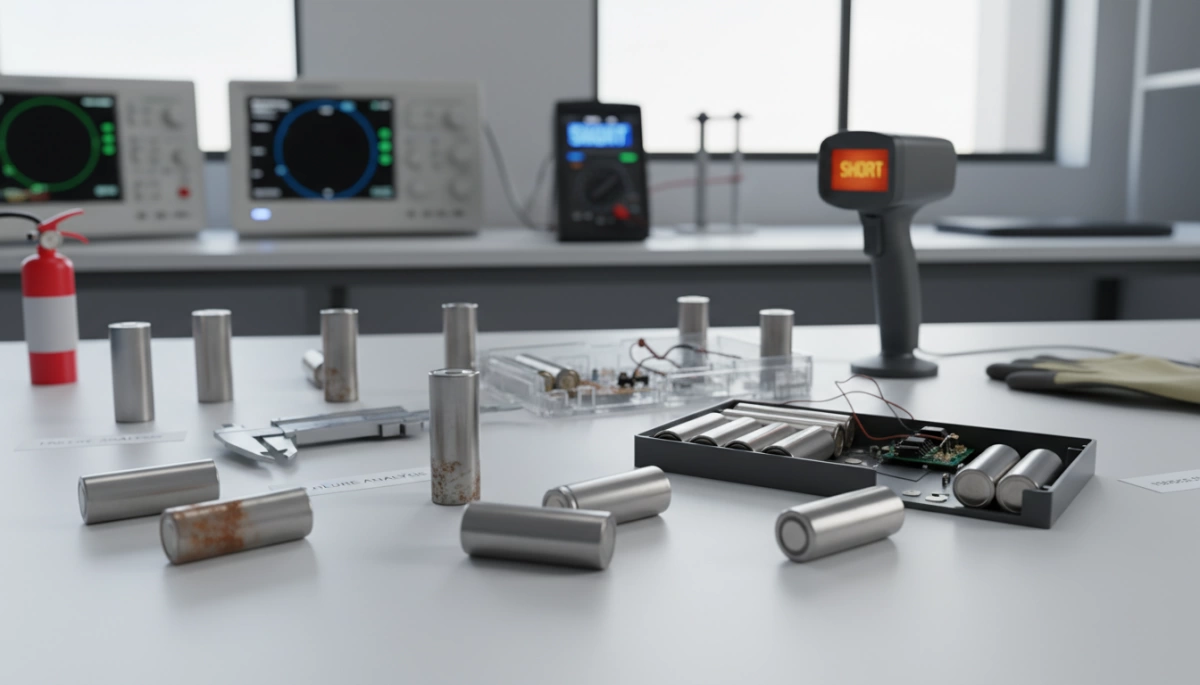
While 18650 cylindrical lithium battery cells are industry favorites for their reliability, they present specific engineering hurdles that we must manage during the custom pack design process. These challenges primarily stem from their rigid physical form and the complexity of managing large arrays of individual units.
Key Technical Limitations
- Thermal Management Complexity: Because 18650s are often packed tightly to reach higher voltages (like our 36V systems), heat tends to accumulate in the center of the pack. Dissipating this heat requires advanced thermal management and precise spacing to prevent performance degradation.
- Lower Packing Efficiency: The cylindrical shape naturally creates “air gaps” between cells. Unlike prismatic or pouch cells that can be stacked flush, 18650 modules have inherent wasted space, which can result in a bulkier final product.
- Fixed Dimensions: The 18mm x 65mm size is standardized and rigid. This lack of flexibility makes them unsuitable for ultra-thin devices or products with irregular internal compartments where a custom-shaped lithium polymer battery might be better.
- Sophisticated BMS Requirements: To ensure a 98.5% quality pass rate, we integrate intelligent BMS to monitor thousands of cells. Without high-level balancing, individual cell variance can shorten the entire pack’s lifespan. To maintain peak performance, it is vital to understand how to check 18650 battery capacity accurately during the maintenance cycle.
of Engineering Challenges
| Challenge | Impact on Battery Pack | Our Optimization Strategy |
|---|---|---|
| Heat Build-up | Risk of thermal runaway | Advanced thermal interfaces and airflow gaps |
| Volumetric Gap | Reduced energy density per cubic inch | High-energy density cell selection (NMC/Li-ion) |
| Form Factor | Limited to specific housing sizes | Rapid prototyping of custom enclosures |
| Cell Balancing | Uneven wear and capacity loss | Automated cell sorting and smart BMS integration |
We overcome these disadvantages through automated cell matching and precision R&D, ensuring that the inherent “cons” of the 18650 format do not compromise the safety or longevity of your power system.
18650 vs. Prismatic and Pouch Form Factors
When comparing the internal structure and advantages and disadvantages of 18650 cylindrical lithium battery cells against other formats, the choice usually comes down to mechanical protection versus space efficiency. While pouch cells are lightweight and prismatic cells offer high capacity in a single block, the 18650 remains the “workhorse” due to its rigid steel casing and standardized dimensions.
Quick Comparison Guide
| Feature | 18650 Cylindrical | Prismatic Cell | Pouch Cell |
|---|---|---|---|
| Mechanical Durability | Excellent (Hard Steel) | Good (Aluminum) | Low (Foil Wrap) |
| Energy Density | High | Moderate | Very High |
| Cost per Wh | Lowest | Moderate | High |
| Swelling Resistance | High | Moderate | Low |
| Cycle Life | Consistent | Variable | Variable |
When to Choose 18650 Cells
We typically recommend the 18650 format for applications where the battery will face physical stress or requires a high degree of reliability over thousands of cycles. Because of their structural integrity, they are the go-to choice for:
- E-bikes and Scooters: The steel shell protects against road vibrations and impacts.
- Robotics: High-drain capabilities and easy replacement in modular designs.
- Portable Power Stations: Excellent thermal stability when managed by a quality BMS.
- Industrial Tools: Our 7.4V 5.2Ah 18650 lithium battery pack is a perfect example of how we utilize these cells for handheld meters that need to survive rugged field use.
While pouch cells win on “thinness,” the 18650 wins on cost-effectiveness and safety. In the United States market, where durability and long-term ROI are prioritized, the cylindrical format remains the gold standard for custom power solutions.
How We Optimize 18650 Performance
At Nuranu, we know that building a reliable power system goes beyond simply selecting a good cell. With over a decade of OEM manufacturing experience and a 98.5% quality pass rate, we engineer custom battery pack assembly solutions that maximize the strengths of 18650 cells while actively mitigating their inherent limitations.
Here is how our manufacturing excellence guarantees top-tier performance for your applications:
- Precision Automated Cell Matching
Cell consistency and matching are the foundation of cycle life longevity. Our 24/7 automated production lines strictly sort and match every single 18650 cell by internal resistance (IR) and voltage before assembly. This precision eliminates weak links, ensuring the entire pack degrades evenly and lasts longer. - Advanced BMS Integration
To overcome the thermal management challenges of densely packed cylindrical cells, our in-house engineering team develops intelligent Battery Management Systems (BMS). These systems provide real-time thermal and voltage monitoring to actively prevent thermal runaway. Whether you are exploring if an 18650 lithium-ion battery belongs to LiFePO4 or standard NMC chemistries, our custom BMS programming adapts perfectly to your specific cell chemistry and discharge rate requirements. - Global Compliance & Safety
We back our cleanroom assembly process with rigorous 100% End-of-Line (EOL) testing. Every custom battery pack we produce is designed to meet strict global safety and export standards, including UN38.3, IEC 62133, CE, and UL. This gives you absolute regulatory confidence when deploying products in the United States and international markets.
Frequently Asked Questions About 18650 Cylindrical Lithium Battery Cells
What is the jelly roll structure in 18650 cells?
The jelly roll refers to the spiral-wound internal architecture of the cell. We layer the cathode, separator, and anode together and roll them tightly into a cylinder. This design maximizes the active surface area within a small footprint, allowing for high energy density and efficient ion transport.
Why is thermal management challenging for 18650 battery packs?
Because 18650 cells are cylindrical, heat tends to concentrate in the center of the “roll.” When we assemble thousands of these into a dense pack, the air gaps between cells can trap heat. We address this by using advanced thermal interface materials and strategic spacing to ensure consistent cooling across the entire module.
How does Nuranu ensure battery pack safety?
Safety is our top priority. We only source cells equipped with a Current Interrupt Device (CID) and PTC (Positive Temperature Coefficient) protection. Additionally, our custom packs undergo strict testing to meet UN38.3 and IEC 62133 standards, ensuring they remain stable under mechanical stress or electrical faults.
When should I choose 18650 cells over prismatic or pouch types?
You should opt for the 18650 when your project requires high mechanical durability, cost-efficiency, and proven reliability. They are the go-to choice for e-bikes, robotics, and power tools. If you are debating between sizes for a new build, it helps to understand which is better, an 18650 or a 21700 lithium battery to balance capacity and weight.
What are common cathode chemistries in 18650 cells?
- NMC (Nickel Manganese Cobalt): Offers the best balance of energy and power.
- LiFePO4 (Lithium Iron Phosphate): Known for extreme safety and long cycle life.
- LCO (Lithium Cobalt Oxide): High energy density, commonly used in older electronics.
How does the separator improve battery performance and safety?
The separator is a microporous membrane that prevents the anode and cathode from touching. A high-quality separator allows lithium ions to pass through easily while acting as a fail-safe; if the cell gets too hot, the pores close up to stop the chemical reaction and prevent thermal runaway.
What makes 18650 cells cost-effective compared to other formats?
The 18650 has been the industry standard for decades. This high manufacturing maturity means production is almost entirely automated, resulting in incredibly low defect rates and massive economies of scale that pouch or prismatic cells can’t always match.
What role does the BMS play in managing 18650 packs?
The Battery Management System (BMS) is essential for balancing the voltage of individual cells. Since 18650 packs often consist of many cells in series and parallel, the BMS ensures no single cell is overcharged or over-discharged, which is critical for maximizing the lifespan of the entire system.
Can 18650 cells be used in ultra-thin device designs?
No. Because of their fixed 18mm diameter, they are not suitable for ultra-slim electronics like smartphones or tablets. However, for high-drain portable devices, they remain the gold standard. You can see this in action by looking at the best flashlight batteries, where the 18650’s power-to-size ratio is unbeatable.







 English
  German
  Spanish
  French
  Italian
  Polish
  Russian
  Thai
Thai  Turkish
  Japanese
  Korean