
Key Factors for 3000W Inverter Battery Sizing
Setting up a 3000W inverter only to have the low-voltage alarm scream the moment you turn on a microwave is a common frustration. To avoid system shutdowns, you must balance your battery bank’s voltage, chemistry, and capacity against the heavy current draw of a high-wattage inverter.
Understanding System Voltage (12V, 24V, or 48V)
The voltage of your battery bank dictates how much current (Amps) flows through your cables. A 3000W inverter pulling from a 12V source requires roughly 250 Amps of continuous current. This creates significant heat and requires massive cabling. Upgrading to a 24V or 48V system cuts that current in half or more, improving efficiency and reducing the stress on your battery’s internal components.
Battery Chemistry: LiFePO4 vs. Lead-Acid
The “type” of battery you choose is just as important as the quantity. Traditional lead-acid batteries suffer from significant voltage sag under heavy 3000W loads and should generally not be discharged past 50%. My Nuranu LiFePO4 (Lithium Iron Phosphate) batteries use Grade A cells that maintain a steady voltage and allow for 100% Depth of Discharge (DoD) without damaging the cells.
| Feature | Lead-Acid / AGM | Nuranu LiFePO4 |
|---|---|---|
| Usable Capacity | 50% | Up to 100% |
| Cycle Life | 300–500 Cycles | 4,000–6,000+ Cycles |
| Weight | Very Heavy | Lightweight & Compact |
| Voltage Stability | Drops under load | Stays consistent |
Managing Runtime and 6000W Surge Requirements
A 3000W inverter doesn’t just pull 3000W; it often handles a 6000W peak surge when starting inductive loads like air conditioners or power tools.
- Continuous Load: Your battery bank must be able to provide enough Amp-hours (Ah) to sustain your devices for the duration you need.
- Surge Handling: The Smart BMS (Battery Management System) in your batteries must be rated to handle the massive momentary current spike of a surge without “tripping” the safety circuit.
- Battery Count: For a 12V system, you generally need multiple batteries in parallel (e.g., three 100Ah or two 200Ah units) to safely provide the high discharge current required for a 3000W continuous load.
By choosing high-quality lithium with a robust BMS, you ensure your battery bank can actually deliver the power your 3000W inverter demands.
Calculating Battery Bank Size for a 3000W Inverter
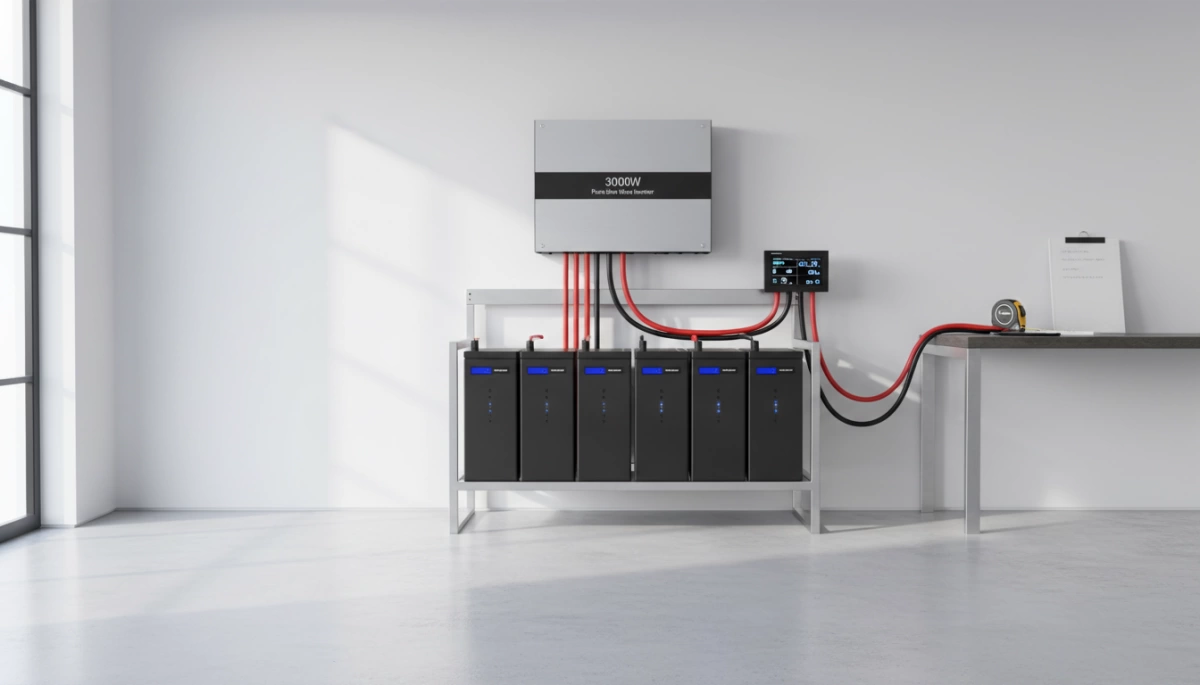
Determining the exact number of batteries starts with a simple math formula to find your inverter current draw calculation. To find the Amps being pulled from your bank, use the formula: Watts / Volts = Amps.
For a 3000W inverter running at full capacity, the draw varies significantly based on your system voltage:
- 12V System: 3000W / 12V = 250 Amps
- 24V System: 3000W / 24V = 125 Amps
- 48V System: 3000W / 48V = 62.5 Amps
Once you have the amperage, multiply it by your desired runtime to find the amp hours needed for 3000W inverter setups. If you want to run a 3000W load for one hour on a 12V system, you technically need 250Ah of usable capacity.
Accounting for Depth of Discharge (DoD)
The most critical step in 3000W inverter battery sizing is factoring in the depth of discharge (DoD). Traditional lead-acid or AGM batteries should only be discharged to 50% to avoid permanent damage. This means if you need 250Ah of power, you actually have to buy a 500Ah lead-acid bank.
With our LiFePO4 technology, you can safely utilize 100% of the rated capacity. This efficiency allows for a much smaller, lighter battery bank. While the internal chemistry of our large-format cells is optimized for these high draws, understanding cell standards like whether are 21700 batteries better than 18650 can help you appreciate the high-density Grade A cells we use in our larger power blocks to maintain steady voltage under these massive loads.
Standard Sizing Steps:
- Step 1: Calculate continuous Amps (Watts ÷ Volts).
- Step 2: Multiply Amps by hours of use (e.g., 250A x 0.5 hours = 125Ah).
- Step 3: Divide by the DoD rating (1.0 for LiFePO4, 0.5 for Lead-Acid).
- Step 4: Add a 15% safety margin to account for inverter conversion inefficiency.
Minimum vs. Recommended Battery Configurations
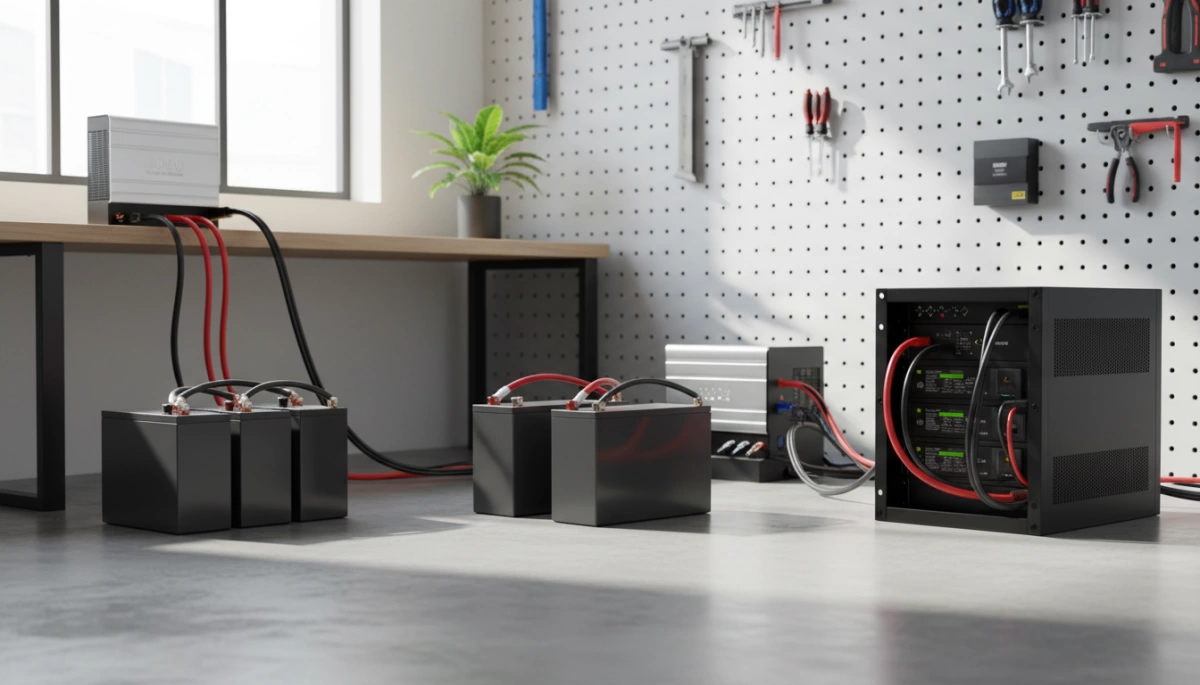
Running a high-draw appliance on a 3000W inverter requires a battery bank that can handle massive current without overheating or shutting down. For a 12V system, a 3000W load pulls approximately 250 Amps. I never recommend running this on a single 100Ah battery, as the discharge rate would likely trigger the BMS protection. To handle this load safely, your battery bank for 3000 watt inverter should consist of at least three 100Ah batteries in parallel or two 200Ah Nuranu units.
12V vs 24V vs 48V Inverter Setup
The efficiency of your system depends heavily on your chosen voltage. Higher voltage reduces the amperage, which allows for thinner cables and less energy loss through heat.
- 12V Systems: Common in smaller RVs and vans. Requires 4/0 AWG cables to manage the 250A draw. You must use a parallel vs series connection strategy to increase capacity to at least 300Ah-400Ah for stability.
- 24V Systems: Cuts the current draw in half to about 125A. This is much more efficient for a 3000W load, offering a balanced middle ground for most off-grid builds.
- 48V Systems: The preferred choice for large-scale installations. The current drops to roughly 62.5A, significantly improving safety and reducing the physical footprint of your wiring.
Choosing the Right Configuration
When building your solar battery bank sizing strategy, you must decide between increasing capacity or voltage. Using our high-performance lithium-ion battery packs, you can easily scale your system.
| System Voltage | Approx. Amperage (3000W) | Recommended Nuranu Config |
|---|---|---|
| 12V | 250A | 3x 100Ah (Parallel) |
| 24V | 125A | 2x 100Ah (Series) |
| 48V | 62.5A | 4x 100Ah (Series) |
For any 3000W application, I suggest prioritizing a 24V or 48V setup. This reduces the stress on the internal components of your batteries and ensures your inverter operates at peak efficiency during high-surge moments. Always ensure your parallel vs series connection points are clean and tight to prevent voltage drops.
LiFePO4 vs. Lead-Acid: Real-World Comparisons
When deciding how many batteries do you need for your 3000 Watt inverter, the chemistry you choose changes everything. Traditional lead-acid batteries are heavy and inefficient under high loads, whereas our LiFePO4 batteries for inverter setups provide consistent voltage and significantly more usable energy.
Performance and Discharge Capability
A 3000W load puts immense stress on a battery bank. Lead-acid batteries suffer from the “Peukert Effect,” meaning their effective capacity drops as the discharge rate increases. In contrast, high discharge rate batteries like our LiFePO4 units maintain a stable voltage curve, ensuring your inverter doesn’t shut down prematurely due to voltage sag.
| Feature | Nuranu LiFePO4 | Lead-Acid / AGM |
|---|---|---|
| Depth of Discharge (DoD) | 100% (Recommended 80-90%) | 50% (To avoid damage) |
| Cycle Life | 4,000 – 6,000+ Cycles | 300 – 500 Cycles |
| Weight | ~1/3 of Lead-Acid | Extremely Heavy |
| Lifespan | 10+ Years | 2 – 3 Years |
| Efficiency | >95% | ~75% – 85% |
Why LiFePO4 Allows for Smaller Battery Banks
Because of the superior depth of discharge inverter batteries offer in the lithium category, you can actually install a smaller physical bank to achieve the same results. To safely run a 3000W load:
- Lead-Acid: You need a massive bank because you can only use half the rated amp-hours without damaging the cells.
- Nuranu LiFePO4: You get nearly the full rated capacity. This allows for a lightweight and compact setup that saves space in RVs, vans, or off-grid cabins.
Our Grade A LiFePO4 cells and integrated Smart BMS protect against the thermal issues and over-discharge common in lead-acid systems. By switching to lithium, you eliminate the need to over-purchase batteries just to compensate for poor discharge limits, making your 3000W system more reliable and easier to manage.
Real-World 3000W Inverter Runtime Scenarios
The 3000W inverter runtime calculation varies significantly based on what you are powering. Because Nuranu LiFePO4 batteries support a 100% Depth of Discharge (DoD), we can provide much more reliable runtimes compared to traditional lead-acid banks.
Emergency Home Backup: Fridge and Lights
During a power outage, your main goal is usually preserving food and maintaining visibility. A standard refrigerator pulls about 150W to 200W once running, but it requires a high surge to start.
- Battery Recommendation: Two Nuranu 12V 200Ah LiFePO4 batteries.
- Expected Runtime: This 400Ah battery bank for 3000 watt inverter setups provides roughly 5.12kWh of energy, enough to keep a fridge and several LED lights running for 24 to 30 hours.
- The Advantage: Our high-performance BMS handles the fridge’s compressor startup surge without tripping the circuit.
RV and Van Life: Air Conditioners and Microwaves
Mobile living demands high power for climate control and cooking. A 13,500 BTU RV air conditioner typically draws 1,200W to 1,500W.
- Battery Recommendation: At least three Nuranu 12V 200Ah batteries in parallel (600Ah total).
- Expected Runtime: This setup offers approximately 4 to 5 hours of continuous AC use. For a 1500W microwave, you can run it for several minutes at a time without significantly impacting your total capacity.
- Weight Savings: Using LiFePO4 batteries for inverter applications in an RV cuts hundreds of pounds off your vehicle’s payload compared to AGM batteries.
Off-Grid Cabin: Power Tools and Appliances
If you are running a remote cabin, you likely use heavy-draw items like well pumps or circular saws. These tools demand a robust solar battery bank sizing strategy to handle the high inverter current draw calculation.
- Battery Recommendation: One or two Nuranu 48V 100Ah battery modules.
- Expected Runtime: A 48V 100Ah unit provides 4.8kWh of storage. This is ideal for intermittent tool use throughout a workday or running a small cabin’s water pump and electronics for 48+ hours.
- System Health: While our BMS provides elite protection, knowing how to revive lithium-ion battery systems that have entered “sleep mode” due to extreme discharge is a vital skill for off-grid owners.
Quick Reference Runtime Table
| Load Type | Total Watts | Suggested Nuranu Bank | Estimated Runtime |
|---|---|---|---|
| Critical Backup | 300W | 200Ah (12V) | 8-9 Hours |
| Full RV Load | 1500W | 400Ah (12V) | 3.5 Hours |
| Heavy Off-Grid | 2500W | 200Ah (48V) | 3.8 Hours |
Safety and Common Mistakes for 3000W Inverter Setups
Safety is the most important factor when building a high-draw power system. Cutting corners on your battery bank for a 3000 watt inverter leads to equipment failure, blown fuses, or even fire hazards. You must ensure every component is rated for the massive current a 3000W load demands.
Proper Cable Sizing to Prevent Voltage Drop
Voltage drop is the silent killer of efficiency. For a 12V system, a 3000W inverter can draw over 250 Amps. Using thin cables will cause them to overheat and drop the voltage before it even reaches the inverter, causing “Low Voltage” alarms.
- Use 4/0 AWG cables for 12V setups to handle the current safely.
- Keep cable runs short (under 5 feet) to minimize resistance.
- Maintain clean connections to prevent arcing; regularly learning how to clean battery contacts ensures your high-current paths remain efficient and cool.
The Risks of Undersized Battery Banks
Attempting to run a 3000W load on a single 100Ah battery is a common mistake. Even if the capacity seems okay for a few minutes, the high discharge rate will likely exceed the battery’s BMS limits. This causes the BMS to “trip” to protect the cells, resulting in an instant power loss. For a 3000W inverter battery sizing plan, you need a bank that can sustain continuous discharge without hitting 100% of its rated limit.
Why Advanced BMS Protection is Non-Negotiable
Every Nuranu LiFePO4 battery is equipped with an Advanced Smart BMS. This system is your last line of defense against over-discharge, short circuits, and thermal runaway. When dealing with high-wattage LiFePO4 batteries for inverters, the BMS ensures that if a fault occurs, the battery disconnects itself before permanent damage happens. If your system shuts down due to an overload, knowing how to fix a lithium-ion battery that won’t charge can help you troubleshoot whether the BMS is simply in protection mode or if there is a deeper hardware issue.
Common Safety Checklist:
- Fuse Everything: Install a high-quality 300A to 350A fuse between the battery and the inverter.
- Check Temperature: Ensure your battery bank has adequate ventilation, as high discharge generates heat.
- Verify Voltage: Never mix old and new batteries or different chemistries in the same bank.
Choosing the Best System Voltage for Your 3000W Inverter
When deciding how many batteries do you need for your 3000 Watt Inverter, the system voltage is the most critical factor. Higher voltage setups significantly reduce the current (amperage) flowing through your wires, which minimizes heat and improves overall energy efficiency.
12V vs. 24V vs. 48V Comparison
For a 3000W load, the physical size of your battery bank remains similar in total energy capacity, but the configuration changes how the power is delivered.
| System Voltage | Approx. Current at 3000W | Recommended Use Case | Efficiency Level |
|---|---|---|---|
| 12V Setup | ~250 Amps | Small RVs, Vans, Boats | Moderate (High heat) |
| 24V Setup | ~125 Amps | Off-grid cabins, Work trucks | High |
| 48V Setup | ~62.5 Amps | Whole-home backup, Solar arrays | Maximum |
When to Upgrade Your System Voltage
While 12V is a standard for many DIY vehicle builds, pushing 3000W through a 12V system requires massive, expensive 4/0 AWG cabling to prevent dangerous voltage drops. If you are designing an off-grid power system battery bank for high-draw appliances, upgrading to 24V or 48V is the smarter choice.
- Move to 24V: If your daily loads consistently exceed 2000W. It cuts your current in half, making it easier for the BMS to manage thermal loads.
- Move to 48V: If you plan on expanding your solar battery bank sizing in the future. It is the most efficient way to run a 3000W pure sine wave inverter without wasting energy as heat.
Using high-quality LiFePO4 batteries allows you to easily scale these voltages by connecting units in series. A higher voltage 12V vs 24V vs 48V inverter setup ensures your system runs cooler, lasts longer, and requires thinner, more manageable wiring.
Nuranu Recommendations for 3000W Inverter Setups
When you are running a high-demand 3000W system, the quality of your power source determines the reliability of your entire off-grid or backup setup. We recommend using Grade A LiFePO4 cells to ensure your battery bank can handle the heavy current draw without significant voltage sag or safety risks. For a 3000W load, our high-capacity LiFePO4 batteries are designed with an advanced Smart BMS to manage the continuous discharge rates required to keep your appliances running smoothly.
Best LiFePO4 Battery Packs for 3000W Loads
To meet the high discharge requirements of a 3000W inverter, we suggest the following Nuranu configurations:
- 12V Systems: At least two 200Ah units or three 100Ah units connected in parallel. This distributes the ~250A load, ensuring you don’t exceed the discharge limits of a single battery’s BMS.
- 24V Systems: Two 24V 100Ah (or one 200Ah) units. This is a more efficient setup that reduces heat and cable thickness requirements.
- 48V Systems: A single 48V 100Ah Nuranu battery can often handle the load, but we recommend a larger bank for extended runtime and better system longevity.
Using our reliable lithium technology ensures your system remains lightweight and compact while providing a 10+ year lifespan. Understanding what is 32650 LiFePO4 battery technology and why it is safe can help you appreciate the stability and protection integrated into our high-performance power solutions.
Pairing Batteries with Pure Sine Wave Inverters
A 3000W inverter is only as good as the power it receives. We prioritize pairing our battery banks with Pure Sine Wave Inverters to guarantee that sensitive electronics—like laptops, medical equipment, and modern kitchen appliances—receive clean, stable energy.
Why this pairing matters:
- BMS Synchronization: Our Smart BMS is tuned to handle the surge currents often seen when a 3000W inverter starts up heavy motors or compressors.
- Efficiency: Pure Sine Wave output minimizes energy waste, ensuring your battery bank provides the maximum possible runtime.
- Safety: The combination of Nuranu’s thermal protection and the inverter’s internal safety features creates a “worry-free” power environment.
For those maintaining smaller secondary packs for portable tools or equipment, knowing if you can trickle charge a lithium battery pack is essential for keeping your entire energy ecosystem ready for use alongside your primary 3000W installation. For the best results, always use high-gauge copper cabling to connect your Nuranu batteries to your inverter to prevent power loss and overheating.
Common Questions About 3000W Inverter Battery Sizing
Can I run a 3000W inverter on one 100Ah battery?
In short, no. A 3000W load on a 12V system pulls approximately 250 Amps. Most single 100Ah LiFePO4 batteries feature a BMS limited to 100A or 150A of continuous discharge. Trying to pull 250A will trigger the Advanced Smart BMS protection and shut the system down. To safely handle a 3000W inverter current draw calculation, you generally need at least three 100Ah batteries in parallel or two 200Ah units.
How long will 400Ah last at full load?
At a continuous 3000W draw on a 12V setup (~250A draw), a 400Ah battery bank will last roughly 1.6 hours. One of the main advantages of our LiFePO4 technology is the 100% depth of discharge (DoD), allowing you to use the full 400Ah without the voltage drop-off common in lead-acid batteries.
Is 24V better than 12V for high wattage?
Yes, 24V and 48V systems are significantly more efficient for high-wattage applications. Increasing the voltage reduces the amperage by half (at 24V) or three-quarters (at 48V). This reduction in current means:
- Less heat generation in the wires and components.
- Thinner cable requirements, saving money and space.
- Improved inverter efficiency during high-draw tasks.
When designing these high-output systems, it is critical to choose a reliable LiFePO4 battery manufacturer that provides Grade A cells capable of sustaining these high discharge rates over thousands of cycles.
Selecting the right cable size for 3000W
Cable sizing is a safety priority. For a 12V battery bank for 3000 watt inverter use, you must use 2/0 AWG or 4/0 AWG pure copper cables. Undersized cables will cause a massive voltage drop, making the inverter alarm trigger prematurely and creating a serious fire risk due to overheating.
Quick Reference for 3000W Setup
| System Voltage | Approx. Current Draw | Recommended Min. Capacity | Suggested Cable Size |
|---|---|---|---|
| 12V | 250A | 300Ah – 400Ah | 4/0 AWG |
| 24V | 125A | 200Ah | 1/0 AWG |
| 48V | 62.5A | 100Ah | 4 AWG |





 English
  German
  Spanish
  French
  Italian
  Polish
  Russian
  Thai
Thai  Turkish
  Japanese
  Korean