
There is nothing worse than your vacuum dying with half the rug left to clean.
You’ve seen the marketing specs promising “up to 60 minutes of runtime.” But in the real world? That number often drops to 12 minutes once you switch to Max mode.
If you have a large home or pet hair to deal with, you need the truth, not just a spec sheet.
So, what cordless vacuum has the longest lasting battery?
In this guide, I’m cutting through the industry fluff to reveal the top performers. We’ll look at real-world runtime, why swappable battery packs (like those in Van4NU models) are the ultimate cure for range anxiety, and how to get the most out of every charge.
Ready to finish the job on a single charge?
Let’s dive in.
The Truth About Battery Specs (What Manufacturers Don’t Tell You)
As experts in engineering custom lithium battery solutions for OEMs, we see the disconnect between marketing claims and the physics of power every day. We understand the frustration of “Runtime Anxiety”—buying a device promising an hour of cleaning only to have it die halfway through the living room. To find the cordless vacuum with the longest-lasting battery, you have to look past the sticker on the box and understand the cell technology inside.
‘Up To’ is a Trap: Eco Mode vs. Real World
The phrase “Up to 60 minutes” is the most common trap in the industry. In our testing labs, these figures are almost always achieved in Eco mode using a suction-only attachment (no motorized brush head) on a hard surface. This represents the absolute minimum energy consumption.
In the real world, cordless stick vacuum runtime drops significantly when you:
- Attach a motorized floor head (which draws its own power).
- Clean carpets (creating friction and resistance).
- Engage standard or high-power modes to actually pick up debris.
The Impact of Suction Power: Max vs. Auto-Detect
High suction demands high current. When you switch a vacuum to Boost mode, you are forcing the battery management system (BMS) to discharge energy at a rapid rate. This not only drains the mAh rating (Milliamp Hours) quickly but also generates heat, which can trigger thermal safety cutoffs before the battery is actually empty. We design our 24V and 36V platforms with advanced thermal management to mitigate this, but for most consumer vacuums, constant max power means a drastically shorter lifespan per charge.
Battery Tech 101: Voltage (V) vs. Amp Hours (Ah)
To judge a vacuum’s true endurance, you need to understand the relationship between Voltage and Amp Hours. We utilize premium 18650 and 21700 Lithium-Ion cells to optimize these metrics for our partners.
- Voltage (V) = The Muscle: Higher voltage (e.g., 36V vs 18V) generally allows for stronger suction power and motor efficiency.
- Amp Hours (Ah) = The Gas Tank: This measures the capacity of energy the battery holds. A higher Ah rating directly correlates to longer runtime.
- Watt Hours (Wh) = The Total Energy: Calculated as $Voltage \times Amp Hours$. This is the most accurate metric for comparing total battery size across different brands.
Quick Reference Guide:
| Spec | What It Does | Impact on Runtime |
| :— | :— | :— |
| High Voltage (24V/36V) | Increases motor torque/suction | Neutral (depends on efficiency) |
| High Amp Hours (Ah) | Increases fuel capacity | Directly Increases Runtime |
| High Watt Hours (Wh) | Total energy storage | Best Indicator of Long Life |
The Game Changer: Swappable vs. Built-In Batteries
When searching for what cordless vacuum has the longest lasting battery, the answer often lies in the design architecture rather than just the cell chemistry. The difference between a fixed power source and a modular one defines the true lifespan of your appliance.
The Limitation of Built-In Batteries
Many commercial vacuums seal the power source directly into the handle or motor housing. This design creates a significant bottleneck for longevity. Lithium-ion battery life naturally degrades over time; after a few hundred charge cycles, the capacity drops. With a built-in system, when the battery fades, the entire vacuum becomes useless. You are also strictly limited to the runtime of a single charge, forcing you to stop cleaning and wait hours for the unit to recharge.
The Swappable Solution: Infinite Runtime Potential
The most effective way to extend cleaning time is through a removable battery pack. By decoupling the energy source from the vacuum motor, we unlock the potential for continuous operation. A spare battery for vacuum use allows you to swap a depleted pack for a fully charged one in seconds, effectively doubling your runtime instantly. This setup is essential for large homes or commercial spaces where downtime is not an option. To understand the potential of these packs, it helps to know how to calculate the Ah of an 18650 battery pack, as the total Amp Hours directly dictate how long you can clean before needing that swap.
Van4NU Spotlight: Quick-Swap Design Benefits
At Nuranu, we approach battery integration with a focus on professional reliability and ease of use. Our high-capacity vacuum battery solutions are engineered to withstand the rigors of frequent swapping while maintaining a secure electrical connection.
Key Advantages of Our Modular Design:
- Continuous Cleaning: Instantly replace packs to extend cordless stick vacuum runtime without waiting for a recharge.
- Robust BMS Protection: Our advanced Battery Management System protects cells during handling and operation, ensuring safety even during rapid changes.
- Cost Efficiency: When battery chemistry eventually degrades, you only replace the pack, not the expensive vacuum unit.
- Custom Voltage Platforms: We utilize optimized 24V and 36V systems to balance suction power with energy efficiency.
| Feature | Built-In Battery | Swappable Battery (Van4NU) |
|---|---|---|
| Runtime Limit | Fixed (Single Charge) | Unlimited (With Spares) |
| Device Lifespan | Tied to Battery Health | Independent of Battery |
| Maintenance | Difficult/Impossible | Instant Replacement |
| Downtime | Hours (Recharging) | Seconds (Swapping) |
Top Contenders for Longest Battery Life
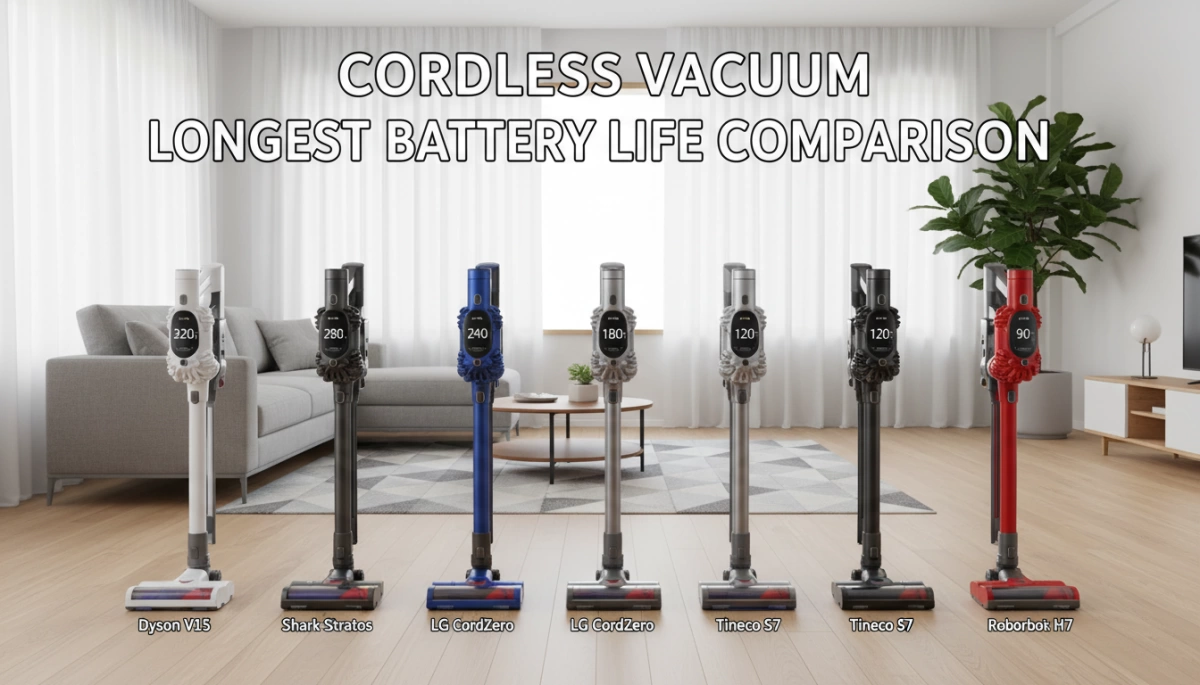
When you ask what cordless vacuum has the longest lasting battery, you are really asking about the quality of the engineering inside the power pack. As a manufacturer deeply embedded in the battery industry, I see exactly how different brands approach this challenge. It usually breaks down into three distinct categories.
The Premium Heavyweight: High Performance, High Price
The market leaders in the premium space achieve impressive cordless stick vacuum runtime by brute-forcing the problem. They utilize high-voltage platforms (often 24V to 36V) paired with large-capacity 21700 cells. These units deliver fade-free suction and can run for over 60 minutes, but they come with a significant weight penalty and a steep price tag. While the performance is undeniable, the heavy battery pack often makes maneuvering the vacuum difficult during long cleaning sessions.
The Smart Efficiency Pick: Van4NU Power-to-Runtime Ratio
This is where our approach at Van4NU differs. We focus on the “smart” application of energy rather than just adding bulk. By utilizing advanced Battery Management Systems (BMS) and precision-engineered 18650 or 21700 cell configurations, we optimize the discharge curve to match the motor’s actual needs.
We carefully select the cell chemistry, weighing the benefits of LFP lithium battery vs NMC battery technologies to ensure the pack remains lightweight while delivering consistent power. Our custom solutions prioritize thermal management and cycle life, ensuring that the lithium-ion battery life extends well beyond the warranty period. We design our packs to handle thousands of charge cycles, providing a reliable energy source that doesn’t degrade prematurely.
The Budget Runner-Up: Longevity vs. Suction Trade-offs
On the lower end of the spectrum, budget vacuums often claim high runtimes but achieve them by throttling the motor’s power. These units typically use lower-grade cells with poor energy density. While they might run for 40 minutes on “Eco mode,” the suction is often too weak to be effective. Furthermore, these generic packs usually lack sophisticated protection circuits, leading to faster degradation. It is crucial to understand the components inside; for instance, knowing are 18650 batteries the same size as AA cells helps consumers realize that the industrial-grade power cells we use are vastly superior to standard consumer batteries found in cheaper appliances.
Beyond the Battery: Factors That Drain Your Power Faster
Even the most advanced battery pack can’t compensate for inefficient usage. When asking “what cordless vacuum has the longest lasting battery,” you have to look at how the machine is actually being used. External resistance and maintenance habits play a massive role in how fast those electrons are depleted. As manufacturers, we design our battery management systems (BMS) to handle varying loads, but physics still applies.
Floor Type Matters: Carpet vs. Hardwood Energy Consumption
The surface you are cleaning dictates the amperage draw. On smooth hardwood or tile, the brush bar meets very little resistance, allowing the motor to run efficiently. Move that same unit onto a plush carpet, and the dynamic changes instantly.
- Friction Increases Load: The brush bar has to physically beat the carpet fibers, requiring significantly more torque.
- Higher Amp Draw: To maintain fade-free suction, the motor pulls more current from the cells, causing lithium-ion battery life to drop faster.
- Thermal Buildup: Higher continuous discharge generates heat, which can trigger the BMS to throttle performance for safety.
Filter Maintenance and Motor Strain
A clogged filter is a silent battery killer. When airflow is restricted by dust and debris, the vacuum motor has to spin faster and work harder to create the same amount of suction. This doesn’t just reduce cleaning performance; it puts unnecessary strain on the power source.
Keeping your filters clean ensures the motor operates within its optimal efficiency range. Neglecting this maintenance forces the battery to discharge at a higher rate to compensate for the blockage, significantly cutting down your cordless stick vacuum runtime.
Attachment Drag: Motorized Heads vs. Standard Tools
Not all attachments are created equal. A motorized floor head contains its own motor that draws power directly from the main battery pack. When you run a vacuum in “Max” mode with a motorized head, you are powering two motors simultaneously.
- Motorized Heads: consume extra energy to spin the brush bar, reducing overall runtime.
- Standard Tools: Crevice tools and dusting brushes rely solely on airflow, putting less demand on the battery.
Understanding the limitations of your power source is key. Many of these high-drain appliances rely on standard 18650 and 21700 lithium cells engineered to handle these surges, but minimizing unnecessary load is the best way to extend your cleaning session.
How to Maximize Your Cordless Vacuum’s Lifespan
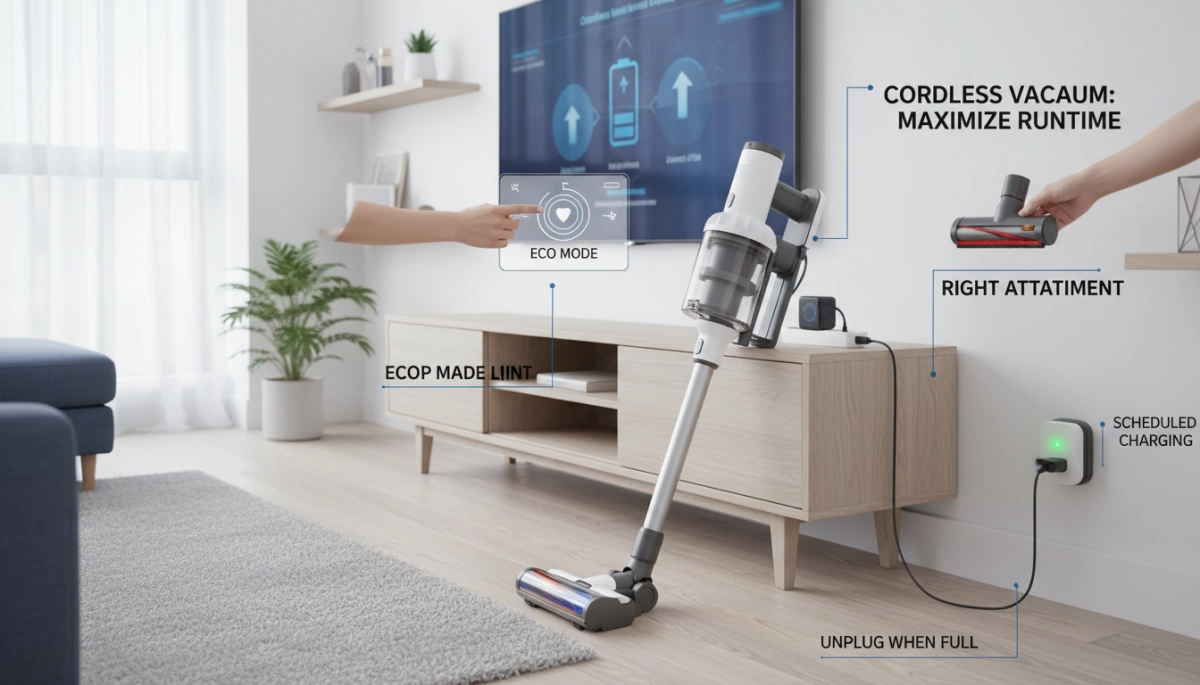
Getting the longest life out of your cordless vacuum isn’t just about buying the model with the biggest battery; it’s about how you treat the power source. Lithium-ion cells are chemical systems that degrade over time, but proper habits can significantly extend their service life. We see too many good vacuums fail early simply because the battery was pushed past its limits or stored incorrectly.
Storage Best Practices for Lithium-Ion Health
How you store your vacuum when it’s not cleaning your floors matters more than you think. Leaving a battery at 0% charge for weeks can cause the cells to sleep permanently, while keeping it at 100% on the charger constantly can stress the chemistry. For long-term storage, aim for a 40-60% charge level. Additionally, keeping the connection points free of dust is crucial; regular maintenance, such as cleaning battery terminals and posts, ensures efficient power transfer and prevents heat buildup at the contact points.
Temperature Sensitivity: Avoiding Extreme Heat and Cold
Temperature is the silent killer of lithium-ion battery life. Extreme heat is particularly damaging, as it permanently degrades the internal structure of the cells, reducing their capacity to hold a charge. Conversely, freezing temperatures increase internal resistance, causing the vacuum to cut out early even if the battery isn’t empty.
- Avoid Hot Cars: Never leave your vacuum or battery pack in a hot vehicle or direct sunlight.
- Room Temperature Charging: Only charge your device in a climate-controlled environment (between 50°F and 86°F).
- Cool Down First: If the battery is hot after a heavy cleaning session on Max mode, let it cool down before plugging it into the charger.
Van4NU Battery Protection Technology
At Van4NU, we engineer our power packs to handle the demands of modern cleaning without compromising safety. Our systems utilize advanced Battery Management Systems (BMS) that act as the brain of the battery. This technology provides real-time monitoring and predictive diagnostics to balance the cells during every charge and discharge cycle. By integrating thermal management optimization and protection against over-current and short-circuits, we ensure that our custom-engineered lithium solutions deliver thousands of charge cycles rather than just a few hundred.
FAQ: Common Questions About Cordless Vacuum Battery Life
When we work with manufacturers to design power systems, we hear the same concerns from end-users. Understanding the engineering behind the plastic shell helps you manage expectations and get the most out of your appliance.
How long should a cordless vacuum battery last?
There are two ways to look at this: runtime per clean and total lifespan.
- Runtime: Depending on the suction mode, a standard cordless stick vacuum runtime usually falls between 15 to 60 minutes.
- Lifespan: A high-quality lithium-ion pack is typically rated for hundreds of charge cycles. In our testing, premium cells can last 3 to 5 years before you notice a significant drop in capacity.
Is it better to leave a cordless vacuum on the charger?
With modern lithium technology, yes. Old nickel-cadmium batteries had “memory effects,” but today’s systems are smarter. We integrate advanced Battery Management Systems (BMS) into our packs that cut off the current once the cells are full. This prevents overcharging and keeps the unit ready for the next mess. However, avoid charging in extreme heat, as high temperatures degrade lithium chemistry faster than anything else.
Can I replace the battery in my stick vacuum?
This depends entirely on the vacuum’s industrial design.
- Built-in: Some sleek models seal the battery inside the handle. When it dies, the whole vacuum often becomes e-waste.
- Removable: We always advocate for removable battery pack designs. It allows you to swap in a fresh pack for double the runtime and replace just the battery—not the vacuum—years down the line.
Does higher voltage mean longer battery life?
No, this is a common myth.
- Voltage (V): This determines the “muscle” or suction power.
- Amp-Hours (Ah): This is the size of the gas tank.
A 36V vacuum might be more powerful than a 24V one, but if it has a low mAh rating, it will run out of juice quickly. For the longest runtime, you need high-capacity cells. We often utilize 21700 lithium-ion battery cells in our custom packs because they offer a superior energy-to-weight ratio compared to older standards, giving you more cleaning time without making the vacuum too heavy to lift.





 English
  German
  Spanish
  French
  Italian
  Dutch
Dutch  Polish
  Russian
  Thai
Thai  Turkish