
Are you struggling to source the right power for your micro-mobility fleet? Choosing the perfect battery partner can make or break your product’s success and your riders’ safety.
As an industry insider, I can tell you that launching a successful brand is about much more than a sleek design. It comes down to one critical supply chain decision: OEM vs ODM Batteries Electric Scooters: Which Is Better for Your Brand?
You might already know that OEM offers rapid scaling, while ODM provides custom engineering. But which route will actually get your product to market faster and protect your bottom line?
In this guide, you’re going to learn exactly how to navigate this choice, step by step. I’ll break down the core technical requirements, from high-discharge platforms to custom BMS development, and show you exactly what to look for in a reliable manufacturing partner.
So if you’re looking to build a safer, more reliable scooter fleet and scale your operations without costly hardware failures, this guide is for you.
Let’s dive right in.
The OEM Route: Scalable Manufacturing
When we talk about OEM battery pack production (Original Equipment Manufacturer), we are essentially talking about execution. In this model, you provide the specs, the blueprints, and the design files, and the factory brings it to life. We aren’t reinventing the wheel here; we are building your wheel, exactly how you designed it, but at a scale you can’t achieve in a garage.
What is OEM Battery Production?
Simply put, an OEM partnership means the manufacturer acts as your production arm. You retain all intellectual property rights to the battery design, the BMS (Battery Management System) logic, and the form factor. The factory’s job is to source the cells (whether LiFePO4 vs Lithium-Ion for scooters), assemble the packs, and ensure they meet your strict criteria. This is the go-to route for established brands that have already invested heavily in their own engineering.
Who Should Choose OEM?
This route isn’t for everyone. It works best if:
- You have a finalized design: Your engineering team has already cracked the code on the voltage platform (be it a 36V electric scooter battery or a high-power 60v battery for electric scooter) and casing dimensions.
- You need white-labeling: You want your brand logo on the casing, not the factory’s. White-label battery manufacturing allows you to market the product entirely as your own.
- Volume is king: You are looking to scale up for a fleet deployment or a major retail launch and need thousands of units, not dozens.
Key Capabilities to Look For
If you are handing over your blueprints, you need to trust the hands building them. When vetting an electric scooter battery manufacturer for OEM work, I look for four non-negotiable pillars:
- Manufacturing Scale: Can they handle the heat? You need a partner capable of churning out 100k+ units annually without bottlenecks. If they can’t scale with your sales, they are a liability.
- Automated Production: Human error is the enemy of battery safety. Look for factories utilizing automated battery cell sorting and spot-welding on 24/7 lines. Automation ensures that every single electric scooter battery pack is identical to the last.
- Reliability Metrics: Don’t just take their word for it; ask for the data. A solid partner should boast a 98.5% pass rate (or higher) on first-pass yield.
- Quality Assurance: This is where safety happens. Your partner must be an ISO 9001 battery factory. Furthermore, they must perform rigorous battery end-of-line testing (EOL) to verify capacity and safety functions before shipping. This includes ensuring compliance with UN38.3 battery certification and IEC 62133 safety standard requirements so your goods don’t get stuck in customs.
The ODM Route: Custom Solutions & Technical Partnership
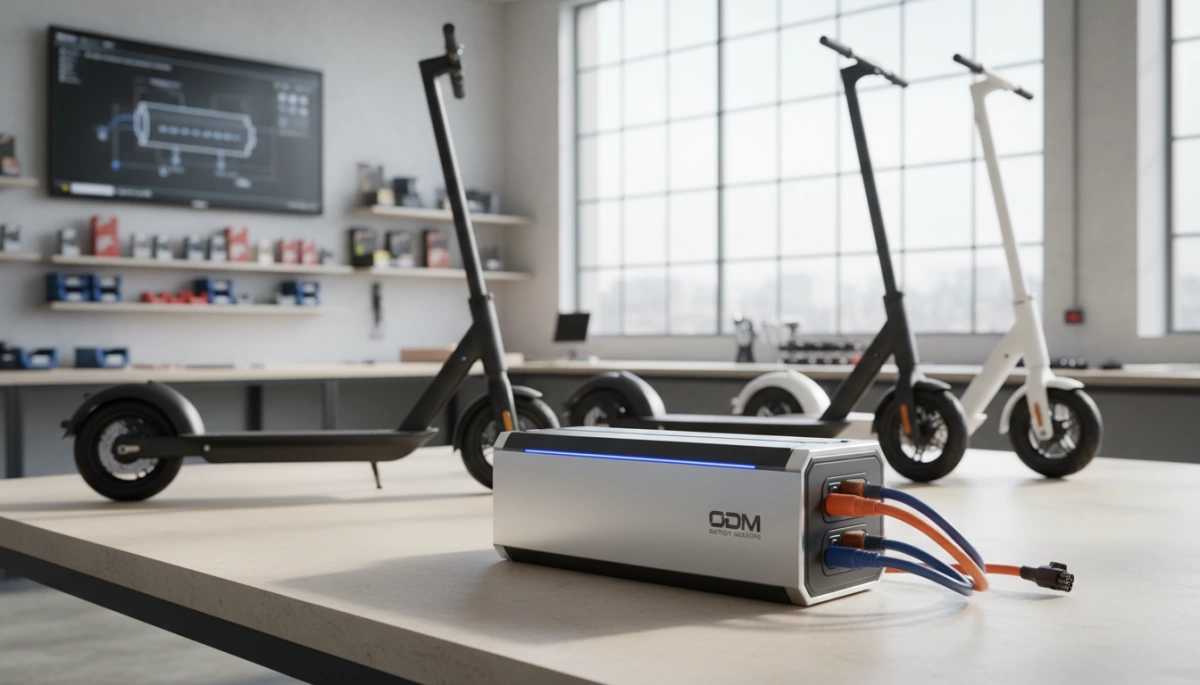
ODM Lithium Battery Design Explained
If you need a power source built completely from the ground up, the ODM (Original Design Manufacturer) route is your best bet. As an ODM partner, we take ownership of the entire engineering and manufacturing process for your electric scooter battery. Instead of settling for an off-the-shelf layout, we design the exact specifications your brand requires.
Who Needs an ODM Battery Partner?
This manufacturing route is ideal for US brands launching scooters with unique form factors. If your new design features a slim steering stem, an unconventional folding deck, or requires highly specific performance outputs—like a high-torque 60v lithium battery for electric scooter applications—an ODM partnership ensures the battery fits perfectly into your physical and technical constraints.
Key Benefits of Custom Scooter Batteries
- Rapid Product Development: We take your raw concept and turn it into a production-ready electric scooter battery pack fast, significantly cutting down your time-to-market.
- Advanced R&D: We engineer the optimal cell chemistry and thermal management systems for your specific rider base. During the design phase, technical safety decisions—like determining exactly how and if you can mix 18650 batteries for specific voltage requirements—are handled entirely by our engineering team to maximize efficiency.
- Custom BMS Development: A reliable Battery Management System is non-negotiable for the US market. We integrate smart BMS technology featuring predictive diagnostics, active thermal monitoring, and strict safety protections to maximize the battery life of electric scooters and prevent critical failures in the field.
ODM Capabilities Overview
| ODM Feature | What It Means for Your Brand |
|---|---|
| Form Factor | 100% custom shapes to fit unique scooter chassis designs. |
| Development Speed | Streamlined transition from initial R&D to mass production. |
| Smart Protections | Custom BMS cut-offs tailored to your specific motor draw. |
| Ideal Candidates | Innovative mobility brands needing specialized performance. |
Quick Comparison Matrix: OEM vs. ODM
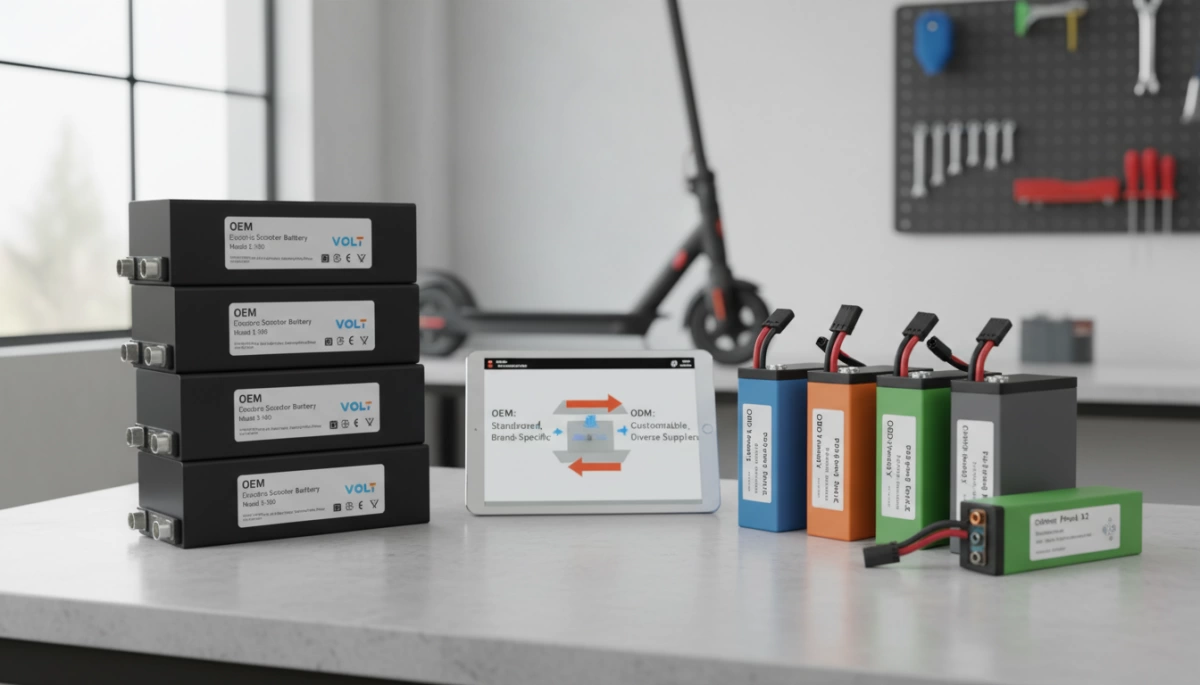
Deciding between an OEM or ODM partnership often comes down to your timeline, budget, and how unique your electric scooter battery needs to be. As your manufacturing partner, we support both paths, but understanding the trade-offs is crucial for your supply chain strategy.
Here is a breakdown of how these two manufacturing routes compare for micro-mobility power solutions:
| Feature | OEM (Original Equipment Manufacturer) | ODM (Original Design Manufacturer) |
|---|---|---|
| Best For | Brands needing proven, standard 24V, 36V, or 48V scooter batteries quickly. | Innovators requiring unique shapes, custom BMS development, or specific high-performance metrics. |
| Time to Market | Fast (Weeks). We utilize existing designs and tooling to accelerate production. | Medium. Requires time for design, prototyping, and validation before mass production. |
| R&D Required | Low. You leverage our pre-validated engineering and safety certifications. | High. Involves deep collaboration on cell chemistry (like 21700 vs 18650 batteries) and thermal management. |
| Cost Investment | Lower Upfront. Minimal tooling fees; cost efficiency comes from volume. | Higher Upfront. Includes NRE (Non-Recurring Engineering) costs for molds and custom electronics. |
| Scalability | High. Ready for immediate volume scaling (100k+ units). | Scalable. Once the prototype is approved, we transition to mass manufacturing. |
If your goal is to hit the market immediately with a reliable, standard solution, OEM is the efficient choice. However, if your vehicle requires a battery with a non-standard form factor or specialized discharge rates to outperform competitors, the ODM route allows us to build a custom rechargeable lithium battery system tailored exactly to your specs.
Core Technical Requirements for Scooter Batteries
When defining the specs for your next electric scooter battery pack, we focus on four non-negotiable technical pillars. These requirements ensure your product balances performance, safety, and market compliance.
Voltage Platforms & Capacity
We engineer systems around standard platforms that dominate the micro-mobility market. While we customize for specific motor requirements, most commercial and consumer scooters rely on established voltage architectures to ensure compatibility and efficiency.
- 24V Systems: Ideal for lightweight, last-mile commuter scooters and neighborhood cruisers.
- 36V Systems: The industry standard for balancing speed and torque, commonly found in the average 36v lithium battery for an electric scooter.
- Custom Platforms: For high-performance needs, we scale up to meet specific power demands.
High Energy Density & Cell Selection
Riders demand range, but they refuse to carry heavy, bulky vehicles. We solve this by utilizing high-energy-density lithium-ion cells (18650 and 21700 formats). This approach maximizes the electric scooter battery life while keeping the overall vehicle weight manageable. Understanding how to choose the right 18650 battery chemistry is vital for optimizing this power-to-weight ratio.
Fast Charging for Fleet Availability
For shared mobility operators and delivery fleets, downtime equals lost revenue. Our battery designs prioritize thermal management to support faster charging cycles without degrading cell health. This ensures your fleet spends more time on the road and less time tethered to a wall.
Mandatory Global Certifications
You cannot scale a brand if your products get stuck at customs. We build compliance into the design phase, ensuring every pack is ready for global distribution.
| Certification | Purpose |
|---|---|
| UN38.3 | Mandatory safety testing for shipping lithium batteries internationally (air/sea). |
| IEC 62133 | The global benchmark for safety requirements in portable sealed secondary cells. |
| UL / CE | Critical safety and conformity standards for entering US and European markets. |
| ISO 9001 | Ensures our manufacturing quality management systems meet international standards. |
After-Sales Support: OEM vs ODM Batteries Electric Scooters
As an entrepreneur in the mobility space, I always stress that choosing between OEM vs ODM batteries electric scooters isn’t just about the initial manufacturing—it is about what happens after the pallets arrive. In the highly competitive US market, your brand reputation hinges entirely on reliability.
If a rider faces electric scooter battery issues, they do not blame the factory in Asia; they blame your brand. Bad support leads to negative reviews, safety liabilities, and tanked sales. A solid post-delivery support system from your manufacturing partner prevents minor glitches from escalating into costly recalls. It guarantees that when a customer needs an electric scooter battery replacement, you have the backing to resolve it instantly.
Essential Support Features for Electric Scooter Batteries
Whether you run standard 36V setups or high-performance 60 volt electric scooter battery systems, your battery supply chain strategy must include comprehensive post-sale backing. Here is the non-negotiable support matrix I require from any battery manufacturer:
| Support Feature | Real-World Impact on Your Scooter Brand |
|---|---|
| Technical Documentation | Clear integration manuals, safety guidelines, and spec sheets. This ensures your team fully understands the technical nuances, like the difference between protected and unprotected 18650 batteries used in your packs. |
| Application Engineering Support | Direct access to engineering teams. They help you seamlessly integrate the electric scooter battery pack with your motor controller and custom BMS development. |
| Field Issue Resolution | Fast, data-driven root cause analysis. If a battery drops voltage early or fails, you need a partner who can diagnose the issue down to the individual cell level immediately. |
| Robust Warranty Programs | Ironclad, hassle-free guarantees. If an electric scooter replacement battery is required due to a manufacturing defect, your partner should absorb the battery cost for electric scooter replacements without a fight. |
Securing these support pillars ensures your electric scooter brand remains reliable, safe, and profitable long after the initial sale.
FAQ: Choosing the Right Battery Partner
When deciding on OEM vs ODM Batteries Electric Scooters, getting the right answers upfront saves time and capital. As a seasoned partner in the micro-mobility space, I hear these core questions from new and established US brands daily.
OEM vs ODM: The Main Difference
When brands ask me to explain the core difference, I keep it simple:
- OEM (Original Equipment Manufacturer): You utilize our existing, fully tested battery designs and white-label them for your brand. It is built for massive scale.
- ODM (Original Design Manufacturer): We act as your engineering partner for a ground-up ODM lithium battery design, creating a completely unique pack tailored to your scooter’s specific chassis and performance specs.
The Fastest Route to Launch
If speed to market is your ultimate goal, OEM battery pack production wins effortlessly. Because the engineering, automated battery cell sorting, and compliance testing are already finished, you completely bypass the R&D phase. You can launch a reliable electric scooter with lithium battery in weeks instead of the months required for an ODM build.
Custom BMS Development: Is It Necessary?
Do you really need a custom Battery Management System? It depends entirely on your use case:
- Go Standard: If you are running typical 24V 36V 48V scooter batteries for standard commuter models, an off-the-shelf BMS handles temperature control, balancing, and standard safety perfectly.
- Go Custom: If you are building high-performance off-road models, a rental fleet requiring advanced GPS telemetry, or a fast battery swap electric scooter, then custom BMS development is absolutely mandatory to prevent field failures and common electric scooter battery issues.
Mandatory International Shipping Certifications
You cannot build a profitable battery supply chain strategy if your shipments get seized at customs. Shipping any lithium ion battery pack for electric scooter into the United States requires strict testing:
- UN38.3 Battery Certification: Non-negotiable for global air and sea transport. It proves your packs can handle pressure, thermal, and vibration stress without incident.
- IEC 62133 Safety Standard: The international baseline for lithium-ion cell and pack safety.
- UL Certification (e.g., UL 2271): While sometimes optional depending on the exact state, having UL certification is heavily expected in the US market to secure insurance and consumer trust.
- Warehousing Protocol: Earning the certifications is only step one; maintaining quality post-transit is step two. Understanding proper logistics and how to store LiFePO4 batteries or standard lithium packs in your US warehouses ensures they hit the streets at 100% capacity.




 English
  German
  Spanish
  French
  Italian
  Polish
  Russian
  Thai
Thai  Turkish
  Japanese
  Korean