
You might already know that upgrading your voltage is the fastest way to boost your e-bike’s torque and eliminate voltage sag…
But can I put a 52v battery on a 48V ebike without completely frying the electronics?
Well, you’re in for a treat because we’ve put together the definitive technical guide to answering this exact question.
Some riders swear by the upgrade.
Others have ended up with a blown controller and a voided warranty.
As experts in OEM electric mobility, we know that safely upgrading your power is a matter of precision engineering, not guesswork. It all comes down to understanding the math behind peak voltage vs nominal voltage and strictly verifying your e-bike motor controller compatibility.
In this post, you’re going to learn exactly what happens to your components when you make the swap, the hidden safety hazards of mismatched displays, and why top-tier brands rely on a custom battery pack manufacturer rather than risky aftermarket upgrades.
Let’s dive right in.
Can I put a 52v battery on a 48V ebike?
Peak Voltage vs Nominal Voltage
Riders constantly ask me if they can swap a 52V battery onto their standard 48V setup to get more speed. To answer that, we first need to look at 48V vs 52V ebike battery specs.
“Nominal” voltage is just an industry-standard average. A fully charged lithium-ion ebike battery pack holds more power than the sticker claims, and that voltage slowly drops as you ride.
The Real Numbers
To understand if your system can handle the upgrade, you have to look at the maximum charge. Here is the exact mathematical breakdown:
| Battery Type | Nominal Voltage | Peak Voltage (100% Charge) |
|---|---|---|
| 48V Battery | 48V | 54.6V |
| 52V Battery | 52V | 58.8V |
The 10% Difference
That 58.8V peak is the magic number. A 52V pack operates roughly 10% higher than a 48V pack. When you execute a 52V battery upgrade on a 48V motor, this extra voltage fundamentally changes how your electric mobility batteries perform:
- Increased Motor RPM: Higher voltage forces the motor to spin faster, directly bumping up your top-end speed.
- E-bike Voltage Sag Reduction: The higher starting voltage prevents the massive power drop-off and sluggish throttle response you normally feel when your battery dips below 50%.
- Maintained Power Output: You get stronger acceleration and better hill-climbing ability because the system can hit its target wattage while pulling fewer amps.
E-Bike Motor Controller Compatibility: What Happens When You Upgrade?
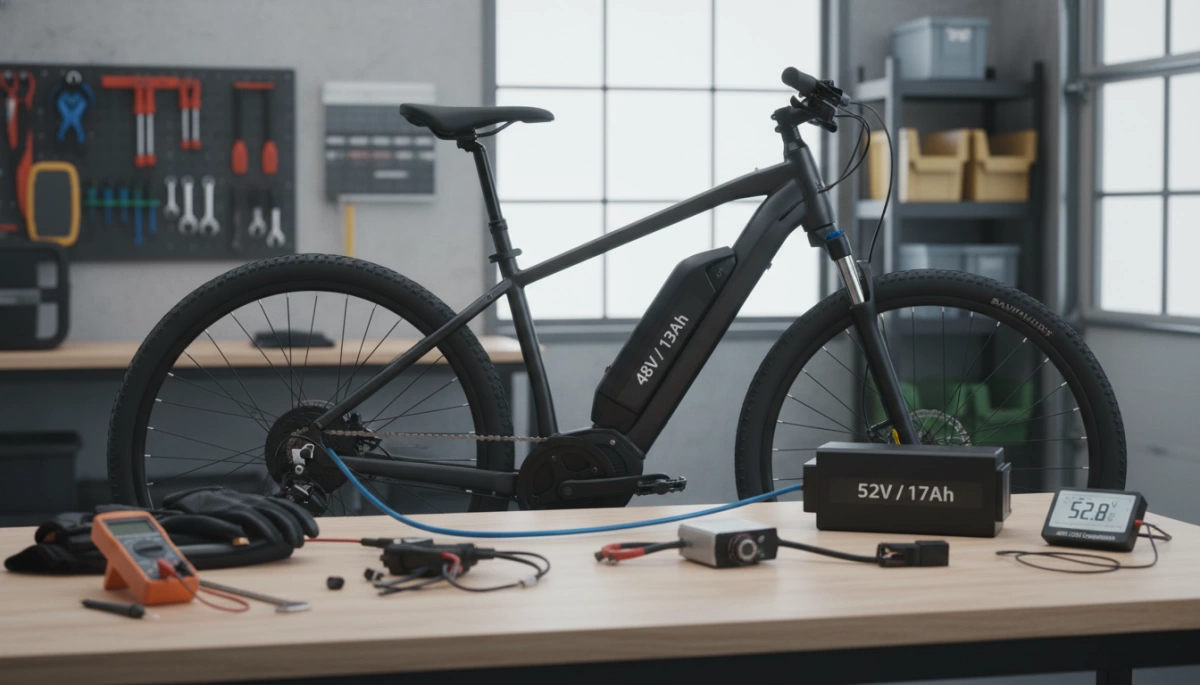
Slapping a 52V battery on a 48V ebike sounds like a quick ticket to more speed and torque. However, you need to know exactly how your stock components will react before making the swap. Here is the reality of what happens when you upgrade.
Controller Capacitor Voltage Limit
Your e-bike motor controller is the true bottleneck in this setup. Think of it as the gatekeeper. Inside that controller are capacitors built with a strict voltage ceiling, typically rated at 63V for standard 48V systems.
Since a fully charged 52V battery pack peaks at 58.8V, you are pushing dangerously close to that 63V max limit. Push it too hard under heavy load, and you risk overloading and frying the capacitors entirely. Before making any mods, understanding what a battery control module is and verifying your specific controller’s capacitor rating is non-negotiable.
48V vs 52V Ebike Battery on the Motor
The motor itself is usually the tough guy in this scenario. Most quality, name-brand 48V motors can easily handle the extra heat and wattage that comes from a 52V battery upgrade on a 48V motor.
At its core, the motor is just a hub of copper windings and magnets. Because the voltage increase is roughly 10%, a well-built motor will absorb that extra power without burning up, assuming you aren’t constantly pinning the throttle up massive hills on a 100-degree day.
E-Bike Display Voltage Calibration
This is where riders get caught off guard. When you mix voltages, you completely throw off your e-bike display voltage calibration.
Here is what you will actually experience on the road:
- The “Always Full” Illusion: Your stock display is calibrated for a 48V discharge curve. With a 52V battery hooked up, your screen will read 100% full for miles on end, giving you a false sense of security.
- Sudden Power Cut-offs: Because the screen gauge is blind to the actual remaining capacity, it won’t warn you when you are running low. The e-bike battery management system (BMS) will eventually hit its low-voltage cutoff to protect the cells, instantly shutting down the bike.
- The Stranded Rider: You will go from cruising with what looks like a half-full battery to a completely dead bike in seconds, leaving you pedaling a very heavy rig back home.
The Hidden Risks of Aftermarket Battery Swaps
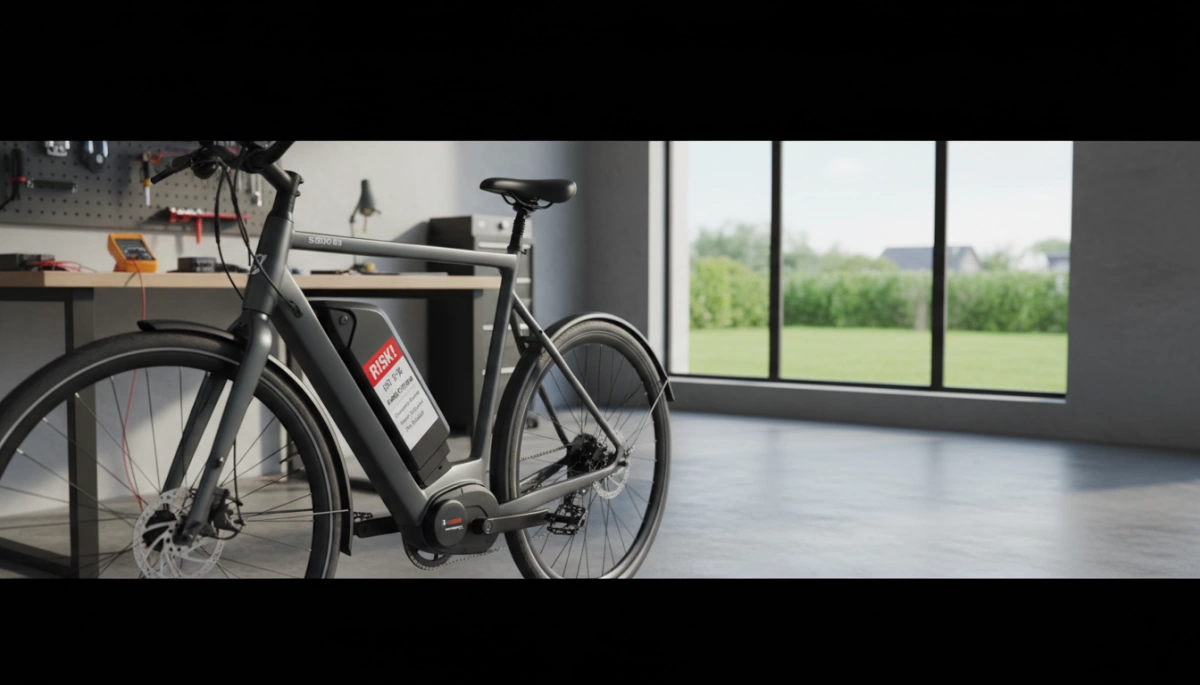
When customers ask me, “Can I put a 52v battery on a 48V ebike?“, I always point out that a slight bump in top speed isn’t the only thing that happens. Upgrading sounds great on paper, but aftermarket battery swaps come with serious hidden risks that can cost you a lot more than a new motor.
E-Bike Battery Management System (BMS) Mismatches
Your e-bike battery management system (BMS) is the brain of your power supply, keeping the internal cells balanced and safe.
- Premature Cut-offs: A stock 48V controller is programmed to expect a specific voltage drop. Swap in a 52V lithium-ion ebike battery pack without reprogramming the controller, and the system gets confused, triggering low-voltage cut-offs way too early.
- Stranded on the Trail: Your display might show 30% battery remaining, but the mismatched calibration suddenly shuts the whole bike down, leaving you pedaling a heavy dead weight back home.
Kiss Your Manufacturer Warranty Goodbye
Let’s be real—quality e-bikes and scooters in the US market aren’t cheap investments.
- Voided Coverage: The second you modify stock electrical systems or attempt an unauthorized e-bike or electric scooter battery replacement, your manufacturer support is completely nullified. If the controller fries or the motor burns out, you are paying out of pocket.
Fire and E-Bike Battery Safety Certifications
This is the ultimate dealbreaker. Mismatched voltages inevitably lead to dangerous charging scenarios.
- Incompatible Chargers: Accidentally using a 48V charger on a 52V battery (or vice versa) is a massive fire hazard.
- Missing Certifications: Many cheap, imported aftermarket batteries lack vital e-bike battery safety certifications like UN38.3 testing. They simply aren’t built to handle the thermal load safely.
- Do It Right: If you are determined to run a custom power solution, you need to understand the science behind it. Learning how to make your own 18650 battery pack with proper BMS configuration is critical, rather than blindly trusting uncertified, plug-and-play aftermarket swaps that could cause a thermal runaway fire in your garage.
Would you like me to draft the final section covering why OEMs rely on custom-engineered battery solutions and proper cell selection?
Why OEMs Rely on Custom Engineered Battery Solutions
When debating a 48V vs 52V ebike battery upgrade, it helps to understand why manufacturers don’t just use off-the-shelf power sources. As a custom battery pack manufacturer, we see firsthand why top brands insist on purpose-built designs. OEM electric mobility batteries are engineered from the ground up to match the exact demands of specific motors and controllers, ensuring safety and performance right out of the box.
Built for the Application
Slapping a generic power source onto a high-performance e-bike or scooter is a fast track to component failure.
- Tailored Engineering: Every custom lithium-ion ebike battery pack is designed specifically for the motor’s peak power draw and the controller’s exact voltage limits.
- Seamless Integration: Whether you are building a new bike or looking for a reliable electric scooter battery replacement, sourcing custom-engineered packs prevents power bottlenecks and eliminates unexpected voltage cut-offs.
Advanced BMS Programming
The brain of the battery is just as important as the raw voltage it provides.
- Real-Time Monitoring: A custom-programmed E-bike battery management system (BMS) constantly communicates with the hardware to prevent over-discharge and balance the cells perfectly.
- Heat Control: Dedicated e-bike battery thermal management is baked into the OEM programming. This ensures the pack safely dissipates heat during steep climbs or long, heavy-throttle commutes in the summer heat.
Cell Selection Matters
Not all battery cells are created equal, and the quality of the individual cells dictates the lifespan, range, and safety of your entire ride.
- Premium Sourcing: Reliable OEMs skip the cheap, generic off-the-shelf cells. Instead, they rely on meticulously sourced 18650 and 21700 battery cells from top-tier brands to guarantee stable voltage and reduce extreme power sag.
- Safety First: Using high-quality cells prevents premature degradation. If you are running an older system, knowing exactly how to tell if a lithium-ion battery is bad can save you from a dangerous on-road failure.
- Proven Performance: For everyday reliability, a properly constructed 18650 lithium-ion battery pack delivers a level of consistent, safe power that mismatched aftermarket upgrades simply cannot match.





 English
  German
  Spanish
  French
  Italian
  Polish
  Russian
  Thai
Thai  Turkish
  Japanese
  Korean