
When clients approach us with power requirements, the most common confusion lies in the difference between how much energy a battery holds and how fast it can release it. Asking “How many amps does a 9V battery have?” is a bit like asking how fast a car is—it depends on the engine design and the fuel system. In the battery world, this comes down to chemistry and internal construction. To engineer a reliable power system, we first need to distinguish between the flow of energy and the storage of energy.
Defining Amperes (Current Flow) vs. Amp-Hours (Capacity)
It is critical to separate two distinct concepts that often get swapped in casual conversation: Amperes (Amps) and Amp-Hours (Ah or mAh).
- Amperes (Current): This is the “flow rate” of electricity. It measures how much current the battery is pushing out at any given second. Think of this as the diameter of a pipe; a wider pipe allows more water to flow through instantly.
- Amp-Hours (Capacity): This represents the total “fuel tank” size. A 9V battery capacity mAh rating tells you how long the battery can sustain a specific load before it dies.
At Nuranu, we design custom lithium solutions where these two metrics are balanced based on the application. A high-capacity battery is useless if it cannot deliver the continuous discharge current required to start a motor or power a high-drain device.
Internal Mechanics: How a Standard 9V Battery Works
A standard 9V battery isn’t a single block of energy; it is actually a pack of smaller cells wired in series. Inside a typical alkaline 9V casing, you will often find six cylindrical AAAA cells (1.5V each) stacked together to reach the 9V nominal voltage.
This construction method directly impacts performance. Because the current must travel through multiple connection points and smaller cells, the battery naturally faces physical limitations. In contrast, our custom lithium platforms utilize optimized cell chemistries (like 18650 or 21700) and advanced Battery Management Systems (BMS) to streamline this flow, reducing energy loss and improving structural integrity.
The Role of Ohm’s Law and Internal Resistance in Output
The biggest limiting factor for 9V battery maximum current is internal resistance. Every battery has some level of resistance inside it that fights against the flow of electricity.
According to Ohm’s Law ($I = V/R$), Current ($I$) is determined by Voltage ($V$) divided by Resistance ($R$).
- High Internal Resistance: Standard alkaline 9V batteries have relatively high internal resistance. If you try to draw too many amps, the voltage drops significantly (voltage sag), and the battery heats up.
- Low Internal Resistance: Lithium chemistries, which we utilize in our custom packs, have much lower internal resistance. This allows for higher discharge rates without significant voltage drop.
For professional applications, understanding this resistance is key. If a device demands more current than the battery’s internal resistance allows, the system will fail. This is why we focus on engineering low-resistance solutions that provide stable power delivery for robotics, medical devices, and industrial tools.
Typical Current Output of a 9V Battery
When we discuss the 9V battery maximum current, it is crucial to distinguish between what a battery can physically release in a split second and what it can sustain without failing. Unlike the custom lithium systems we engineer at Nuranu for industrial robotics or mobility, a standard consumer 9V battery is not built for heavy lifting. It is designed primarily for high-voltage, low-current applications.
Short-Circuit and Peak Current Limits (The Danger Zone)
Technically, if you short-circuit a fresh alkaline 9V battery, it might briefly spike to around 1 to 2 Amps. However, this is not a functional operating range. At this level, the internal resistance causes the voltage to collapse almost instantly, generating significant heat.
In our engineering process, specifically when designing safe lithium battery systems, we prioritize thermal management and current regulation. For a standard 9V cell, pushing near the peak vs continuous amps 9V limit is dangerous and inefficient. The battery simply cannot dissipate the heat fast enough, leading to potential leakage or rupture.
Continuous Safe Current Ranges for Daily Use
For reliable performance, the continuous discharge current 9V batteries can handle is surprisingly low. To get the full rated capacity out of the cell, you generally want to stay within specific ranges depending on the chemistry:
- Alkaline: Best suited for loads under 50mA. Anything above 300mA will drain the battery in minutes and cause severe voltage sag.
- Carbon-Zinc: Strictly for very low drain, typically under 15mA.
- Lithium (Primary): Can handle higher draws, often sustaining 500mA to 800mA comfortably due to lower internal resistance.
Real-World Output Examples: Smoke Detectors vs. Guitar Pedals
Understanding the safe current draw 9V limits helps in selecting the right power source. A standard 9V battery works perfectly for devices that sip power rather than gulp it.
- Smoke Detectors: These sit in the micro-amp range (uA) for monitoring, only pulling 50-100mA briefly when the alarm sounds.
- Guitar Pedals: Analog pedals usually draw 10mA to 50mA. Digital pedals might pull 150mA, pushing the limits of alkaline cells.
- Robotics & Motors: This is where standard 9V batteries fail. Small DC motors often require start-up currents exceeding 1 Amp. For these high-drain applications, we recommend moving away from consumer 9V cells to custom battery solutions for smart robotics that utilize high-discharge lithium cells to ensure consistent torque and runtime.
How Battery Chemistry Affects Amps and Performance
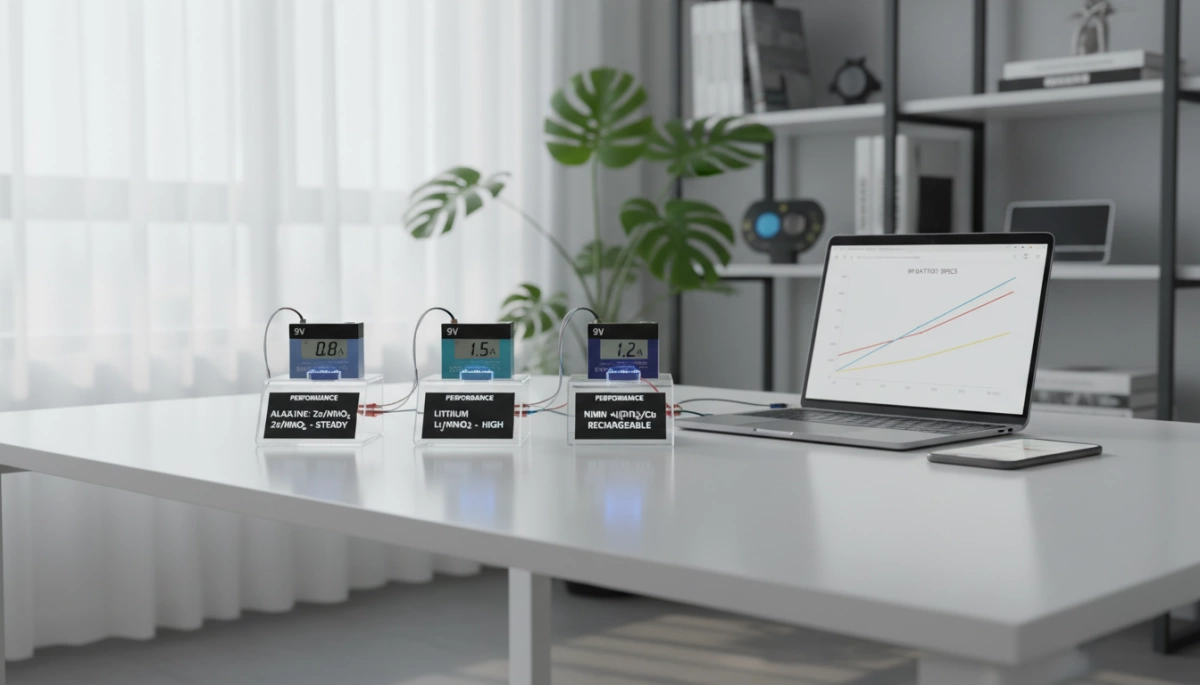
The raw number of amps a battery can deliver isn’t just about size; it is fundamentally dictated by what is inside the metal casing. Internal resistance varies wildly between chemistries, acting as a gatekeeper for how fast energy flows. Understanding these differences is critical when selecting power sources for professional equipment versus basic household electronics.
Alkaline 9V Specs: Capacity, Output, and Voltage Sag
Standard alkaline batteries rely on a chemical reaction between zinc and manganese dioxide. While reliable for shelf life, they suffer from high internal resistance. This creates a significant bottleneck for current delivery.
- Capacity: Typically ranges from 500mAh to 600mAh.
- Max Continuous Current: Often limited to 50mA – 100mA before performance tanks.
- Voltage Sag: As soon as you demand high amps, the voltage drops rapidly below usable levels.
For low-drain devices like smoke detectors, this is fine. However, in high-drain applications, an alkaline 9V battery will appear “dead” long before its energy is actually depleted because it cannot push the current fast enough to maintain voltage.
Lithium 9V Advantages: Higher Capacity and High-Drain Performance
We prioritize lithium technology in our engineering because it solves the resistance problem. A lithium-based 9V battery (often utilizing Lithium-Manganese Dioxide or Lithium-Thionyl Chloride for primary cells) offers superior energy density and a much flatter discharge curve.
- Higher Capacity: Can exceed 1200mAh, effectively doubling the runtime of alkaline.
- High Current Draw: Capable of sustaining 500mA to 1A+ without severe voltage sag.
- Weight: Offers a 70% weight reduction compared to older chemistries, a standard we maintain across our custom systems.
This chemistry is essential for digital electronics that require a steady voltage floor. The Lithium 9V higher output ensures that devices operate at peak efficiency until the very end of the charge cycle. For engineers designing complex portable devices, understanding the broad applications of rechargeable lithium polymer battery packs and lithium-ion cells is key to ensuring consistent power delivery.
Rechargeable NiMH and Li-ion Output Differences
Rechargeable options introduce different voltage behaviors. NiMH (Nickel-Metal Hydride) batteries typically operate at a nominal 7.2V or 8.4V, rarely hitting a true 9V. While they handle moderate current better than alkaline, their lower starting voltage can be an issue for some sensitive equipment.
Li-ion (Lithium-Ion) 9V batteries are the powerhouse of the rechargeable world.
- Voltage: Often regulated to a steady 9V or unregulated (8.4V peak).
- Safety: Built-in BMS (Battery Management System) protects against over-current and thermal runaway.
- Cycle Life: Offers triple the lifespan of traditional rechargeable chemistries.
Comparison of Chemistry Types and Best Use Cases
To visualize the 9V battery chemistry comparison, here is a breakdown of how these power sources stack up in real-world scenarios:
| Chemistry Type | Avg. Capacity (mAh) | Max Safe Continuous Amps | Best Use Case |
|---|---|---|---|
| Alkaline | 550 mAh | < 100mA | Smoke alarms, wall clocks, remotes. |
| Carbon-Zinc | 400 mAh | < 50mA | Very low drain, disposable toys. |
| Lithium (Primary) | 1200 mAh | 1000mA+ | Medical devices, tactical gear, outdoor sensors. |
| NiMH (Rechargeable) | 200 mAh | 500mA | Wireless mics, older paintball hoppers. |
| Li-ion (Rechargeable) | 600+ mAh | 1000mA+ | High-end audio, instrumentation, robotics. |
Choosing the right chemistry ensures you aren’t just getting the right voltage, but the necessary continuous discharge current 9V devices demand to function correctly.
Factors That Limit or Influence Current Delivery
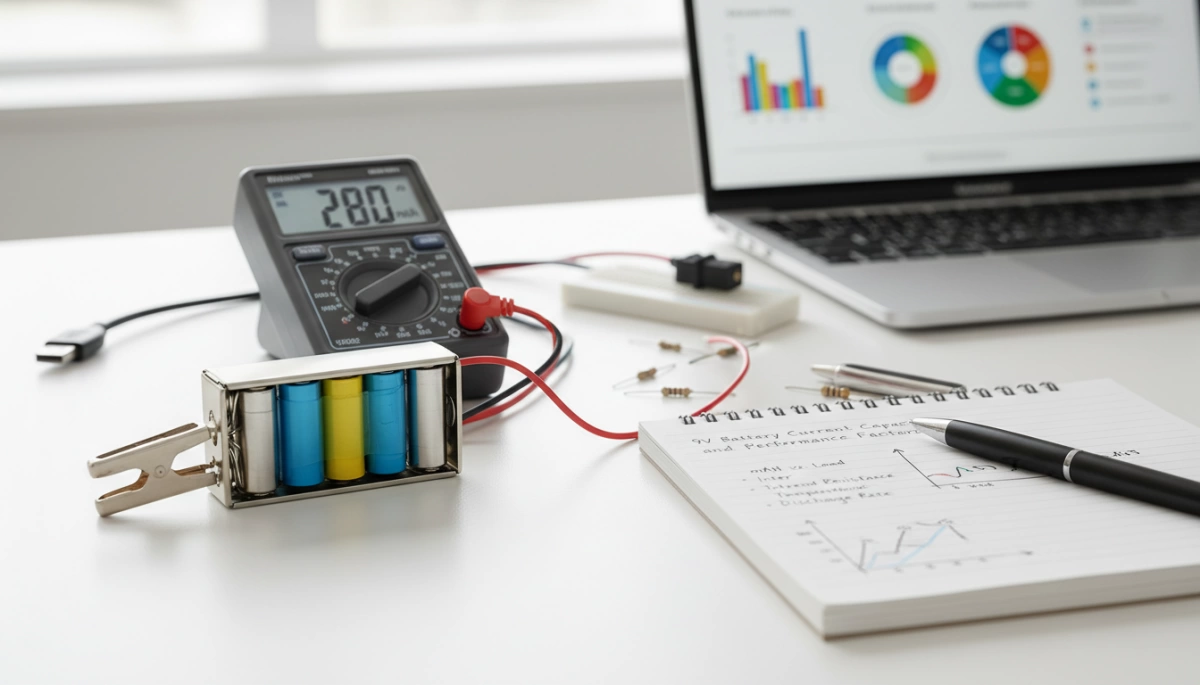
When engineering power systems, simply looking at the label rating isn’t enough. Several physical and environmental variables dictate the actual amperage a battery can deliver in a real-world scenario. Understanding these constraints is critical for ensuring reliable device performance and safety.
Internal Resistance and Voltage Drop Under Load
Every battery has 9V battery internal resistance, which acts as a barrier to the flow of electricity. Think of it like a bottleneck in a pipe; the narrower the pipe, the harder it is to push water through quickly. When a device demands a high current draw, this internal resistance causes the voltage to drop significantly, a phenomenon known as 9V battery voltage sag. If the voltage sags below the device’s cutoff point, the electronics will shut down, even if the battery still has remaining capacity. This is why standard alkaline 9V batteries often fail in high-drain applications—their high internal resistance prevents them from delivering the necessary amps without a massive drop in voltage.
How Temperature Fluctuations Impact Performance
Ambient temperature plays a massive role in chemical reaction speeds. In cold environments, the electrochemical reactions inside the cell slow down, increasing internal resistance and severely limiting the continuous discharge current 9V capabilities. Conversely, extreme heat can temporarily increase performance but degrades the chemistry rapidly and poses safety risks. At Nuranu, we engineer our custom lithium solutions with thermal management in mind to ensure consistent output across varied temperature ranges, solving the reliability issues common in standard consumer batteries.
Battery Age and State of Charge Effects
A battery’s ability to deliver current diminishes as it ages and discharges. A fresh battery has low resistance and can sustain higher amperage. However, as the State of Charge (SoC) drops, internal resistance climbs. This means a battery at 20% capacity cannot support the same current spikes as one at 100%. For critical applications, recognizing the signs of degradation is essential; knowing how to tell if your battery is dead prevents unexpected system failures during operation.
Reading and Understanding Discharge Curves
To accurately predict runtime and current capability, engineers rely on the 9V battery discharge rate curve.
- Alkaline Curves: typically show a steep, linear decline in voltage. As soon as the load is applied, voltage starts dropping, making them poor for devices requiring steady power.
- Lithium Curves: maintain a flat, consistent voltage for most of the discharge cycle before dropping off sharply at the end.
This “flat” discharge curve is why we prioritize lithium chemistries for our OEM clients—it ensures the device receives consistent amperage and voltage right up until the battery is depleted.
Real-World Applications: When a 9V Battery Works (and When It Fails)
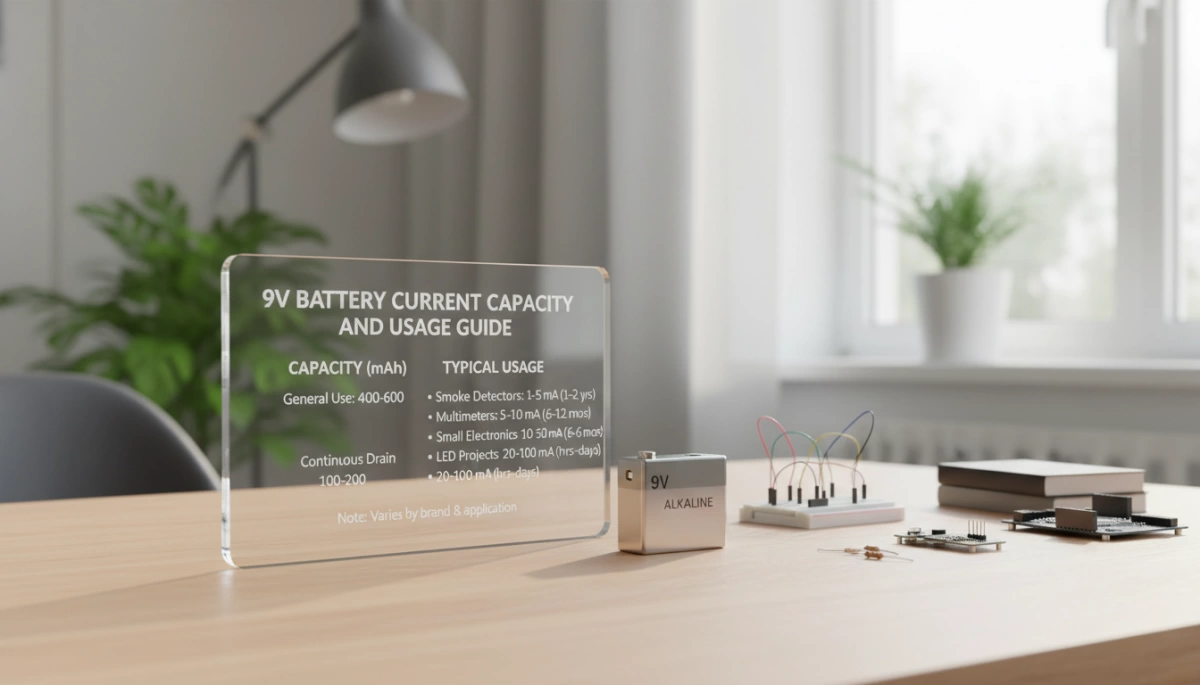
Understanding the limitations of current delivery is crucial when selecting a power source. While the rectangular 9V battery is a household staple, its high internal resistance makes it unsuitable for many modern electronics that demand high amperage. We often see engineering teams struggle when they attempt to power high-load devices with a form factor designed for low-drain applications.
Ideal Low-Drain Devices for 9V Batteries
Standard 9V batteries excel in applications where the device sits idle for long periods and requires very little current to operate. The chemistry is optimized for longevity rather than power output.
- Smoke Detectors: The classic use case. The device draws micro-amps for monitoring and only needs a short burst of milli-amps for the alarm.
- Professional Audio Equipment: Guitar pedals and active pickups typically draw very low current (often under 50mA), making the 9V format acceptable.
- Multimeters and Handheld Testers: These devices require a stable reference voltage but do not pull significant current during measurement.
High-Drain Devices to Avoid (Motors and Bright LEDs)
The biggest mistake we see is using standard 9V batteries for high drain 9V applications like robotics or bright lighting arrays. A standard alkaline 9V cannot sustain high discharge rates without suffering from severe voltage sag.
- DC Motors & Robotics: Using a 9V battery for Arduino/motors usually results in failure. As soon as the motor creates a load, the voltage drops, often resetting the microcontroller.
- High-Power Flashlights: The internal resistance of a standard 9V block restricts the flow of energy, making it inefficient for heating elements or high-lumen LEDs.
- Sustained Digital Processing: Devices with Wi-Fi modules or continuous data logging will drain a standard 9V in minutes, not hours.
Alternatives for High-Current Needs: Parallel Setups and Custom Packs
When your application demands more amps than a consumer-grade 9V can provide, you have two main engineering paths. You can wire multiple batteries in parallel to increase capacity and current handling, but this adds bulk and weight.
The superior solution for manufacturers is transitioning to custom lithium solutions. For instance, replacing a disposable 9V block with a rechargeable 7.4V 5.2Ah 18650 lithium battery pack for handheld instruments drastically improves performance. These packs offer far lower internal resistance, allowing for the higher continuous discharge rates required by modern industrial tools and medical devices. At Nuranu, we engineer these systems to provide predictable runtime and handle the current spikes that would otherwise kill a standard battery.
Why Choose Lithium for Better Amps and Reliability
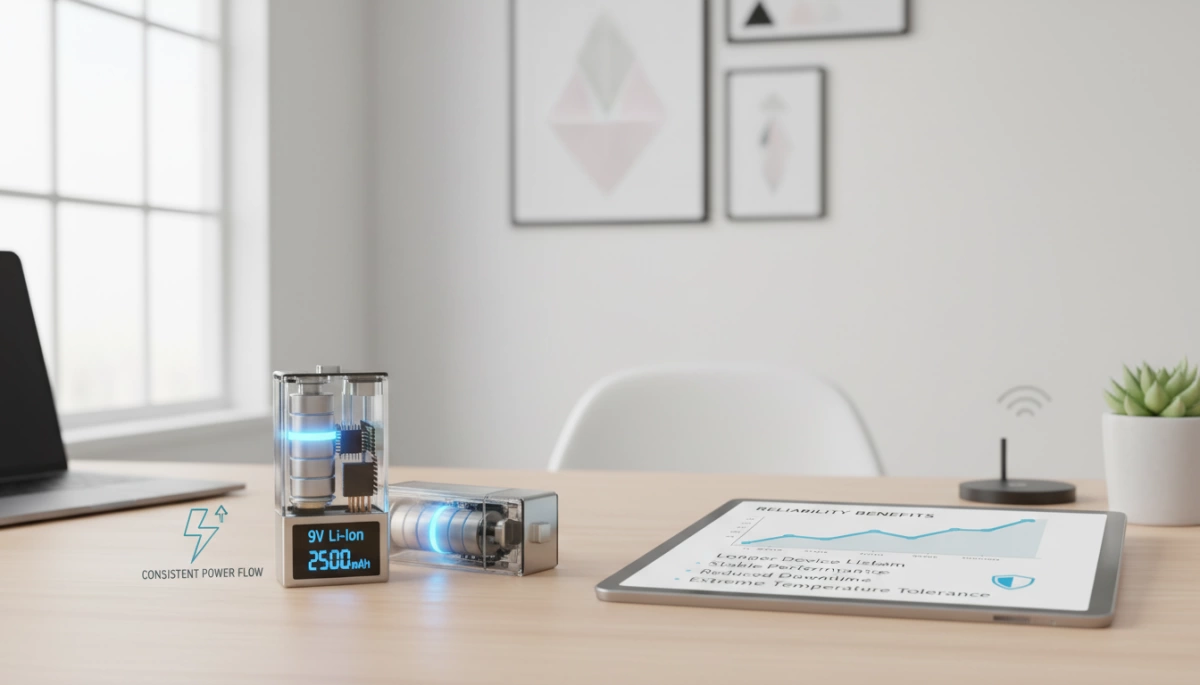
When consistent power delivery is non-negotiable, relying on standard alkaline chemistry often leads to disappointment. In professional settings, we see voltage sag kill performance in high-drain devices. Switching to lithium technology is not just about extending runtime; it is about maintaining a stable discharge rate under load. Lithium systems provide a massive advantage in energy density, offering up to a 70% weight reduction compared to older lead-acid or alkaline equivalents while delivering triple the lifespan.
Superior Energy Density and Voltage Consistency
The biggest issue with traditional 9V batteries is internal resistance. As you draw more amps, the voltage drops rapidly, causing devices to shut down prematurely. Lithium chemistries maintain a flat voltage curve, ensuring your equipment receives consistent power right until the battery is empty.
| Feature | Standard Alkaline 9V | Nuranu Custom Lithium |
|---|---|---|
| Voltage Stability | Drops significantly under load | Remains constant until depletion |
| High Current Handling | Poor (High internal resistance) | Excellent (Low internal resistance) |
| Lifespan | Single-use / Short cycle life | 3x longer lifespan |
| Weight | Heavy | ~70% lighter |
Custom Lithium Solutions for High Current Demands
For applications requiring higher amperage than a retail 9V block can provide, off-the-shelf solutions are often dangerous or ineffective. We engineer custom battery systems using optimized cell chemistries—such as comparing 21700 vs 26650 cells—to handle high discharge rates without overheating. Our engineering team acts as an extension of your own, integrating advanced Battery Management Systems (BMS). This technology monitors real-time current and thermal conditions, ensuring safety and reliability even during peak loads in robotics or medical devices.
Scaling Performance Beyond Standard 9V Limitations
Sometimes the physical constraints of a standard 9V case limit your amperage potential. If your device demands sustained high current, we design packs that bridge the gap. For example, a custom 7V 2600mAh lithium-ion battery pack can provide the robust power needed for professional lighting or motorized equipment where a standard 9V would fail. With a production capacity of over 100,000 units monthly and ISO 9001 certified quality control, we scale these high-performance solutions from initial prototype to mass manufacturing.
Frequently Asked Questions (FAQs)
Can a standard 9V battery output 1 amp?
For a standard alkaline 9V battery, the answer is generally no. Attempting to pull a continuous discharge current of 1 amp will cause the voltage to collapse almost instantly due to high internal resistance. While the battery might technically deliver that current for a split second, it is not a functional operating range. However, advanced lithium chemistries are different. A high-quality lithium-based system designed for high drain 9V applications can handle higher amperage, but for sustained high-current needs, we typically recommend a custom battery pack solution rather than a consumer-grade 9V cell.
What is the actual mAh capacity of a 9V battery?
The 9V battery capacity in mAh varies significantly by chemistry.
- Alkaline: Typically ranges from 400 mAh to 600 mAh.
- Carbon-Zinc: Lower performance, usually around 400 mAh.
- Lithium (Primary): Can reach up to 1200 mAh, offering superior energy density.
- Rechargeable Li-ion: Usually between 600 mAh and 800 mAh, but they maintain voltage better under load.
Understanding these capacity limits is crucial for predicting runtime. Just as there are two major reasons that affect the service life of lithium batteries, factors like discharge rate and temperature will drastically change the usable capacity of a 9V battery in real-world scenarios.
Is high current draw dangerous for 9V batteries?
Yes, pushing a battery beyond its rated maximum current can be dangerous. Standard 9V batteries have high internal resistance; drawing too much current generates excessive heat. In extreme cases, this heat can lead to leakage, seal failure, or thermal runaway. This is why our custom battery solutions incorporate a Battery Management System (BMS) to monitor discharge rates and ensure safety. If your application requires high amps, relying on a standard 9V form factor without proper thermal management is a risk to both the device and the user.
How does voltage sag affect device performance?
9V battery voltage sag occurs when the load (current draw) is too high for the battery’s internal chemistry to support. As the amps go up, the voltage drops. If the voltage drops below the device’s cutoff threshold, the electronics will shut down, even if the battery still has remaining capacity. This is common in motorized devices or high-brightness LEDs. A device might work for a few minutes and then die, only to work again after the battery “rests” and voltage recovers. Using a battery with lower internal resistance, like lithium, minimizes this sag and ensures consistent performance.







 English
  German
  Spanish
  French
  Italian
  Polish
  Russian
  Thai
Thai  Turkish
  Japanese
  Korean