
Verify Real Electric Scooter Battery Manufacturers vs. Traders
When you are sourcing an OEM electric scooter battery supplier overseas, the first major hurdle is filtering out the middlemen. You might assume you are negotiating directly with a factory, but you are frequently dealing with a trading company. Why does this matter? Traders add unnecessary cost markups, bottleneck critical engineering feedback, and have absolutely no direct control over the quality of your custom rechargeable lithium battery packs.
Here is how I spot the difference quickly: look at the supplier’s product catalog. Traders typically list a massive, unrelated variety of goods. True electric scooter battery manufacturers are hyper-focused strictly on battery systems, cells, and energy storage.
Look for Scalable Production Capacity
If your scooter brand takes off, your supplier needs the infrastructure to scale seamlessly. A boutique assembly shop might nail the initial prototype but fail completely when transitioning to mass production.
- The Baseline: Target suppliers with a proven production capacity of at least 100,000+ units per month.
- The Benefit: This ensures that large orders for electric mobility scooter batteries wholesale won’t result in crippling supply chain delays when your seasonal demand spikes.
Automated Production Lines are Non-Negotiable
When conducting a China battery factory audit, pay close attention to the assembly floor. Relying on manual labor is a major red flag for high-volume lithium ion battery packs for electric scooters because human error invariably leads to pack inconsistency.
You must demand automated machinery in two critical stages of manufacturing:
- Automated Cell Sorting: Machines test and group individual cells based on precise internal resistance and voltage metrics. Grouping identical cells prevents the internal pack imbalances that drastically reduce an electric scooter’s battery life and performance.
- Automated Spot Welding: Consistent, machine-controlled welds guarantee strong structural integrity and low-resistance connections. Weak manual welds lead to localized heat buildup and total power failure under high-drain riding conditions.
At Nuranu, we treat these engineering standards as absolute minimums. By utilizing heavily automated sorting and welding on our production lines, we ensure every single battery for an electric scooter that leaves the floor delivers the exact same reliability, thermal stability, and cycle life as your approved engineering prototype.
Step 2: The Technical Audit – Cells and Chemistry
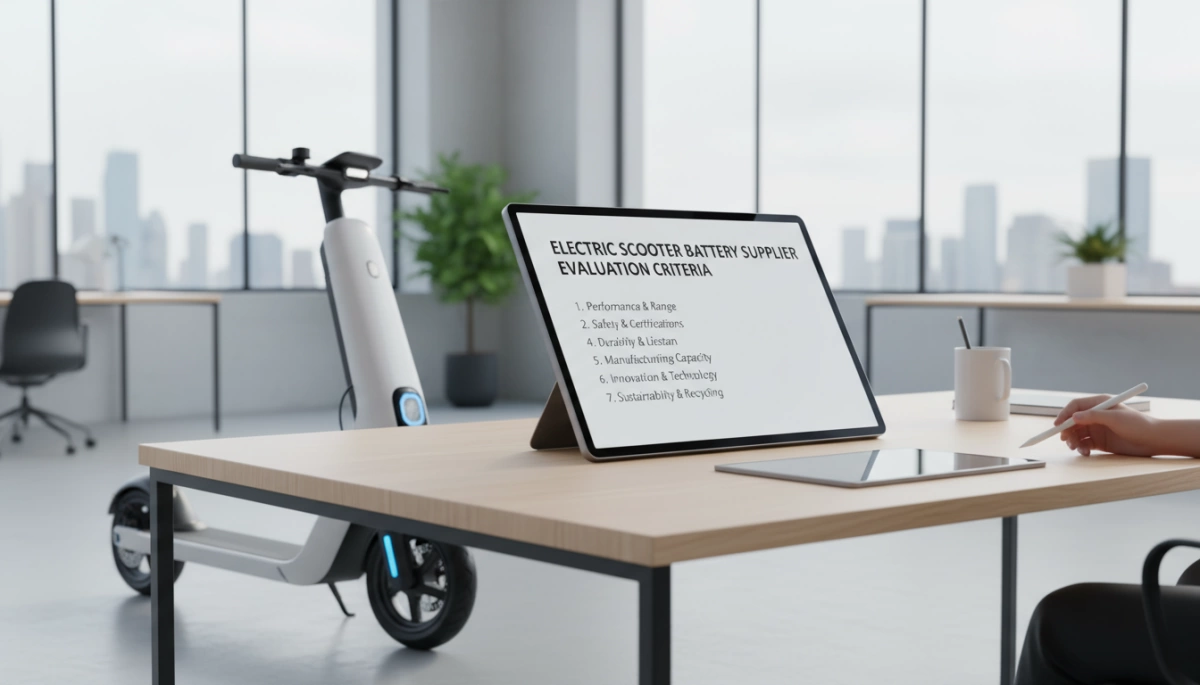
Once you’ve verified the manufacturer’s legitimacy, the next hurdle is the technical audit. This is where most low-cost suppliers fail. You aren’t just buying a black box; you are buying the specific chemistry and engineering inside it. If a supplier cannot transparently discuss cell sourcing and chemistry tradeoffs, walk away.
Cell Sourcing: Grade A vs. The Rest
The most critical component of any electric scooter battery pack is the cell itself. In China, the market is flooded with “Grade B” cells—units that failed quality control for top-tier EV manufacturers but are repackaged for lower-end scooters.
- Grade A Cells: We only use fresh, Grade A cells. These ensure consistent voltage and capacity across the entire pack.
- Proprietary vs. Brand Name: While we work with major international brands, we also utilize verified proprietary cells that pass rigorous testing.
- The Risk: Beware of suppliers claiming impossible capacities (like a 30Ah pack in a case that only fits 15Ah). If the price is suspiciously low, you are likely getting recycled or B-grade cells that will degrade within months.
Chemistry Selection: NMC vs. LiFePO4
Choosing the right chemistry depends entirely on your scooter’s intended use. We don’t believe in a “one size fits all” approach.
| Feature | NMC (Lithium-Ion) | LiFePO4 (Lithium Iron Phosphate) |
|---|---|---|
| Cell Type | Typically 21700 lithium-ion battery or 18650 | 26650 or 32650 cylindrical cells |
| Energy Density | High. Best for compact scooters needing long range. | Moderate. Heavier and bulkier. |
| Cycle Life | ~500-1000 cycles | ~2000+ cycles |
| Safety | Good (requires quality BMS) | Excellent (very stable thermally) |
| Best For | Commuter scooters, portable designs | Delivery fleets, heavy-duty usage |
For most consumer e-scooters in the US market, NMC is the standard because riders demand lightweight portability. However, for commercial fleets where longevity trumps weight, LiFePO4 vs Lithium-ion battery comparisons often favor LiFePO4.
Voltage Platforms
Your supplier must demonstrate expertise in your specific voltage platform. A factory that specializes in low-speed 24V toys may not have the engineering capability to build a safe, high-discharge 60V lithium battery for electric scooter racing.
- Standard Commuter: We routinely build 36V lithium battery for electric scooter systems and 48V packs for daily commuting.
- High Performance: For dual-motor beasts, we engineer 60V and 72V systems capable of handling massive current draws without overheating.
We ensure the voltage platform matches the motor controller perfectly to prevent voltage sag during acceleration.
Step 3: BMS Intelligence – The Brain of the Battery
When figuring out how to evaluate electric scooter batteries suppliers in China, you simply cannot ignore the Battery Management System. If the lithium cells are the muscle of your electric scooter battery pack, the BMS is the brain. A poorly designed BMS is the primary culprit behind electric scooter battery fires. You need a manufacturing partner who deeply understands what a battery control module does to guarantee rider safety and long-term reliability.
Essential BMS Features to Demand
Don’t settle for a basic, off-the-shelf circuit board. When vetting an OEM electric scooter battery supplier, dig into their BMS (Battery Management System) development capabilities. Make sure their systems include:
- Core Safety Protocols: Strict overcharge, over-discharge, and short-circuit protection are non-negotiable baselines.
- Active Thermal Management: The system must constantly monitor temperatures to prevent thermal runaway, especially critical for high-performance 48v/60v lithium battery customization.
- Smart Communication: Demand advanced features like predictive diagnostics and smart communication protocols (CANBus or UART). This ensures the battery talks flawlessly with the scooter’s main controller to optimize range and power delivery.
Nuranu Insight: In-House R&D is Crucial
Here is my Nuranu insight from years in the industry: always verify that the supplier has dedicated, in-house BMS R&D engineers. Many factories just outsource their BMS boards to third-party vendors. If your riders start experiencing electric scooter battery issues or you need a custom firmware update for a new scooter model, an outsourced BMS means you will be waiting weeks for a fix. In-house engineering ensures rapid troubleshooting, seamless integration, and a safer ride for your US customers.
Would you like me to generate the content for Step 4: Certifications & Compliance next?
Step 4: Certifications & Compliance When Evaluating Electric Scooter Batteries Suppliers in China
When I vet electric scooter battery manufacturers, missing paperwork is a hard dealbreaker. If a supplier cannot immediately provide verified testing documents, I walk away. In the US market, non-compliant batteries are a massive liability, often leading to customs seizures or, worse, electric scooter battery fires.
Here is the exact compliance checklist you must demand before partnering with any factory:
Essential Electric Scooter Battery Safety Standards (UL 2271)
- UL 2271: This is the gold standard for Light Electric Vehicles (LEVs). If you are importing a lithium ion battery pack for electric scooter use into the United States, this certification proves the pack can handle real-world physical and electrical stress.
- IEC 62133: The fundamental international safety standard for rechargeable cells and battery packs.
Mandatory Shipping Compliance
- UN38.3 Certification for Battery Shipping: You legally cannot put a lithium battery on an airplane or cargo ship without this. It proves the battery can withstand altitude changes, thermal shifts, vibration, and shock during transit.
- MSDS (Material Safety Data Sheet): Required by all freight forwarders to handle your international shipment safely.
Factory Quality Management
- ISO 9001: Always look for an ISO 9001 certified battery factory. This ensures the supplier isn’t just getting lucky with a golden prototype, but actually has strict, repeatable quality control processes on their assembly line.
Whether you are sourcing an off-the-shelf unit or designing a custom pack built around a specific 18650 lithium-ion battery configuration, verifying these documents is non-negotiable. Don’t just take their word for it—ask for the actual certificates and verify the factory’s name exactly matches the paperwork.
Step 5: Testing Protocols & Quality Control (QC)

When dealing with electric scooter battery manufacturers overseas, you need to watch out for the “Golden Sample” trap. It goes like this: a supplier sends you a flawless, high-performing prototype. You approve it, sign the contract, but the mass-produced units end up being completely unreliable. Never base your decision solely on the prototype. You must ask exactly how they test their mass production units before those batteries ever hit a shipping container headed for the States.
To ensure your electric scooter battery replacement units or OEM builds actually hold up on rough American roads, demand total transparency on their testing protocols. Every reliable China battery factory audit should look for these specific procedures.
Non-Negotiable Battery Testing Protocols
- Aging Test: This isn’t a quick check. Batteries need to be repeatedly charged and discharged over a set period to verify cell stability. Proper battery pack cycle life testing ensures the battery won’t degrade rapidly after a few months of daily commuting.
- Vibration Testing: City streets are full of potholes and rough terrain. The battery pack needs to survive constant shaking on a vibration table without internal welds breaking or cells shorting out.
- Drop Testing: Real-world accidents happen. The outer casing and internal structure must withstand sudden impacts without causing a catastrophic thermal event.
- 100% EOL (End-of-Line) Testing: Every single battery must be tested before it leaves the factory floor. Random sampling is not enough. Whether they are building a massive 72V system or a standard 36V 10Ah lithium-ion battery pack for an electric kick scooter, EOL testing guarantees the voltage, capacity, internal resistance, and BMS functions are exactly as promised.
If a supplier hesitates, skirts around the details, or gives vague answers about their QC processes, walk away. Your business reputation depends on delivering reliable hardware, not just a good-looking prototype.
Step 6: R&D and Customization Speed

Fast Speed to Market
When evaluating electric scooter battery manufacturers in China, R&D speed is a massive dealbreaker. The US mobility market moves incredibly fast. If a factory takes months just to get a prototype into your hands, your product launch is already falling behind. You need a partner who can turn your concepts into a testable prototype in a matter of weeks, not seasons. Quick turnarounds keep your supply chain agile and ensure you hit the market while the demand is hot.
48v/60v Lithium Battery Customization
Off-the-shelf solutions rarely work for innovative designs. Whether you are designing a brand new ride or sourcing an electric scooter battery replacement, your supplier’s engineering team must be highly adaptable. As an operation deeply committed to environment protection through efficient energy solutions, we know firsthand that a dedicated R&D team makes all the difference in producing safe, long-lasting custom builds.
When auditing a supplier’s customization capabilities, demand flexibility in these core areas:
- Deck Integration: They must be able to adjust the physical shape and dimensions of your custom rechargeable lithium battery packs so they drop perfectly into your specific scooter deck without wasting space.
- Custom Wiring: Your supplier should easily swap out or tailor the electric scooter battery connector and wiring harness to match your exact controller setup.
- Power Scaling: Whether you need a standard setup for short commutes or a high-performance 60v lithium battery for electric scooter applications, their engineers should be able to dial in the voltage and capacity to hit your exact range and speed goals.
Step 7: After-Sales Support & Warranty
Avoid the “Ghosting” Trap
A major headache I see US buyers face when evaluating electric scooter batteries suppliers in China is the infamous “ghosting” risk. You pay the invoice, the shipment clears customs, and suddenly, your factory contact stops replying. When a customer comes to you needing an electric scooter battery replacement, or you encounter unexpected electric scooter battery issues during assembly, a silent supplier is a massive liability.
What to Demand Before You Buy
You need rock-solid guarantees before wiring a single dollar. Whether you are sourcing a standard 36v lithium battery for electric scooter fleets or a high-performance 72v lithium battery for electric scooter models, demand these non-negotiables:
- Clear Warranty Terms: Do not accept vague promises. Demand a strict 12 to 24-month warranty. Your coverage needs to align perfectly with the average battery life of electric scooter models you sell.
- English-Speaking Tech Support: Integration issues happen. You need direct access to support staff or engineers who speak clear English to help troubleshoot BMS communication or wiring problems instantly.
- Defective Unit Replacements: Get the exact replacement policy in writing. If a lithium ion battery pack for electric scooter fails, who pays for the return shipping? How fast do they send the replacement battery electric scooter unit? Addressing defects promptly ties directly into overall pack safety, which is just as critical as understanding whether 26650 LiFePO4 batteries are safe for your specific mobility application.






 English
  German
  Spanish
  French
  Italian
  Polish
  Russian
  Thai
Thai  Turkish
  Japanese
  Korean