
Electric Scooter Batteries MOQ Explained: What Importers Need to Know
Demystifying MOQ: Why Do Battery Manufacturers Set Minimums?
Importers constantly ask us why electric scooter battery manufacturers enforce strict Minimum Order Quantities (MOQs). Whether you are sourcing a standard 36v lithium ion battery for electric scooter fleets or developing custom rechargeable battery packs, MOQs are not arbitrary hurdles. They are a direct reflection of production economics, rigorous safety compliance, and engineering bandwidth. We establish these minimums to mitigate financial risk and guarantee the unit economics make sense for your bottom line and our production lines.
Economies of Scale in Raw Materials
Building reliable power systems starts with high-volume procurement. Cell sourcing dictates the baseline of any production run.
- Cell Sourcing Volume: Procuring premium 18650, high-capacity 21700, or ultra-stable LiFePO4 cells requires massive upfront commitments to our upstream suppliers to keep per-unit costs viable.
- Tooling and Enclosures: Fabricating custom enclosures, specialized nickel busbars, and heavy-duty wiring assemblies demands dedicated factory tooling.
- Production Viability: Spinning up an automated assembly line for a mere 50 units simply cannot absorb the setup costs or the raw material minimums required for high-grade components.
The Cost of Customization: Battery Management System (BMS)
The core of any lithium ion battery pack for electric scooter applications is the Battery Management System (BMS). This is not a place to cut corners, and customizing it requires significant upfront investment.
- Thermal Management: Custom BMS programming is non-negotiable for preventing electric scooter battery fires. We engineer these systems to strictly regulate temperature during high-draw acceleration and fast charging.
- Rider Safety Parameters: Fine-tuning the overcharge, deep discharge, and short-circuit protections demands intense engineering and testing hours.
- Amortizing R&D: These upfront engineering costs must be amortized across a minimum production run. Without an adequate MOQ, your per-unit electric scooter battery replacement cost would skyrocket.
Standard vs. Custom MOQs
Not all minimums are created equal. Your required order size depends entirely on the complexity and uniqueness of your specific mobility platform.
- Off-the-Shelf Standard Platforms: A standard 24V or 36v electric scooter battery utilizing existing molds and standardized BMS protocols carries a much lower, accessible MOQ (typically 100 to 500 units). The R&D is already done, and the supply chain is active.
- Fully Customized Proprietary Packs: If your project requires unique form factors, drop-in lead-acid replacements, or proprietary IoT communication protocols, the MOQ scales up significantly (often 1,000+ units). We require this volume to justify the dedicated assembly lines and the rigorous safety validation a totally new architecture demands.
Would you like me to generate the next section covering the “Core Technical Specs That Influence Your Order Size”?
Core Technical Specs That Influence Your Order Size
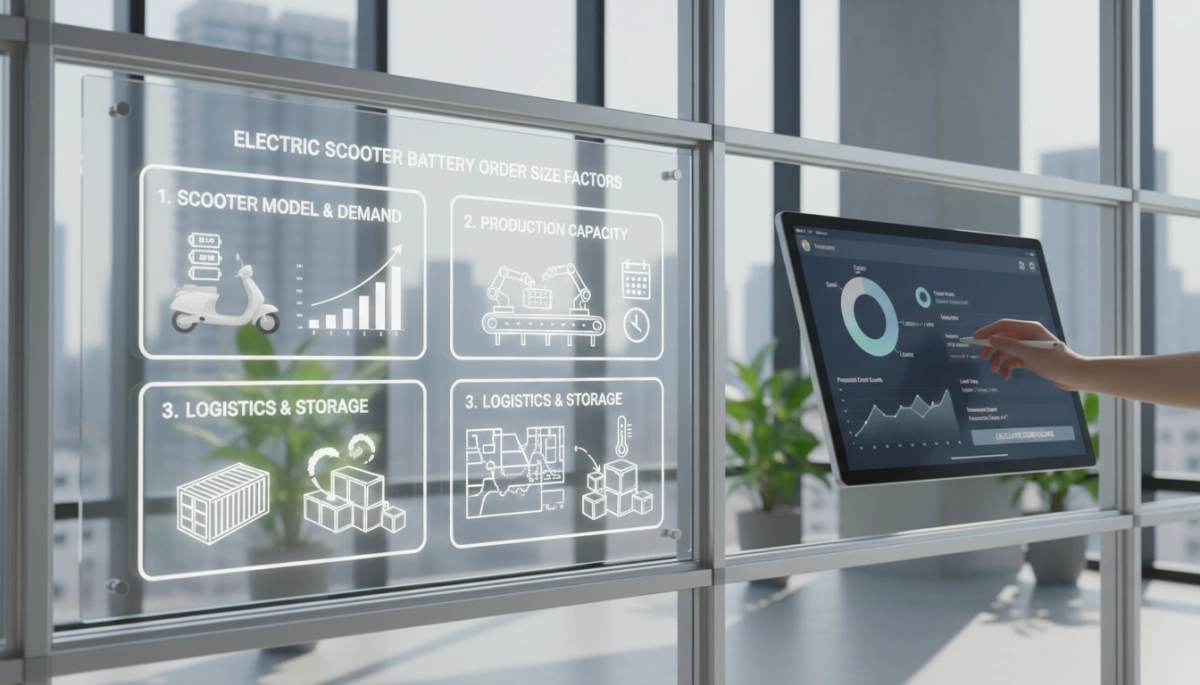
When we negotiate with electric scooter battery manufacturers for the US market, the technical specifications we demand directly dictate the Minimum Order Quantity (MOQ). Customization requires capital, and factories pass that risk onto the importer through higher volume requirements. Let’s break down exactly what drives these numbers.
Voltage Systems: The 24V and 36V Standard
In the 2-wheel mobility sector, 24V and 36V systems are the undisputed industry standards. These voltage platforms hit the perfect sweet spot, balancing sustained power discharge with rapid charging times. Because an off-the-shelf 36v lithium ion battery for electric scooter is practically universally adopted, factories have the components readily available. Sticking to these standard systems usually secures you a much lower, more flexible MOQ.
Energy Density vs. Weight
Upgrading your fleet’s performance means pushing for higher energy density and lighter weights.
- Lightweight Lithium Cells: Sourcing premium, high-density cells tightens supply chain availability, extending manufacturing timelines and driving up MOQs.
- Drop-In Lead-Acid Replacements: If you are migrating older scooter designs to modern lithium ion battery pack for electric scooter tech, custom enclosures and connectors are required. You are no longer buying an off-the-shelf part, which guarantees a higher MOQ to offset the tooling costs. If you’re building a brand, knowing exactly how long lithium batteries last under these high-density loads is critical for justifying the larger volume commitment.
Intelligent Features & Smart Prototyping
Today’s consumers expect an electric scooter with removable battery capabilities and smart diagnostics. Integrating a custom battery management system (BMS) for real-time thermal monitoring or hot-swap functionality requires intense R&D.
Adding these intelligent features severely impacts the initial prototyping phase. Factories have to allocate engineering hours to program and test the BMS before bulk manufacturing can even begin, ensuring your custom pack won’t fail in the field.
How Specs Impact Your MOQ at a Glance:
| Feature Category | Technical Requirement | MOQ Impact | Production Timeline |
|---|---|---|---|
| Voltage | Standard 24V / 36V Systems | Low | Fast (Standardized) |
| Energy Density | Custom High-Density / Drop-In Lead-Acid Replacements | Medium to High | Extended (Sourcing Cells) |
| Smart Tech | Custom BMS / Hot-Swap / Predictive Diagnostics | Highest | Longest (Intensive R&D) |
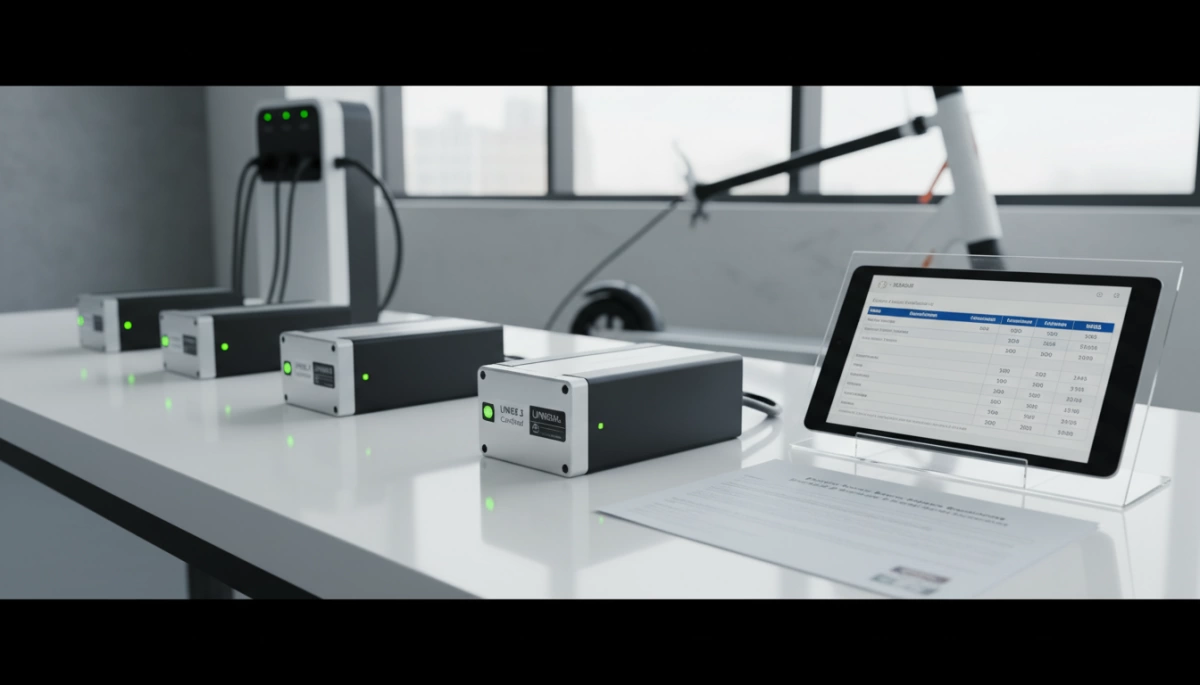
When you are importing electric scooters from overseas, compliance is never optional. Understanding the rules keeps your shipments moving and your business out of trouble.
Why Certifications Dictate MOQs
Testing a lithium ion battery pack for electric scooter to meet international standards is expensive. Certified labs charge thousands of dollars to validate a single pack design. To make financial sense of these heavy upfront lab fees, electric scooter battery manufacturers have to set higher Minimum Order Quantities (MOQs). By spreading that flat testing cost across a larger production run of custom rechargeable battery packs, the factory keeps your per-unit cost viable.
Electric Scooter Safety Certifications
We have all seen the headlines about electric scooter battery fires. This is exactly why the industry relies on strict safety benchmarks. Before placing any bulk order, I always verify this “alphabet soup” of mandatory certifications:
- UN38.3 Certification Lithium Batteries: Absolutely mandatory. You cannot legally ship lithium batteries by air or sea without proving they can handle altitude, thermal, and vibration stress.
- UL & CE Marks: UL is the gold standard for the US market, ensuring electrical safety, while CE is required for Europe.
- IEC 62133: The global safety standard for the safe operation of lithium cells and battery packs under fault conditions.
- ISO 9001: This guarantees the factory uses a consistent, audited quality management system.
Understanding the deep technical specs—like knowing what is the charging voltage for 3.7v lithium ion battery cells—is a great start, but your battery management system (BMS) must actively pass these rigorous lab tests to prevent catastrophic overcharging and short circuits.
The 98.5% Standard and EOL Testing
Never settle for “good enough.” A reliable manufacturer must guarantee a quality-pass rate of at least 98.5%. The only way factories hit this metric is through 100% End-of-Line (EOL) testing.
This means every single 36v lithium ion battery for electric scooter rolling off the line gets plugged in and tested for voltage sag, capacity limits, and BMS response. Whether you are buying standard scooter decks or sourcing power systems for other applications, 100% EOL testing is what ensures dead units don’t end up in your US warehouse.
Logistics, Hazmat Shipping, and Hidden Costs
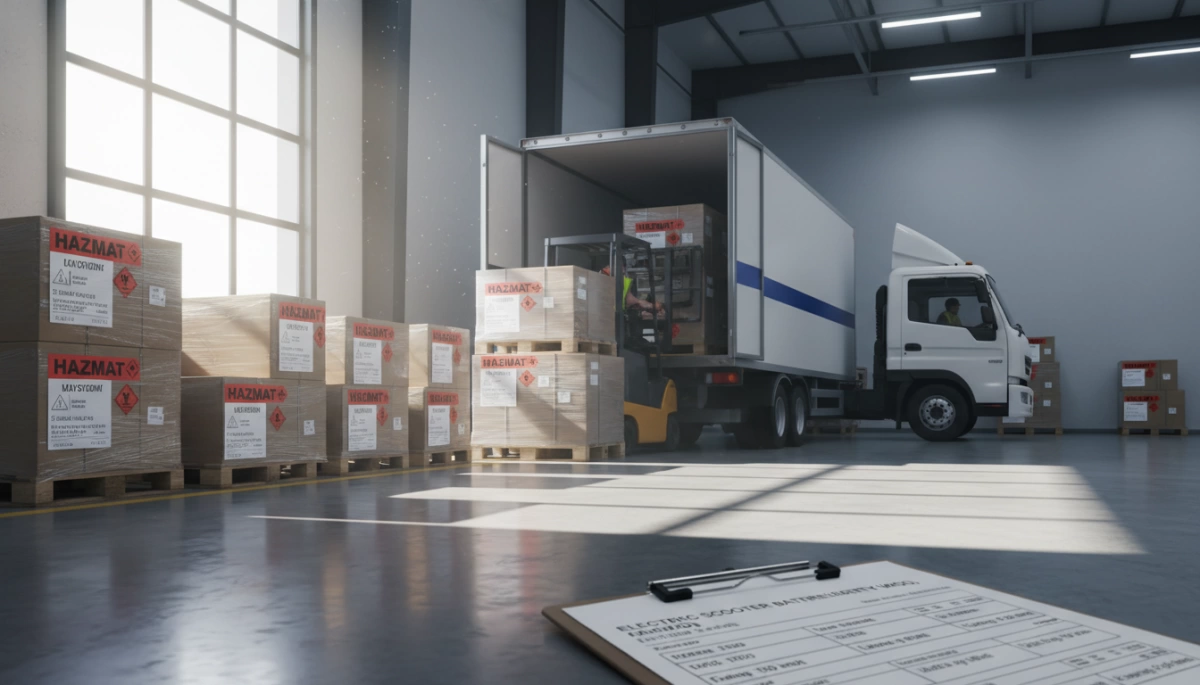
When you are importing electric scooters from overseas, the factory sticker price is only part of the equation. Moving large lithium packs across the ocean introduces a massive layer of complexity and hidden costs that can easily kill your profit margins if you aren’t prepared.
The Reality of Hazmat Shipping Lithium Batteries
Under international shipping laws, lithium-ion batteries are strictly classified as Class 9 Dangerous Goods. This classification dictates exactly how we move these products into the United States market.
- Air Freight is Prohibitive: Flying a batch of 36v lithium ion battery for electric scooter replacements via air is incredibly expensive and severely restricted by strict weight limits. For bulk orders, air freight is completely off the table.
- Specialized Sea Freight: You are locked into ocean freight. These shipments require specialized handling, specific placement away from heat sources on the vessel, and extensive hazardous materials documentation.
- Safety First: Stringent packaging and UN38.3 certifications are non-negotiable to prevent electric scooter battery fires during turbulent ocean transit.
Volume Shipping Economics: Why MOQ Isn’t Always Cost-Effective
Here is where many new buyers get tripped up. Hitting the exact minimum order quantity (MOQ) demanded by electric scooter battery manufacturers might seem like the safest financial play, but it often backfires on the logistics side.
Because of the steep surcharges associated with dangerous goods, shipping small volumes is brutally inefficient.
- The LCL Trap: Shipping Less than Container Load (LCL) means you share container space. Hazmat processing fees, customs broker charges, and origin handling fees are often billed at flat rates. If you only order the base MOQ, those flat fees spread across fewer units, artificially inflating your landed electric scooter battery replacement cost.
- The FCL Advantage: Scaling up to a Full Container Load (FCL) changes the math in your favor. Whether you are stocking massive 60v dual-motor packs or testing out how long will a 12v 5ah battery last in entry-level kids’ models, filling your own container drastically dilutes the shipping cost per unit.
When negotiating your wholesale electric scooter batteries order, don’t just calculate the factory’s production minimums. You need to model out the volume required to optimize your sea freight and properly absorb those unavoidable hazmat shipping surcharges.
The Importer’s Playbook: Scaling from Prototype to Mass Production
Successful importing isn’t about guessing; it’s about a calculated ramp-up. We don’t expect you to order a full container on day one. In fact, we advise against it. A strategic partnership moves through distinct phases to mitigate risk and ensure your electric scooter battery performance matches your specs perfectly before you commit significant capital.
Step 1: Rapid Prototyping
Never buy blindly. The first step is demanding a custom sample. We turn concepts into production-ready batteries in weeks, allowing you to test real-world metrics like voltage sag and enclosure fit. You need to physically verify the pack performance to know how to tell if a lithium ion battery is bad or if the BMS programming needs adjustment before a single consumer rides it.
Step 2: The Pilot Run
Once the prototype is validated, we move to a pilot run. This involves negotiating a smaller initial MOQ to test your logistical flow and market reception. This stage bridges the gap between engineering samples and full-scale manufacturing, letting you verify quality control without the pressure of massive inventory.
Step 3: Automated Scaling
When your product takes off, we scale with you. Our facility operates 24/7 automated production lines capable of outputting over 100,000+ units monthly. Whether you need standard packs or complex custom rechargeable battery packs, our automated cell sorting and matching ensure consistency even at high volumes to meet peak seasonal demand.
Step 4: Securing After-Sales Engineering Support
We don’t disappear after delivery. A reliable manufacturer acts as an extension of your team. We provide comprehensive technical documentation and root cause analysis for any field issues. If a rider reports a problem, we help you determine if it’s a motor controller issue or if you need a specific electric scooter battery replacement. Your success drives our mission, so we stay engaged long after the sale.





 English
  German
  Spanish
  French
  Italian
  Polish
  Russian
  Thai
Thai  Turkish
  Japanese
  Korean