
Learn About Button Battery Sizes Voltage Dimensions and Compatibility

You’ve likely stood in the electronics aisle, staring at a confusing wall of silver discs, wondering if a CR2032 is actually interchangeable with a CR2025.

It’s a common headache.

But here is the truth: those alphanumeric codes aren\’t random. They are a precise formula for chemistry and dimensions.

In this guide, you’re going to learn exactly how to decode button battery sizes so you never buy the wrong replacement again.

We’ll break down the critical differences between lithium vs alkaline coin cells, explain the IEC battery naming standards, and show you how to read the \”secret code\” hidden in the numbers.

Ready to ensure your devices get the precise power they need?

Let’s dive right in.

Decoding the Alphanumeric Codes: What Do They Mean?

When you look at the back of a blister pack or the face of a coin cell, the string of letters and numbers can look like a secret code. As experts in battery supply, we know that these codes aren\’t random—they are precise descriptors of the battery\’s chemistry and physical dimensions. Understanding this logic is the first step to ensuring you never buy the wrong size again.

Understanding the IEC Standard Naming Convention

The International Electrotechnical Commission (IEC) established the IEC battery naming standards to create a universal language for power cells. This system ensures that a battery bought in the United States fits a device manufactured in Japan or Germany. The code is broken down into two distinct parts: the prefix (letters), which indicates the chemical composition, and the suffix (numbers), which defines the physical coin cell battery dimensions.

Breaking Down the Letters: CR vs. LR vs. SR Chemistries

The first letter in the code tells you exactly what is happening inside the metal casing. This determines the voltage and the ideal use case for the battery. Here is how we categorize the most common chemistries:

Prefix Chemistry Voltage Typical Application
C Lithium 3V Key fobs, medical devices, motherboards
L Alkaline 1.5V Toys, laser pointers, calculators
S Silver Oxide 1.55V Precision watches, medical instruments
P Zinc Air 1.45V Hearing aids (our specialty at Nuranu)

Cracking the Number Code: The Diameter and Height Formula

Once you know the chemistry, the numbers tell you the size. This is critical because button cell battery dimensions are measured in millimeters. The numbering system usually follows a four-digit format (like the ubiquitous CR2032):

  • First two digits (20): Represent the diameter in millimeters. A \”20\” means the battery is 20mm wide.
  • Last two digits (32): Represent the height (thickness) in tenths of a millimeter. A \”32\” means the battery is 3.2mm thick.

Example:

  • CR2016: 20mm wide, 1.6mm thick.
  • CR2032: 20mm wide, 3.2mm thick.

Why a 0.1mm Difference Matters for Connectivity

Precision is non-negotiable. While two batteries might look similar in diameter, a slight variance in thickness can prevent your device from functioning.

  • Too Thick: If you force a thicker battery (like a CR2032) into a slot designed for a thinner one (like a CR2026), you risk damaging the battery contacts or cracking the device casing.
  • Too Thin: Using a thinner battery in a deep slot results in a loose connection. This leads to intermittent power failure, causing devices like watches to lose time or hearing aids to cut out unexpectedly.

We always recommend matching the exact code to your device\’s manual to ensure the contacts engage with the correct pressure.

Deep Dive into Lithium Coin Cells (The CR Series)

When you look at 3V lithium battery sizes, you are almost always dealing with the CR series. These are the flat, silver discs found in everything from car key fobs to motherboard CMOS slots. The \”CR\” stands for a specific chemistry: Lithium Manganese Dioxide. Unlike the zinc-air batteries we use for hearing aids that rely on outside air, these cells are self-contained powerhouses designed for long-term reliability.

The Big Three Explained: CR2032, CR2026, and CR2016

The most confusing part for customers is often the similarity between the three most popular sizes. They all look like identical silver coins, but their dimensions dictate their capacity. The secret is in the name: the first two digits represent the diameter in millimeters, and the last two digits represent the height (thickness) in tenths of a millimeter.

Here is a quick breakdown of the coin cell battery dimensions:

Battery Code Diameter Height (Thickness) Typical Capacity Common Uses
CR2032 20mm 3.2mm ~220-240 mAh Motherboards, Car Keys, Toys
CR2026 20mm 2.5mm ~160-170 mAh Calculators, Watches, Remotes
CR2016 20mm 1.6mm ~90 mAh LED Lights, Fitness Trackers

Interchangeability: Can I Use a CR2026 in a CR2032 Slot?

This is the most frequent question we get regarding CR2032 vs CR2026 compatibility. Since both batteries share the exact same 20mm diameter and 3V output, a CR2026 will physically slide into a slot designed for a CR2032. However, it is thinner by 0.7mm.

  • CR2026 in a CR2032 Slot: It often works in a pinch, but the connection may be loose. If the device relies on spring tension to hold the battery, a sudden movement could break the circuit.
  • CR2032 in a CR2026 Slot: This usually does not work. The extra thickness prevents the battery compartment from closing or puts dangerous pressure on the device\’s internal components.
  • Stacking CR2016s: Never stack two CR2016 batteries to replace a CR2032 unless the device is specifically designed for it. Stacking them doubles the voltage to 6V, which will fry most 3V electronics instantly.

Voltage Differences and Device Compatibility

While the physical size varies, the voltage across the CR series remains a standard 3 volts. The primary difference lies in the capacity (mAh) and internal resistance. A thicker battery like the CR2032 contains more chemical material, allowing it to sustain power delivery for longer periods compared to the thinner CR2016. Understanding the relationship between lithium battery voltage and power capacity is crucial when selecting a cell for high-drain devices like security sensors or medical equipment. Using a thinner battery with lower capacity will simply result in the device dying much faster.

Why We Recommend High Energy Density Options

For critical devices, we always recommend sticking to the exact size specified by the manufacturer to ensure maximum energy density. While it might be tempting to buy a multi-pack of mixed sizes, a high-drain device like a modern car key fob requires the sustained current that only the correct form factor can provide. Using a smaller capacity battery might save you a trip to the store today, but it will likely fail when you need it most.

Alkaline vs. Silver Oxide: Choosing the Right Small Button Cell

When you look beyond our specialized hearing aid batteries, you will likely encounter a confusing array of smaller button cells used in household electronics. The most common confusion lies between Alkaline (LR) and Silver Oxide (SR) chemistries. While they often share the same physical dimensions, their performance characteristics differ significantly, and choosing the wrong one can lead to poor device performance or frequent replacements.

Visual Distinctions: Tall Cylinders vs. Flat Coins

Unlike the wide, flat lithium coin cells (like the CR2032) that resemble a nickel, standard button cells often look more like squat cylinders. They typically feature a smaller diameter but a taller height. If you place a standard LR44 vs AG13 equivalent side-by-side, you will notice they are physically identical in shape, despite the different chemical compositions inside. This shared form factor is why understanding the chemistry is critical—physically fitting into the slot doesn\’t guarantee it\’s the best power source for the job.

The Alkaline (LR) Use Case: Toys and High-Drain Bursts

Batteries with the prefix \”LR\” utilize alkaline chemistry. These are generally more affordable and are best suited for devices that don\’t require a constant, precision voltage for long periods.

  • Best For: Children\’s toys, small LED flashlights, and laser pointers.
  • Behavior: The voltage drops gradually as the battery drains.
  • Trade-off: While cost-effective, they may leak if left in devices for too long after depletion.

The Silver Oxide (SR) Advantage: Precision for Watches

For precision electronics, Silver Oxide battery benefits become clear. Identified by the \”SR\” prefix, these cells utilize a silver-zinc chemistry that offers a higher energy density and, crucially, a very flat discharge curve. This means the battery maintains a steady voltage until the very end of its life, rather than tapering off like alkaline cells.

  • Best For: Wristwatches, medical instruments, and digital calipers.
  • Why Upgrade: In a watch, an alkaline battery might cause the time to lag as power fades, whereas a silver oxide cell ensures accuracy until it is fully exhausted.

Common Equivalents: LR44, AG13, and A76

Navigating the naming conventions is the hardest part of buying replacements. Manufacturers often use proprietary codes for the exact same standard size. The most ubiquitous size in this category is the 11.6mm x 5.4mm cell. Here is a quick breakdown of the interchangeable names you will see on packaging:

Chemistry Common Names Application
Alkaline LR44, AG13, A76, L1154 Toys, Calculators
Silver Oxide SR44, SR44W, 357, 303 Watches, Medical Devices

When in doubt, check your device manual. While you can usually swap an SR battery into a slot meant for an LR (to get longer life), putting an alkaline battery into a precision watch is generally not recommended due to button cell voltage differences over time.

Hearing Aid Battery Sizes and Color Codes
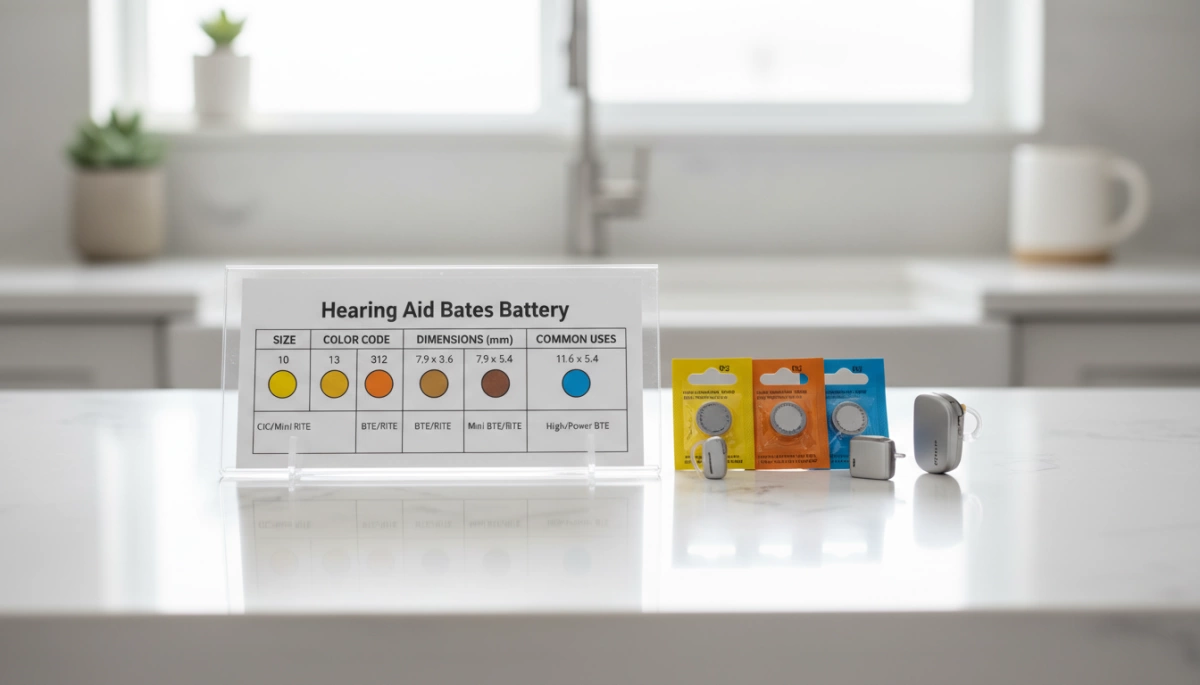
Hearing Aid Battery Sizes and Color Codes Guide

When you start to learn about button battery sizes specifically for hearing instruments, you will notice the industry operates on a strict standard. Unlike the confusing array of watch battery codes, hearing aid batteries use a universal color and number system. At Nuranu, we stock all the major players—Rayovac, Power One, Duracell, Signia, and Widex—and they all adhere to this four-color code to make your life easier.

Understanding Zinc Air Technology

Hearing aid batteries are unique because they typically use Zinc Air technology. These cells are air-activated, meaning they remain dormant until you remove the colored sticky tab on the back. Once that tab is peeled, oxygen enters through tiny holes in the casing to interact with the zinc inside, generating a steady 1.45V.

This is a crucial distinction from other power sources. Unlike the sealed chemistry found when analyzing the four key properties of rechargeable lithium polymer batteries, Zinc Air cells require constant airflow to function correctly.

  • Pro Tip: After removing the tab, let the battery sit for one full minute before inserting it into your device. This \”airing out\” period allows the voltage to ramp up fully, ensuring you get the maximum lifespan out of every cell.

The Universal Color Tab System

To simplify replacements, manufacturers use specific colors on the packaging and the pull-tabs. If you know your color, you know your size.

  • Size 10 (Yellow): Smallest standard size.
  • Size 312 (Brown): Slim profile, very common.
  • Size 13 (Orange): Medium thickness.
  • Size 675 (Blue): Largest and most powerful.

Size 675 (Blue) vs. Size 13 (Orange)

These two sizes handle the heavy lifting for larger devices.

  • Size 675 (Blue): This is the powerhouse of the group. It is physically the largest button battery in this category and is designed for high-power Behind-the-Ear (BTE) hearing aids and cochlear implants. Because these devices draw significant power, the 675 offers the highest capacity to keep them running longer.
  • Size 13 (Orange): While slightly smaller than the blue tab, the Size 13 is a workhorse for standard BTE and In-the-Ear (ITE) devices. It balances size with energy density, making it a reliable choice for users who need moderate power without the bulk of a 675.

Size 312 (Brown) vs. Size 10 (Yellow)

As devices get smaller, the batteries must follow suit.

  • Size 312 (Brown): This is one of the most popular sizes we sell. It is thinner than a Size 13 but has the same diameter. You will typically find these in Receiver-in-Canal (RIC) and In-the-Canal (ITC) hearing aids where a slim profile is essential for comfort.
  • Size 10 (Yellow): The smallest of the \”Big Four.\” These are used in Completely-in-Canal (CIC) aids that sit deep inside the ear. Because they are tiny, they have less capacity than the others, so we always recommend buying these in our 60-pack or 120-pack bundles to ensure you never run short.

We prioritize freshness in every shipment. Since Zinc Air batteries have a long shelf life as long as the tab stays on, stocking up with our bulk options or subscription service is the smartest way to manage your hearing health costs.

Master Cross-Reference Guide for Battery Equivalents

Button Battery Size Cross-Reference Guide

Navigating the aisle for replacements can feel like cracking a secret code. You might have an old battery in your hand that says \”AG13,\” but the pack on the shelf says \”LR44.\” Are they the same? Yes. Manufacturers often use proprietary prefixes, but the underlying button battery cross reference chart relies on standardized dimensions and chemistry. Whether you are looking for a watch battery replacement guide or power for a hearing aid, understanding these equivalents saves you from buying the wrong size.

Decoding Brand-Specific Prefixes (DL, ECR, etc.)

Big brands love to put their stamp on standard sizes. If you see a prefix like DL (Duracell) or ECR (Energizer) followed by a number, simply ignore the letters to find the standard IEC size. For example, a DL2032 is identical to a standard CR2032. They are interchangeable. We stock major brands like Rayovac, Power One, and Duracell, and while the packaging might look different, a Size 312 hearing aid battery is always a Size 312, regardless of the letters before it.

Converting AG Series to Standard LR Numbers

The \”AG\” series is commonly found in toys, laser pointers, and calculators, often imported. These are alkaline batteries. The most common confusion we see is the LR44 vs AG13 equivalent. Here is the simple rule: AG13 is the same as LR44. They are also compatible with A76 and 357 (though 357 is silver oxide and lasts longer). Knowing this conversion helps you grab the right pack without hesitation.

Quick Lookup Chart for Common Replacements

To make your life easier, here is a quick breakdown of the most common swaps we encounter.

  • Hearing Aid Batteries (Zinc Air):

    • Size 10 (Yellow): ZA10, PR70, 7005ZD
    • Size 312 (Brown): ZA312, PR41, 7002ZD
    • Size 13 (Orange): ZA13, PR48, 7000ZD
    • Size 675 (Blue): ZA675, PR44, 7003ZD
  • General Button Cells:

    • CR2032: DL2032, ECR2032, 5004LC
    • LR44: AG13, A76, 357 (Silver Oxide upgrade), L1154
    • LR41: AG3, 192, 392 (Silver Oxide upgrade)

Always check the diameter and voltage if you are unsure, but generally, if the numbers match, the battery fits.

Critical Safety, Handling, and Storage Best Practices
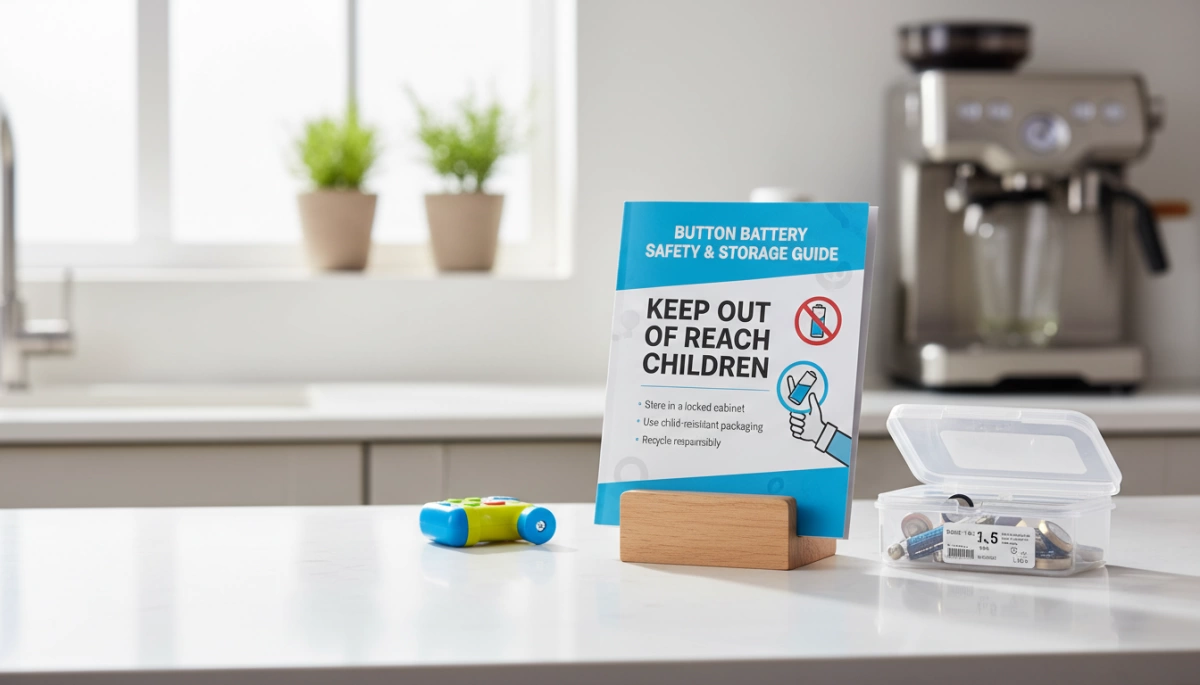
Button Battery Safety and Storage Guide

The Swallowing Hazard: Protecting Kids and Pets

We cannot stress this enough: button batteries pose a serious risk if mishandled. Their small, shiny appearance makes them look like candy to toddlers or interesting toys to pets. Beyond the obvious choking hazard, a swallowed battery can trigger a chemical reaction with saliva, causing severe internal burns in as little as two hours. This is why we prioritize stocking brands that utilize child safety battery packaging, often requiring scissors to open. Always store your spare packs in a high, locked cabinet and dispose of used cells immediately in a secure bin.

Handling Tips: Why You Shouldn\’t Touch Battery Faces

You might not realize it, but how you pick up a battery affects its performance. I always advise customers to handle these cells by the edges, never by touching the flat top and bottom surfaces simultaneously. Touching both sides can create a circuit through your skin, slightly draining the battery before it even enters your device. Furthermore, natural oils from your fingers can increase electrical resistance.

For those using Zinc Air hearing aid batteries, keeping the colored tab on until the exact moment of use is vital. If you are exploring different form factors, our guide to coin cells vs cylinders breaks down how physical design impacts handling and usage.

Proper Storage Techniques to Maximize Shelf Life

A common myth is that storing batteries in the refrigerator preserves them. For button batteries, especially Zinc Air types, this is actually harmful. The moisture and condensation inside a fridge can corrode the seal or activate the chemistry prematurely. To ensure you get the most out of long shelf life button batteries, keep them at room temperature in a dry environment. At Nuranu, we maintain a strict inventory rotation to guarantee that every pack we ship has a distant \”best-before\” date, ensuring the power is there when you need it.

Frequently Asked Questions About Button Battery Sizes

Navigating the world of miniature power sources can be tricky. Here are the answers to the most common questions we get from customers trying to learn about button battery sizes and specifications.

Are All Button Batteries the Same Voltage?

No, and assuming they are can damage your device. Button cell voltage differences are determined by the chemistry inside the casing:

  • Zinc Air (Hearing Aids): Standard 1.45V. These rely on air flow to activate.
  • Alkaline & Silver Oxide: Typically 1.5V to 1.55V. Common in watches and toys.
  • Lithium Coin Cells (CR Series): Rated at 3V. These are twice as powerful as standard button cells.

Always check your device manual. Putting a 3V lithium cell into a slot designed for a 1.5V alkaline battery can fry the electronics instantly.

How Can I Measure a Battery If the Code Is Worn Off?

If the alphanumeric code is illegible, you can identify the battery by measuring its physical dimensions. You will need a caliper for precision.

  1. Measure the Diameter: Measure across the widest part of the circle.
  2. Measure the Height: Measure the thickness from top to bottom.
  3. Match to a Chart: Use the measurements to find the corresponding coin cell battery dimensions.

For example, if you measure a diameter of 20mm and a height of 3.2mm, you have a CR2032.

What Is the Difference Between a Coin Cell and a Button Cell?

While people often use the terms interchangeably, there is a visual distinction based on shape and chemistry:

  • Coin Cells: Usually refer to Lithium batteries (like the CR2032). They are wider and thinner, resembling a nickel or quarter.
  • Button Cells: Usually refer to Alkaline, Silver Oxide, or Zinc Air batteries. They have a smaller diameter but a taller profile, looking more like a traditional shirt button.

How Do I Safely Dispose of Used Lithium Batteries?

Never throw button or coin batteries in the regular household trash. Even \”dead\” batteries can hold enough residual charge to cause a short circuit if they touch other metal objects, creating a fire hazard. To dispose of them safely:

  • Tape the Terminals: Place a piece of non-conductive tape (like electrical or duct tape) over both sides of the battery.
  • Recycle: Take them to a designated battery recycling drop-off center or a hazardous waste collection site.

Proper handling prevents accidents; understanding how to manage lithium battery fire risks is essential for keeping your home safe, as lithium chemistries can be volatile if mishandled or punctured.
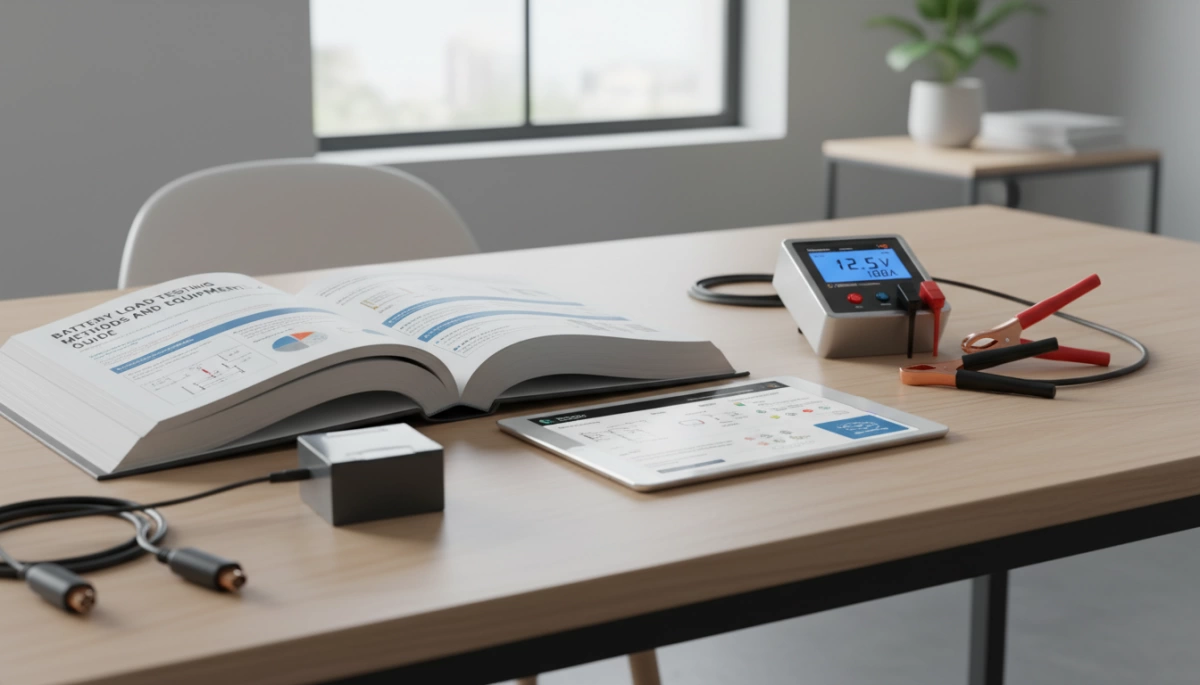
Battery Load Test Guide Methods Equipment and Accurate Analysis

The Science: Why Batteries Fail Under Load

We have all seen it happen: a battery shows a perfect \”float\” voltage on a standard multimeter, yet the moment the backup system engages, the power collapses. This phenomenon occurs because Open Circuit Voltage (OCV) is a static measurement that tells us very little about the battery\’s ability to do actual work. At Nuranu, we emphasize that the only way to verify true reliability is by applying a load.

Internal Resistance (IR) and Voltage Sag

The primary culprit behind load failure is Internal Resistance (IR). As batteries age, their internal impedance rises. According to Ohm’s Law ($V = I times R$), as current ($I$) is drawn from the battery, voltage drops across this internal resistance.

If the IR is high, the Voltage Sag under load becomes severe. The terminal voltage can drop below the critical cut-off point immediately, triggering a system shutdown even if the battery technically holds a charge. Our Intelligent Battery Discharge Testers are designed to capture this specific behavior, identifying batteries that are \”voltage rich\” but \”power poor.\”

Chemical vs. Physical Health Issues

When we analyze test data, failures generally stem from two categories:

  • Chemical Degradation: In VRLA and flooded lead-acid batteries, sulfation on the plates or electrolyte dry-out increases resistance. In Lithium-ion systems, electrode degradation reduces capacity.
  • Physical Faults: Loose inter-cell connections, corroded terminals, or broken internal welds create \”hot spots.\” These physical issues cause massive resistance spikes that are easily detected by our Wireless Cell Monitoring modules during a discharge cycle.

AC-IR vs. DC-IR Differences

Understanding the type of resistance we are measuring is vital for accurate State of Health (SOH) analysis.

Feature AC-IR (Impedance) DC-IR (Resistance)
Measurement Method Injecting a small AC signal (1kHz). Measuring voltage drop under high current load.
Primary Use Quick, non-invasive health check. Definitive capacity and power verification.
Accuracy Good for trending, susceptible to noise. Highly accurate reflection of real-world performance.
Nuranu Application Preliminary screening. Core function of DC Load Banks.

We rely on DC-IR data derived from actual load testing because it simulates the exact stress the battery will face during a power outage, providing the only undeniable proof of capacity.

Advanced Load Testing Methods

Battery Load Testing Methods and Equipment Guide

To get a true picture of a battery\’s health, we have to move beyond simple voltage checks and apply rigorous, controlled stress. At Nuranu, we utilize intelligent discharge technologies that go far beyond old-school resistive banks. By controlling how the energy is drawn, we can simulate exact operating conditions and uncover weak cells that would otherwise pass a static test.

Constant Current (CC) Discharge Techniques

This is the industry gold standard for determining actual Amp-hour (Ah) Capacity. In a Constant Current Discharge test, our equipment automatically adjusts the resistance to maintain a steady amperage draw—regardless of the battery\’s dropping voltage.

  • Why we use it: It is the only way to verify if a battery meets its manufacturer\’s Ah rating.
  • How it works: If you have a 100Ah battery, we might program a 10A draw for 10 hours. If the voltage hits the cutoff before time is up, the capacity is degraded.

  • Nuranu Advantage: Our testers use wireless modules to monitor individual cell voltages in real-time during this process, ensuring no single cell drops below safe limits while the string is under load.

Constant Power (CP) Mode for UPS and EVs

Backup systems and electric vehicles don\’t act like simple resistors. As their voltage drops, they draw more current to maintain the same power output (Watts). We use CP Mode to simulate this behavior accurately.

  • Application: Critical for data centers and telecom UPS systems.
  • The Stress Test: This mode puts maximum thermal and chemical stress on the battery near the end of the discharge cycle, revealing connection issues or internal resistance spikes that a CC test might miss.
  • Safety Note: Whether you are testing standard VRLA strings or verifying if LiFePO4 batteries need to be vented during high-wattage discharge, using a programmable DC Electronic Load ensures the test stops exactly at the safety threshold.

Constant Resistance (CR) and Dynamic Loading

While less common for capacity certification, Constant Resistance (CR) mode is useful for simulating passive loads like emergency lighting or heating elements. For more complex scenarios, we employ Dynamic and Step Loading. This allows us to program a specific profile—such as a high-current spike followed by a low-draw plateau—to mimic the actual duty cycle of a forklift or a renewable energy storage system. This \”real-world\” simulation is vital for predicting how a battery bank will perform when it really counts.

Equipment Selection: Choosing the Right Tool

Getting accurate data for your Battery Load Test Guide: Methods, Equipment and Results starts with selecting the hardware that matches your specific application. You can\’t fix what you can\’t measure, and using the wrong tester can lead to misdiagnosing a healthy battery as dead—or worse, trusting a bad one.

Analog Carbon Pile Testers

These are the old-school workhorses often found in auto shops. They work by compressing carbon discs to create a massive physical electrical load, converting the battery\’s energy into heat.

  • Best for: High-current cranking tests (CCA) on lead-acid starter batteries.
  • Pros: Extremely durable, simple to operate, and provides a real-world stress test.
  • Cons: They get very hot, lack digital precision, and rely on the operator to manually time the load duration.

Handheld Digital Conductance Analyzers

If you need speed and safety, digital analyzers are the modern standard. Instead of draining the battery with a heavy load, these devices send a small AC signal through the terminals to measure conductance and estimate Internal Resistance (IR). This correlates to the battery\’s ability to deliver current. They are perfect for quick fleet maintenance checks because they don\’t deplete the battery\’s State of Charge.

Programmable DC Electronic Loads

For professional diagnostics, especially with deep cycle or lithium chemistries, a DC Electronic Load is the gold standard. These units allow you to program exact discharge profiles (like Constant Current or Constant Power) to simulate specific devices. This precision is critical when you are plotting a full Discharge Curve to verify capacity. For instance, if you are determining how to revive a dead 18650 battery and need to verify if the cell is actually holding a charge after the repair, a programmable load will give you the definitive data that a simple multimeter cannot.

Importance of 4-Terminal Sensing (Kelvin Connection)

Precision testing falls apart if your connections are bad. Standard two-wire setups measure the resistance of the test leads plus the battery, which skews your results when dealing with milliohms.

  • The Solution: Use a Kelvin Connection (4-terminal sensing).
  • How it works: One pair of wires carries the current, while a separate pair measures the voltage.
  • The Result: This eliminates the voltage drop across the test leads, giving you a pure reading of the battery\’s voltage right at the terminals. If you are measuring State of Health (SOH) or low-resistance lithium cells, 4-terminal sensing is non-negotiable.

Step-by-Step Professional Load Test Procedure

Battery Load Test Procedure and Monitoring

Executing a proper load test isn\’t just about hooking up wires; it requires a systematic approach to ensure safety and data accuracy. We design our Intelligent Battery Discharge Testers to automate much of this, but the setup remains critical for valid results.

Preparation, Safety, and SoC Checks

Before initiating any discharge, safety is priority number one. Ensure the battery bank is isolated from the live system if required and verify that all terminals are clean and tight. Loose connections create heat and skew results. If you are managing complex banks, understanding the risks of wiring batteries in parallel danger is essential to prevent short circuits or imbalances during the test.

  • Visual Inspection: Check for casing cracks or leaks.
  • State of Charge (SoC): Ensure the battery is fully charged (100% SoC) and has rested for a few hours to stabilize the Open Circuit Voltage (OCV).
  • Sensor Installation: Attach our wireless cell monitoring modules to individual cells (2V, 6V, or 12V) to track specific performance within the string.

Setting C-Rate and Cut-off Voltage Parameters

On the tester\’s interface, you must define the \”stop conditions.\” This prevents damaging the battery by draining it too far. Our equipment allows you to set automatic shutdowns based on voltage, capacity, or time.

Parameter Description Typical Setting
Discharge Current (C-Rate) The constant load applied. Often 0.1C or 0.2C (e.g., 10A for a 100Ah battery).
Cut-off Voltage The voltage floor where the test stops. ~1.75V per cell (e.g., 42V for a 48V system).
Duration Max time for the test to run. Based on rated capacity (e.g., 5 hours or 10 hours).

Execution: Monitoring Voltage Sag

Once you hit \”Start,\” the load bank applies the resistance using safe PTC ceramic elements. Immediately observe the Voltage Sag. A healthy battery will show a slight initial drop and then stabilize. If the voltage plummets instantly, the Internal Resistance (IR) is likely too high, indicating a bad block or connection.

Observing the Discharge Curve

As the test progresses, our integrated software logs data to generate the Discharge Curve. You are looking for a steady plateau.

  • Healthy: Voltage remains steady for the majority of the duration.
  • Weak: Voltage drops gradually but faster than the manufacturer\’s spec.
  • Failed: Sudden \”knee\” drop in voltage well before the expected time.

Using the wireless modules, you can identify if a single cell is dragging down the entire bank\’s voltage, allowing for targeted replacement rather than scrapping the whole system.

Analyzing Results: Pass, Fail, or Degraded?

Battery Load Test Analysis and Capacity Evaluation

Once the Intelligent Battery Discharge Tester completes its cycle, the focus shifts from execution to interpretation. We don\’t just look for a simple \”pass\” or \”fail\” light; we analyze the data logged by our PC management software to determine the true State of Health (SOH). Accurate analysis prevents premature replacement of good units and ensures critical backup systems aren\’t relying on \”zombie\” batteries that fail under real stress.

The 9.6V Rule for 12V Lead Acid

For standard 12V lead-acid blocks, the 9.6V rule is the industry benchmark during a high-rate load test. If the voltage drops below 9.6V while under a load equivalent to half the CCA rating for 15 seconds, the battery is generally considered defective. However, our intelligent testers go beyond simple voltage checks by monitoring the entire discharge curve to differentiate between a surface charge issue and actual plate degradation.

Calculating Actual Amp-hour Capacity

The most reliable metric for industrial applications is the actual Amp-hour (Ah) Capacity. By running a Constant Current (CC) discharge test, our equipment measures exactly how much energy the battery delivers before hitting the cutoff voltage.

  • 100% – 90% Capacity: Excellent condition.
  • 89% – 80% Capacity: Serviceable, but requires monitoring.
  • Below 80% Capacity: Industry standard for replacement.

Interpreting Steep Drops and Plateaus

Visualizing the Discharge Curve via our PC software reveals issues that a multimeter misses.

  • Steep Initial Drop: Indicates high Internal Resistance (IR) or bad connections.
  • Mid-Test Plateau: Normal operation where voltage stabilizes.
  • Premature Drop-off: Signals lost capacity or a weak cell within the string.

Using our wireless cell monitoring modules, we can pinpoint exactly which 2V, 6V, or 12V cell is causing the drop. This granular data is essential when determining how to tell if a lithium-ion battery is bad or if a specific lead-acid jar needs swapping.

Comparing Results Against Manufacturer Datasheets

Finally, we validate the test results against the manufacturer\’s specific discharge tables. A battery might pass a generic load test but fail to meet the specific runtime requirements of your data center or telecom site. By comparing the time-to-cutoff against the datasheet, we verify if the battery system can truly support the critical load for the required duration.

Common Pitfalls in Load Testing

Battery Load Testing Challenges and Best Practices

I’ve seen perfectly good batteries tossed in the recycling bin simply because the testing procedure was flawed. Even the most expensive equipment can’t compensate for user error. To ensure your Battery Load Test Guide results are accurate, you need to avoid these three major mistakes that skew State of Health (SOH) data.

Testing Batteries with Low State of Charge

You cannot perform a valid load test on a battery that isn\’t fully charged. This is the number one error in the field. If a battery is only at 50% capacity, the Open Circuit Voltage (OCV) might look okay, but the voltage will collapse immediately under load, mimicking a failed cell.

  • The Rule: Always charge the battery to 100% and let it rest (surface charge dissipation) before testing.
  • The Risk: Testing a discharged battery leads to false negatives. Understanding what constitutes a good 18650 battery or lead-acid unit means knowing that performance relies heavily on starting with a full tank of electrons.

Ignoring Ambient Temperature Effects

Batteries are chemical devices, and chemistry is slaves to temperature. In the US, testing a battery in a freezing garage in Minnesota will give vastly different results than testing the same unit in a hot Arizona workshop.

  • Cold Temperatures: Slow down the chemical reaction, artificially increasing Internal Resistance (IR) and reducing capacity. A good battery might fail a load test simply because it is cold.
  • High Temperatures: Temporarily boost performance but degrade long-term health.
  • Solution: ideally, bring the battery to room temperature (around 77°F / 25°C) before testing to get a standardized result.

Overlooking Bad Connections and Contact Resistance

Your test results are only as good as the physical connection between the tester and the battery terminals. Corrosion, dirt, or loose clamps introduce extra resistance that the tester reads as Internal Resistance (IR) inside the battery.

  • Voltage Sag: Poor contact causes a massive voltage sag at the terminals as soon as current flows.
  • The Fix: Always clean lead posts and terminals with a wire brush.
  • Connection Type: Ensure your clamps are biting into clean metal. If you are building or testing custom packs, knowing how to properly assemble a battery pack ensures that your interconnects aren\’t the source of the resistance.

Frequently Asked Questions (FAQs)

Load Testing vs. Multimeter Voltage Check

We often see technicians relying solely on a multimeter, but that only gives you half the story. A multimeter measures Open Circuit Voltage (OCV), which is essentially a surface reading. A battery can show a healthy 12.6V or higher while sitting idle but fail instantly once a real load is applied.

Load testing is the only way to verify the battery\’s ability to deliver current. It simulates an actual power outage or operational demand to reveal internal issues like high resistance or broken inter-cell connectors that a simple voltage check will miss.

How Often Should Industrial Batteries Be Tested?

For critical backup systems in telecom, data centers, and utilities, sticking to a schedule is non-negotiable. Based on IEEE standards and general best practices:

  • New Systems: Perform an acceptance test upon installation to establish a baseline.
  • Operating Systems: Conduct a discharge test annually.
  • Aging Systems: Once the battery capacity drops below 90% or the system reaches 85% of its service life, increase testing frequency to every six months or quarterly.

Using our intelligent discharge testers with wireless monitoring simplifies this process, allowing for frequent checks without the massive logistical headache of manual logging.

Can You Load Test a Frozen Battery?

Absolutely not. Never attempt to load test or charge a frozen battery. When the electrolyte in a lead-acid battery freezes, the case can crack, and the internal plates may warp. Applying a heavy load current to a frozen battery creates a severe safety hazard, including the risk of explosion. Always bring the battery to room temperature and inspect the casing for physical damage before attempting any diagnostics.

Difference Between CCA and Amp-hour Capacity

It is crucial to use the right metric for your specific application. Cold Cranking Amps (CCA) measures the burst of energy a battery can deliver at 0°F for 30 seconds—this is vital for starting engines. Amp-hour (Ah) Capacity, on the other hand, measures how much energy a battery can store and deliver over a longer period.

Ah capacity is the standard for deep-cycle applications, including UPS systems, solar storage, and lithium formats like those described in what is a 18650 battery.

Feature Cold Cranking Amps (CCA) Amp-hour Capacity (Ah)
Primary Use Engine Starting (Automotive) Deep Cycle (Solar, UPS, Telecom)
Duration Short Burst (30 Seconds) Long Duration (Hours to Days)
Key Factor High Current Delivery Total Energy Storage
Test Method High-Rate Discharge Constant Current/Power Discharge

Best Flashlight Batteries 18650 21700 AA AAA CR123A Guide

You might already own a high-performance flashlight, but are you getting the lumens you actually paid for?

Here is the hard truth: putting a cheap battery in a premium light is like putting regular gas in a Ferrari.

You kill the performance.

Whether you are confused by the difference between 18650 and 21700 cells, or trying to decide between rechargeable AA and CR123A backups, you are in the right place.

In this guide, you’re going to learn exactly how to choose the best flashlight batteries to maximize runtime, safety, and brightness.

No more guessing. Just raw power.

Let’s dive in.

The Heavy Hitters: Lithium-Ion Rechargeables (18650 & 21700)

When identifying the Best Flashlight Batteries: AA, AAA, 18650, 21700 and CR123A, we must start with the high-performance engines driving modern illumination: Lithium-Ion (Li-ion) rechargeables. Traditional alkaline chemistries simply cannot sustain the high current draw required by today\’s professional-grade LEDs. To achieve blinding \”Turbo\” modes and extended runtimes, we rely on the superior energy density and voltage stability of Li-ion technology.

Why Li-Ion is the Standard for Modern LEDs

We engineer our tactical and EDC lights to push the boundaries of brightness. A standard alkaline battery drops in voltage rapidly under load, causing lights to dim quickly. In contrast, a high-drain rechargeable battery maintains a consistent 3.6V or 3.7V output, ensuring your light performs at peak intensity for longer durations.

21700 Batteries: The Powerhouse for High-Lumen Turbo Modes

The 21700 battery represents the cutting edge of flashlight power. slightly larger than the older 18650 standard, these cells offer a massive leap in performance.

  • Capacity: Up to 5000mAh, providing significantly longer runtimes.
  • Discharge Rate: Capable of handling higher amperage, which is critical for sustaining maximum output in high-lumen tactical lights.
  • Application: Ideal for duty lights and outdoor searchlights where power density is paramount.

18650 Batteries: The Perfect Balance for Everyday Carry (EDC)

While the 21700 is a powerhouse, the 18650 battery remains the gold standard for compact versatility. We view the 18650 as the \”sweet spot\” for Everyday Carry (EDC) because it balances substantial power with a slimmer profile that fits comfortably in a pocket.

  • Versatility: Compatible with the widest range of modern high-performance flashlights.
  • Size-to-Power Ratio: Excellent energy density without the bulk of larger cells.

USB-C Rechargeable Cells vs. Standard Cells

One of the most significant conveniences we offer is the integration of charging technology directly into the battery.

  • Standard Cells: Require a separate external charger or a flashlight with a magnetic/rubber-flap charging port.
  • USB-C Rechargeable Cells: Feature a built-in USB-C port directly on the battery casing.

Benefits of Built-in USB-C Charging:

  1. Travel Friendly: No need to carry a bulky external charger; just use your phone cable.
  2. Redundancy: If the flashlight\’s charging port is damaged, the battery can still be charged independently.
  3. Simplicity: LED indicators on the battery anode clearly show charging status (Red for charging, Green for full).

Traditional and Backup Power: AA, AAA, and CR123A

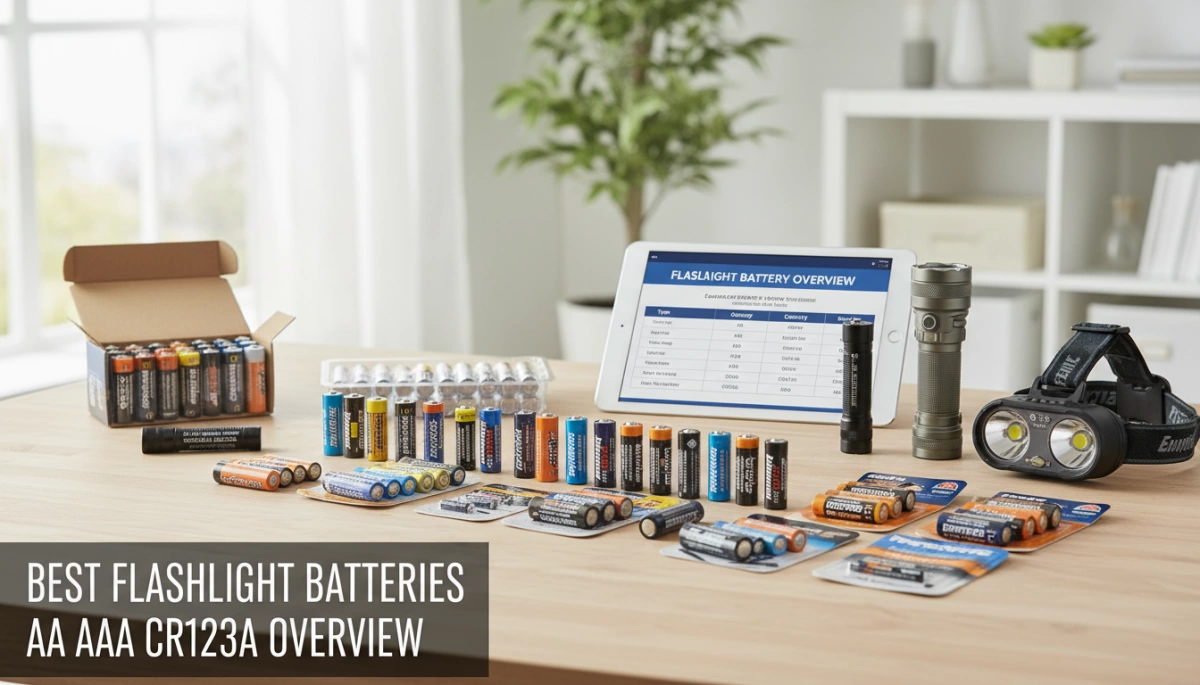
Best Flashlight Batteries AA AAA CR123A Overview

While the industry is shifting toward rechargeable lithium-ion standards, traditional cell sizes still play a critical role in backup scenarios and compact EDC (Everyday Carry) gear. Understanding the chemistry differences here is vital because putting the wrong cell in your light can either result in poor performance or a fried circuit board.

CR123A Lithium Primary: The Cold Weather and Storage King

If you are building an emergency kit for your car or a \”bug-out\” bag, the CR123A is widely considered the best flashlight battery for the job. Unlike rechargeable cells that self-discharge over time, CR123A shelf life can exceed 10 years, meaning they are ready to fire up even after sitting in a drawer for a decade.

Furthermore, cold weather battery performance is where lithium primaries shine. Standard alkaline and even some NiMH batteries struggle to output power when temperatures drop below freezing. CR123A cells maintain voltage stability in extreme cold, making them essential for winter carry. While we often engineer specialized solutions like low-temperature lithium batteries for industrial robotics, for a standard consumer handheld light, the CR123A remains the go-to disposable option for harsh environments.

The Danger of Alkaline AA/AAA Batteries

I cannot stress this enough: do not use alkaline batteries in high-end flashlights unless it is an absolute emergency. Alkaline batteries are prone to leaking corrosive potassium hydroxide, which will destroy the internal contacts and springs of your expensive light. Additionally, they have high internal resistance, meaning they cannot provide the current needed for modern high-output LEDs. You will likely see your light dim rapidly or fail to access higher brightness modes entirely.

NiMH Rechargeables: The Safe Alternative

For lights that require AA or AAA sizing, Nickel-Metal Hydride (NiMH) is the superior choice. Brands like Eneloop offer NiMH low self-discharge technology, which solves the old problem of dead batteries after a week of non-use. They don\’t leak, they maintain a flatter discharge curve than alkalines, and they can handle the current draw of modern EDC lights much better.

14500 Lithium-Ion: The High-Voltage Warning

This is where things get dangerous for the uninitiated. A 14500 lithium battery is identical in physical size to a standard AA battery, but it operates at 3.7V to 4.2V, whereas a standard AA is 1.5V.

  • Voltage Mismatch: Putting a 14500 into a light designed only for 1.5V AA batteries will instantly burn out the driver and LED.
  • Identification: Always check the label. If it says \”Li-ion\” or \”3.7V,\” it is not a standard AA.

It is crucial to know what you are handling. Just as you need to know how to identify an 18650 battery to avoid counterfeits or mismatched specs, you must verify if your AA-sized battery is actually a high-voltage lithium cell before inserting it into your device.

Decoding Battery Specs: How to Read the Label

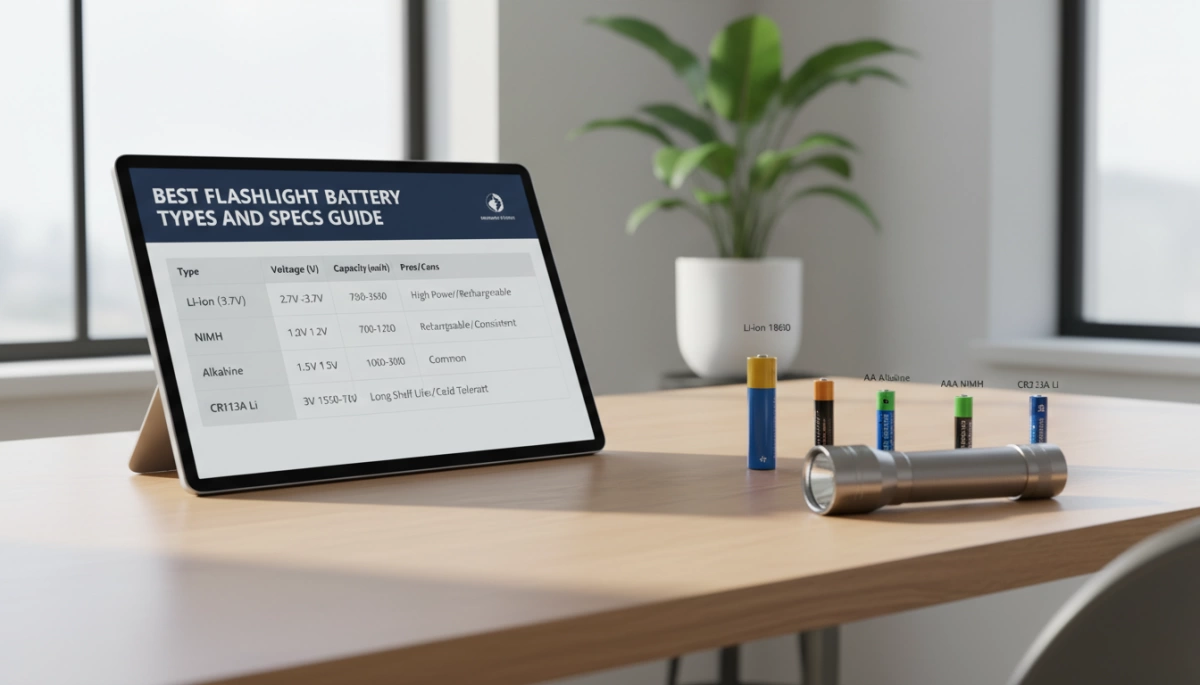
Best Flashlight Battery Types and Specs Guide

When you pick up a battery for your high-performance flashlight, the numbers on the wrapper can look like a secret code. Understanding these specifications is critical because putting the wrong cell in a tactical light isn\’t just about poor performance—it can be a safety hazard. Here is the breakdown of what actually matters when you are looking at the label.

Capacity (mAh) vs. Discharge Rate (Amps)

There is often a trade-off between how long a battery lasts and how much raw power it can deliver at once. You have to balance two main metrics:

  • Capacity (mAh): Measured in milliamp-hours, this indicates the \”fuel tank\” size. A higher number, like 5000mAh on a 21700 cell, means longer runtimes on lower settings.
  • Discharge Rate (Amps): This is the Continuous Discharge Current (CDR). It measures how much current the battery can push out without overheating.

If your flashlight has a massive 4,000-lumen \”Turbo\” mode, it requires a high-drain rechargeable battery capable of delivering high amperage instantly. Often, batteries with the highest capacity (mAh) have lower discharge rates, while high-discharge cells might have slightly less capacity. You need to match the battery\’s CDR to your light\’s maximum draw.

Protected vs. Unprotected Cells: Understanding the Safety Circuit

This is the most critical distinction for your safety. Lithium-ion chemistry is volatile if mishandled.

  • Protected Cells: These feature an integrated Protection Circuit Board (PCB) or BMS. This small chip acts as a safety guard, preventing overcharge, over-discharge, and short circuits. For loose batteries used in flashlights, we almost always recommend protected cells.
  • Unprotected Cells: These are raw cells usually intended for building battery packs where an external BMS handles safety. They are shorter and cheaper but carry a higher risk of fire if shorted or over-drained.

It is vital to understand the difference to prevent accidents. For a deeper dive into selecting the right power source, check our guide on how to choose a high-quality and safe 18650 battery to ensure your equipment remains reliable.

Button Top vs. Flat Top: Ensuring Physical Connection

Even if the voltage and chemistry are correct, the physical shape of the battery determines if it will fit in your light.

  • Button Top: These look like standard AA batteries with a protruding positive pole. Most consumer flashlights and series-connected lights require button tops to make proper contact.
  • Flat Top: The positive end is flush with the casing. These are common in vaping devices and some compact lights, but they often fail to make contact in flashlights that have physical reverse polarity protection mechanisms.

Always check your flashlight\’s manual. If it requires a button top, a flat top cell simply won\’t work because it won\’t touch the positive terminal.

Brand Synergy and Safety Protocols

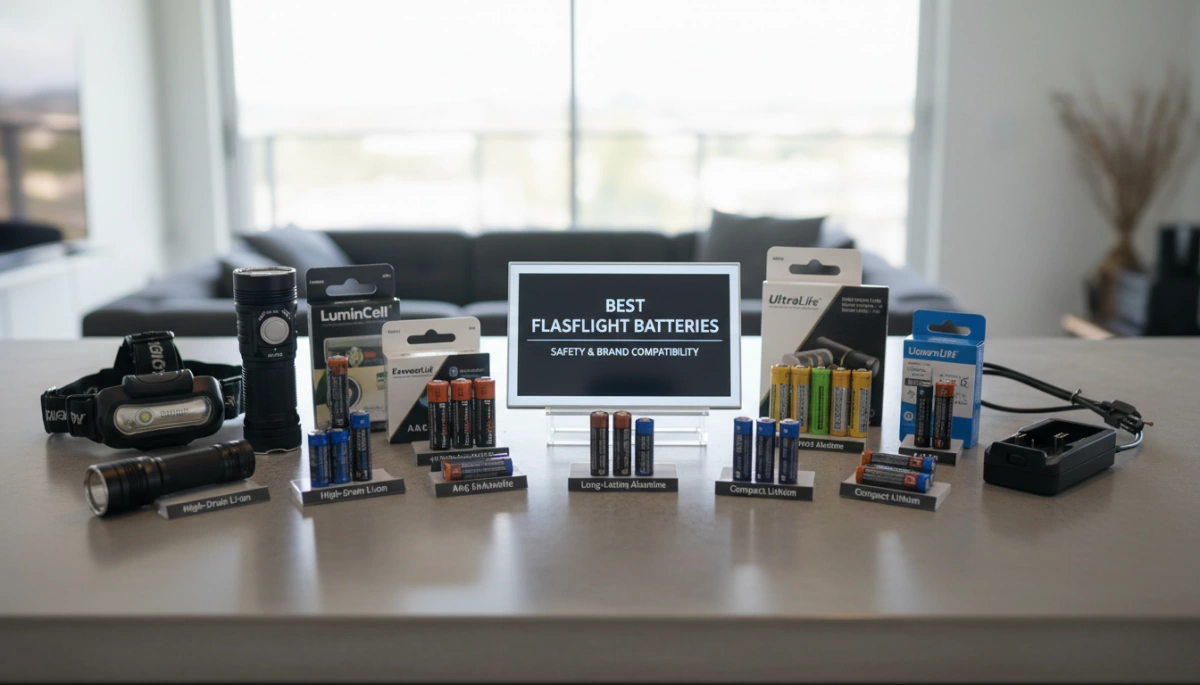
Best Flashlight Batteries Safety & Brand Compatibility

When dealing with high-performance illumination tools, the power source is just as critical as the LED emitter itself. Using sub-par power sources in professional-grade lights isn\’t just a performance bottleneck; it can be a safety hazard.

Why Generic Batteries Fail on \”Turbo\” Mode

You might wonder why a generic cell from a discount bin causes your flashlight to flicker or drop output immediately after activating \”Turbo\” mode. The answer lies in the Continuous Discharge Current (CDR). Modern tactical lights require a massive, instantaneous surge of amperage to reach peak lumens.

  • High Internal Resistance: Cheap cells cannot dump power fast enough, causing voltage sag.
  • Tripped Circuits: If the battery isn\’t a high-drain rechargeable battery, the sudden draw might trip its internal safety fuse, shutting the light off completely.
  • Heat Buildup: Inefficient power delivery generates excessive heat, wasting energy and potentially damaging the flashlight\’s driver.

The Importance of Matching Brands

We engineer our power solutions to match the specific physical and electrical tolerances of our lights. A standard 18650 might fit, but small variations in length—often due to the addition of a protection circuit or a built-in USB-C port—can prevent the tail cap from closing or cause rattling.

Furthermore, voltage matching is crucial. Using a dedicated 7V 2600mAh lithium-ion battery pack for light ensures that the driver receives steady voltage without overstressing the components. Mixing mismatched brands often leads to poor contact conductivity, especially if the cells lack the gold-plated contact points found on premium units.

Identifying Counterfeit Lithium Cells and Fire Risks

The market is flooded with re-wrapped batteries claiming impossible specs. If you see an 18650 claiming 9,000mAh capacity, it is a counterfeit. These fakes often lack an overcharge protection circuit (PCB) and proper thermal vents.

  • Weight Test: Quality lithium cells are dense. Fakes often feel suspiciously light.
  • Wrapper Quality: Look for misaligned labels or typos.
  • The Risk: Without thermal regulation and pressure relief valves, a short-circuited counterfeit cell can vent aggressively or catch fire, especially when pushed by a high-output flashlight. Always prioritize safety and verified specs over cheap pricing.

Frequently Asked Questions About Flashlight Batteries

Can I use a 21700 battery in an 18650 flashlight?

No, they won\’t fit. The numbers in the battery name refer to physical dimensions: a 21700 cell is 21mm wide and 70mm long, whereas an 18650 is 18mm wide and 65mm long. A 21700 is simply too thick to slide into a tube machined for the smaller 18650 standard. However, the reverse is often possible; many 21700 flashlights include a plastic sleeve adapter that allows you to use an 18650 as a backup power source.

What is the shelf life of a CR123A battery?

CR123A lithium primary batteries are the kings of storage. A high-quality cell typically offers a 10-year shelf life with minimal self-discharge. Unlike alkaline batteries that are prone to leaking and destroying electronics over time, CR123As remain stable and ready to fire even after sitting in a drawer or emergency kit for a decade. This reliability makes them the preferred choice for tactical applications and emergency backup lights.

Why do high-drain batteries get hot?

Heat is a byproduct of power. When you activate \”Turbo\” mode on a modern LED light, the driver pulls a massive amount of current—often exceeding 15 amps—from the high-drain rechargeable battery. This rapid energy transfer creates internal resistance, which generates heat. While our cells are engineered to handle high temperatures, your flashlight\’s thermal regulation system should step down the brightness to protect both the electronics and your hands.

Is it safe to leave lithium-ion batteries in the charger?

While quality chargers and protected cells feature an overcharge protection circuit to stop current flow once the battery hits 4.2V, we do not recommend leaving them on the charger indefinitely. Continuous \”topping off\” or micro-cycles can degrade the battery chemistry over time. To maximize the lifespan of your cells, remove them once the indicator turns green. Understanding the nuances of how to trickle charge a 18650 battery pack can help you maintain optimal performance and safety for your power sources.

24V Power Wheels Battery Benefits Features and Care Guide

Is your child’s outdoor adventure constantly cut short by a dead battery?

We’ve all been there: a disappointed kid and a heavy toy car stuck in the grass.

The truth is, stock batteries often lack the power needed for real fun.

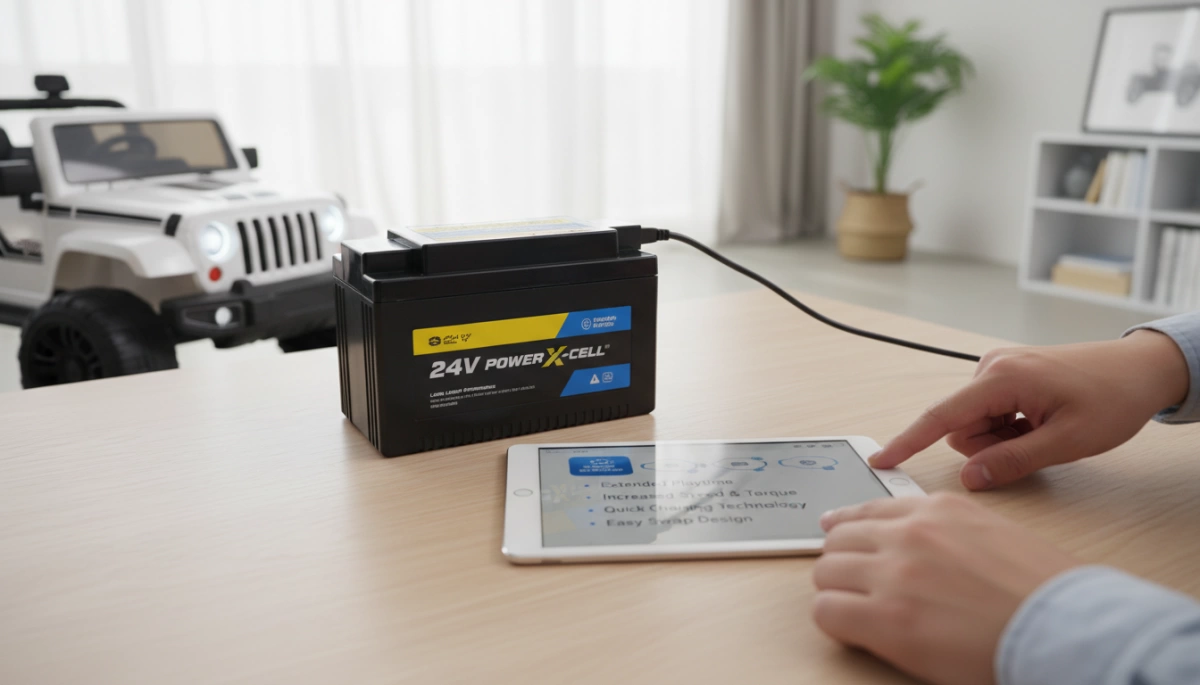
But upgrading to a robust 24V Power Wheels battery can transform that sluggish ride into a high-performance machine.

In this guide, you’re going to discover exactly how to boost runtime, increase speed, and ensure safety with the right power source.

We’ll break down the massive benefits of switching to lithium, the essential features to look for, and the maintenance tips that keep the fun going for years.

Ready to supercharge playtime?

Let’s get started.

What Is a 24V Power Wheels Battery?

A 24V Power Wheels battery represents a significant step up in the world of electric ride-on toys, acting as the powerhouse for vehicles designed for older children and rougher terrains. Unlike the standard 6V or 12V systems found in starter toys, a 24V system delivers the necessary torque and speed to move heavier loads effectively. At Nuranu, we specialize in high-tech rechargeable lithium battery packs that redefine how these systems operate, moving beyond simple energy storage to become intelligent power management solutions.

Understanding Voltage Basics and Setups

In the realm of 24V ride on toy battery configurations, voltage dictates power. A 24V system provides double the electrical pressure of a 12V setup, resulting in higher top speeds and better hill-climbing ability.

  • Series vs. Native Packs: Traditionally, some manufacturers achieved 24V by wiring two heavy 12V lead-acid batteries in a series connection. However, modern engineering favors native 24V packs.
  • Our Approach: We utilize advanced Lithium-Ion (18650, 21700) and LiFePO4 cells to create integrated 24V platforms. This ensures consistent power delivery without the complexity or weight of daisy-chaining multiple smaller units.

Comparing Sealed Lead-Acid vs. Modern Lithium Options

The shift from lead acid vs lithium Power Wheels battery technology is where we see the most dramatic performance improvements. While Sealed Lead-Acid (SLA) batteries have been the industry standard for decades, they are heavy, slow to charge, and degrade quickly.

By transitioning to our lithium technologies, we offer distinct advantages rooted in our manufacturing capabilities:

  • Weight Reduction: Our lithium solutions offer a 70% weight reduction compared to traditional lead-acid equivalents. This drop in weight instantly improves the vehicle’s power-to-weight ratio, reducing strain on motors.
  • Longevity: We engineer batteries to provide triple the lifespan of standard lead-acid units. This means fewer replacements and better long-term value.
  • Efficiency: With high energy density, our packs support extended range and rapid charging cycles, minimizing downtime between play sessions.

Compatibility and Age Appropriateness

A 24V Power Wheels upgrade is typically geared toward children aged 5 to 10 years. These vehicles are larger, faster, and often mimic real-world SUVs or ATVs. Because safety and reliability are paramount for this age group, our batteries include advanced Battery Management Systems (BMS). This technology provides real-time monitoring and protection, ensuring that the higher power output remains safe for residential use. Whether for custom prototypes or scalable manufacturing, we design our 24V solutions to integrate seamlessly with standard platforms, offering a “drop-in” level of convenience for upgrading fleet performance.

Key Benefits of a 24V Battery for Power Wheels

24V Power Wheels Battery Benefits and Features

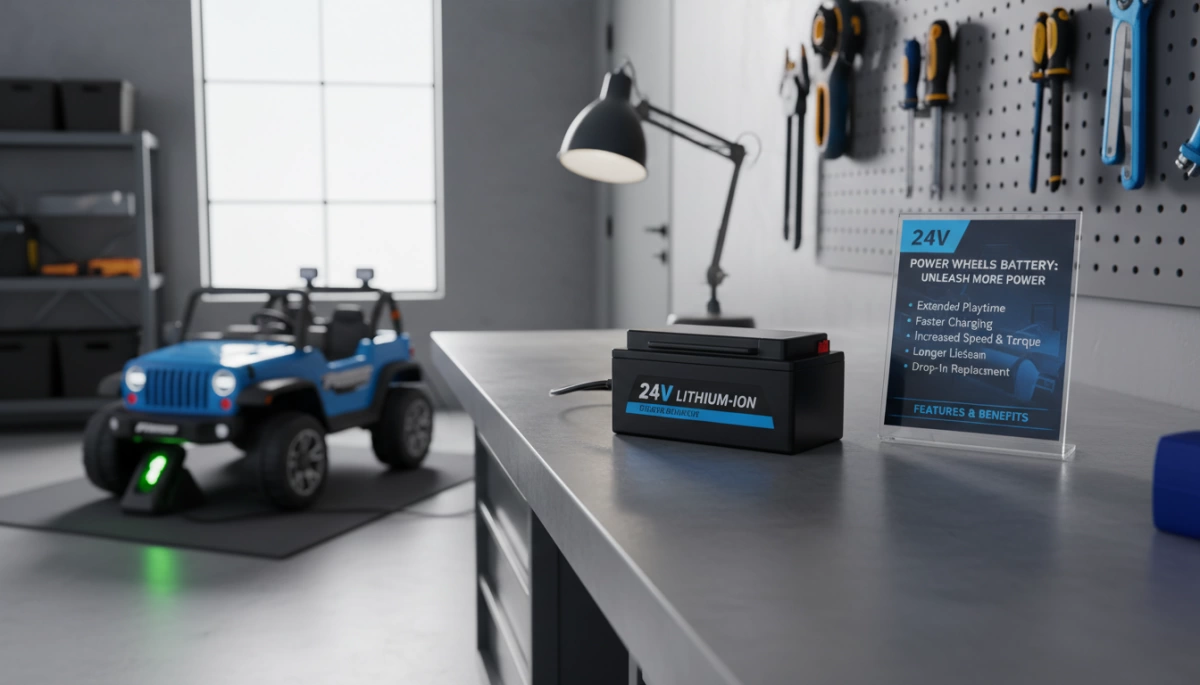
Upgrading to a high-performance 24V ride on toy battery transforms the driving experience from sluggish to spirited. As a manufacturer with over 10 years of industry experience, I have seen firsthand how shifting from traditional lead-acid to modern lithium technology impacts performance. The difference isn’t just in raw speed; it is about efficiency, handling, and long-term value.

Enhanced Performance and Hill-Climbing Power

A standard Power Wheels 24 volt upgrade delivers immediate torque improvements. Unlike older batteries that struggle under load, our lithium solutions maintain a high energy density. This provides the consistent power necessary for traversing rough terrain, making these the ideal Power Wheels hill climbing battery. The optimized discharge rates ensure that the vehicle doesn’t bog down on grass or gravel, keeping the 24V kids ride on speed steady even when the going gets tough.

Extended Runtime and Consistent Output

One of the biggest frustrations for parents is a toy that dies after 20 minutes. Modern lithium packs offer significantly longer 24V Power Wheels runtime due to superior energy density. Furthermore, the power curve is flat; the vehicle runs at full power until the battery is depleted, rather than gradually slowing down like lead-acid equivalents. For those interested in the technical backbone of high-capacity packs, understanding the advantages of the 26650 lithium-ion battery reveals why specific robust cell formats are essential for delivering this sustained energy.

Weight Reduction and Motor Longevity

Weight is a critical factor in electric mobility. Our lithium battery packs offer a 70% weight reduction compared to traditional lead-acid units.

  • Improved Handling: A lighter battery lowers the vehicle’s center of gravity and improves agility.
  • Reduced Strain: Less weight means the electric motors work less to move the vehicle, reducing wear and tear on gears and wiring.
  • Easier Swaps: Parents can easily remove and recharge the battery without lugging around a heavy lead block.

Long-Term Value and Durability

While the initial investment might be higher, the longevity of lithium makes it the smarter financial choice. These batteries offer triple the lifespan of lead-acid alternatives. Combined with weather-resistant construction and advanced thermal management, a quality 24V lithium battery withstands extreme temperatures and years of use, eliminating the need for frequent seasonal replacements.

Feature Traditional Lead-Acid Nuranu Lithium Upgrade
Weight Heavy (Strains motors) 70% Lighter (Improves agility)
Lifespan 300-500 Cycles 3x Longer Lifespan
Power Delivery Fades as battery drains Consistent 100% output
Maintenance Requires care/topping off Maintenance-free

Essential Features to Look for in a Quality 24V Battery

24V Power Wheels Battery Features and Benefits

When selecting a 24V Power Wheels battery, looking beyond just the voltage label is critical for ensuring safety and performance. We focus on specific technical standards that separate reliable power sources from generic replacements.

Battery Chemistry: Why Lithium Beats Lead-Acid

The most significant upgrade you can make is switching from heavy sealed lead-acid (SLA) units to modern lithium technology. Specifically, we utilize LiFePO4 battery architectures because they offer superior stability and longevity. Unlike lead-acid batteries that degrade quickly, our lithium solutions provide triple the lifespan and a 70% weight reduction. This drop in weight instantly improves the power-to-weight ratio of the vehicle, reducing strain on the motor while extending runtime.

The Critical Role of a Built-in BMS

For any lithium 24V battery for kids car applications, a Battery Management System (BMS) is non-negotiable. This integrated circuit acts as the brain of the battery. Our advanced BMS provides real-time monitoring and predictive diagnostics to ensure rider safety. It actively balances cells and cuts power if it detects short circuits, over-voltage, or extreme temperatures, preventing the thermal risks associated with unprotected lithium cells.

Capacity and Discharge Rates

24V Power Wheels runtime depends heavily on capacity (measured in Amp-hours or Ah) and discharge efficiency. High-performance toys require a battery that can deliver sustained power without sagging.

  • High Energy Density: We optimize our packs to hold more energy in a smaller footprint, allowing for extended play sessions.
  • Sustained Discharge: Our designs ensure consistent power delivery, so the vehicle doesn’t slow down significantly as the battery drains.

Fast Charging and Certifications

A quality battery should minimize downtime. Our lithium solutions support rapid charging cycles, getting the vehicle back in action much faster than standard lead-acid chargers allow. Furthermore, safety claims must be backed by documentation. We maintain a 98.5% quality pass rate with 100% End-of-Line (EOL) testing. Always verify that the battery carries global certifications such as UN38.3, CE, UL, and IEC 62133 to ensure it meets strict international safety standards.

Feature Lead-Acid (SLA) Nuranu Lithium (LiFePO4) Benefit
Weight Heavy 70% Lighter Better handling & speed
Lifespan Short (300~ cycles) 3x Longer Long-term value
Safety Basic fuses Advanced BMS Active protection
Charging Slow (8-12 hrs) Rapid Charging Less downtime

Safety Considerations for 24V Power Wheels Batteries

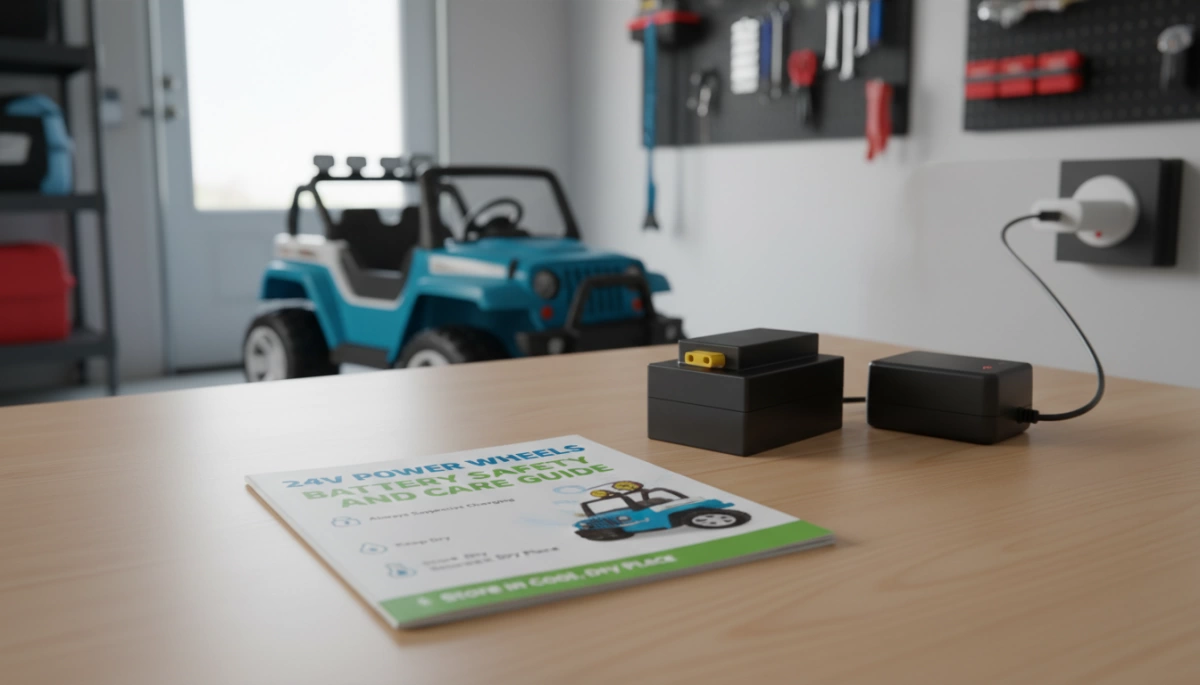
24V Power Wheels Battery Safety and Care Guide

Upgrading a ride-on toy to a 24V system unlocks serious power, but it also demands a stricter focus on safety protocols. Moving from a standard 12V setup to 24V doubles the potential voltage, resulting in significantly higher speeds and torque. As a manufacturer committed to reliability, we emphasize that safety is engineered into the battery itself, but operational awareness is just as important for parents.

Age Guidelines and Speed Management

A 24V Power Wheels upgrade transforms a slow toy into a machine capable of speeds that can surprise inexperienced drivers. Because of the increased acceleration and top speed, 24V systems are generally recommended for children aged 5 to 10 years old who have developed better hand-eye coordination.

  • Weight Limits: Adhere strictly to the vehicle’s chassis weight limits. While our lithium batteries offer a 70% weight reduction compared to lead-acid, the rider’s weight combined with the higher speed puts more stress on the toy’s gears and braking systems.
  • Soft-Start Modules: We strongly advise installing a soft-start controller (PWM). This feature ramps up the power gradually rather than delivering a sudden jolt of 24V electricity, preventing whiplash and reducing mechanical stress on the gearbox.

24V Lithium BMS Protection vs. Lead-Acid Risks

The most critical safety component in modern battery technology is the Battery Management System (BMS). Traditional lead-acid batteries lack intelligence; they can overheat or leak acid if the casing is compromised. In contrast, our lithium solutions are designed with integrated 24V lithium BMS protection to actively manage risks.

Our advanced BMS provides real-time monitoring to ensure:

  • Thermal Runaway Prevention: The system detects abnormal temperature spikes and cuts power before the battery can overheat, a crucial feature for 24V Power Wheels safety features.
  • Short Circuit Protection: Instant shutdown in the event of a wiring fault to prevent electrical fires.
  • Over-Discharge Defense: Prevents the cells from draining to unsafe levels, which protects the battery’s chemical integrity.

Charging Protocols for Accident Prevention

Proper kids electric car battery care relies heavily on using the correct charging equipment. A common mistake is attempting to charge a lithium battery with an old lead-acid charger. This is dangerous because lead-acid chargers do not have the precise voltage cutoff required for lithium chemistry.

To ensure safety and longevity:

  1. Match the Charger: Always use a charger specifically rated for the battery’s chemistry (LiFePO4 or Li-ion) and voltage platform.
  2. Monitor Connections: Ensure connectors (like Anderson Powerpole or XT60) are secure and free of debris to prevent resistance heating.
  3. Cool Down: Allow the battery to cool to room temperature after a high-speed run before plugging it in.

How to Care for Your 24V Power Wheels Battery

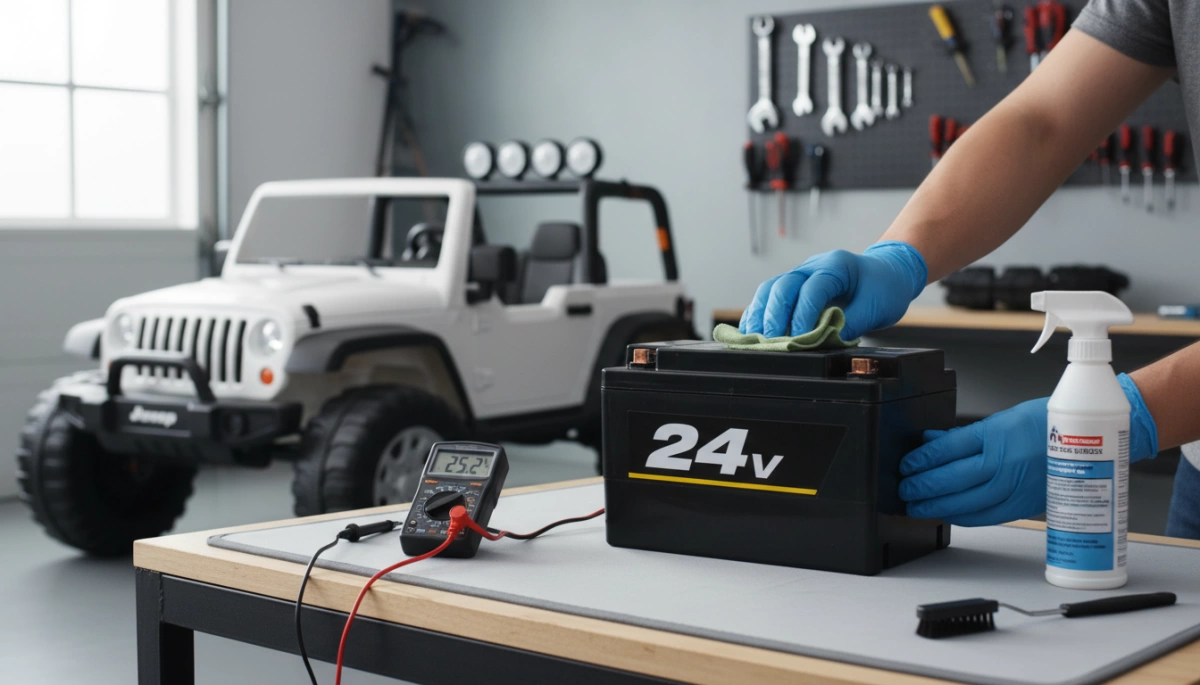
24V Power Wheels Battery Care and Maintenance

To ensure your investment lasts through years of play, following proper 24V battery charging tips is non-negotiable. While our lithium packs are engineered for durability with a 98.5% quality pass rate, user habits play a massive role in maintaining that performance.

Smart Charging Practices

The most critical rule is matching your charger to the battery chemistry. If you have upgraded to a 24V LiFePO4 battery, you must use a lithium-specific charger. Using an old lead-acid charger can damage the cells or fail to reach a full charge because the voltage algorithms differ.

  • Avoid Extreme Temperatures: Never charge a lithium battery when it is freezing (below 32°F/0°C). While our R&D focuses on thermal management for discharge, charging in extreme cold can cause permanent damage.
  • Don’t Overcharge: Our advanced Battery Management System (BMS) protects against overcharging, but it is best practice to unplug the battery once the indicator turns green.

Daily and Seasonal Maintenance

Power Wheels battery maintenance is significantly easier with lithium than traditional options since there is no fluid to top off. However, simple upkeep ensures safety and reliability.

  • Clean Connections: Dirt and corrosion on terminals increase resistance, leading to heat buildup. Wipe them down periodically.
  • Winter Storage: If the toy won’t be used for months, store the battery at approximately 50% charge in a dry, room-temperature area. Unlike lead-acid batteries that die quickly in storage, our lithium packs have a low self-discharge rate and will be ready for spring.

Troubleshooting Common Issues

If you notice performance drops, basic kids electric car battery care involves checking the system before blaming the battery.

  • Sudden Shutdowns: If the car stops on steep hills, the BMS likely cut power to prevent overheating or over-current damage. This is a safety feature, not a defect.
  • Short Runtime: Verify that the charger is actually outputting current. A faulty charger is often the culprit behind a battery that seems to “die fast.”
  • Voltage Drops: Loose wiring in the vehicle can cause voltage sag. Ensure all connections are tight to handle the high continuous discharge rates of modern 24V systems.

Lithium vs. Lead-Acid: Why Many Parents Are Switching

When upgrading a 24V kids ride on speed machine, the choice between traditional sealed lead-acid (SLA) and modern lithium technology is the biggest decision you’ll make. At Nuranu, we see a massive shift occurring as parents realize that sticking with older battery tech limits the potential of high-performance toys. The Lead acid vs lithium Power Wheels battery debate ultimately comes down to performance, longevity, and convenience.

Weight Reduction and Terrain Performance

The most immediate difference you will notice is the weight. Our lithium solutions offer a 70% weight reduction compared to standard lead-acid batteries. In a toy car, shedding that dead weight translates directly to better acceleration and significantly less strain on the motor and gearbox. This weight advantage makes a lithium pack the ultimate Power Wheels hill climbing battery, allowing the vehicle to tackle grass, gravel, and rough terrain without bogging down or overheating the motors.

Lifespan and Cost Efficiency

While lead-acid units might appear cheaper upfront, the long-term value heavily favors lithium.

  • Triple the Lifespan: Our batteries are engineered to last three times longer than traditional lead-acid equivalents, meaning you aren’t buying replacements every season.
  • Sustained Voltage: Unlike SLA batteries that lose power as they drain, causing the car to slow down, our lithium cells provide consistent voltage. This ensures the 24V Power Wheels runtime remains at full speed until the battery is depleted.
  • Maintenance-Free: We design our packs for “drop-in” simplicity with no maintenance required—no water checking or terminal cleaning needed.

Understanding the broader applications of rechargeable lithium polymer battery packs highlights why this technology is superior for high-drain devices like ride-on cars. By switching to lithium, you are investing in a safer, faster, and more reliable play experience that lasts for years.

Are AA Batteries Lithium Lithium Metal AA vs Li Ion Explained

You might be wondering if that expensive pack of Lithium AA batteries is actually worth the hype…

Or if putting a high-voltage Li Battery in your TV remote is a recipe for disaster.

Here is the short answer: Are AA Batteries Lithium? usually, no. Most are still standard alkaline.

But the ones that are lithium change the game entirely.

There is a massive difference between Lithium Metal AA (disposable powerhouses) and Lithium-Ion (rechargeable tech).

Confusing them can fry your electronics or simply drain your wallet.

As battery experts, we are going to cut through the marketing noise. In this guide, you’ll learn the exact chemistry differences, performance specs, and how to choose the right power source for your specific device.

Let’s dive in.

What Does “Lithium AA Battery” Actually Mean?

We often see confusion when clients ask for Lithium AA batteries. It is a loaded term because “AA” refers strictly to the physical dimensions—roughly 14.5mm by 50.5mm—not the chemical energy inside. Whether it is powering a TV remote or a high-end tactical flashlight, the size remains the standard, but the engine driving that power varies significantly.

Defining AA as a Size Standard, Not a Chemistry

At Nuranu, we engineer custom battery packs daily, and the first thing we clarify is that form factor does not equal chemistry. An AA battery is simply a vessel. While most consumers are used to standard alkaline cells, the AA battery types comparison actually spans three distinct chemistries, each with unique behaviors:

  • Alkaline: The standard, disposable everyday battery found in grocery stores.
  • Lithium Metal (Primary): High-performance, non-rechargeable batteries (often labeled as Lithium Iron Disulfide).
  • Lithium-Ion (Li-ion): Secondary, rechargeable batteries that offer high cycle life and energy density.

Distinguishing Between Alkaline, Lithium Metal, and Li-ion

Understanding the difference between Lithium metal vs lithium ion is critical for both safety and performance. Primary lithium batteries (Lithium Metal) are designed as direct replacements for alkaline; they are disposable and built for longevity. In contrast, Lithium-ion technology focuses on rechargeability and high power output. You cannot simply swap them blindly without understanding the voltage specifications.

Busting the 3.7V vs. 1.5V Voltage Myth

This is the most dangerous misconception we encounter. Standard alkaline and Lithium Metal AA batteries operate at a nominal voltage of 1.5V. This is safe for almost all household electronics.

However, a raw Lithium-ion cell in an AA form factor (technically known as a 14500 cell) typically operates at 3.7V. That is more than double the voltage of a standard AA. If you put a 3.7V Li-ion cell into a device designed for 1.5V Alkaline vs lithium AA, you risk instantly frying the circuit board. Always check if your device supports the higher voltage or if the battery has a built-in step-down regulator.

Lithium Metal AA Batteries: The Primary Powerhouse

When you see a battery labeled “Lithium” that looks exactly like a standard AA and isn’t rechargeable, you are looking at a Primary Lithium Battery. In the engineering world, we refer to this specific chemistry as Lithium Iron Disulfide (Li-FeS₂). Unlike the rechargeable lithium-ion packs we design for custom industrial applications, these cells are built for single use, offering a massive performance upgrade over traditional alkaline cells without changing the form factor.

The 1.5V Advantage

The most critical spec here is the voltage. A 1.5V lithium AA is designed to be a direct replacement for standard alkaline batteries. This is distinct from the 3.7V nominal voltage found in a standard 18650 battery or other secondary lithium cells. By maintaining that 1.5V standard, these batteries provide a safe, high-energy solution for everything from TV remotes to high-end photography equipment without frying the electronics.

Why Li-FeS₂ Beats Alkaline

We recommend Lithium AA batteries for critical applications because of their superior discharge profile.

  • Flat Voltage Curve: Alkaline batteries lose voltage steadily as they drain, causing devices to run sluggishly. Lithium metal holds a steady 1.5V output until the cell is almost completely depleted.
  • High Capacity: You typically get around 3000mAh of capacity, which can last up to 6x longer than alkaline in high-drain devices like digital cameras.
  • Zero Leakage: Unlike alkaline cells containing potassium hydroxide that can corrode your electronics, Lithium iron disulfide batteries are constructed differently and do not leak inside your expensive gear.

Built for Extremes

One of the standout features of this chemistry is cold weather battery performance. Standard batteries fail near freezing, but lithium metal cells operate effectively from -40°F to 140°F (-40°C to 60°C). Combined with a shelf life that can exceed 20 years, they are the undisputed choice for emergency kits, outdoor sensors, and reliable backup power.

Lithium-Ion (Li-ion) Batteries: Rechargeable Alternatives

Lithium Ion AA Batteries vs Lithium Metal Cells

When we discuss rechargeable AA lithium options, we are usually referring to two distinct types of technology. It is critical to distinguish between raw industrial cells and consumer-ready replacements to avoid damaging your electronics.

Standard 3.7V Li-ion Cells (14500) vs. AA Form Factor

In the industrial battery world, the AA size is technically known as the 14500 cylindrical cell (14mm diameter, 50mm length). While these fit physically into an AA slot, they operate at a nominal voltage of 3.7V, which is more than double the voltage of a standard 1.5V alkaline battery.

If you insert a raw 3.7V 14500 cell into a standard TV remote or toy, you will likely fry the circuit board instantly. These high-voltage cells are designed for high-drain applications like tactical flashlights or custom battery packs where we series-connect cells for higher voltage platforms. Understanding the charging voltage for 3.7V lithium-ion batteries is essential for safely managing these powerful cells in custom projects.

How 1.5V Regulated Li-ion AA Batteries Work

To bridge the gap between high-performance lithium chemistry and standard household devices, engineers developed voltage-regulated lithium-ion AA batteries. These are sophisticated units that integrate a tiny Battery Management System (BMS) and a buck converter directly inside the cell casing.

  • Internal Chemistry: Uses a standard 3.7V lithium-ion core.
  • Regulation: The internal circuit steps the voltage down to a constant 1.5V output.
  • Result: A drop-in rechargeable replacement that mimics the voltage of alkaline but provides the power density of lithium.

Pros and Cons: High Cycle Life vs. Initial Cost

Switching to rechargeable lithium requires a shift in how you view battery costs. While the upfront price tag is higher, the performance metrics justify the investment for frequent users.

  • Cycle Life: A high-quality Li-ion AA can withstand 500 to 1,000 charge cycles.
  • Voltage Stability: unlike alkaline batteries that lose voltage as they drain, regulated lithium AAs provide steady power until the very end.
  • Long-Term Value: Although the initial cost is higher, our data suggests these batteries are effectively 62% cheaper over their lifespan compared to constantly buying disposables.

Head-to-Head Comparison: Lithium Metal AA vs. Lithium-Ion vs. Alkaline

Lithium Metal AA vs Lithium Ion vs Alkaline Batteries

When we engineer battery solutions at Nuranu, we look at the raw data. Choosing between Alkaline vs lithium AA or rechargeable Li-ion isn’t just about price—it’s about how the chemistry behaves under load. Here is the breakdown of how these three distinct chemistries stack up in real-world performance.

Nominal Voltage and Energy Density

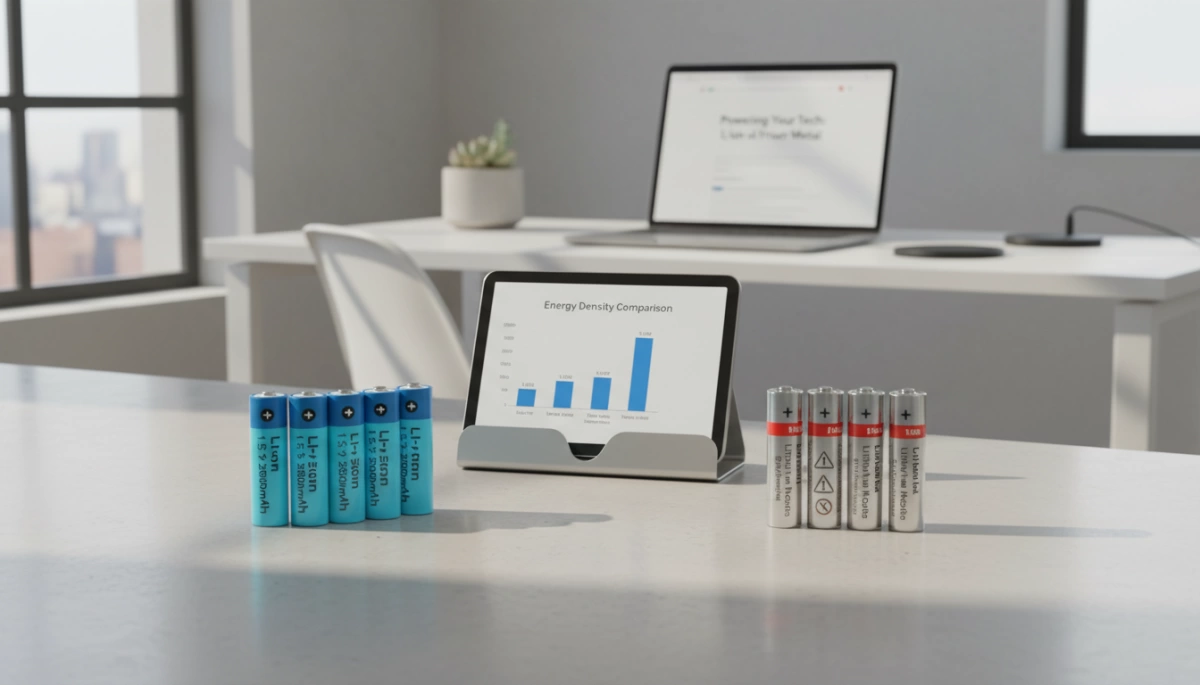
Lithium battery energy density is the game-changer here. Standard alkaline batteries start at 1.5V but suffer from a steep voltage drop; as you use them, they get weaker. Primary lithium batteries (Lithium Metal) maintain a rock-steady 1.5V output until they are nearly depleted, offering 3-6x the energy density of alkaline cells (200–300 Wh/kg).

Lithium-ion (Li-ion) sits in a different class. A standard Li-ion cell (like the 14500 size) operates at a nominal 3.7V. While this is powerful, it requires specific device compatibility. However, the chemistry used in these cells is scalable; the same high-performance tech found in a single cell is what we use to build larger 24V 18650 lithium-ion battery packs for electric mobility.

Shelf Life and Leakage Risks

If you have ever opened a remote to find white crusty corrosion, you have seen alkaline failure. Alkaline batteries use a water-based electrolyte that can leak potassium hydroxide. Lithium AA batteries (specifically Lithium Iron Disulfide) use a non-aqueous electrolyte, effectively eliminating leakage risks.

  • Alkaline: 5-10 year shelf life (prone to leakage).
  • Lithium Metal: 15-20 year battery shelf life (extreme stability).
  • Li-ion: Rechargeable, so shelf life is measured in cycles (500+), though they do have a slow self-discharge rate if left unused for months.

Cost Per Use and Lifetime Value

Alkaline wins on the sticker price, but Lithium Metal vs lithium ion is where the real value battle happens. While lithium options have a higher upfront cost, our data shows they are roughly 62% cheaper long-term due to lifespan and efficiency. You buy fewer batteries and get consistent performance, especially in high-drain devices where alkaline cells die prematurely.

Feature Alkaline AA Lithium Metal AA (Primary) Li-ion 14500 (Rechargeable)
Chemistry Zinc-Manganese Dioxide Lithium Iron Disulfide (Li-FeS2) Lithium-Ion
Voltage 1.5V (Drops quickly) 1.5V (Constant) 3.7V (Nominal)
Rechargeable No No Yes (500+ Cycles)
Capacity ~2500 mAh (Low drain only) ~3000-3500 mAh ~800-1000 mAh (at 3.7V)
Best For Clocks, Remotes Cameras, Extreme Cold Flashlights, Custom Electronics

Compatibility and Safety: Will Lithium Batteries Damage Your Devices?

The short answer is: it depends entirely on the voltage. At Nuranu, we engineer custom battery systems daily, and we know that mismatching voltage is the fastest way to fry sensitive electronics. Understanding the difference between a direct replacement and a high-voltage industrial cell is critical for device safety.

Safety of 1.5V Lithium Metal Replacements

If you are using 1.5V lithium AA batteries (Lithium Iron Disulfide), your devices are perfectly safe. These cells are engineered specifically to mimic the voltage profile of standard alkaline batteries.

  • Drop-in Compatibility: They work seamlessly in digital cameras, flashlights, and toys designed for 1.5V.
  • No Over-Voltage Risk: The nominal voltage is identical to fresh alkaline cells, so there is no risk of overpowering the circuit.
  • Leak-Proof Construction: Unlike alkaline batteries that use corrosive potassium hydroxide, lithium metal cells are sealed under high pressure and rarely leak, protecting your expensive gear from internal corrosion.

Risks of Using Unregulated 3.7V Li-ion in Standard Devices

This is where users often get into trouble. A standard Lithium-ion AA (often labeled as a 14500 cell) typically operates at a nominal 3.7V.

  • Voltage Mismatch: Putting a 3.7V battery into a device built for 1.5V delivers more than double the expected voltage. This will almost certainly burn out the bulb, motor, or circuit board instantly.
  • Physical Fit: Because 14500 cells are the same physical size as AA, it is easy to make this mistake. Always check the label for voltage ratings before installation.
  • Chemistry Differences: Just as it is important to know are all 18650 batteries rechargeable when dealing with larger packs, you must verify if your AA-sized cell is a primary (disposable) or secondary (rechargeable) chemistry to avoid charging accidents.

The Role of Protection Circuits and Certifications

For modern applications, we recommend voltage regulated lithium ion AA batteries. These contain a tiny internal circuit (BMS) that steps the native 3.7V down to a safe 1.5V output.

  • BMS Protection: A quality Battery Management System prevents over-discharge, over-charging, and short circuits.
  • Certifications: Reliable lithium batteries should meet global safety standards like UN38.3 and IEC 62133.
  • Thermal Management: High-quality cells include PTC (Positive Temperature Coefficient) devices to prevent overheating during high-drain use.

Whether you are powering a custom robotics project or consumer electronics, ensuring your power source has the correct voltage and safety certifications is non-negotiable.

When to Choose Lithium AA Over Alkaline or NiMH

Selecting the right power source isn’t just about fitting the slot; it is about matching the chemistry to the application’s energy demand. At Nuranu, we see firsthand how choosing the wrong cell leads to device failure or wasted budget. Here is the breakdown of when to upgrade to lithium and when to stick with standard options.

Low-Drain Devices: When to Stick with Alkaline

For devices that sip power slowly over months or years—like TV remotes, wall clocks, or smoke detectors—standard alkaline vs lithium AA comparisons often favor alkaline purely on upfront cost. These devices do not require the high current delivery or the flat voltage curve of lithium. Paying a premium for high-performance cells in a remote control is unnecessary overhead. However, always be wary of alkaline leakage in expensive electronics if left unchecked for years.

High-Drain Gear: Why Lithium Metal Rules

When powering high drain battery performance equipment like digital cameras, tactical flashlights, or medical devices, primary Lithium Metal AA (Li-FeS2) is the superior choice. Alkaline batteries suffer from severe voltage sag under heavy load, often losing up to 75% of their capacity. In contrast, lithium metal maintains a steady 1.5V output and is significantly lighter.

This chemistry is also critical for outdoor applications. If your gear operates in freezing conditions, such as trail cameras or outdoor sensors, lithium is mandatory. We often compare the resilience of these cylindrical cells to other primary lithium formats, similar to the durability differences seen in 3V coin cells vs cylinders, where form factor and chemistry dictate performance in extreme environments (-40°F to 140°F).

Frequent Users: The Economics of Regulated Li-ion

For daily users—think gaming controllers, wireless microphones, or VR headsets—single-use batteries are a financial drain. This is where rechargeable AA lithium (regulated 1.5V Li-ion) becomes the logical investment. While the initial price is higher, the long-term value is undeniable.

  • Cycle Life: A regulated Li-ion AA can be recharged 500+ times.
  • Voltage Stability: Unlike NiMH which drops to 1.2V (making devices think they are low on power), regulated Li-ion holds 1.5V until depletion.
  • Cost Efficiency: Despite the higher sticker price, switching to rechargeable lithium is roughly 62% cheaper long-term compared to constantly replacing alkalines.

Quick Selection Guide

Application Recommended Battery Why?
TV Remotes / Clocks Alkaline Low cost, low energy demand.
Digital Cameras / Flashlights Lithium Metal (Primary) Handles high power spikes, lightweight.
Outdoor Sensors Lithium Metal (Primary) Superior cold weather battery performance.
Gaming Controllers Regulated Li-ion (Rechargeable) 1.5V constant output, saves money over time.

The Bigger Picture: Why Lithium Technology Matters

Lithium Metal vs Li AA Battery Energy Impact

The shift toward lithium isn’t just a trend; it is a necessity driven by the physics of lithium battery energy density. At Nuranu, we engineer systems that achieve 200–300 Wh/kg, offering three to six times the capacity of legacy alkaline technology. This efficiency allows modern devices to be lighter and run significantly longer between charges or replacements.

From an environmental perspective, the math is simple. One high-quality rechargeable lithium cell can replace hundreds of disposable alkaline batteries over its lifespan, drastically reducing landfill waste. As electronics evolve—becoming faster and more power-hungry—the high internal resistance of older battery types simply cannot keep up. Whether it is for portable electronics or critical systems designed for backup power, the stability of lithium chemistry is unmatched. This technology is the backbone of the future of high-performance electronics, enabling innovations in robotics, medical equipment, and IoT devices that require consistent, reliable power delivery.

Frequently Asked Questions

Are all AA batteries lithium?

No. The vast majority of AA batteries on the market are alkaline (Zinc-Manganese Dioxide). A Lithium AA battery is a specific high-performance type designed for demanding applications. While they look identical in size to fit standard devices, the internal chemistry is completely different. Lithium variants offer significantly higher energy density (200–300 Wh/kg) and are roughly 33% lighter than their alkaline counterparts.

Can you recharge lithium AA batteries?

This is a critical distinction. Primary lithium metal batteries (typically 1.5V Li-FeS2) are disposable and must never be recharged, as doing so can cause venting or fire. However, rechargeable AA lithium options exist, usually based on Lithium-ion chemistry (often labeled as 14500 cells or regulated 1.5V Li-ion). These are designed for hundreds of cycles. Just like you need the right equipment to safely charge an 18650 battery, rechargeable AA lithium cells require compatible chargers to manage their specific voltage requirements.

Are lithium AA batteries worth the extra cost?

For high-drain devices, the answer is a definitive yes. While the upfront cost is higher than alkaline, lithium AA batteries can last 3x to 6x longer in power-hungry gear like digital cameras, medical equipment, or flashlights. In our analysis of industrial applications, switching to lithium often results in a 62% lower long-term cost because you replace them far less frequently. For low-drain devices like TV remotes, however, standard alkaline is usually sufficient.

What is the difference between lithium and lithium-ion?

The terms are often confused, but the difference lies in rechargeability:

  • Lithium (Primary): Non-rechargeable. It uses a metallic lithium anode and provides a steady 1.5V. It is designed for single use with a massive shelf life (10-15 years).
  • Lithium-ion (Secondary): Rechargeable. These cells move lithium ions between the cathode and anode. They typically operate at a higher nominal voltage (3.7V) or use internal regulation to mimic 1.5V.

Do lithium batteries leak?

Generally, no. Alkaline batteries are notorious for leaking corrosive potassium hydroxide, which can ruin electronics. Lithium metal vs lithium ion batteries both utilize superior sealing technology and non-aqueous electrolytes. This makes them the safest choice for expensive digital electronics that may sit in storage for extended periods.

Are lithium batteries safe in extreme cold?

Yes, they excel in these conditions. Cold weather battery performance is a major weakness for alkaline batteries, which often fail near freezing. In contrast, Nuranu’s lithium technology is engineered to operate reliably in temperatures ranging from -40°C to 60°C (-40°F to 140°F), making them the industry standard for outdoor sensors and winter equipment.

How Many Amps Does a 9V Battery Have A Clear Power Output Guide

When clients approach us with power requirements, the most common confusion lies in the difference between how much energy a battery holds and how fast it can release it. Asking “How many amps does a 9V battery have?” is a bit like asking how fast a car is—it depends on the engine design and the fuel system. In the battery world, this comes down to chemistry and internal construction. To engineer a reliable power system, we first need to distinguish between the flow of energy and the storage of energy.

Defining Amperes (Current Flow) vs. Amp-Hours (Capacity)

It is critical to separate two distinct concepts that often get swapped in casual conversation: Amperes (Amps) and Amp-Hours (Ah or mAh).

  • Amperes (Current): This is the “flow rate” of electricity. It measures how much current the battery is pushing out at any given second. Think of this as the diameter of a pipe; a wider pipe allows more water to flow through instantly.
  • Amp-Hours (Capacity): This represents the total “fuel tank” size. A 9V battery capacity mAh rating tells you how long the battery can sustain a specific load before it dies.

At Nuranu, we design custom lithium solutions where these two metrics are balanced based on the application. A high-capacity battery is useless if it cannot deliver the continuous discharge current required to start a motor or power a high-drain device.

Internal Mechanics: How a Standard 9V Battery Works

A standard 9V battery isn’t a single block of energy; it is actually a pack of smaller cells wired in series. Inside a typical alkaline 9V casing, you will often find six cylindrical AAAA cells (1.5V each) stacked together to reach the 9V nominal voltage.

This construction method directly impacts performance. Because the current must travel through multiple connection points and smaller cells, the battery naturally faces physical limitations. In contrast, our custom lithium platforms utilize optimized cell chemistries (like 18650 or 21700) and advanced Battery Management Systems (BMS) to streamline this flow, reducing energy loss and improving structural integrity.

The Role of Ohm’s Law and Internal Resistance in Output

The biggest limiting factor for 9V battery maximum current is internal resistance. Every battery has some level of resistance inside it that fights against the flow of electricity.

According to Ohm’s Law ($I = V/R$), Current ($I$) is determined by Voltage ($V$) divided by Resistance ($R$).

  • High Internal Resistance: Standard alkaline 9V batteries have relatively high internal resistance. If you try to draw too many amps, the voltage drops significantly (voltage sag), and the battery heats up.
  • Low Internal Resistance: Lithium chemistries, which we utilize in our custom packs, have much lower internal resistance. This allows for higher discharge rates without significant voltage drop.

For professional applications, understanding this resistance is key. If a device demands more current than the battery’s internal resistance allows, the system will fail. This is why we focus on engineering low-resistance solutions that provide stable power delivery for robotics, medical devices, and industrial tools.

Typical Current Output of a 9V Battery

When we discuss the 9V battery maximum current, it is crucial to distinguish between what a battery can physically release in a split second and what it can sustain without failing. Unlike the custom lithium systems we engineer at Nuranu for industrial robotics or mobility, a standard consumer 9V battery is not built for heavy lifting. It is designed primarily for high-voltage, low-current applications.

Short-Circuit and Peak Current Limits (The Danger Zone)

Technically, if you short-circuit a fresh alkaline 9V battery, it might briefly spike to around 1 to 2 Amps. However, this is not a functional operating range. At this level, the internal resistance causes the voltage to collapse almost instantly, generating significant heat.

In our engineering process, specifically when designing safe lithium battery systems, we prioritize thermal management and current regulation. For a standard 9V cell, pushing near the peak vs continuous amps 9V limit is dangerous and inefficient. The battery simply cannot dissipate the heat fast enough, leading to potential leakage or rupture.

Continuous Safe Current Ranges for Daily Use

For reliable performance, the continuous discharge current 9V batteries can handle is surprisingly low. To get the full rated capacity out of the cell, you generally want to stay within specific ranges depending on the chemistry:

  • Alkaline: Best suited for loads under 50mA. Anything above 300mA will drain the battery in minutes and cause severe voltage sag.
  • Carbon-Zinc: Strictly for very low drain, typically under 15mA.
  • Lithium (Primary): Can handle higher draws, often sustaining 500mA to 800mA comfortably due to lower internal resistance.

Real-World Output Examples: Smoke Detectors vs. Guitar Pedals

Understanding the safe current draw 9V limits helps in selecting the right power source. A standard 9V battery works perfectly for devices that sip power rather than gulp it.

  • Smoke Detectors: These sit in the micro-amp range (uA) for monitoring, only pulling 50-100mA briefly when the alarm sounds.
  • Guitar Pedals: Analog pedals usually draw 10mA to 50mA. Digital pedals might pull 150mA, pushing the limits of alkaline cells.
  • Robotics & Motors: This is where standard 9V batteries fail. Small DC motors often require start-up currents exceeding 1 Amp. For these high-drain applications, we recommend moving away from consumer 9V cells to custom battery solutions for smart robotics that utilize high-discharge lithium cells to ensure consistent torque and runtime.

How Battery Chemistry Affects Amps and Performance

9V Battery Amps and Chemistry Performance

The raw number of amps a battery can deliver isn’t just about size; it is fundamentally dictated by what is inside the metal casing. Internal resistance varies wildly between chemistries, acting as a gatekeeper for how fast energy flows. Understanding these differences is critical when selecting power sources for professional equipment versus basic household electronics.

Alkaline 9V Specs: Capacity, Output, and Voltage Sag

Standard alkaline batteries rely on a chemical reaction between zinc and manganese dioxide. While reliable for shelf life, they suffer from high internal resistance. This creates a significant bottleneck for current delivery.

  • Capacity: Typically ranges from 500mAh to 600mAh.
  • Max Continuous Current: Often limited to 50mA – 100mA before performance tanks.
  • Voltage Sag: As soon as you demand high amps, the voltage drops rapidly below usable levels.

For low-drain devices like smoke detectors, this is fine. However, in high-drain applications, an alkaline 9V battery will appear “dead” long before its energy is actually depleted because it cannot push the current fast enough to maintain voltage.

Lithium 9V Advantages: Higher Capacity and High-Drain Performance

We prioritize lithium technology in our engineering because it solves the resistance problem. A lithium-based 9V battery (often utilizing Lithium-Manganese Dioxide or Lithium-Thionyl Chloride for primary cells) offers superior energy density and a much flatter discharge curve.

  • Higher Capacity: Can exceed 1200mAh, effectively doubling the runtime of alkaline.
  • High Current Draw: Capable of sustaining 500mA to 1A+ without severe voltage sag.
  • Weight: Offers a 70% weight reduction compared to older chemistries, a standard we maintain across our custom systems.

This chemistry is essential for digital electronics that require a steady voltage floor. The Lithium 9V higher output ensures that devices operate at peak efficiency until the very end of the charge cycle. For engineers designing complex portable devices, understanding the broad applications of rechargeable lithium polymer battery packs and lithium-ion cells is key to ensuring consistent power delivery.

Rechargeable NiMH and Li-ion Output Differences

Rechargeable options introduce different voltage behaviors. NiMH (Nickel-Metal Hydride) batteries typically operate at a nominal 7.2V or 8.4V, rarely hitting a true 9V. While they handle moderate current better than alkaline, their lower starting voltage can be an issue for some sensitive equipment.

Li-ion (Lithium-Ion) 9V batteries are the powerhouse of the rechargeable world.

  • Voltage: Often regulated to a steady 9V or unregulated (8.4V peak).
  • Safety: Built-in BMS (Battery Management System) protects against over-current and thermal runaway.
  • Cycle Life: Offers triple the lifespan of traditional rechargeable chemistries.

Comparison of Chemistry Types and Best Use Cases

To visualize the 9V battery chemistry comparison, here is a breakdown of how these power sources stack up in real-world scenarios:

Chemistry Type Avg. Capacity (mAh) Max Safe Continuous Amps Best Use Case
Alkaline 550 mAh < 100mA Smoke alarms, wall clocks, remotes.
Carbon-Zinc 400 mAh < 50mA Very low drain, disposable toys.
Lithium (Primary) 1200 mAh 1000mA+ Medical devices, tactical gear, outdoor sensors.
NiMH (Rechargeable) 200 mAh 500mA Wireless mics, older paintball hoppers.
Li-ion (Rechargeable) 600+ mAh 1000mA+ High-end audio, instrumentation, robotics.

Choosing the right chemistry ensures you aren’t just getting the right voltage, but the necessary continuous discharge current 9V devices demand to function correctly.

Factors That Limit or Influence Current Delivery

9V Battery Current Capacity and Performance Factors

When engineering power systems, simply looking at the label rating isn’t enough. Several physical and environmental variables dictate the actual amperage a battery can deliver in a real-world scenario. Understanding these constraints is critical for ensuring reliable device performance and safety.

Internal Resistance and Voltage Drop Under Load

Every battery has 9V battery internal resistance, which acts as a barrier to the flow of electricity. Think of it like a bottleneck in a pipe; the narrower the pipe, the harder it is to push water through quickly. When a device demands a high current draw, this internal resistance causes the voltage to drop significantly, a phenomenon known as 9V battery voltage sag. If the voltage sags below the device’s cutoff point, the electronics will shut down, even if the battery still has remaining capacity. This is why standard alkaline 9V batteries often fail in high-drain applications—their high internal resistance prevents them from delivering the necessary amps without a massive drop in voltage.

How Temperature Fluctuations Impact Performance

Ambient temperature plays a massive role in chemical reaction speeds. In cold environments, the electrochemical reactions inside the cell slow down, increasing internal resistance and severely limiting the continuous discharge current 9V capabilities. Conversely, extreme heat can temporarily increase performance but degrades the chemistry rapidly and poses safety risks. At Nuranu, we engineer our custom lithium solutions with thermal management in mind to ensure consistent output across varied temperature ranges, solving the reliability issues common in standard consumer batteries.

Battery Age and State of Charge Effects

A battery’s ability to deliver current diminishes as it ages and discharges. A fresh battery has low resistance and can sustain higher amperage. However, as the State of Charge (SoC) drops, internal resistance climbs. This means a battery at 20% capacity cannot support the same current spikes as one at 100%. For critical applications, recognizing the signs of degradation is essential; knowing how to tell if your battery is dead prevents unexpected system failures during operation.

Reading and Understanding Discharge Curves

To accurately predict runtime and current capability, engineers rely on the 9V battery discharge rate curve.

  • Alkaline Curves: typically show a steep, linear decline in voltage. As soon as the load is applied, voltage starts dropping, making them poor for devices requiring steady power.
  • Lithium Curves: maintain a flat, consistent voltage for most of the discharge cycle before dropping off sharply at the end.

This “flat” discharge curve is why we prioritize lithium chemistries for our OEM clients—it ensures the device receives consistent amperage and voltage right up until the battery is depleted.

Real-World Applications: When a 9V Battery Works (and When It Fails)

9V Battery Current Capacity and Usage Guide

Understanding the limitations of current delivery is crucial when selecting a power source. While the rectangular 9V battery is a household staple, its high internal resistance makes it unsuitable for many modern electronics that demand high amperage. We often see engineering teams struggle when they attempt to power high-load devices with a form factor designed for low-drain applications.

Ideal Low-Drain Devices for 9V Batteries

Standard 9V batteries excel in applications where the device sits idle for long periods and requires very little current to operate. The chemistry is optimized for longevity rather than power output.

  • Smoke Detectors: The classic use case. The device draws micro-amps for monitoring and only needs a short burst of milli-amps for the alarm.
  • Professional Audio Equipment: Guitar pedals and active pickups typically draw very low current (often under 50mA), making the 9V format acceptable.
  • Multimeters and Handheld Testers: These devices require a stable reference voltage but do not pull significant current during measurement.

High-Drain Devices to Avoid (Motors and Bright LEDs)

The biggest mistake we see is using standard 9V batteries for high drain 9V applications like robotics or bright lighting arrays. A standard alkaline 9V cannot sustain high discharge rates without suffering from severe voltage sag.

  • DC Motors & Robotics: Using a 9V battery for Arduino/motors usually results in failure. As soon as the motor creates a load, the voltage drops, often resetting the microcontroller.
  • High-Power Flashlights: The internal resistance of a standard 9V block restricts the flow of energy, making it inefficient for heating elements or high-lumen LEDs.
  • Sustained Digital Processing: Devices with Wi-Fi modules or continuous data logging will drain a standard 9V in minutes, not hours.

Alternatives for High-Current Needs: Parallel Setups and Custom Packs

When your application demands more amps than a consumer-grade 9V can provide, you have two main engineering paths. You can wire multiple batteries in parallel to increase capacity and current handling, but this adds bulk and weight.

The superior solution for manufacturers is transitioning to custom lithium solutions. For instance, replacing a disposable 9V block with a rechargeable 7.4V 5.2Ah 18650 lithium battery pack for handheld instruments drastically improves performance. These packs offer far lower internal resistance, allowing for the higher continuous discharge rates required by modern industrial tools and medical devices. At Nuranu, we engineer these systems to provide predictable runtime and handle the current spikes that would otherwise kill a standard battery.

Why Choose Lithium for Better Amps and Reliability

9V Lithium Battery Amps and Reliability Benefits

When consistent power delivery is non-negotiable, relying on standard alkaline chemistry often leads to disappointment. In professional settings, we see voltage sag kill performance in high-drain devices. Switching to lithium technology is not just about extending runtime; it is about maintaining a stable discharge rate under load. Lithium systems provide a massive advantage in energy density, offering up to a 70% weight reduction compared to older lead-acid or alkaline equivalents while delivering triple the lifespan.

Superior Energy Density and Voltage Consistency

The biggest issue with traditional 9V batteries is internal resistance. As you draw more amps, the voltage drops rapidly, causing devices to shut down prematurely. Lithium chemistries maintain a flat voltage curve, ensuring your equipment receives consistent power right until the battery is empty.

Feature Standard Alkaline 9V Nuranu Custom Lithium
Voltage Stability Drops significantly under load Remains constant until depletion
High Current Handling Poor (High internal resistance) Excellent (Low internal resistance)
Lifespan Single-use / Short cycle life 3x longer lifespan
Weight Heavy ~70% lighter

Custom Lithium Solutions for High Current Demands

For applications requiring higher amperage than a retail 9V block can provide, off-the-shelf solutions are often dangerous or ineffective. We engineer custom battery systems using optimized cell chemistries—such as comparing 21700 vs 26650 cells—to handle high discharge rates without overheating. Our engineering team acts as an extension of your own, integrating advanced Battery Management Systems (BMS). This technology monitors real-time current and thermal conditions, ensuring safety and reliability even during peak loads in robotics or medical devices.

Scaling Performance Beyond Standard 9V Limitations

Sometimes the physical constraints of a standard 9V case limit your amperage potential. If your device demands sustained high current, we design packs that bridge the gap. For example, a custom 7V 2600mAh lithium-ion battery pack can provide the robust power needed for professional lighting or motorized equipment where a standard 9V would fail. With a production capacity of over 100,000 units monthly and ISO 9001 certified quality control, we scale these high-performance solutions from initial prototype to mass manufacturing.

Frequently Asked Questions (FAQs)

Can a standard 9V battery output 1 amp?

For a standard alkaline 9V battery, the answer is generally no. Attempting to pull a continuous discharge current of 1 amp will cause the voltage to collapse almost instantly due to high internal resistance. While the battery might technically deliver that current for a split second, it is not a functional operating range. However, advanced lithium chemistries are different. A high-quality lithium-based system designed for high drain 9V applications can handle higher amperage, but for sustained high-current needs, we typically recommend a custom battery pack solution rather than a consumer-grade 9V cell.

What is the actual mAh capacity of a 9V battery?

The 9V battery capacity in mAh varies significantly by chemistry.

  • Alkaline: Typically ranges from 400 mAh to 600 mAh.
  • Carbon-Zinc: Lower performance, usually around 400 mAh.
  • Lithium (Primary): Can reach up to 1200 mAh, offering superior energy density.
  • Rechargeable Li-ion: Usually between 600 mAh and 800 mAh, but they maintain voltage better under load.

Understanding these capacity limits is crucial for predicting runtime. Just as there are two major reasons that affect the service life of lithium batteries, factors like discharge rate and temperature will drastically change the usable capacity of a 9V battery in real-world scenarios.

Is high current draw dangerous for 9V batteries?

Yes, pushing a battery beyond its rated maximum current can be dangerous. Standard 9V batteries have high internal resistance; drawing too much current generates excessive heat. In extreme cases, this heat can lead to leakage, seal failure, or thermal runaway. This is why our custom battery solutions incorporate a Battery Management System (BMS) to monitor discharge rates and ensure safety. If your application requires high amps, relying on a standard 9V form factor without proper thermal management is a risk to both the device and the user.

How does voltage sag affect device performance?

9V battery voltage sag occurs when the load (current draw) is too high for the battery’s internal chemistry to support. As the amps go up, the voltage drops. If the voltage drops below the device’s cutoff threshold, the electronics will shut down, even if the battery still has remaining capacity. This is common in motorized devices or high-brightness LEDs. A device might work for a few minutes and then die, only to work again after the battery “rests” and voltage recovers. Using a battery with lower internal resistance, like lithium, minimizes this sag and ensures consistent performance.

D Battery Guide What It Is and Its Standard Voltage Explained

You’ve likely relied on a D battery to power a heavy-duty flashlight or a boombox during a power outage.

But do you know exactly what makes this large cylindrical dry cell tick?

Many assume that because it is significantly larger than an AA cell, it must pack a higher voltage.

That is actually a myth.

In this guide, I’m going to break down everything you need to know about D battery voltage, its massive capacity, and why it remains the king of high-drain devices.

From standard IEC R20 specifications to the differences between alkaline, NiMH, and modern lithium alternatives, you’ll get the technical facts without the fluff.

Let’s dive right in.

What Exactly Is a D Battery?

If you have ever handled a heavy-duty flashlight or a portable radio, you know exactly what a D cell battery is. Introduced back in the late 1890s, this battery size—technically known as the IEC R20 battery—has remained a staple for high-energy applications where weight and size are less critical than raw runtime. Unlike the slim cells used in modern smartphones, the D battery is a large cylindrical dry cell built to hold a massive amount of chemical energy.

Standard Physical Specifications

Let’s look at the hard numbers. In the battery world, precision matters. A standard D size battery is defined by specific dimensions that ensure it fits into everything from megaphones to Geiger counters:

  • Diameter: 33.2 mm (often measuring up to 34.2 mm depending on the casing).
  • Length: 61.5 mm.
  • Weight: These are heavy hitters, weighing between 135g and 200g depending on whether you are using Alkaline or NiMH chemistry.

Visual Comparison: The “Fuel Tank” Analogy

To understand the D battery, you have to compare it to its smaller siblings. While a D cell often shares the same voltage as a AA or C battery, the physical difference is substantial.

Think of it this way: if a AA battery is a small water bottle, the D battery is a 5-gallon jug. It is significantly wider and heavier than the C cell (Size R14) and dwarfs the standard AA. This extra physical volume allows the D battery to pack much more anode and cathode material inside, which translates directly to higher capacity and longer runtimes in high-drain devices.

D Battery Voltage Explained

D Battery Voltage and Types Explained

Let’s get straight to the numbers. For the vast majority of consumer applications, the nominal voltage of a standard Alkaline D battery is 1.5V. If you take a fresh cell right out of the package and test it with a multimeter, you will likely see an open-circuit reading closer to 1.6V, but this settles down quickly once the battery is under load.

A common misconception I encounter is the idea that a bigger battery equals more voltage. That is not the case. A tiny AAA and a massive D cell battery often share the exact same chemistry, meaning their electrical potential is identical. The physical size difference is strictly about capacity (mAh)—think of the D cell as having a massive fuel tank compared to the AAA’s shot glass, allowing it to run longer, not harder.

However, chemistry dictates voltage, so you need to pay attention to the specific type you are buying:

  • Alkaline & Zinc-Carbon: Standard 1.5V.
  • NiMH Rechargeable: Typically 1.2V nominal voltage. While lower, these maintain their voltage better under heavy loads than alkalines.
  • Lithium Primary (Industrial): Specialized Lithium D cell 3.6V options exist (often Li-SOCl2). Warning: Do not put these in a standard radio or flashlight; the excess voltage will fry your device.

If you are exploring high-performance energy storage, modern lithium-ion battery products are often replacing these older form factors in custom builds due to superior energy density, provided the voltage is managed correctly.

Capacity and Performance: Why D Batteries Pack More Power

D Battery Capacity Voltage Performance Comparison

Let me be straight with you: the size of a battery doesn’t determine its voltage, but it definitely dictates how long it will run. While a D cell shares the same 1.5V nominal voltage as a standard AA, the difference lies entirely in the D battery capacity mAh. Think of voltage as the water pressure and capacity as the size of the water tank. A D battery is a massive tank compared to its smaller siblings, holding significantly more chemical energy inside that large cylindrical dry cell.

Typical Capacity by Chemistry

The actual runtime you get depends heavily on the chemistry inside the can. I’ve tested countless cells, and here is the breakdown:

  • Alkaline D Batteries: These are the workhorses, typically offering 12,000 to 18,000 mAh. They are ideal for low-to-moderate drains over long periods.
  • NiMH Rechargeable: These vary wildly. Some are just AA cells inside a D shell (2,000 mAh), while high-quality true D cells can reach 10,000 mAh.
  • Carbon-Zinc: The budget option, usually topping out around 8,000 mAh. I rarely recommend these for modern gear.

Comparison: D Battery vs C Battery vs AA

To visualize why you would choose the bulkier option for high-drain battery applications, look at the energy density differences below.

Battery Size Nominal Voltage Typical Capacity (Alkaline) Relative Energy
AA 1.5V ~2,500 mAh 1x (Baseline)
C 1.5V ~8,000 mAh ~3.2x AA
D 1.5V ~18,000 mAh ~7.2x AA

When comparing a D battery vs AA battery, the D cell provides roughly 6 to 7 times the runtime in the same device, assuming the device can physically fit it. This is why heavy-duty flashlights and megaphones rely on them; an AA would die in minutes under those loads.

Factors Affecting Real-World Performance

Capacity numbers on the label are best-case scenarios. In the real world, three main factors kill your runtime:

  1. Discharge Rate: Drawing high current causes voltage sag. A battery discharge curve for an alkaline cell drops steeply under heavy load, meaning you might not get the full 18,000 mAh if you are powering a high-wattage motor.
  2. Temperature: Cold weather increases internal resistance. If you are using gear in freezing temps, expect significant capacity loss.
  3. Cut-off Voltage: Some devices stop working once the battery hits 1.1V, while others drain it down to 0.8V. If your device is sensitive to voltage drops, you might think you have a bad battery when it actually has plenty of capacity left, just at a lower voltage.

Common Types of D Batteries and Their Best Applications

D Battery Types and Voltage Applications

When you are shopping for power, you need to match the chemistry to the job. Not all D cells behave the same way, and mixing them up can lead to poor performance or damaged gear. Let me break down the three main contenders you will run into.

Alkaline D Battery (Standard Consumer Choice)

This is the standard cylinder you find in grocery stores. An Alkaline D battery provides a nominal voltage of 1.5V and is designed for a long shelf life. These are the go-to for high-drain battery applications that sit idle for a while before being used, like heavy-duty Maglites, boomboxes, or emergency radios. They deliver reliable power, but once the voltage sags, they are done.

NiMH Rechargeable D Battery

If you are burning through disposables, Nickel-Metal Hydride (NiMH) is the common rechargeable swap. You need to know that these have a nominal voltage of 1.2V, which is lower than alkaline. While they are cost-effective for high-usage devices like toys, the lower voltage might make some older incandescent flashlights look a bit dimmer.

Lithium D Cell 3.6V (Industrial & Specialized)

Here is where you need to be careful. There are primary lithium D cells (specifically Lithium Thionyl Chloride) that output a massive 3.6V. These are not direct replacements for standard 1.5V alkaline cells. If you put a Lithium D cell 3.6V into a standard radio, you will likely fry the electronics. These are strictly for industrial metering, medical equipment, and extreme temperature environments. For users looking for high-performance rechargeable solutions without the voltage risk, we often recommend looking into LiFePO4 battery packs as a modern upgrade for heavy-duty setups.

Practical Use Cases Checklist

To get the best performance and avoid damaging your electronics, stick to these applications:

  • Alkaline: Megaphones, portable fans, and emergency backup kits.
  • NiMH: Remote control vehicles and frequently used camping lanterns.
  • Lithium (3.6V): Smart utility meters, memory backup, and professional medical devices.

The Modern Alternative: Lithium Batteries vs. Traditional D Cells

Let me be straight with you: if you are still relying exclusively on disposable alkaline D batteries for high-demand applications, you are likely wasting money and carrying dead weight. While the traditional D cell battery has been the standard for decades, modern lithium technology has completely outpaced it in terms of energy density and efficiency.

Key Advantages of Lithium Technology

When I compare alkaline D battery performance against lithium equivalents, the difference is night and day. Lithium chemistries (like Li-ion or LiFePO4) offer a significantly flatter battery discharge curve, meaning they provide consistent power right until they are empty, unlike alkaline cells that lose voltage steadily.

  • Weight Reduction: Lithium cells are up to 70% lighter than their alkaline counterparts. This is a massive benefit for portable high-drain battery applications like mega-flashlights or portable audio gear.
  • Temperature Performance: Alkaline cells struggle in freezing temps. A Lithium D cell 3.6V (often used in industrial metering) or a consumer-grade lithium rechargeable performs reliably in extreme cold and heat.
  • Shelf Life: Lithium batteries have a much lower self-discharge rate, making them ideal for emergency kits that sit idle for years.

Comparison: Alkaline vs. Advanced Lithium Solutions

The most critical difference lies in longevity and cost-effectiveness. An alkaline D cell is single-use. Once that chemical reaction is done, it goes in the trash. In contrast, modern lithium solutions—especially when scaling up to larger power banks—offer thousands of recharge cycles.

Feature Traditional Alkaline D Lithium / LiFePO4 Solution
Nominal Voltage 1.5V (drops under load) 1.5V (Regulated) or 3.2V/3.7V
Cycle Life Single-Use (1 Cycle) 2,000 – 5,000+ Cycles
Energy Density Low (Heavy/Bulky) High (Compact/Light)
Voltage Sag Significant under load Minimal / Consistent

Ideal Scenarios for Upgrades

For heavy-duty users, swapping out banks of disposable D cells for a rechargeable system is a smart move. In scenarios like marine electronics, RV power, or solar setups, moving away from heavy dry cells to a dedicated 12V lithium battery system ensures you get consistent voltage and massive capacity without the bulk. This upgrade is essential for anyone prioritizing reliability and long-term value over the initial low cost of disposable batteries.

How to Test and Maintain D Batteries

D Battery Testing and Maintenance Guide

I can’t stress this enough: stop guessing if your batteries are dead by bouncing them on the table. To get real answers, you need to use a multimeter. While I often discuss the strict voltage requirements of 18650 lithium-ion batteries, testing a standard D cell battery is straightforward, but you still need to know the numbers.

Set your multimeter to DC voltage and touch the probes to the terminals. Here is the breakdown of what the numbers mean for a standard Alkaline D battery:

  • 1.5V – 1.6V: Fresh and ready for high-drain applications.
  • 1.3V – 1.4V: Partially used. Fine for low-drain devices like radios, but might struggle in high-powered flashlights.
  • Below 1.2V: Effectively dead for heavy loads.

Storage and Safety Best Practices

Proper maintenance extends shelf life and prevents damage to your devices. Heat is the enemy of any battery chemistry. Store your IEC R20 battery stock in a cool, dry place (around 60°F–70°F). Avoid the refrigerator; condensation can lead to corrosion.

Follow these safety rules to avoid leaks:

  • Never Mix Brands or Ages: Mixing a fresh cell with an old one causes the new battery to force energy into the depleted one, leading to leaks or ruptures.
  • Remove Dead Cells Immediately: An empty Alkaline D battery is prone to leaking potassium hydroxide, which will destroy battery contacts.
  • Check Terminals: Before installation, ensure the contacts on both the battery and the device are clean and free of corrosion.

Frequently Asked Questions

Let’s clear up the confusion. I get asked these questions constantly by folks trying to figure out if they can swap chemistries or why their device isn’t running right. Here is the straight talk on D battery specifics.

Are all D batteries 1.5V?

No, and assuming they are can be dangerous. While the standard alkaline D battery and zinc-carbon types sit at a nominal voltage 1.5V, that isn’t the rule for every chemistry.

  • NiMH Rechargeable: These typically run at 1.2V.
  • Lithium (Primary): Industrial Lithium D cell 3.6V batteries (like Li-SOCl2) exist and are meant for specialized equipment, not your boombox.
  • LiFePO4: Some modern replacements operate at 3.2V.

Always check the label. Putting a 3.6V cell into a device built for 1.5V will likely fry the electronics.

Can I use rechargeable D batteries in devices designed for alkaline?

In most cases, yes. A NiMH rechargeable D battery operates at 1.2V, which is slightly lower than the 1.5V of an alkaline. However, because alkaline voltage drops as it depletes (often going below 1.2V quickly), most devices are designed to handle this lower voltage range. You might notice a slightly “dimmer” start in unregulated flashlights, but they generally work fine.

What’s the difference between C and D batteries?

It comes down to physical size and fuel tank size, not voltage.

  • Voltage: Both are typically 1.5V.
  • Capacity: This is the D battery vs C battery differentiator. A D cell is physically larger (Size R20), allowing it to hold significantly more chemical energy.
  • Result: A D battery will run much longer under the same load compared to a C battery.

Are lithium D cells a direct replacement for standard alkaline?

This is tricky. If you buy specific “1.5V Lithium” replacements designed for consumer electronics, yes. These often have internal circuitry to regulate the voltage down. However, if you grab a raw industrial lithium cell, you risk damage. When looking at modern upgrades, it is worth understanding the pros and cons of Lithium Iron Phosphate (LFP) batteries to see if that chemistry suits your specific high-drain application better than standard disposable cells.

Battery Terminals and Posts Types Maintenance and Cleaning Guide

Ever turned your key only to hear a dreaded click?

You might think your battery is dead, but often, the real culprit is a poor connection hiding in plain sight.

As experts in heavy-duty power solutions at Nuranu, we know that neglected battery terminals and posts can leave you stranded, whether you’re in a daily driver or an off-grid rig.

In this guide, you’re going to learn exactly how to identify different battery terminal types, from standard SAE battery terminals to specialized marine battery terminals.

We’ll cut through the noise on battery terminal maintenance and show you the professional way to handle battery post cleaning and remove car battery terminal corrosion for good.

Ready to ensure your engine starts every time?

Let’s dive in.

Battery Posts vs. Terminals: What’s the Difference?

At Nuranu, we often see confusion regarding the anatomy of a power connection, but understanding the distinction is critical for safety and performance. While the terms are often used interchangeably, they refer to two distinct parts of the electrical interface.

  • The Battery Post: This is the physical contact point built directly onto the battery casing itself. On traditional units, this is often a lead stub, but on our modern LiFePO4 and custom lithium packs, these may appear as threaded inserts, recessed contacts, or spot-welded tabs. It is the source of the power.
  • The Battery Terminal: Also known as the cable connector, this is the clamp, ring, or lug attached to the end of your device’s wiring. It connects the load (your EV, golf cart, or instrument) to the power source.

Getting this terminology right is the first step in maintenance. A loose or corroded connection between the battery post and the terminal creates electrical resistance. This resistance leads to voltage drops and heat buildup, which can compromise the efficiency of even the most advanced Battery Management Systems (BMS). Whether you are dealing with a standard lead post or a high-tech lithium interface, a clean, tight marriage between these two components is non-negotiable for reliable power.

Common Battery Post Types

Battery Terminal Types and Maintenance Guide

Identifying the correct hardware is the first step in any maintenance or replacement project. While we specialize in advanced lithium technology, understanding the standard battery terminal types used across the industry is essential for ensuring compatibility, especially when upgrading legacy systems. Different applications require specific post geometries to handle vibration, current load, and space constraints.

Here are the most prevalent standards you will encounter:

  • SAE Battery Terminals (Top Post): This is the standard for most American and European vehicles. The posts are tapered lead cones located on top of the battery. Crucially, the positive post is slightly larger in diameter than the negative post to prevent reverse polarity mistakes.
  • JIS Terminals (Pencil Post): Common in older Japanese vehicles, these look like SAE posts but are significantly thinner. Warning: Never try to force an SAE clamp onto a JIS post or shim a JIS clamp onto an SAE post; it results in poor contact and dangerous arcing.
  • Side Post Battery Terminals: Often found on General Motors vehicles, these feature internal threads on the side of the casing rather than protruding posts. This design reduces the risk of accidental short circuits across the top of the battery but can be harder to inspect for corrosion.
  • Marine Battery Terminals (Threaded Stud): These utilize a threaded stud (usually 5/16″ or 3/8″) with a wing nut. This setup allows for quick, tool-free connections and is ideal for securing multiple accessory wires on boats or RVs.

When we engineer a drop-in 12V lithium battery replacement, we often replicate these standard form factors. This ensures that whether you are running a golf cart, a solar setup, or an industrial machine, the new technology integrates seamlessly with your existing cables.

Battery Terminal Materials

Battery Terminal Materials Conductivity Comparison

When we engineer power solutions, the metal used at the connection point is just as critical as the cells inside the pack. Choosing the right material determines how efficiently energy moves from the battery to your device. While traditional setups often rely on standard lead, modern high-efficiency systems—especially those utilizing 36V lithium battery technology—demand materials that minimize resistance and heat buildup.

Here is how the most common materials stack up:

  • Lead Terminals: These are the industry standard for starting batteries. Lead is soft and malleable, allowing the clamp to “squish” onto the post for a tight mechanical seal. However, lead has lower electrical conductivity compared to other metals and is structurally weak. We are increasingly moving toward lead-free battery terminals in advanced applications to avoid toxicity and improve performance.
  • Brass Terminals: Brass is significantly harder than lead and offers better conductivity. It resists corrosion well, making it a popular choice for marine environments. However, brass is an alloy, so while it is an upgrade over lead, it still doesn’t match the raw flow rate of pure copper.
  • Tin-Plated Copper Terminals: This is the gold standard for heavy-duty battery connectors and high-performance lithium packs. Copper provides superior electrical conductivity, ensuring minimal voltage drop. The tin plating is essential because it acts as a shield against oxidation, preventing the copper from turning green and losing connection quality.

For anyone running sensitive electronics or high-drain motors, upgrading to tin-plated copper terminals is one of the easiest ways to ensure your system delivers all the power it’s capable of producing.

Battery Terminal Corrosion: The Silent Killer

That crusty white, blue, or green substance forming on your battery posts isn’t just an eyesore—it is a major performance barrier. We often see car battery terminal corrosion occur when hydrogen gas vents from traditional lead-acid batteries and reacts with the metal connectors. This chemical reaction creates a layer of lead sulfate or copper sulfate, which acts as an electrical insulator rather than a conductor.

When this buildup goes unchecked, it forces your system to work harder to push current through the resistance. This creates a voltage drop that can prevent a vehicle from starting or cause electronic devices to flicker. While our Nuranu LiFePO4 technology eliminates the acid venting issues typical of lead-acid units, keeping contacts clean is still vital for longevity. Neglecting connection hygiene is a quick way to shorten how long lithium-ion batteries last or prematurely kill a lead-acid unit.

Impact of Corrosion on Performance

If you ignore the buildup, the consequences go beyond a bad connection:

  • High Resistance: The “blue powder” blocks the flow of electricity, reducing the power available to your motor or device.
  • Overheating: Resistance generates heat at the terminal, which can melt plastic casing or damage the post.
  • Charging Failures: The alternator or charger cannot push energy back into the battery effectively, leaving you with a dead cell.

Battery corrosion removal isn’t just cosmetic; it is a critical maintenance step to ensure your battery delivers the amps it was rated for.

Tools for Battery Maintenance

Battery Terminal Cleaning and Maintenance Tools

Before you start scrubbing away corrosion, you need to gather the right kit. Using the wrong tool can strip a lead post or damage the delicate plating on a lithium contact. At Nuranu, we emphasize safety and precision, whether you are working on a golf cart or a custom industrial pack.

Here is the essential gear for effective battery terminal maintenance:

  • Personal Protective Equipment (PPE): Never skip this. Safety glasses and acid-resistant rubber gloves are mandatory to protect against accidental splashes or sparks.
  • Terminal Cleaning Brushes: For standard SAE posts, use a dedicated wire terminal brush with both male and female ends. For smaller electronics or recessed contacts, a fiberglass scratch pen or 1000+ grit sandpaper provides better control.
  • Socket Set and Wrenches: You need a reliable socket set (typically 10mm or 13mm for automotive) to loosen clamps without rounding off the nuts. Always use insulated tools if working on high-voltage systems.
  • Chemical Cleaners: Keep 91% Isopropyl alcohol on hand for general degreasing. For neutralizing acid on older lead-acid types, a baking soda paste works best.
  • Finishing Supplies: Have a microfiber cloth for drying and dielectric grease to seal the connection after cleaning.

If you are maintaining sensitive equipment, such as a 11.1V lithium battery for smart medical monitors, avoid heavy wire brushes. Instead, use cotton swabs and alcohol to ensure the contacts remain conductive without damaging the surface.

How to Clean Battery Terminals

To restore full power flow, you need to strip away oxidation and grime effectively. Whether you are dealing with a standard lead-acid unit or maintaining the contacts on a Nuranu lithium pack, the goal is a clean, tight, metal-to-metal connection. Always wear safety glasses and rubber gloves before starting; battery acid and corrosion dust are hazardous materials you don’t want on your skin.

Step 1: Disconnect Safely

Start by disconnecting the battery cables to isolate the power. Always remove the negative (black) cable first, followed by the positive (red) cable. This sequence prevents accidental short circuits if your wrench touches the chassis or a metal frame while you are loosening the positive terminal.

Step 2: Neutralize and Apply Solvent

The cleaning agent you choose depends entirely on the battery chemistry:

  • For Lead-Acid Corrosion: If you see white, blue, or green crust, you need baking soda battery corrosion removal. Mix one tablespoon of baking soda with a cup of warm water. Apply this solution to the posts and clamps; it will fizz aggressively as it neutralizes the acidic buildup.
  • For Lithium/Electronics: Do not use water or baking soda paste on our lithium packs. Instead, use 91% (or higher) isopropyl alcohol on a cotton swab or cloth. This cuts through dirt and oils without introducing moisture that could damage the BMS.

Step 3: Scrub the Posts

For heavy buildup, use a wire brush or a specialized terminal cleaning tool to scrub the posts and the inside of the cable clamps until the metal shines brightly. For smaller contacts or spot-welded strips common in custom packs, a fiberglass pen or 1000-grit sandpaper works best to clean battery posts without removing excessive material. If the terminals remain deeply pitted or loose after scrubbing, you may need to investigate further to see https://nuranu.com/how-do-i-know-if-my-lithium-ion-battery-is-bad/ before attempting to use it again.

Step 4: Rinse, Dry, and Reconnect

If you used the baking soda method, rinse carefully with a small amount of water and dry immediately with a microfiber cloth. Ensure all components are 100% dry before reassembly. Reconnect the positive cable first, then the negative. Performing thorough battery corrosion removal is a critical step before putting equipment away for the season, which aligns with best practices on https://nuranu.com/how-to-store-lifepo4-batteries/.

Preventing Future Corrosion

Once you have scrubbed the terminals clean, the job isn’t finished until you seal the metal. Leaving bare metal exposed to the elements just invites oxidation and rust to return immediately. At Nuranu, we emphasize that proper shielding is the key to maintaining a “zero maintenance” experience, even with high-end lithium systems.

Dielectric Grease and Protective Sprays

The most reliable way to stop corrosion in its tracks is by blocking oxygen and moisture. Dielectric grease battery terminals are the industry standard for this. Since this grease is non-conductive, it prevents stray current and arcing while creating an airtight seal over the connection.

  • Silicone Dielectric Grease: Apply a thin layer to the posts and the inner surface of the clamps before tightening. It repels water and withstands high temperatures.
  • Anti-Corrosion Battery Spray: These sprays dry into a protective film. They are excellent for coating the entire assembly after everything is tightened down.

Anti-Corrosion Washers and Maintenance

For top-post setups, chemically treated felt washers are a simple, effective upgrade. Usually color-coded (red for positive, green for negative), these washers sit at the base of the post to neutralize vapors and block moisture wicking.

While navigating the pros and cons of Lithium Iron Phosphate (LFP) batteries reveals that our lithium packs don’t leak acid like old lead-acid units, external environmental corrosion can still occur on the metal contacts. If you are figuring out how to connect batteries in series to increase voltage, remember that every added connection point requires protection. A quick inspection every few months ensures your power delivery stays efficient and safe.

Replacing Damaged Terminals

Sometimes, no amount of scrubbing or baking soda paste can save a connection. Knowing when to stop cleaning and start replacing is a critical part of battery terminal maintenance. If the metal structure of the terminal or post is compromised, you are dealing with a safety hazard, not just a dirty contact. Continued use of a damaged terminal increases resistance, which generates heat and can lead to dangerous failures, especially in high-capacity lithium systems.

Signs It’s Time to Replace

Inspect your connections closely after cleaning. If you spot any of these red flags, swap out the part immediately:

  • Deep Pitting: If corrosion has eaten away significant metal, the contact area is reduced, limiting current flow.
  • Cracks or Fractures: Overtightening often cracks lead or brass clamps. A cracked terminal cannot maintain the tension needed for a secure connection.
  • Stripped Threads: If you can’t tighten the bolt to the manufacturer’s torque spec, the connection will vibrate loose.
  • Heat Damage: Look for melted insulation or discoloration on the cable near the post. This indicates extreme heat caused by high resistance. Damage often occurs when mixing different battery types or ages creates uneven loads, leading to overheating at the connection points.

A Note on Custom Lithium Packs

For standard lead-acid clamps, replacement is a simple DIY job. However, with our custom lithium-ion and LiFePO4 packs, terminal damage often requires a different approach. Since many of our terminals are integrated with spot-welded nickel strips or connected directly to a BMS, you should not attempt to splice or solder these yourself without the right equipment. If a terminal on a sealed lithium pack is damaged, it usually requires professional service to ensure the internal BMS and cells remain safe.

FAQs About Battery Terminals

We field questions daily about keeping connections reliable, from massive industrial banks to the custom lithium packs we manufacture. Here are the quick answers to the most common maintenance myths and specs.

Can I Use Coke to Clean Battery Terminals?

Technically, yes, but we don’t recommend it. The phosphoric acid in soda will eat away at battery terminal corrosion, but the high sugar content leaves a sticky residue. This residue attracts dirt and grime, which eventually leads to more resistance and heat buildup. You are much better off using a baking soda and water mix or a dedicated battery corrosion removal spray that evaporates cleanly.

Is Vinegar Good for Cleaning Posts?

It depends on the chemistry. Vinegar is acidic, so it works well to neutralize alkaline leaks (like from household batteries). However, for standard lead-acid buildup, you need a base like baking soda to neutralize the acid. For our lithium-ion and LiFePO4 packs, we strictly advise using 91%+ Isopropyl alcohol to clean battery posts. It removes oxidation and oils without introducing water or reactive chemicals into the BMS or casing.

How Tight Should Terminals Be?

“Snug” is the technical term we use. You want the connection tight enough that the terminal cannot be moved by hand, ensuring maximum conductivity. However, cranking them down too hard can strip the soft lead threads on starter batteries or crack the casing on rigid packs. If you have tightened your connections but still face power cutouts with smaller cells, the issue might not be the terminal itself; knowing how to reset an 18650 battery can often resolve these “dead” battery scenarios without replacing hardware.

Quick Maintenance Rules

  • Torque Specs: usually 10–15 ft-lbs for automotive side posts; hand-tight plus a quarter turn for wing nuts.
  • Grease: Always apply dielectric grease battery terminals after tightening, not before, to seal out moisture.
  • Safety: Never clean terminals while the battery is under load or charging.

What Is a 5V Battery Easy Beginner’s Guide to Types and Uses

What Exactly Is a 5V Battery?

A 5V battery is a power source engineered to deliver a consistent 5-volt direct current (DC) output. This specific voltage is the universal standard for the vast majority of modern digital electronics, including USB-powered devices, smartphones, and development boards like Arduino. While it functions as a single unit for the end-user, the technology inside is often more complex than a standard AA battery.

The Voltage Myth: Chemistry vs. Output

It is important to understand a fundamental reality of battery physics: No single commercial battery cell naturally produces exactly 5 volts.

Battery voltage is determined by internal chemistry. For example:

  • Lithium-Ion (Li-ion): Nominally 3.7V (ranges from 3.0V to 4.2V).
  • Alkaline: Nominally 1.5V.
  • Lead-Acid: Nominally 2.0V per cell.

Because no raw chemical reaction lands perfectly on 5V, a “5V battery” is actually a battery system. It combines raw energy cells with intelligent electronics to manipulate the voltage into a usable standard.

Achieving 5V: Boost Converters and Regulators

To bridge the gap between raw chemical voltage and the 5V requirement, we utilize specialized power management circuits. This is where the difference between a raw cell and a finished battery pack becomes clear.

We achieve a stable 5V output through two primary methods:

  • 3.7V to 5V Boost Converter: This is the most common method for compact devices. We take a standard 3.7V lithium-ion or polymer cell and use a “step-up” circuit (boost converter) to elevate the voltage to a steady 5V. This allows for lightweight, single-cell designs.
  • Voltage Regulation (Step-Down): For larger applications requiring more capacity, we connect cells in series to create higher voltages (e.g., 7.4V or 12V). A voltage regulator 5V circuit then “steps down” this higher voltage to a precise 5V. This method is often more efficient for high-drain industrial applications.

At Nuranu, we integrate these management systems directly into our custom packs, ensuring that despite the fluctuating voltage of the internal chemistry, your device receives a clean, constant 5V power supply.

How Does a 5V Battery Work?

At its core, a 5V battery system functions by converting stored chemical energy into a precise electrical output required for digital electronics. Unlike standard alkaline batteries that drain linearly, a rechargeable 5V power supply battery relies on a combination of high-density lithium cells and smart electronics to maintain a steady flow of power.

Since the native voltage of a standard lithium-ion cell is nominally 3.7V, achieving a constant 5V output requires three critical components working in unison:

  • Internal Cells: The energy reservoir, typically composed of Lithium-Ion (18650/21700) or Lithium Polymer cells.
  • DC-DC Converter: This is the bridge between the cell and your device. We use a 3.7V to 5V boost converter to step up the voltage from a single cell, or a buck converter to step it down from a higher voltage series pack (like 7.4V).
  • Battery Management System (BMS): The “brain” of the pack. The Battery management system BMS monitors current, temperature, and voltage to prevent overcharging or short circuits. This safety layer is what differentiates a reliable industrial pack from a raw cell. Understanding the mechanics of protected 18650 batteries vs. unprotected versions is essential for ensuring the longevity and safety of the system.

Voltage regulation is the final piece of the puzzle. A voltage regulator 5V circuit ensures that even as the internal battery drains from 4.2V down to 3.0V, the output remains a stable 5V. This stability is critical for USB-powered devices and microcontrollers, which can malfunction if the voltage fluctuates.

Main Types of 5V Batteries

5V Battery Types Overview and Comparison

When sourcing a 5V power supply battery, it is important to understand that “5V” is rarely the native voltage of a chemical cell. Instead, we engineer these systems using specific chemistries paired with voltage regulation circuits (BMS) to deliver a stable 5V output. Here is a breakdown of the primary technologies we utilize and encounter in the market.

Rechargeable Lithium-Ion (Li-ion) and Li-Po

Lithium-based solutions are the industry standard for modern electronics due to their high energy density.

  • Lithium-Ion (Li-ion): Typically using cylindrical cells like 18650 or 21700, these packs are robust and energy-efficient. A single cell has a nominal voltage of 3.6V or 3.7V, which we boost to 5V using a converter. For larger packs, we arrange cells in series (e.g., 7.4V) and step the voltage down. Knowing how to choose a high-quality 18650 lithium-ion battery is critical for ensuring the safety and longevity of your 5 volt battery pack.
  • Lithium Polymer (Li-Po): These use a pouch format, allowing for ultra-thin and custom shapes. They function similarly to Li-ion regarding voltage (3.7V nominal) but are preferred for lightweight, compact devices like wearables where a rigid cylinder won’t fit.

LiFePO4: Safety and Lifespan

For industrial applications requiring maximum safety and cycle life, we often recommend Lithium Iron Phosphate (LiFePO4). While slightly heavier than standard Li-ion, LiFePO4 cells (3.2V nominal) offer superior thermal stability and can last 3-4 times longer. A rechargeable lithium polymer 5V equivalent in LiFePO4 is ideal for medical devices or equipment that runs constantly, as it resists overheating and degradation.

NiMH and Non-Rechargeable Alternatives

While less common in high-tech manufacturing today, older chemistries still exist:

  • NiMH (Nickel-Metal Hydride): These 1.2V cells are often stacked in a series of four (4.8V) to approximate a 5V supply. However, they are heavier and hold less charge than lithium alternatives.
  • Alkaline (Non-Rechargeable): Three 1.5V alkaline batteries in series provide 4.5V, which can power some simple 5V logic circuits, but the voltage drops rapidly under load, making them unsuitable for precision electronics.

Single Cell vs. Battery Pack Choices

The choice between a single cell and a multi-cell pack depends on your device’s power draw.

  • Single Cell with Boost Converter: Best for low-power devices. We take a single 18650 battery 5V solution (physically one cell with a PCB) to save space.
  • Multi-Cell Pack (Series/Parallel): Essential for high-drain devices. We configure cells to increase capacity (mAh) and voltage stability, ensuring the device runs longer between charges.

Popular Form Factors and Examples

When we talk about a 5V battery, we aren’t usually referring to a single off-the-shelf cell like a AA battery. Instead, we are looking at specific form factors designed to deliver that steady 5V output required by modern electronics. Most of these solutions rely on lithium technology paired with regulation circuitry.

Power Banks and USB Battery Packs

The most recognizable portable 5V power source is the standard USB power bank. Inside that sleek plastic or metal casing, you will usually find a cluster of lithium-ion cells or a flat lithium-polymer pouch. Since the native voltage of these cells is 3.7V, the device uses an internal 3.7V to 5V boost converter to step up the voltage for the USB output. These are plug-and-play solutions perfect for charging phones or running small USB fans.

18650 and 21700 Custom Battery Packs

For DIY enthusiasts and industrial applications, building a 5 volt battery pack using cylindrical cells is very common. The 18650 battery 5V setup typically involves using a battery holder or spot-welding cells in parallel, connected to a BMS and a boost module. Because these packs are often built from salvaged or individual cells, it is crucial to check if your 18650 battery is good before assembly to prevent capacity mismatches that could ruin the pack’s performance.

Compact DIY Modules

For projects where space is tight, such as wearable electronics or small sensors, compact DIY modules are the way to go. These often consist of a small, flat LiPo battery connected directly to a tiny voltage regulator 5V board. They lack the protective bulk of a power bank but offer a lightweight 5V power supply battery solution for embedded systems.

Comparison of 5V Battery Types

Here is a quick breakdown to help you decide which form factor fits your needs:

Form Factor Typical Capacity Weight Cycle Life Best Use Case
USB Power Bank 2,000 – 30,000 mAh Heavy 300–500 cycles Charging phones, tablets, consumer gadgets
Custom 18650 Pack 2,500 mAh+ (per cell) Medium 500–1000 cycles Robotics, high-drain DIY projects, flashlights
Compact LiPo Module 100 – 2,000 mAh Very Light 300–500 cycles Wearables, Arduino/ESP32, drones
Alkaline Pack (3x or 4x) Varies Medium Single-use Low-power toys, emergency backups (requires regulation)

Common Applications of 5V Batteries

5V Battery Applications and Basics Guide

The 5V standard is arguably the most versatile voltage platform in modern electronics. Because it aligns with the universal USB standard, we see these power sources driving everything from pocket-sized gadgets to specialized industrial sensors. At Nuranu, we engineer solutions that cater to both high-volume consumer needs and niche industrial requirements.

Consumer Electronics and USB Devices

The most visible application is the USB power bank battery. These portable chargers are essential for keeping smartphones, tablets, and wireless headphones running on the go. While the internal chemistry is often 3.7V lithium, the output is strictly regulated to a steady 5V to match USB protocols, ensuring safe charging for sensitive devices.

DIY Electronics and Prototyping

For makers and engineers, a reliable 5V battery for Arduino or Raspberry Pi is critical. These development boards require stable voltage to process data without resetting.

  • Microcontrollers: Powering logic boards for home automation projects.
  • Robotics: Driving small servo motors and sensors in educational or hobbyist robots.
  • Custom Projects: Many developers utilize standard 18650 battery cells configured with a BMS and a boost converter to create long-lasting 5V packs for remote monitoring stations.

Wearable Technology

We frequently design compact 5V rechargeable battery solutions for the wearable market. This sector demands lightweight and safe power sources for applications like heated jackets, smart vests, and portable medical monitoring devices where bulk is not an option.

Industrial and Custom Uses

Beyond consumer tech, we manufacture industrial lithium packs for specialized equipment. These often replace older alkaline setups to reduce waste and improve runtime in:

  • Portable point-of-sale (POS) terminals.
  • Handheld barcode scanners and inventory trackers.
  • Field testing equipment requiring a rugged portable 5V power source.

In these professional settings, off-the-shelf power banks rarely suffice. Custom engineering ensures the battery shape fits the device housing perfectly while delivering the precise current required for heavy-duty cycles.

Key Considerations When Choosing a 5V Battery

5V Battery Essentials: Capacity, Current, Safety, Lifespan

Selecting the right 5 volt battery pack for your project involves more than just matching the voltage. As a manufacturer, I see many buyers overlook critical specs that affect performance and safety. To ensure your device runs reliably, you need to evaluate the specific demands of your application against the battery’s capabilities.

Here are the primary factors to keep in mind:

  • Capacity (mAh vs. Wh): While most people look at mAh capacity 5V ratings, Watt-hours (Wh) give you a better picture of total energy. Higher capacity means longer runtime, but it also increases physical size.
  • Output Current: Your device needs a specific amount of current to operate. A standard USB port might give 1A or 2.1A, but high-performance electronics often require a continuous discharge of 3A or more. If the battery cannot supply the necessary current, the device will shut down.
  • Safety Features: Never compromise on safety. A high-quality Battery management system BMS is non-negotiable. It protects against overcharging, short circuits, and overheating—critical for any portable 5V power source.
  • Size and Weight: Lithium technology allows for compact designs. When optimizing for space, understanding the difference between a 18650 lithium battery or 26650 lithium battery helps you balance energy density with the physical footprint of the final pack.
  • Lifespan: Consider the cycle life. Quality lithium packs offer significantly more charge cycles than cheaper alternatives, reducing long-term replacement costs and environmental impact.

Charging Compatibility is the final piece of the puzzle. Ensure your charging input matches the battery’s chemistry requirements to prevent damage and ensure a full charge every time.

Safety and Maintenance Tips for 5V Batteries

5V Battery Safety Maintenance and Certification Guide

Dealing with lithium-based power requires respect. Using a poor-quality 5 volt battery pack or mismatched components isn’t just inefficient; it is a legitimate fire hazard. The biggest risk usually comes from bypassing standard safety features or using cells that lack internal safeguards. For DIY enthusiasts building custom packs, it is critical to understand if your 18650 batteries have built-in protection to prevent dangerous over-discharge and short circuits.

Follow these maintenance guidelines to keep your gear safe:

  • Temperature Control: Extreme heat is the enemy. Never leave your portable 5V power source in a hot car or direct sunlight. Store it at room temperature (around 68°F/20°C).
  • Proper Storage: If you aren’t using the battery for a while, store it at roughly 50% charge. Storing it fully empty can kill the cells, while fully charged storage degrades capacity faster.
  • Check Certifications: Reliable batteries carry safety marks like UN38.3, IEC 62133, or UL. These standards ensure the pack has passed rigorous testing for shock, vibration, and short circuits.
  • Disposal: Never throw lithium batteries in the regular trash. They must be taken to a certified recycling center to prevent environmental damage and fires.

Why Lithium Technology Dominates 5V Solutions

In the world of portable power, lithium chemistry has effectively retired older technologies like NiCd and lead-acid. For manufacturers and engineers designing 5V systems, lithium-ion (Li-ion) and lithium polymer (Li-Po) offer a performance edge that is impossible to ignore.

At Nuranu, we focus on lithium solutions because they solve the biggest challenges in modern electronics: space and weight.

Superior Performance Metrics

Compared to traditional battery chemistries, lithium-ion 5V output solutions provide distinct advantages:

  • High Energy Density: You get significantly more capacity (mAh) in a smaller footprint, which is critical for sleek consumer electronics.
  • Weight Reduction: Lithium packs are roughly 70% lighter than lead-acid equivalents, making them ideal for portable devices.
  • Extended Lifespan: With proper management, these batteries offer triple the cycle life of older tech, reducing replacement costs.

Customization with 18650 and 21700 Cells

The versatility of cylindrical cells, such as the 18650 battery, allows us to build custom packs tailored to specific voltage and amperage needs. Since a standard lithium cell operates at a nominal 3.7V, we engineer packs with integrated BMS and DC-DC converters to deliver a stable, regulated 5V.

Whether using a single cell for a compact sensor or a multi-cell configuration for a high-capacity 5V power bank, safety remains paramount. We ensure every custom pack meets rigorous standards, addressing concerns about how safe 18650 batteries are through advanced thermal management and short-circuit protection. This flexibility makes lithium the undisputed leader for reliable, rechargeable 5V power.

FAQs about 5V Batteries

Can a single cell provide 5V output?

No, a single lithium-ion cell typically has a nominal voltage of 3.6V or 3.7V. To achieve a 5V output, we integrate a 3.7V to 5V boost converter directly into the battery pack or use multiple cells in series with a voltage regulator. When you are looking to choose the right 18650 battery for a 5V project, understand that the raw cell voltage will always need adjustment to hit that specific target.

How does a boost converter work?

A boost converter is an electronic circuit that steps up the lower voltage from the battery (like 3.7V) to a higher, stable voltage (5V). This allows a standard lithium-ion 5V output to power USB devices effectively, maintaining steady performance even as the battery drains.

Are all 5V batteries rechargeable?

Most modern 5V solutions used in electronics, like power banks and custom packs, are rechargeable because they rely on lithium chemistry. However, primary (non-rechargeable) alkaline packs exist but are less efficient for high-drain devices. For long-term industrial use, we recommend rechargeable chemistries like Li-ion or LiFePO4.

What safety precautions are essential?

Never operate a lithium battery without a Battery Management System (BMS). The BMS monitors voltage, temperature, and current to prevent overcharging or short circuits. At Nuranu, we ensure all packs meet rigorous standards like UN38.3 and UL to guarantee safety during transport and operation.

How to choose the right 5V battery for my project?

Start by calculating your device’s power consumption in Watts or Amps.

  • Capacity: Higher mAh means longer runtime.
  • Discharge Rate: Ensure the battery can handle the peak current your device draws.
  • Application: A battery designed for smart robots often requires higher durability and vibration resistance compared to a simple stationary sensor.

Always consult with a manufacturer if you need a custom form factor to fit tight enclosures.

Mastering Watt Hours to Amp Hours Guide by Lithium Battery Manufacturer

Key Definitions: What Are Watt Hours and Amp Hours?

Understanding the difference between watt hours vs amp hours is the foundation of building a reliable power system. As a manufacturer, I see many users focus solely on one metric, which often leads to undersized systems or inefficient component selection. To master lithium battery energy storage, you must understand how these two units interact within your power ecosystem.

Amp Hours (Ah) and Charge Capacity

Amp Hours (Ah) measure the charge capacity of a battery. This value tells you how much amperage a battery can provide over a specific period. For example, a 100Ah battery can theoretically deliver 10 amps for 10 hours. In battery capacity calculation, Ah is essentially the “fuel tank” size, describing the volume of electricity available to flow through your wires.

Watt Hours (Wh) and Total Energy

Watt Hours (Wh) represent the total energy or the actual “work” a battery can perform. While Ah measures current volume, Wh accounts for the pressure (voltage) behind that current. This is the most accurate way to measure solar battery capacity because it reflects the actual runtime you can expect.

  • Definition: 1 Watt Hour is the energy consumed by a 1-watt load running for one hour.
  • Significance: Wh allows for a direct comparison between different battery chemistries and configurations.
  • Calculation Utility: Wh is the universal language for sizing appliances and energy storage systems.

Comparing Capacity Across Different System Voltages

The biggest mistake in the industry is comparing batteries by Ah alone without looking at the nominal voltage. When performing a Wh to Ah conversion, the voltage completely changes the energy density of the pack.

Battery Rating System Voltage Total Energy (Wh) Energy Comparison
100Ah 12.8V 1,280 Wh Base Unit
100Ah 25.6V 2,560 Wh 2x the energy
100Ah 51.2V 5,120 Wh 4x the energy

To ensure an accurate battery sizing guide, always convert your requirements to Watt Hours. This ensures that whether you are running a 12V RV system or a 48V home ESS, you are comparing apples to apples regarding the actual power available to your loads.

Mastering Watt Hours to Amp Hours: Expert Tips – Professional Lithium Battery Manufacturer Vendor

Watt Hours to Amp Hours Conversion Guide

To get your battery sizing right, you need to understand the mathematical relationship between energy (Wh) and capacity (Ah). As a professional lithium battery manufacturer, I always emphasize that you cannot compare Amp Hours across different voltages without first converting them to Watt Hours.

The Amp Hours to Watt Hours Formula

This is the battery capacity calculation used to determine the total energy stored in a pack. To find the total energy, multiply the capacity by the nominal voltage:

  • Wh = Ah × V
  • Example: A 100Ah battery at 12.8V provides 1,280Wh (1.28kWh) of energy.

The Wh to Ah Conversion

When you know your daily energy consumption in Watt Hours and want to find the required battery capacity, use this Wh to Ah conversion:

  • Ah = Wh / V
  • Example: If you need 5,000Wh of energy for a 48V system, you need a capacity of roughly 104Ah.

Step-by-Step Math for Common Systems

Understanding the amp hours to watt hours formula changes how you view your power needs. Higher voltage systems require fewer Amp Hours to provide the same total energy, which allows for thinner wiring and less heat.

System Voltage Capacity (Ah) Total Energy (Wh)
12V System (12.8V nominal) 100Ah 1,280Wh
24V System (25.6V nominal) 100Ah 2,560Wh
48V System (51.2V nominal) 100Ah 5,120Wh

If you are just starting out with small-scale energy storage, learning how to DIY a 12V LiFePO4 battery pack is a great way to see these formulas in action. For larger setups, always use the nominal voltage of 51.2V for 48V lithium systems to ensure your math reflects the actual performance of the cells. Consistent calculations prevent undersizing your bank and ensure your system runs efficiently under load.

Why Nominal Voltage Matters in Lithium Battery Energy Storage

LiFePO4 Battery Voltage and Energy Calculation

When we talk about mastering watt hours to amp hours, nominal voltage is the most critical variable. In the world of lithium battery energy storage, the “12V” or “48V” labels are often shorthand. For LiFePO4 chemistry, a standard 12V battery actually carries a nominal voltage of 12.8V, while a 48V system is typically 51.2V.

This difference matters because energy (Wh) is the product of capacity (Ah) and voltage (V). If you calculate your system based on 12V instead of 12.8V, your math will be off by nearly 7%. For specialized equipment, such as a 14.8V lithium battery pack for portable oxygen generators, the nominal voltage is precisely engineered to match the device’s specific draw, ensuring the electronics run efficiently without overheating or premature shutdown.

Lithium’s Flat Discharge Curve vs. Lead-Acid

One of the biggest advantages of LiFePO4 is its voltage stability. While lead-acid batteries suffer from a steady voltage drop as they drain, lithium maintains a nearly flat discharge curve.

  • Consistent Power: Your inverter and appliances receive stable voltage until the battery is nearly 95% depleted.
  • Higher Efficiency: Stable voltage means lower current draw for the same power output, reducing heat in your wiring.
  • Accurate Sizing: Because the voltage doesn’t sag under load, your Wh to Ah conversion remains accurate throughout the entire discharge cycle.

Calculating Energy for High-Voltage Packs

In large-scale residential or commercial setups, we move into high-voltage territory to reduce amperage and save on wiring costs. Understanding the jump from 12.8V to 51.2V is vital for correct battery sizing:

System Type Nominal Voltage Capacity (Ah) Total Energy (Wh)
Standard 12V LiFePO4 12.8V 100Ah 1,280Wh
Standard 24V LiFePO4 25.6V 100Ah 2,560Wh
Standard 48V LiFePO4 51.2V 100Ah 5,120Wh

For anyone building a serious power system, always use the manufacturer’s stated nominal voltage rather than the generic system voltage. This ensures your energy storage calculations are spot-on, preventing you from under-sizing your bank and leaving you in the dark.

Mastering Watt Hours to Amp Hours: Expert Tips for Precise Battery Sizing

To get the most out of your energy storage, you must look beyond the basic Wh to Ah conversion. As a professional manufacturer, I see many users overlook real-world system inefficiencies, which leads to undersized power banks. Accurate sizing is the difference between a reliable power system and one that leaves you in the dark.

Accounting for Inverter Efficiency and Energy Losses

No electrical system is 100% efficient. When calculating your usable battery capacity, you have to factor in the “tax” paid during energy conversion.

  • Inverter Efficiency Losses: Most high-quality DC-to-AC inverters operate at 85% to 95% efficiency. To be safe, I recommend multiplying your total required Watt Hours by 1.15.
  • Wiring Resistance: Power is lost as heat through cables. For RVs and solar setups, using the correct wire gauge is vital to maintaining LiFePO4 voltage stability.
  • BMS Consumption: The Battery Management System itself uses a tiny amount of power to monitor and protect the cells, which should be considered for long-term standby applications.

Calculating Usable Capacity and Depth of Discharge (DoD)

The depth of discharge lithium batteries can handle is their greatest strength. Unlike lead-acid batteries, which you should only discharge by 50%, our lithium packs safely offer 80% to 100% of their rated capacity.

  • Cycle Life Optimization: For those wanting the longest possible lifespan, I suggest sizing your system for an 80% DoD.
  • Usable Wh Formula: (Total Ah × Nominal Voltage) × 0.80 = Safe Usable Watt Hours.

Planning Daily Energy Needs for Solar and RV Systems

When we design configurations for solar lighting or off-grid RV kits, we focus on the discharge rate. It is not just about how much energy you have, but how fast you can pull it out.

  • High-Current Loads: If you run heavy appliances like an A/C or microwave, you need a higher Ah rating to stay within the battery’s continuous discharge limits.
  • Sizing for Autonomy: Always plan for “days of autonomy.” If your solar panels can’t charge for two days due to weather, your lithium battery energy storage should have enough Wh to bridge the gap.

By mastering these calculations, you ensure your high-cycle LiFePO4 batteries perform exactly as expected, providing reliable power for years to come.

Mastering Watt Hours to Amp Hours: Practical Sizing Examples

Watt Hours to Amp Hours Battery Sizing Guide

When I design a lithium battery energy storage system, I always start with the total energy requirement in Watt Hours (Wh). For a standard 10kWh home solar storage system, the battery capacity calculation depends entirely on your system voltage. If you are running a 48V (nominal 51.2V) setup, you need approximately 200Ah of capacity to hit that 10.24kWh mark. Using a 24V system would require 400Ah for the same energy, illustrating why higher voltage is more efficient for large-scale residential use.

Comparing 100Ah Batteries at Different Voltages

A “100Ah battery” isn’t a fixed amount of energy. The voltage determines how much work the battery can actually do. This is a critical step in any battery sizing guide for RVs or solar setups.

Voltage (V) Amp Hours (Ah) Total Energy (Wh) Use Case
12.8V 100Ah 1,280Wh Small RVs / Vans
25.6V 100Ah 2,560Wh Trolling Motors / Small Off-grid
51.2V 100Ah 5,120Wh Home Energy Storage

For specialized projects, we often utilize the 11.1v 15ah 18650 lithium battery for industrial supporting equipment to provide precise energy density for compact devices where traditional 12V blocks are too bulky.

Runtime Estimates and Nuranu Configuration

To use a battery runtime calculator effectively, you must factor in the continuous load. If you have a 5.12kWh (5120Wh) battery pack, here is how long it will power typical American household appliances at a 90% depth of discharge:

  • Full-size Refrigerator (150W): ~30.7 hours
  • LED Lights & Laptop (100W): ~46 hours
  • Space Heater (1500W): ~3 hours
  • Central AC (3000W): ~1.5 hours

Our Nuranu configuration charts emphasize that while Wh to Ah conversion is a mathematical certainty, your actual runtime is influenced by discharge rates. High-draw appliances deplete the solar battery capacity faster due to heat and slight efficiency drops, even with the superior stability of LiFePO4 chemistry. Understanding these comparisons ensures you don’t undersize your bank and leave your home in the dark.

Mastering Watt Hours to Amp Hours: Advantages of LiFePO4 for Usable Energy

When maximizing your power potential, understanding battery chemistry is just as vital as the math. As a professional lithium battery manufacturer vendor, we prioritize LiFePO4 technology because it offers the most efficient performance for any lithium battery energy storage project. Mastering Watt Hours to Amp Hours: expert tips begins with selecting a battery that maintains its voltage and delivers every bit of stored energy.

  • LiFePO4 Voltage Stability: This is the key to longer runtimes. Unlike lead-acid batteries that see a significant voltage drop as they discharge, LiFePO4 voltage stability ensures your equipment receives steady power until the battery is nearly depleted.
  • Grade A Prismatic Cells: We build our packs using premium Grade A prismatic cells. These provide superior thermal stability and higher energy density, ensuring your investment lasts for years.
  • Integrated Smart BMS: Every battery we produce features a smart Battery Management System. This tech balances cells and protects against over-discharge. For the best results, consult our LiFePO4 battery care guide to keep your high-cycle LiFePO4 batteries in peak condition.
  • Scalable Modular Designs: Our systems are designed for flexibility. Whether you are powering a small off-grid cabin or a large commercial ESS, our modular units allow you to scale your capacity effortlessly as your energy demands increase.

By choosing high-quality LiFePO4, you ensure that your calculated Watt Hours translate into actual, usable power in the field.