
Group 24 Lithium Battery Guide by Professional Manufacturer

Group 24 Battery Dimensions and Physical Specs

When you are looking to replace an old power cell, the first question is always: “Will it fit my battery tray?” The BCI Group 24 size is one of the most common standards used in the United States for marine, RV, and solar applications. We find that sticking to these precise measurements ensures a “drop-in” replacement without needing to modify your mounting hardware.

BCI Group 24 Specifications

  • Length: 10.25 inches (260 mm)
  • Width: 6.81 inches (173 mm)
  • Height: 8.875 inches (225 mm)

Terminal Types and Configurations

The Group 24 standard isn’t just about the box size; the terminal layout matters for your cable reach.

  • Top-Post: The most common configuration for standard automotive and deep-cycle needs.
  • Dual Terminals: Frequently found in marine batteries, offering both threaded posts for electronics and traditional round posts for engine cranking.
  • 24F vs. 24R: Pay attention to the “F” or “R” designations, which indicate reversed polarity. We recommend double-checking your cable orientation before selecting a specific model to avoid short circuits.

Capacity and Performance Metrics

There is a massive difference in energy density when comparing traditional tech to modern lithium upgrades. While a lead-acid Group 24 battery typically offers 70-85 Ah, our LiFePO4 Group 24 replacements often deliver a full 100 Ah of capacity in the exact same footprint.

Metric Lead-Acid Group 24 Lithium LiFePO4 Group 24
Typical Capacity 70-85 Ah 100 Ah
Usable Capacity ~50% (35-42 Ah) 100% (100 Ah)
Cold Cranking Amps (CCA) 500-800 High Peak Discharge
Reserve Capacity (RC) ~100-140 mins Consistent Voltage Output

Key Performance Ratings

  • Cold Cranking Amps (CCA): Critical for starting engines in cold weather.
  • Marine Cranking Amps (MCA): Similar to CCA but measured at 32°F, specific to boating needs.
  • Reserve Capacity: This measures how many minutes the battery can run a 25-amp load before the voltage drops too low. With lithium, the stable voltage curve means you get a much more reliable discharge rate compared to the steady decline of lead-acid.

Common Battery Types in the BCI Group 24 Size
Group 24 Battery Types and Maintenance Guide

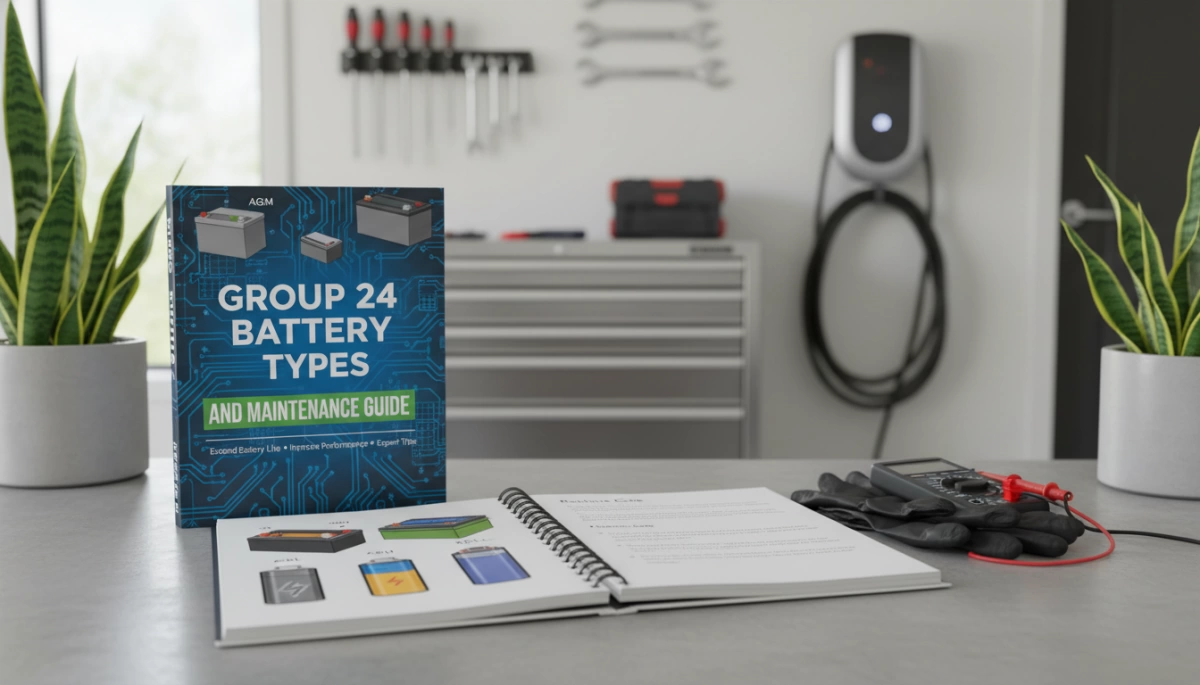
When you’re looking for a Group 24 battery, you’ll run into four main chemistries. Each has its place depending on your budget and how hard you plan to run your equipment. While the Group 24 battery dimensions stay the same, the tech inside changes everything.

Flooded Lead-Acid (FLA)

This is the old-school choice. It’s the most affordable upfront but comes with a “tax” on your time.

  • Pros: Cheapest entry price; widely available.
  • Cons: Requires regular water top-offs; prone to leaking acid; heavy.
  • Maintenance: You have to check fluid levels monthly. Neglecting this is why most fail early, so understanding how often to replace your car battery becomes critical if you stick with lead-acid.

AGM (Absorbent Glass Mat)

A Group 24 AGM battery is a major step up for most boaters and RVers.

  • Maintenance-Free: Completely sealed, so no spilling or gassing.
  • Vibration Resistant: Built tough for bumpy roads or choppy water.
  • Performance: Better at handling high-current draws than standard flooded cells.

Gel-Cell Batteries

Gel batteries use a thickened electrolyte. They are often confused with AGM but are specifically designed for deep-cycle applications.

  • Best For: Low-power, long-duration discharge.
  • Sensitivity: They require specific charging profiles. If you use a standard charger, you’ll cook the gel and ruin the battery quickly.

Lithium LiFePO4: The Modern High-Performance Upgrade

The Group 24 LiFePO4 battery is the gold standard for anyone serious about power. It’s the smartest investment for long-term savings.

  • Efficiency: You get nearly double the usable energy compared to lead-acid.
  • Weight: About half the weight, making it a favorite for Trolling motor battery Group 24 setups.
  • Safety: We use stable chemistry that won’t catch fire. If you’re curious about the tech, learning what is 32650 lifepo4 battery and is it safe gives you a good idea of why this chemistry is so reliable for our Group 24 builds.
Battery Type Lifespan (Cycles) Maintenance Weight
Flooded 300 – 500 High Heavy
AGM 500 – 800 None Heavy
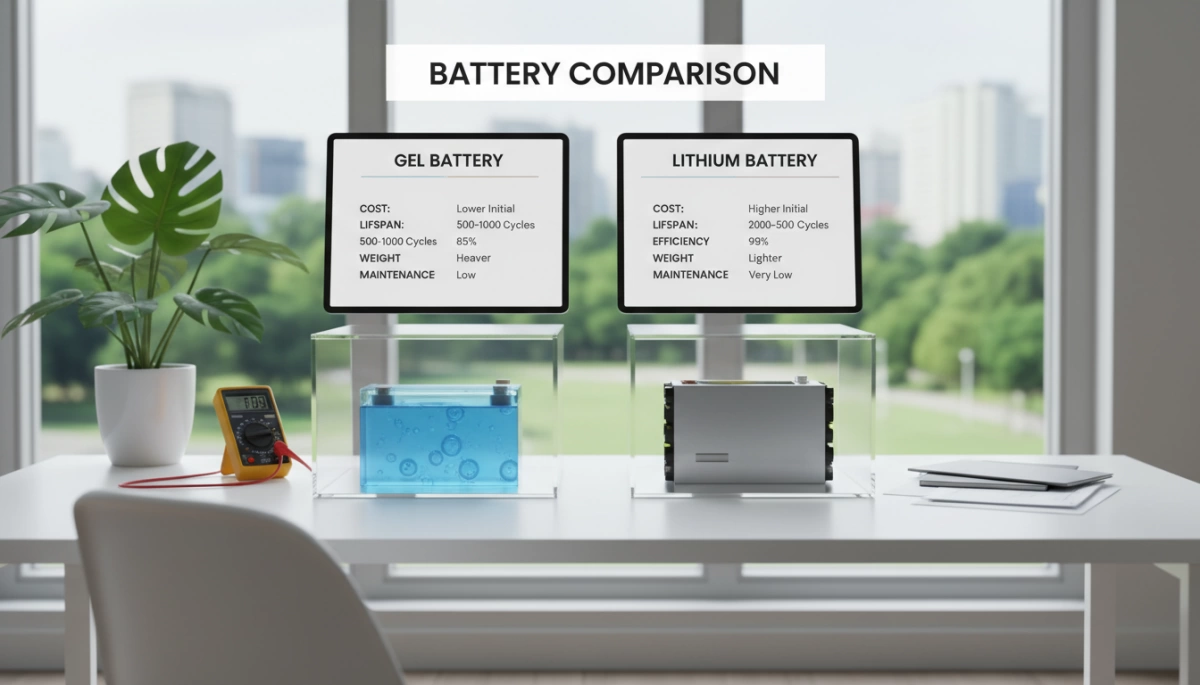
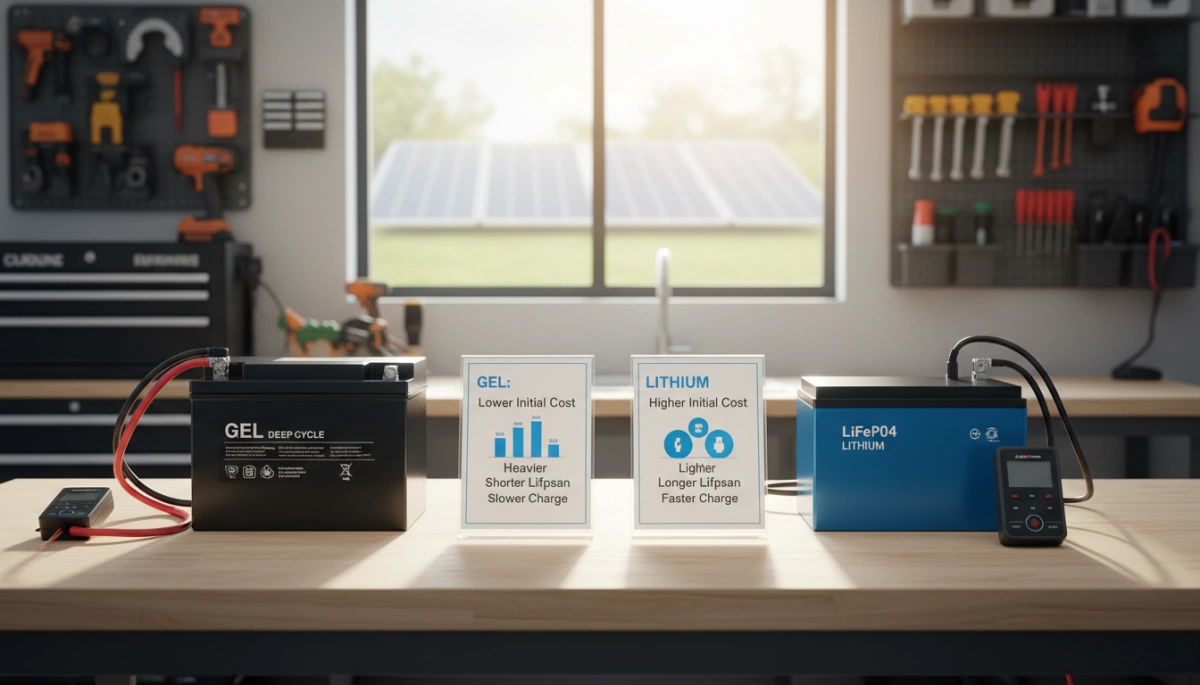
Gel 500 – 1,000 None Heavy
Lithium (LiFePO4) 3,000 – 5,000+ None Ultra-Light

Why Upgrade to a Lithium Group 24 Battery – Professional Lithium Battery Manufacturer Vendor Insights

Switching to a Group 24 LiFePO4 battery is the most effective way to modernize your power system. As a dedicated manufacturer, we focus on replacing heavy, inefficient lead-acid blocks with high-performance lithium technology that delivers more power with less hassle. A lithium upgrade Group 24 isn’t just a minor improvement; it is a total overhaul of your energy capabilities.

Superior Performance and Efficiency

The technical advantages of moving to lithium are immediate and impactful for any high-demand application.

  • Massive Weight Savings: Our batteries are approximately 1/3 the weight of lead-acid equivalents. This 70% weight reduction improves fuel efficiency in RVs and increases speed in marine applications.
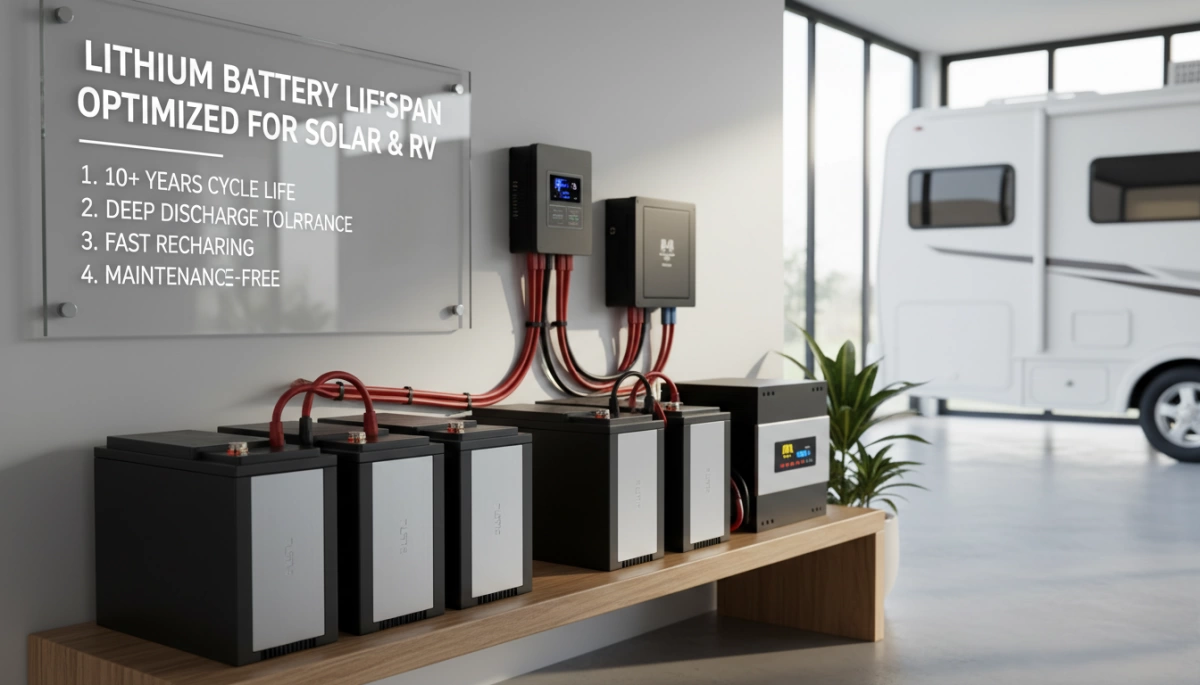
  • Extreme Longevity: We build our batteries to last between 4,000 and 6,000+ deep cycles. Compared to the few hundred cycles you get from lead-acid, this provides a reliable 10-year service life.
  • 100% Usable Capacity: You can safely use the entire capacity of a lightweight deep cycle battery without damage. Lead-acid batteries are typically limited to 50% depth of discharge, meaning a lithium battery provides twice the runtime in the same BCI size.

Advanced Safety and Maintenance-Free Design

Our units are designed for “set it and forget it” operation. Every battery features an integrated Smart BMS lithium battery management system. This internal controller monitors the health of the Grade A cells, preventing overcharging, over-discharging, and thermal issues. To understand why this internal brain is so critical, you can see how even smaller cells require similar logic by checking do 18650 batteries have protection to ensure long-term stability.

  • Fast Charging: Lithium chemistry accepts a charge much faster than traditional batteries, significantly reducing your downtime.
  • Stable Voltage: Unlike lead-acid, where voltage drops as the battery drains, lithium maintains a steady output. This ensures your trolling motors and electronics run at full strength until the battery is nearly empty.
  • Eco-Friendly & Maintenance-Free: There is no acid to spill, no toxic fumes, and absolutely no need for water refilling. It is a clean, sealed solution for harsh environments.

By choosing a professional vendor for your Group 24 needs, you ensure that you receive a battery optimized for high energy density and maximum safety standards.

Choosing a Professional Lithium Battery Manufacturer Vendor for Group 24

When you are looking for a Group 24 LiFePO4 battery, the vendor you choose determines the safety and longevity of your power system. As a professional manufacturer, we focus on high-performance standards that go beyond the basic retail shelf options. We prioritize industrial-grade components to ensure every unit delivers “worry-free” power for years.

  • Grade A LiFePO4 Cells: We use only brand-new, Grade A cells to ensure maximum stability and energy density. This is the foundation of a battery that lasts 10+ years.
  • Integrated Smart BMS: Our batteries feature a built-in Smart BMS lithium battery management system. This “brain” monitors everything—protecting against overcharge, over-discharge, short circuits, and thermal issues.
  • Rugged Environmental Protection: Our Group 24 builds come with IP65/IP67 waterproof ratings, making them ideal for the heavy spray of marine environments or the dust of off-grid trails.
  • Scalability and Flexibility: We design these units for easy scalability. Whether you need to connect in series for higher voltage or parallel for more capacity, our internal architecture supports your custom power needs.
  • Extreme Temperature Durability: These batteries are built to handle the heat and the cold. For users in northern climates, following a winter maintenance guide for lithium batteries ensures your Group 24 cells stay healthy even when the temperature drops.

By sourcing directly from a professional manufacturer, you gain access to 4,000 to 6,000+ deep cycles, providing a significantly lower total cost of ownership compared to traditional lead-acid alternatives. We focus on providing high-quality solutions that meet global standards like CE, UN38.3, and MSDS, ensuring your installation is safe, legal, and reliable.

Versatile Applications for a Group 24 LiFePO4 Battery

Our Group 24 LiFePO4 battery is a powerhouse designed to handle demanding American outdoor and industrial environments. Whether you are hitting the lake or living off-grid, this specific size provides a compact footprint with significantly more usable energy than traditional options.

Marine and Boating

As a premier marine Group 24 battery, this unit is the go-to choice for trolling motor battery Group 24 applications. Unlike lead-acid, lithium maintains a steady voltage until it is nearly depleted, meaning your motor won’t lose thrust halfway through the day. It also powers:

  • Fish finders and high-end GPS units.
  • Onboard LED lighting and bilge pumps.
  • Compact radio systems and communication gear.

RV and Off-Grid Camping

For RV enthusiasts, the RV Group 24 battery serves as a reliable house power source. Since many battery trays are built specifically for the Group 24 size, a lithium upgrade Group 24 is a simple drop-in replacement that doubles your runtime. It is the perfect solution for:

  • Powering slide-outs and leveling jacks.
  • Running vent fans and water pumps.
  • Charging laptops and mobile devices via inverters.

Solar Energy and Industrial Backup

In solar setups, the deep-cycle performance of our LiFePO4 cells allows for 100% depth of discharge without damaging the chemistry. This makes it ideal for small solar kits, emergency UPS backups, and industrial mobility equipment like wheelchairs or electric carts. If you are replacing an old unit, understanding how to tell if your battery is dead is the first step toward upgrading to a maintenance-free lithium system.

Real-World Runtime Examples

A standard 12V 100Ah Group 24 lithium battery offers vastly different performance compared to lead-acid. Because you can use the full capacity, the runtimes for typical loads are impressive:

Typical Load Average Power Draw Estimated Runtime (100Ah Lithium)
LED Lights 10 Watts 120 Hours
CPAP Machine 30 Watts 40 Hours
Portable Fridge 50 Watts 24+ Hours
Trolling Motor 200 Watts (Variable) 4-6 Hours of typical use

Our batteries ensure that whether you are on a remote job site or a weekend fishing trip, your power supply remains consistent and “worry-free.”

Group 24 vs Group 27 and Group 31
Group 24 Battery Comparison and Fitment Guide

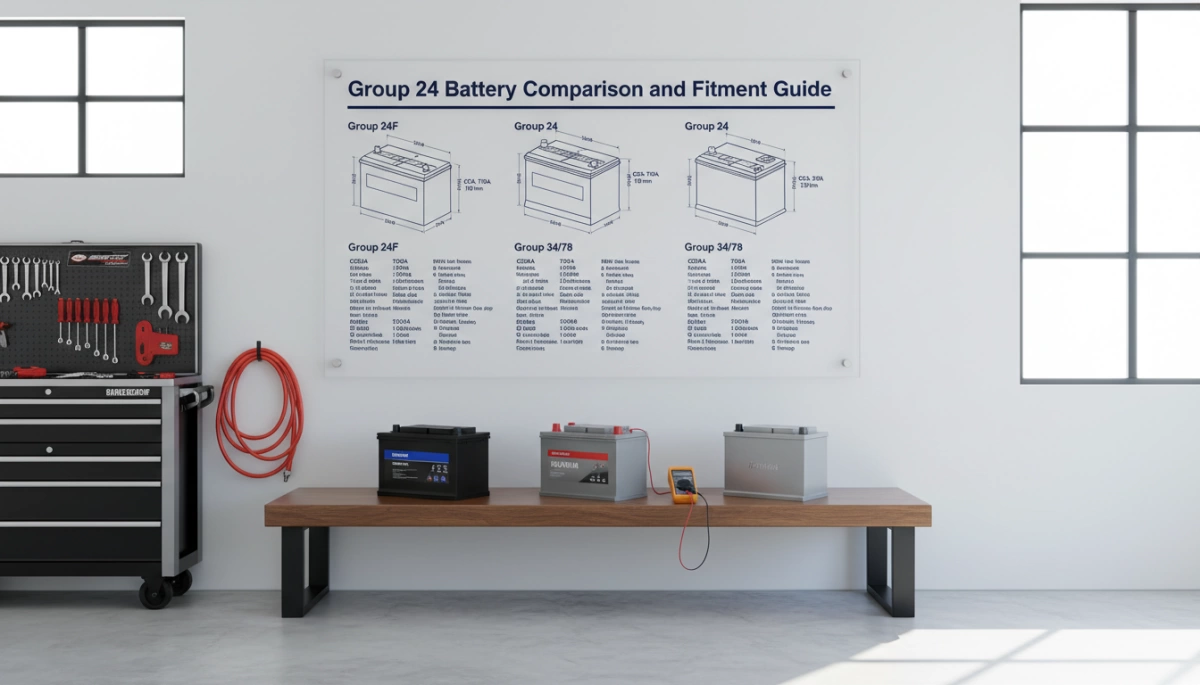
When you’re upgrading your power system, size matters just as much as capacity. The BCI Group 24 battery is often the “goldilocks” choice for many RV and boat owners because it fits into standard factory battery boxes while delivering massive, reliable power.

Group 24 vs Group 27: Size vs Capacity

The main difference between these two is the physical footprint.

  • Group 24: Measures approximately 10.25″ L x 6.81″ W. It is the industry standard for tight compartments.
  • Group 27: Usually about 12″ long, requiring more shelf space.
    In the lithium world, we pack a 100Ah 12V LiFePO4 into a Group 24 case. This gives you the same energy density that used to require a much larger and heavier Group 27 lead-acid battery, making the lithium upgrade Group 24 the smarter play for space-saving efficiency.

Group 24 vs Group 31: Heavy-Duty Needs

The Group 31 is the “heavy hitter” of the bunch, being significantly longer and taller. While a Group 31 lead-acid battery is often chosen for high-capacity needs, it comes with a massive weight penalty. Our Group 24 lithium options provide 100% usable capacity (DOD), meaning a single Group 24 LiFePO4 often outperforms a bulky Group 31 lead-acid battery in real-world runtime without the back-breaking weight.

When to Choose Group 24 for Fitment Constraints

You should stick with the Group 24 size if your setup involves:

  • Existing Battery Trays: Most factory RV and trolling motor compartments are built specifically for this footprint.
  • Weight Sensitivity: Keeping your tongue weight or boat balance in check is easier with a compact, lightweight unit.
  • Modular Expansion: It is often easier to fit two Group 24 batteries side-by-side in a custom storage area than to struggle with the dimensions of larger BCI groups.

While we specialize in these standard vehicle sizes, we also manufacture specialized LiFePO4 battery packs for solar LED street lights and other compact applications, ensuring that no matter the “fitment constraint,” we have a high-performance lithium solution ready to go. Choosing the right size ensures a drop-in replacement Group 24 experience that is truly plug-and-play.

Installation and Safety: Everything You Should Know About Group 24 Battery Upgrades
Group 24 LiFePO4 Battery Installation Safety Guide

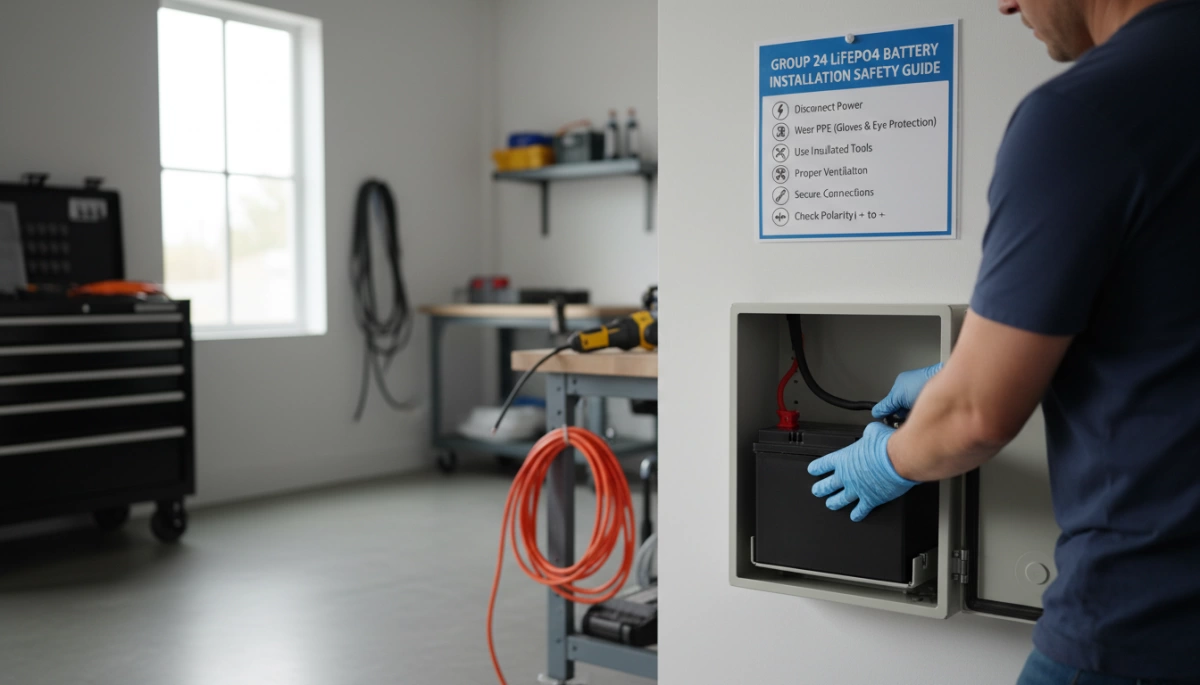
Upgrading to a Group 24 LiFePO4 battery is a seamless process when you follow a few professional standards. As a manufacturer, we design these units to be a true drop-in replacement, meaning they match the footprint of traditional lead-acid batteries while providing significantly better performance.

Ensuring a Snug Fit and Proper Wiring

Our Group 24 lithium batteries strictly follow the BCI standard dimensions (approx. 10.25″ x 6.81″ x 8.875″). Because lithium is roughly 1/3 the weight of lead-acid, you must ensure the battery is properly secured with straps or brackets to prevent it from shifting in your RV or boat during transit.

  • Capacity Expansion: If your power needs grow, you can easily wire our batteries in parallel to increase your total Amp-hours.
  • Voltage Scaling: For high-power applications like a trolling motor battery Group 24 setup, you can connect units in series to achieve 24V or 36V.
  • Smart BMS Protection: Our integrated Smart BMS automatically manages cell balancing and protects against short circuits during installation.

Charging Guidelines and Handling

To reach the 4,000–6,000+ cycle potential, you should use a charger specifically designed for LiFePO4 chemistry. While some AGM chargers may work, a dedicated lithium charger ensures the battery reaches 100% usable capacity without stressing the Grade A LiFePO4 cells.

  • Mounting Orientation: Unlike lead-acid, these batteries can be mounted on their side or end, offering more flexibility in tight RV compartments.
  • Venting Requirements: One of the biggest safety questions we receive is do LiFePO4 batteries need to be vented? In most standard applications, they do not require external venting because they do not release toxic gas during charge or discharge.
  • Temperature Safety: If you operate in extreme cold, always check the internal temperature before charging. Our low-temperature heating series is recommended for users who need to charge in sub-freezing environments.

By sticking to these professional installation steps, you ensure your Group 24 LiFePO4 battery remains a reliable, maintenance-free power source for over a decade.

Maintenance Tips for Your Group 24 Battery Longevity

Why Lithium Beats Lead-Acid for Maintenance

One of the main reasons I recommend a Lithium upgrade Group 24 to our customers is the total lack of maintenance. While traditional flooded batteries require you to check water levels and clean off acid corrosion, our Group 24 LiFePO4 battery is completely sealed and maintenance-free. You don’t have to worry about venting gases or equalization charges. It is truly a “set it and forget it” power solution for your RV or boat.

Storage Recommendations and SOC Monitoring

If you want to protect your investment, how you store your deep cycle Group 24 battery matters. Unlike lead-acid, which needs to stay at 100% to avoid sulfation, lithium is happiest at a partial state of charge (SOC).

  • Ideal Storage Level: Keep the battery at 50% to 60% SOC if you aren’t using it for more than a month.
  • Temperature Control: Store it in a cool, dry place. Avoid freezing temperatures when the battery is completely discharged.
  • BMS Monitoring: Use the integrated Smart BMS to monitor cell health. For those building custom setups, utilizing a high-quality 12.8V 80Ah 32650 LiFePO4 battery pack ensures the same stability and protection standards we build into our Group 24 units.

Maximizing Cycle Life and Knowing When to Replace

To get the full 10-year lifespan out of your battery, avoid consistently discharging it to 0%, even though lithium can handle it. Most of our users see the best results by staying within the 10% to 90% range.

When should you replace it?

  • Capacity Drop: When the battery no longer holds at least 80% of its original rated capacity.
  • Physical Damage: Any signs of casing bloat or terminal damage.
  • BMS Alerts: If the internal management system frequently trips due to cell imbalance.

By following these simple steps, you ensure your Group 24 battery provides reliable, high-performance power for years of off-grid adventures.

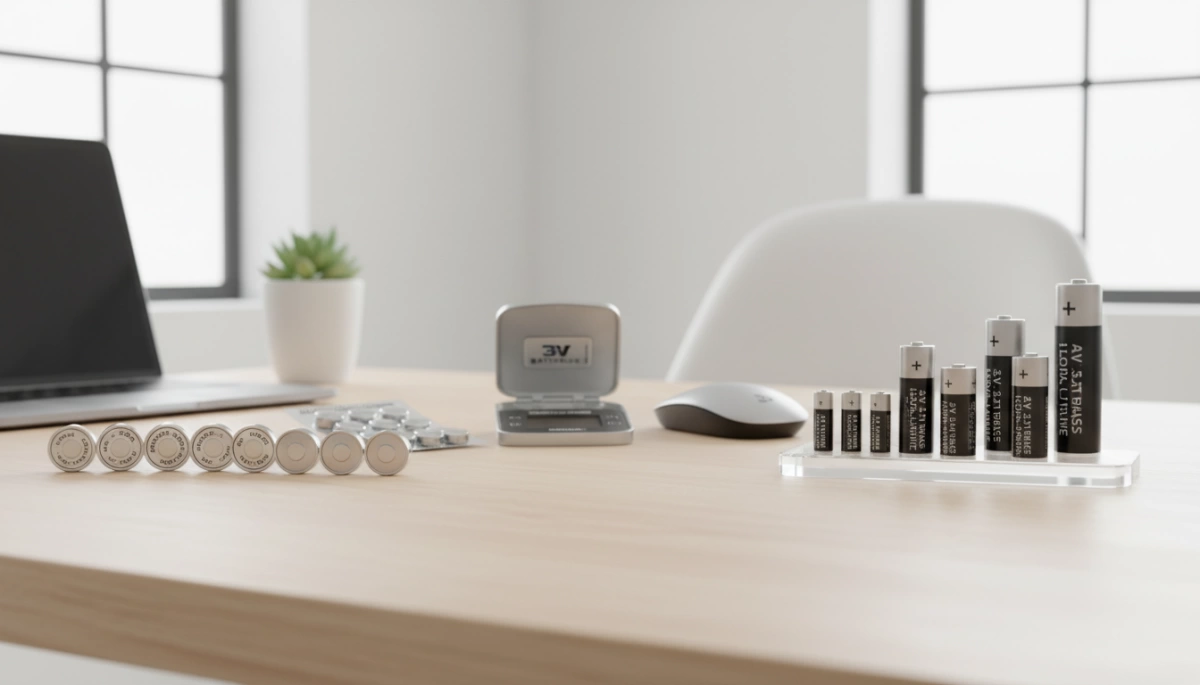
3V Batteries Guide Coin Cells vs Cylindrical Cells Compared

Selecting the right 3V lithium battery shouldn’t be a guessing game. While a CR2032 coin cell and a CR123A cylindrical battery share the same nominal voltage, their performance profiles couldn’t be more different. The form factor you choose dictates everything from mAh capacity to how your device handles high-drain pulses.

In this definitive guide, I’m breaking down the technical nuances of Li-MnO2 chemistry to show you exactly how coin cells and cylindrical cells stack up in the real world. Whether you’re designing a low-profile sensor or replacing a battery in a tactical flashlight, this comparison will ensure you get the shelf life and power density your electronics require.

Let’s dive right in.

Understanding 3V Lithium Battery Basics

Reliability is the number one concern I hear from clients looking for power solutions. When you’re managing a fleet of devices or building a new product, you need to know the power source won’t quit. I focus on Lithium Manganese Dioxide (Li-MnO2) chemistry because it is the industry standard for high-performance, long-lasting 3V power.

Li-MnO2 Chemistry Benefits

I choose Li-MnO2 for my 3V range because it provides a level of stability that other chemistries can’t match.

  • Constant Voltage: It delivers a steady 3V discharge, ensuring devices don’t flicker or fail as the battery ages.
  • Thermal Resilience: These cells operate efficiently in both extreme cold and high-heat environments.
  • Safety: The chemistry is inherently stable, which is critical for the leak-resistant designs I provide.

Decoding the CR Battery Name

Understanding the naming convention is simpler than it looks. The “CR” prefix is the IEC designation for this specific chemistry:

  • C: Stands for the Lithium Manganese Dioxide chemistry.
  • R: Indicates a Round shape (which covers both coin and cylindrical types).
  • The Numbers: In coin cells, these tell you the physical size (diameter and height).

Primary Lithium Battery Stability

These are primary batteries, which means they are not rechargeable. I stand by primary lithium cells for critical applications because they offer much higher energy density and reliability than rechargeable alternatives.

One of the most significant advantages I offer is a 10-year shelf life. Because of the incredibly low self-discharge rate of my Li-MnO2 cells, they retain their power for a decade when stored properly. This makes them the perfect “set it and forget it” solution for everything from computer CMOS backups to emergency security sensors. You can stock up in bulk knowing every unit will be ready to perform when it’s finally called into action.

3V Coin Cells: The Industry Standard for Compact Tech

3V coin cells, often called 3V button batteries, are the backbone of modern small-scale electronics. We focus on the Lithium Manganese Dioxide (Li-MnO2) chemistry because it provides a stable voltage and high energy density in a very slim profile. These are primary lithium batteries designed for longevity and precision.

Popular 3V Coin Cell Sizes

The naming convention is simple: the first two digits are the diameter in millimeters, and the last two are the height in tenths of millimeters.

  • CR2032: The most common lithium coin cell, measuring 20mm x 3.2mm. It offers the best balance of capacity and size.
  • CR2026: At 2.5mm thick, it is the go-to for sleeker devices where a CR2032 won’t fit.
  • CR2016: The ultra-thin 1.6mm option, frequently used in slim gadgets or stacked to reach higher voltages.

CR2026 vs CR2032: Understanding the Difference

The main distinction is thickness and battery capacity mAh. A CR2032 typically holds around 220-240mAh, while a CR2026 holds about 160-170mAh. Because they share the same 20mm diameter, some battery compartments might physically fit both, but you should always stick to the specified thickness to ensure proper terminal contact and runtime.

Key Coin Cell Applications

In our experience, these cells excel in “set it and forget it” devices. They are optimized for low-drain performance where the device stays idle for long periods.

  • Computer Motherboards: Maintaining CMOS settings and the system clock.
  • Medical Devices: Powering digital thermometers and glucose monitors.
  • Security & IoT: Small window sensors and portable lighting solutions like keychain LEDs.
  • Consumer Goods: Digital scales, watches, and car key fobs.
Battery Type Diameter Thickness Nominal Capacity
CR2032 20mm 3.2mm ~235mAh
CR2026 20mm 2.5mm ~170mAh
CR2016 20mm 1.6mm ~90mAh

For businesses looking to integrate these into products, selecting the right battery by usage category is vital. We provide these cells in bulk to ensure high-performance reliability across large-scale deployments, maintaining a leak-resistant design that protects your hardware.

3V Cylindrical Battery Power

High-Drain Performance and CR123A Features

When your gear needs a serious punch, cylindrical cells like the CR123A battery and CR2 are the industry standard. Unlike coin cells, these are designed specifically for high-drain and pulse discharge tasks. I rely on these for equipment that demands quick bursts of energy, such as tactical flashlights or high-end digital camera flashes.

A lithium cylindrical battery offers several unique advantages:

  • Superior Pulse Discharge: Ideal for smart home sensors and alarm systems that remain idle but need immediate high power when triggered.
  • Extreme Temperature Resilience: These batteries perform exceptionally well in the cold, making them the go-to choice for outdoor security cameras in the northern United States.
  • High Energy Density: They pack a massive amount of power into a small volume compared to traditional alkaline options.

While these are primary (non-rechargeable) cells, their shape often leads to confusion with other lithium types. Understanding how to identify an 18650 battery is a great way to ensure you don’t mix up your rechargeable cells with these high-performance 3V primary units.

Choosing a high-drain 3V battery like the CR123A ensures your critical tech—from rangefinders to professional-grade smoke detectors—stays powered with a stable voltage curve that doesn’t drop off prematurely.

3V Batteries: The Definitive Guide to Coin Cells vs Cylinders Comparison

3V Batteries Coin Cells vs Cylindrical Comparison

When we compare these two form factors, the choice comes down to the power-to-size ratio. While both utilize Li-MnO2 chemistry to provide a steady 3V output, their physical architecture dictates how they perform under load. A lithium coin cell is designed for long-term, low-drain stability, while a lithium cylindrical battery is built for high-energy bursts and higher battery capacity mAh.

Performance Trade-offs: Size vs. Power

  • Capacity and Runtime: Cylindrical cells like the CR123A battery often provide four to five times the total energy of a CR2032 battery, making them better for heavy-use devices.
  • Current Delivery: The internal structure of a high-drain 3V battery (cylinder) allows it to handle large pulses without a significant voltage drop.
  • Physical Constraints: You cannot swap a coin cell for a cylinder. Even though the voltage matches, the physical dimensions and mounting styles are completely different.
  • Discharge Curve Comparison: Both offer a very flat discharge curve, but coin cells are optimized for micro-amp draws over years, whereas cylinders are optimized for milli-amp draws over months.
Feature 3V Coin Cells (e.g., CR2450) 3V Cylinders (e.g., CR2)
Typical Capacity 225mAh – 620mAh 850mAh – 1550mAh
Form Factor Flat, disc-shaped Small, tube-shaped
Main Advantage Space-saving / Light weight High pulse capability
Best For CMOS, fobs, and sensors Optics, cameras, and alarms

We ensure our 3V range meets the specific discharge requirements of your tech. Selecting the wrong type usually results in device failure—not because of voltage, but because a coin cell cannot provide the “punch” that a cylindrical cell delivers during high-drain activities like wireless transmission or motor operation. Maintaining the correct primary lithium battery type is essential for long-term reliability in the field.

Choosing the Right 3V Battery for Your Tech

Choosing between a flat button battery and a cylindrical cell depends entirely on the energy needs and physical space of your device. For electronics that require a slim profile and low constant power, 3V coin cells like the CR2032 battery are the standard choice. These are essential for maintaining memory on computer motherboards (CMOS backup) and keeping car key fobs or watches running for years.

If your tech involves high-drain components or frequent wireless transmission, you need the higher capacity found in lithium cylindrical batteries. Modern smart home setups and security systems rely on the CR123A battery to handle the heavy pulse loads required for sensors and cameras.

3V Battery Application Guide

  • Low-Drain & Slim Devices: Use 3V button battery models (CR2032, CR2026, CR2016) for medical sensors, calculators, and ultra-thin digital electronics.
  • Security & Smart Home: The CR123A is the go-to for smart locks, PIR motion sensors, and high-intensity LED flashlights.
  • Specialized Optics: The CR2 cylindrical cell is designed for compact high-power devices like laser rangefinders and photographic equipment.
  • Industrial IoT: Lithium coin cells provide the stable, long-term voltage needed for bridge sensors and remote tracking tags.

When selecting power for your hardware, always match the device’s drain rate with the battery’s discharge capability. While a coin cell saves space, a high-drain 3V battery in a cylindrical format ensures your high-performance gear doesn’t fail during peak activity. Selecting the right form factor guarantees you get the maximum battery capacity mAh and the full 10-year shelf life promised by the Li-MnO2 chemistry.

3V Batteries: Performance Factors for Coin Cells vs Cylinders

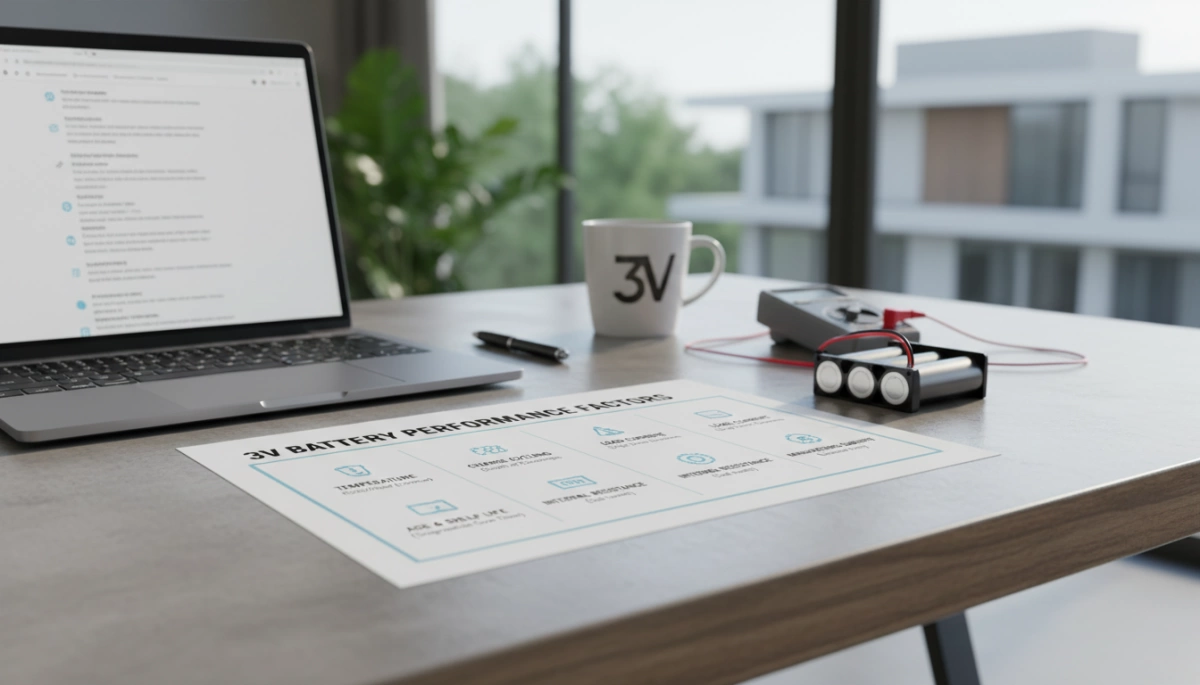
3V Battery Performance Factors Guide

When sourcing power for professional electronics, performance isn’t just about the initial charge—it’s about how that energy is managed over years of service. In my experience providing wholesale solutions, the following factors determine if a cell is truly industrial grade.

Battery Shelf Life and Self-Discharge

The Li-MnO2 chemistry we use in our 3V range offers incredible stability. One of the biggest advantages is the 10-year shelf life. Because these primary lithium batteries have a very low self-discharge rate, they stay ready for action even after years in a warehouse or an emergency kit. This is a critical specification for coin cell applications like CMOS backups and security sensors that must remain functional without frequent maintenance.

Resilience in Extreme Weather

Whether you are using a CR123A battery in an outdoor security camera or a CR2032 battery in medical equipment, temperature resilience is non-negotiable. Our 3V lithium range is engineered to maintain a stable discharge curve in both freezing conditions and high-heat environments where standard alkaline cells typically fail.

Leak Prevention and Internal Resistance

To ensure your devices stay safe, we focus on superior construction and optimized internal resistance:

  • Leak Protection: High-quality seals prevent corrosive damage to expensive electronics, a must for high-density 3V button battery setups.
  • Internal Resistance: Lower resistance ensures that a high-drain 3V battery can deliver the necessary pulse for smart home devices and IoT sensors without a significant voltage drop.
  • Industrial Grading: Our cells are designed for consistent performance, minimizing the risk of premature device failure in the field.

By focusing on these technical benchmarks, we ensure our lithium coin cell and cylindrical products meet the rigorous demands of the United States B2B market.

Handling and Disposal of 3V Batteries

Safe Coin Cell Battery Handling and Disposal

Safety is a top priority when managing any primary lithium battery. Because 3V batteries are high-energy-density components, they require specific handling to ensure they remain stable throughout their 10-year shelf life.

Child Safety and Ingestion Risks

The compact size of a lithium coin cell like the CR2032 makes it a significant choking and ingestion hazard. We advocate for strict safety protocols:

  • Bitter Coatings: Many of our cells are available with a non-toxic bitterant layer designed to discourage children from swallowing them.
  • Secure Storage: Always keep bulk quantities in their original, child-resistant wholesale packaging.
  • Medical Urgency: If a cell is swallowed, seek emergency medical help immediately, as the 3V current can cause severe internal tissue damage quickly.

Storage for the Long Haul

To maintain the stability of the Li-MnO2 chemistry, store your inventory in a cool, dry environment. Avoid areas with high humidity or temperature fluctuations, which can stress the battery seals. When managing stock for high-demand applications like portable lighting, ensure older stock is used first to maximize the benefit of our 10-year shelf life.

Responsible Recycling Practices

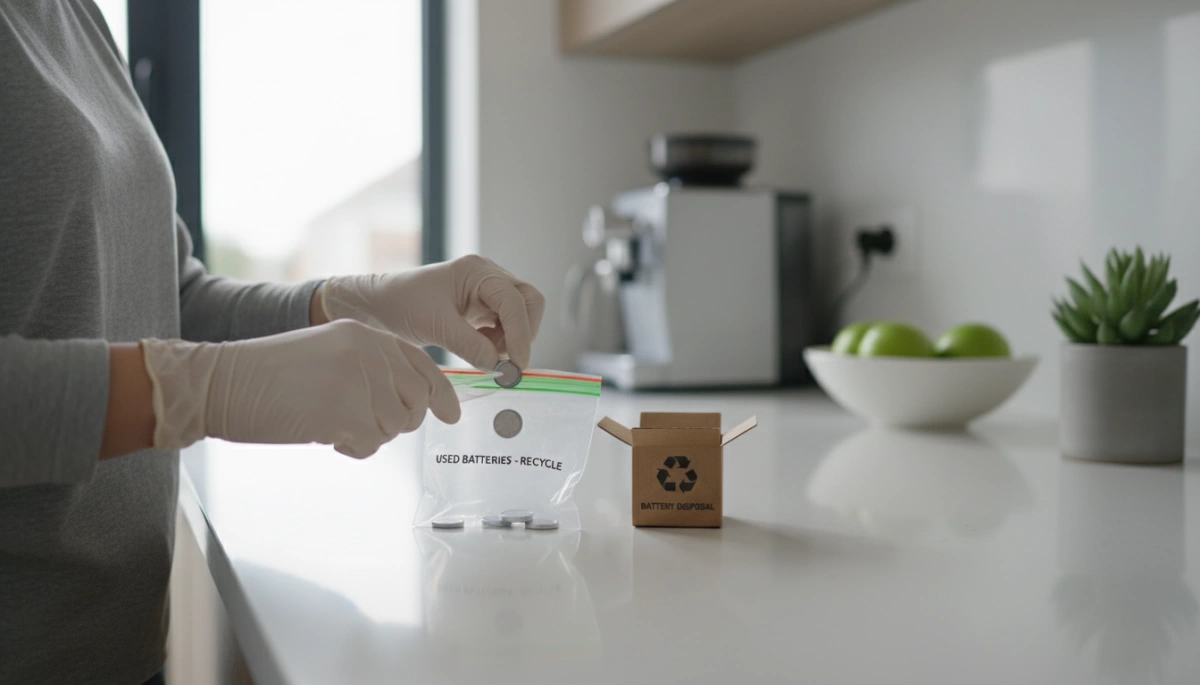
Lithium batteries should never be tossed in the standard trash or recycling bin. Improper disposal can lead to “thermal runaway” or fires in waste management trucks.

  • Terminal Taping: Before recycling, place a small piece of clear tape over the terminals to prevent short-circuiting.
  • Drop-off Locations: Use certified US lithium recycling centers or local hazardous waste programs.
  • Leak Prevention: While our industrial-grade cells are designed to be leak-resistant, always inspect old devices for signs of corrosion before removing spent batteries.

Picking Your Perfect 3V Battery: The Definitive Guide to Coin Cells vs Cylinders

Selecting the right power source is about more than just finding a battery that fits the slot. You have to balance the physical space of your device with its actual energy appetite. Here is how I recommend narrowing down your choice to ensure long-term reliability.

Evaluate Your Power Demands

  • Identify the Drain Rate: If you are powering a simple car key fob or a medical thermometer, a lithium coin cell like the CR2032 battery is the ideal choice for low-drain, steady performance. However, for equipment that needs a sudden burst of energy—like a smart lock or a security camera—you need the high-drain 3V battery capabilities of a CR123A battery.
  • Space Constraints vs. Capacity: Always check the battery capacity mAh ratings. While a 3V button battery is great for slim profiles, a lithium cylindrical battery offers significantly more runtime for power-hungry IoT devices.
  • Match Voltage and Chemistry: Ensure your hardware is designed for Li-MnO2 chemistry. Our 3V lithium range is built for stability, offering a 10-year shelf life that generic alkaline options simply cannot match.

Trust Reliable Industrial Standards

When you are sourcing batteries for critical applications, brand consistency matters. We focus on delivering high-performance cells that resist leakage and maintain a flat discharge curve. Choosing a professional-grade 3V source prevents the “voltage sag” that often causes electronics to malfunction prematurely. Always verify that your selection matches both the physical battery size chart requirements and the specific pulse-current needs of your tech.

Charging LiFePO4 Batteries in Parallel and Series Guide

Understanding Series vs. Parallel Connections

When building a lithium battery bank configuration, you have two primary options: series or parallel. I often see confusion between the two, but the difference is simple. Think of it as a choice between power pressure (voltage) and stored energy duration (capacity).

Voltage vs. Capacity: The Core Differences

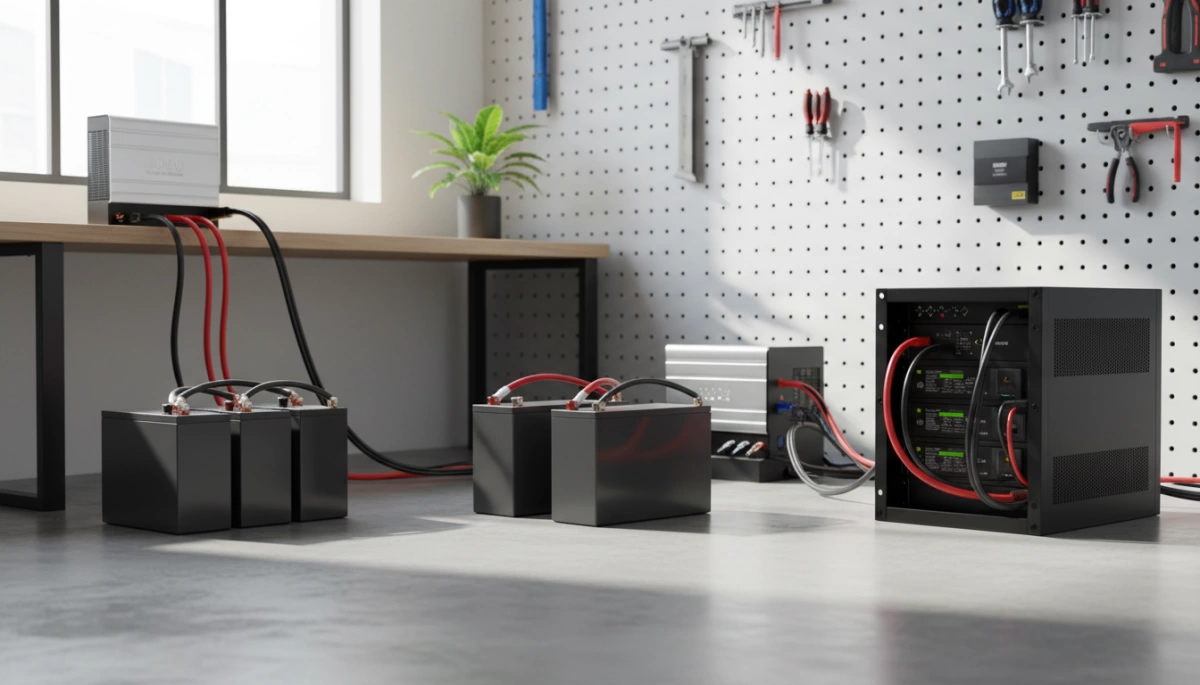
  • LiFePO4 Parallel Wiring: This method connects the positive terminals together and the negative terminals together. It increases your total capacity (Amp-hours/Ah) while the voltage remains the same. For example, two 12V 100Ah batteries in parallel create a 12V 200Ah bank.
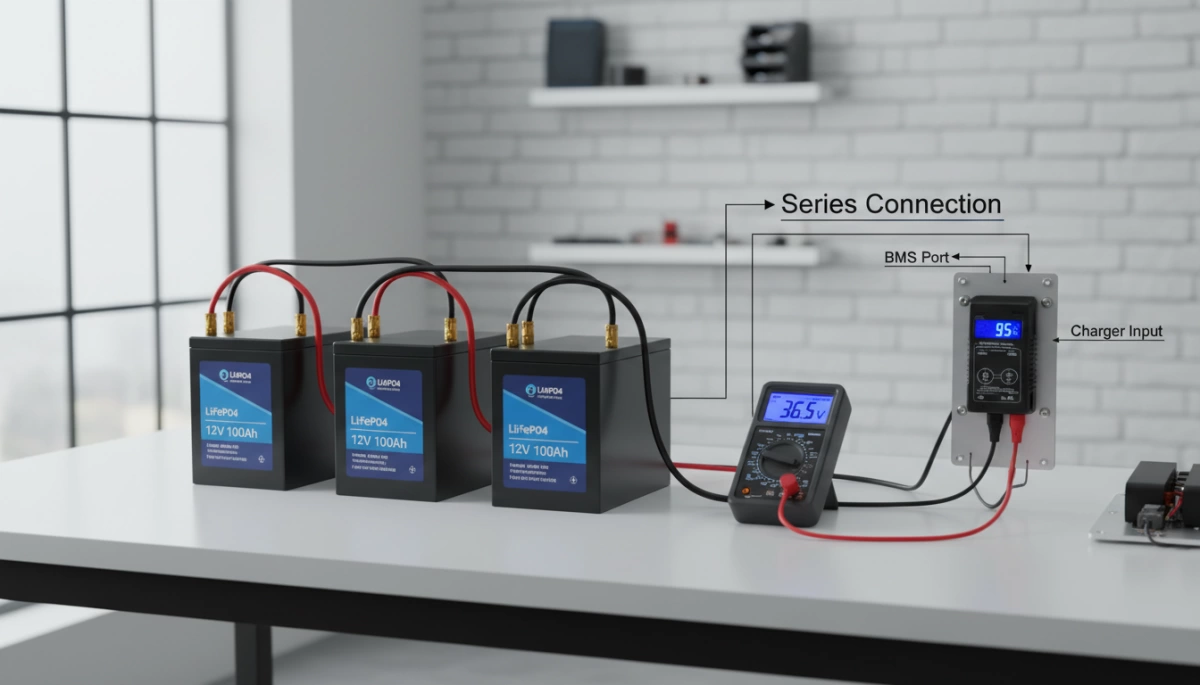
  • LiFePO4 Series Connection: This method connects the positive terminal of one battery to the negative of the next. It increases the total voltage while the capacity remains the same. Two 12V 100Ah batteries in series create a 24V 100Ah bank.

Pros and Cons Comparison Table

Feature Parallel Configuration Series Configuration
Primary Goal Longer runtime (Capacity) Higher system power (Voltage)
Wiring Complexity Low Moderate (Requires balancing)
System Efficiency Standard High (Lower current, less heat)
Cable Requirements Thicker cables needed for high amps Thinner cables due to higher voltage
Failure Risk One battery can fail; others keep running One battery failure breaks the circuit

Best Applications for RV, Marine, and Solar

Choosing the right setup depends entirely on your equipment and energy needs. I recommend matching your configuration to your specific use case to avoid unnecessary gear upgrades.

  • RV Lithium Battery Expansion: Most RVs operate on a 12V DC system. Parallel wiring is the standard here, allowing you to increase your “off-grid” time without swapping out your lights, pumps, or fans.
  • Marine Applications: For trolling motors, a 12V to 48V lithium setup via series connection is common to meet motor specs. For house banks, parallel is often preferred to maintain 12V compatibility.
  • Off-grid Solar Battery Bank: In large solar arrays, series connections are king. Moving to 24V or 48V reduces the size of the wires needed and significantly increases the efficiency of your inverter and charge controller.

Essential Rules Before Any LiFePO4 Connection

Before you start bolting cables to terminals, you must follow strict preparation rules to protect your investment. A poorly planned lithium battery bank configuration leads to premature cell failure and can even trigger a battery management system (BMS) shutdown. When building a custom system, understanding the right lithium battery bank configuration is the first step toward a safe and efficient power system.

Matching Voltage and the Top-Balancing Procedure

The most critical step before any LiFePO4 series connection or LiFePO4 parallel wiring is matching the voltage of every unit. If you connect batteries with different charge levels, the high-voltage battery will dump massive amounts of current into the low-voltage battery instantly.

  • Step 1: Charge each battery individually to 100% using a dedicated LiFePO4 charger.
  • Step 2: Let them rest for 24 hours to stabilize.
  • Step 3: Use a multimeter to ensure all batteries are within 0.05V of each other.
  • Top Balancing: For the best results, connect all batteries in parallel and let them sit for 24 hours before reconfiguring them into your final series or parallel bank. This ensures state of charge matching across the entire system.

Using Identical Batteries: Why Brand and Age Matter

You cannot mix and match batteries like you might with old AA alkalines. For a stable 12V to 48V lithium setup, your batteries must be identical in the following areas:

  • Capacity (Ah): Mixing a 100Ah battery with a 200Ah battery will cause the smaller battery to drain and charge faster, leading to constant BMS trips.
  • Brand and Model: Different manufacturers use different BMS logic and cell grades. Even a small difference in internal resistance can unbalance the bank.
  • Age and Cycle Count: A three-year-old battery has higher internal resistance than a brand-new one. Always buy your batteries at the same time to ensure they “age” together. Even specialized equipment, like a lithium-ion battery pack for military-rugged computers, relies on perfectly matched cells to maintain peak performance under stress.

Limits on Mixing Chemistries and States of Charge

Never mix LiFePO4 with Lead Acid, AGM, or standard Lithium-ion (NMC) batteries in the same bank. These chemistries have different nominal voltages and charging profiles; mixing them is a fire hazard.

Furthermore, ensure your state of charge matching is verified before the first use. If one battery is at 50% and the other is at 100%, the BMS will struggle to balance the cells, significantly reducing the usable capacity of your entire off-grid solar battery bank. Keep it simple: same brand, same capacity, same age, and same voltage.

Wiring LiFePO4 Batteries in Parallel for Maximum Capacity

Parallel wiring is the go-to method for increasing your total Amp-hour (Ah) capacity while maintaining the same system voltage. This is the standard lithium battery bank configuration for 12V RV systems or marine setups where you need significantly longer runtimes without upgrading your inverter or existing DC components.

Step-by-Step Parallel Wiring Instructions

  1. State of Charge Matching: Before making any connections, use a voltmeter to ensure every battery is within 0.1V of the others. This prevents a high-voltage battery from dumping a massive, uncontrolled current into a lower-voltage one.
  2. Connect Positives: Use high-quality, heavy-gauge cables to link the positive terminal of the first battery to the positive of the second.
  3. Connect Negatives: Link the negative terminal of the first battery to the negative of the second.
  4. Cable Uniformity: Use equal length battery cables for every bridge. Even a small difference in length changes resistance, causing one battery to work harder than the rest.

Diagonal Cross-Connection and Busbars

To ensure even wear across the bank, I always use the diagonal cross-connection method. Instead of attaching both your main positive and negative leads to the first battery, you connect the main positive to battery #1 and the main negative to the last battery in the string. This forces the current to flow equally through all batteries in the bank.

For larger builds involving four or more batteries, skip the daisy-chain cables and use solid copper busbars. Busbars provide a central termination point that simplifies LiFePO4 parallel wiring and significantly reduces the risk of heat buildup from loose or cluttered terminal connections.

How to Charge a Parallel Bank Safely

When charging a parallel bank, the voltage remains the same, but the required charging time increases because of the added capacity. You can use a single LiFePO4-compatible charger, but ensure its amperage is sufficient for the total bank size. If you are also managing smaller portable cells in your gear, following a professional 21700 battery charging guide can help you understand how different lithium capacities handle current saturation.

  • BMS Coordination: Each battery’s BMS will still monitor its own cells, but the charger sees the bank as one large battery.
  • Ammeter Monitoring: Use a high-quality battery monitor with a shunt to track the total current entering and exiting the bank.
  • Temperature Checks: During the first few charge cycles, check for hot spots at the terminals to ensure all connections are torqued correctly and resistance is balanced.

Wiring LiFePO4 Batteries in Series

LiFePO4 Battery Series Wiring and Charging Guide

When I need to increase system voltage without changing the amp-hour capacity, a LiFePO4 series connection is the go-to configuration. This is standard for building a 12V to 48V lithium setup for off-grid power or heavy-duty trolling motors. By connecting the positive terminal of one battery to the negative terminal of the next, the voltages add up while the capacity remains that of a single unit.

Step-by-Step Series Wiring Instructions

To ensure a safe and efficient high-voltage bank, follow these steps:

  • Top-Balance First: Always ensure every battery is fully charged individually before connecting them.
  • Link the Terminals: Connect the negative terminal of Battery A to the positive terminal of Battery B.
  • Final Output: Your system’s positive lead connects to the remaining positive terminal on Battery A, and the negative lead connects to the remaining negative terminal on Battery B.
  • Use Proper Hardware: Always use equal length battery cables of the correct gauge to prevent uneven resistance across the bank.

Choosing a Higher-Voltage or Multi-Bank Charger

When charging LiFePO4 batteries in parallel and series guide configurations, the charger must match the total nominal voltage. For a 24V series string, you need a dedicated 24V LiFePO4 charger with a lithium-specific profile. Alternatively, I often recommend a multi-bank charger LiFePO4 system. This allows each battery in the series string to be charged independently, which is the most effective way to prevent one battery from reaching a full charge faster than the others.

Managing Cell Drift and Series Balancing

The biggest challenge with series strings is “drift,” where batteries eventually reach different states of charge. Even with a high-quality battery control module managing internal cells, the external 12V blocks can become unbalanced. To solve this, I suggest battery balancer use. An active balancer constantly redistributes energy between the batteries in the series to keep their voltages identical. Without this, one battery might hit its high-voltage cutoff prematurely, causing the entire bank to shut down even if the other batteries aren’t full. Regular maintenance checks with a multimeter will help you catch these imbalances before they affect your runtime.

Series-Parallel Mixed Configurations

When your energy needs outgrow a simple setup, mixing series and parallel connections is the best way to scale. This lithium battery bank configuration allows you to increase both the system voltage and the total capacity simultaneously. For example, if you are building a high-capacity off-grid solar battery bank, you might need more than just a single string of batteries to handle the load.

When to Combine Series and Parallel

We typically recommend these hybrid setups for heavy-duty applications like whole-home backup or large marine vessels. By using a mixed configuration, you can achieve a 12V to 48V lithium setup while doubling or tripling your runtime. The most common arrangement is the 4S2P setup (4 batteries in series, with two of these strings connected in parallel). This creates a high-voltage system that remains efficient under heavy discharge.

Wiring Diagrams for Complex Banks

To wire a 4S2P bank correctly, you must first create two separate series strings.

  • Step 1: Connect four batteries in a LiFePO4 series connection to reach your target voltage (e.g., 48V).
  • Step 2: Repeat this for the second string.
  • Step 3: Connect the positive terminal of the first string to the positive of the second, and do the same for the negatives.

Charging Strategies for 4S2P Setups

Charging a mixed bank requires a high-output charger that matches the total voltage of the series strings. Because these banks are complex, understanding the principle of lithium battery charging and discharging is vital for maintaining balance across all cells.

  • Use a single high-voltage charger: Ensure it is rated for the total bank voltage (e.g., a 48V charger for a 4S2P 12V-battery bank).
  • Busbars are mandatory: Use heavy-duty busbars to ensure even current distribution across all parallel strings.
  • Cross-link midpoint connections: For maximum stability, connect the midpoints of your series strings together to allow the BMS units to stay better aligned.
  • Sizing: Ensure all cables are the exact same length and gauge to prevent uneven resistance, which can lead to one string working harder than the rest.

Charging LiFePO4 Batteries In Parallel And Series: Best Practices and Parameters

I recommend using a dedicated CC/CV (Constant Current/Constant Voltage) charging profile for any lithium battery bank configuration. This two-stage approach ensures the cells reach the correct LiFePO4 charging voltage safely and efficiently. Unlike lead-acid, lithium iron phosphate does not require a complex multi-stage algorithm with desulfation or heavy equalization.

When you select units from our LiFePO4 product lineup, you must ensure your charger is set to the specific requirements of your series or parallel setup. For an off-grid solar battery bank, the charge controller must be programmed with the following parameters to prevent the BMS from disconnecting.

Recommended Charging Voltage Settings

System Voltage Bulk / Absorption (100% SoC) Float Voltage (Standby) Low Voltage Cut-off
12V (4S) 14.2V – 14.6V 13.5V – 13.6V 10.8V – 11.2V
24V (8S) 28.4V – 29.2V 27.0V – 27.2V 21.6V – 22.4V
48V (16S) 56.8V – 58.4V 54.0V – 54.4V 43.2V – 44.8V

Essential Current and Temperature Safety

Managing the flow of energy is critical for lithium iron phosphate safety and long-term performance. I follow these strict rules to avoid premature cell degradation:

  • Charge Rate (C-Rate): I suggest a standard charge rate of 0.5C (half the battery’s capacity in amps). While many cells can handle higher, 0.5C strikes the best balance between speed and longevity.
  • Temperature Limits: Never charge LiFePO4 batteries if the ambient temperature is below 32°F (0°C). Charging in freezing conditions causes lithium plating, which permanently damages the cells.
  • Absorption Time: Keep absorption time short. Once the current drops to roughly 5% of the battery capacity, the bank is fully charged.
  • Solar Optimization: For specialized solar lighting applications, I set the float voltage slightly lower to reduce stress on the cells when they remain at a high state of charge matching the daily sun cycle.

By adhering to these parameters, you maintain the internal chemistry balance and ensure the BMS does not have to intervene due to over-voltage or over-temperature conditions.

The Role of the Battery Management System (BMS)

The Battery Management System (BMS) is the brain of your setup. Whether you are running a simple parallel array or a complex 12V to 48V lithium setup, the BMS acts as a digital watchdog. It monitors every individual cell to ensure they stay within safe operating limits, preventing catastrophic failures and extending the life of your investment.

How the BMS Protects Configured Banks

In any lithium battery bank configuration, the BMS provides critical layers of lithium iron phosphate safety that traditional lead-acid batteries simply don’t have:

  • Over-Voltage Protection: Shuts down the input if the LiFePO4 charging voltage spikes too high.
  • Over-Discharge Protection: Prevents the bank from draining to a point where the chemistry is permanently damaged.
  • Short Circuit & Over-Current: Instantly disconnects the load if it detects a wiring fault or massive surge.
  • Thermal Management: Stops charging if temperatures drop below freezing or rise to dangerous levels.

BMS Intervention During Cell Imbalance

When cells drift apart in voltage, it limits the total usable capacity of your bank. Much like the logic used to balance 18650 batteries in smaller packs, a high-quality BMS performs active or passive balancing. If one cell hits its peak before the others, the BMS will throttle the charge or bleed off excess energy to let the lagging cells catch up. This prevents one “weak link” from shutting down your entire off-grid solar battery bank.

Monitoring Your Bank via Bluetooth App

Modern BMS units often feature integrated Bluetooth, turning your smartphone into a high-tech dashboard for your LiFePO4 series connection or parallel bank. This visibility is a game-changer for maintenance:

  • Real-Time Data: View the exact State of Charge (SoC) and individual cell voltages.
  • Health Diagnostics: Spot potential drift or underperforming cells before they cause a system failure.
  • Current Tracking: Monitor exactly how many amps are entering or leaving your RV lithium battery expansion.
  • Instant Alerts: Receive notifications if the BMS triggers a safety cutoff due to temperature or voltage issues.

Safety Precautions and Common Mistakes

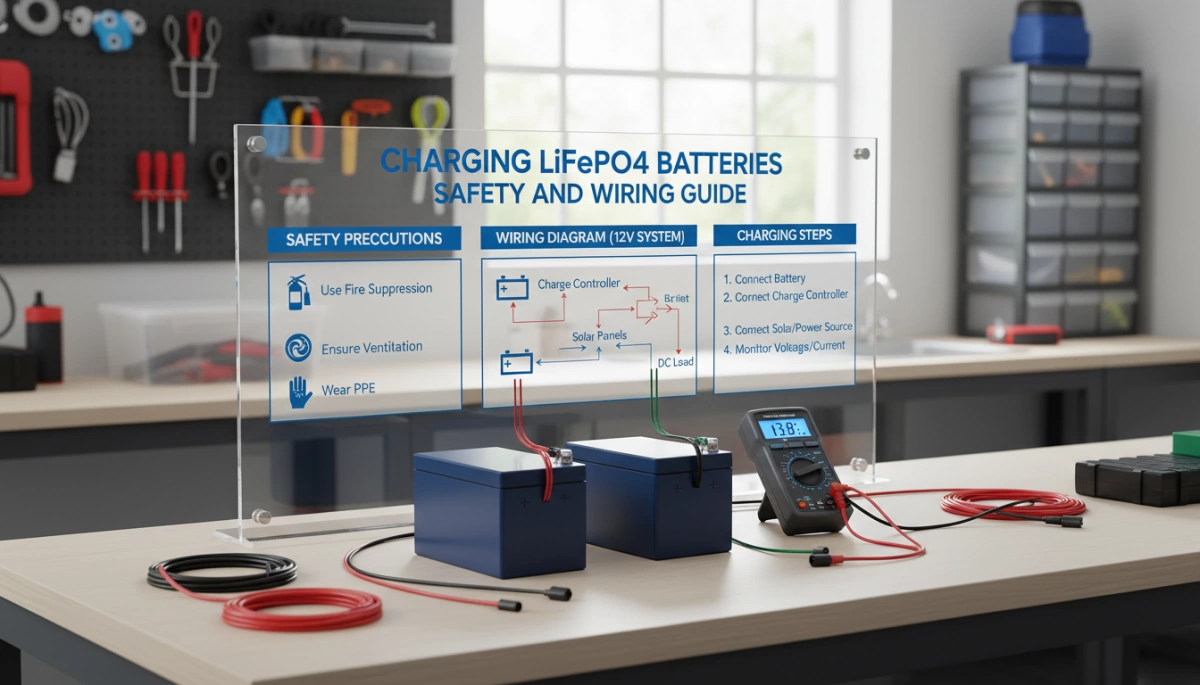
Charging LiFePO4 Batteries Safety and Wiring Guide

Building a custom lithium battery bank configuration involves high amperage and expensive components. I cannot stress enough that safety protocols are not optional. A single loose connection or undersized cable can lead to significant heat generation, melted terminals, or even a fire hazard. Whether you are dealing with a simple 12V setup or a high-voltage LiFePO4 series connection, adhering to strict wiring standards is the only way to ensure longevity and safety.

Cable Sizing and Torque Specifications

The most common mistake I see in DIY builds is using undersized cables. Current flows like water; if the pipe (cable) is too narrow, pressure (heat) builds up. You must size your cables based on the maximum continuous discharge current of the entire bank, not just a single battery.

  • Equal Length is Mandatory: When wiring in parallel, you must use equal length battery cables for every connection. If one cable is six inches longer than the other, that battery has higher resistance, works less, and causes the other batteries to overwork.
  • Torque it Down: Loose terminals create arcing and heat. Use a torque wrench to tighten terminal bolts exactly to the manufacturer’s specification. Over-tightening strips threads; under-tightening melts posts.

Fuse Placement and Wiring Risks

Every ungrounded conductor needs protection. Install a high-quality Class T or ANL fuse on the main positive cable, as close to the battery terminal as physically possible. This fuse is the gatekeeper for lithium iron phosphate safety, cutting the circuit instantly if a catastrophic short occurs.

Improper wiring often leads to immediate BMS shutdowns. If you accidentally reverse polarity or create a short while configuring series vs parallel batteries, the BMS is designed to sacrifice itself to save the cells. However, frequent tripping can damage the FETs. If your system frequently cuts power unexpectedly, it is often a protection mechanism kicking in. Understanding the common causes of batteries not discharging can help you identify if your BMS is triggering due to wiring faults or external load issues.

Maintenance Tips for Longevity

While LiFePO4 is touted as “maintenance-free,” that refers to the internal chemistry, not the external connections. To keep your system running for a decade:

  • Annual Re-Torque: Vibrations in RVs and boats loosen nuts over time. Check them once a year.
  • Clean Connections: Ensure terminals are free of dust and corrosion.
  • Check for Swelling: Visually inspect the battery case. Any bloating indicates severe internal stress or failure.

Troubleshooting Your LiFePO4 Battery Bank Configuration

Even with a perfect setup, a battery bank can drift over time. Identifying issues early prevents permanent capacity loss and keeps your system running at peak efficiency. I always watch for specific red flags that indicate an imbalance in your lithium battery bank configuration.

Spotting the Signs of Battery Bank Imbalance

If your inverter cuts out early or your capacity feels lower than usual, you likely have an imbalance. In a LiFePO4 series connection, one battery may reach its high-voltage cutoff before the others are fully charged, causing the battery management system (BMS) to shut down the entire string. Common symptoms include:

  • Premature BMS Tripping: The charger stops even though the total bank voltage is below the target.
  • Voltage Divergence: Individual battery voltages differ by more than 0.1V at rest or during charging.
  • Rapid Voltage Drop: One battery’s voltage falls significantly faster than the others under a heavy load.

Diagnosing and Rebalancing Your Cells

To fix an imbalanced bank, you must isolate the problem batteries. Use a high-quality multimeter to check each unit’s voltage. If I find a significant variance, I perform a manual top balancing LiFePO4 procedure to sync the state of charge matching across the bank.

  • Isolate the Batteries: Disconnect all series or parallel cables to treat each battery as a standalone unit.
  • Individual Charging: Use a dedicated LiFePO4 charger to bring every battery to 100% individually.
  • Parallel Reset: Connect all fully charged batteries in parallel and let them sit for 24 hours to equalize their internal voltages.
  • Verification: Ensure all batteries show identical voltage readings before reassembling your 12V to 48V lithium setup.

Maintaining a healthy bank requires understanding that factors to consider when designing and manufacturing lithium batteries directly impact how they behave in a long-term configuration. Regular maintenance checks on cable torque and terminal cleanliness are also essential for preventing resistance-related imbalances. If one battery consistently fails to hold its charge compared to the rest, it may be time to replace that specific unit to protect the overall health of your off-grid solar battery bank.

How Much Does a Deep Cycle Battery Weigh Guide

Factors That Influence Deep Cycle Battery Weight

When you’re outfitting an RV, boat, or solar array, understanding deep cycle battery weight is critical for managing your gross vehicle weight rating (GVWR) and fuel efficiency. The weight of a battery isn’t just a random number; it is a direct reflection of its internal chemistry, capacity, and construction quality.

How Chemistry Affects Weight

The internal components used to store energy are the primary drivers of mass.

  • Lead-Acid and AGM: These batteries rely on thick lead plates and heavy acid electrolytes. Because lead is one of the densest common materials, these units are notoriously heavy and difficult to maneuver.
  • LiFePO4 (Lithium Iron Phosphate): We design our Nuranu batteries using Lithium Iron Phosphate, which has a much higher energy density. This technology allows us to cut the weight down to approximately 1/3 of a traditional lead-acid battery while delivering the same or better power output.

Capacity and BCI Group Size Standards

The physical footprint and the amount of energy stored (Amp-hours) also dictate the weight.

  • BCI Group Sizes: Standards like Group 24, 27, and 31 define the physical dimensions. Generally, a larger group size accommodates more materials and therefore weighs more.
  • Amp-Hour (Ah) Capacity: A 300Ah battery requires more internal cells and materials than a 100Ah model. When comparing 100Ah battery weight, chemistry remains the biggest variable, but capacity is the baseline for the physical size.

Internal Build Quality and Casing

What’s inside the box matters just as much as the chemistry.

  • Plate and Cell Quality: We use Grade A prismatic cells which are engineered for efficiency and weight reduction. In older lead-acid tech, thicker plates were needed for durability, adding significant bulk.
  • Housing Materials: Modern deep cycle batteries use high-impact, IP65-rated waterproof plastics. These materials provide rugged protection for off-grid use without the unnecessary weight of older rubber or heavy-gauge metal casings.

Does a Heavier Battery Mean Better Quality?

In the past, a heavier lead-acid battery often signaled thicker plates and a longer lifespan. However, in the modern market, that logic is obsolete.

  • The Weight-to-Power Shift: A heavy battery is now often an indicator of older, less efficient technology.
  • Lithium Superiority: Our lightweight LiFePO4 batteries offer 4,000 to 6,000+ deep cycles and a 10-year lifespan, proving that you don’t need “heavier” to get “better.”
  • Portability: Choosing a lighter battery simplifies DIY installations and reduces the physical strain on your vehicle’s suspension and your own back.

Average Weights by Battery Type

When you are comparing the average deep cycle battery pounds, the chemistry inside the case is the biggest factor. Traditionally, deep cycle power meant lugging around heavy lead plates, but modern technology has significantly changed the scale.

Flooded Lead-Acid: The Traditional Heavyweight

Flooded lead-acid (FLA) batteries are the old-school standard. They rely on thick, heavy lead plates submerged in a liquid electrolyte. For a standard 100Ah capacity, a flooded marine battery weight usually lands between 60 and 70 pounds. Because they are not sealed, they must stay upright, making their bulk even more difficult to manage during installation.

AGM and Gel: Maintenance-Free but Bulky

AGM (Absorbent Glass Mat) and Gel batteries are popular because they are spill-proof and maintenance-free. However, “maintenance-free” doesn’t mean “lightweight.” Since they still utilize lead-acid chemistry, an AGM deep cycle battery weight is often higher than flooded versions to account for the denser internal materials.

  • 100Ah AGM Weight: 65–75 lbs
  • Pros: Sealed and vibration resistant
  • Cons: Extremely heavy and difficult to move alone

Lithium (LiFePO4): The Lightweight Game-Changer

This is where we have revolutionized the market. Our LiFePO4 technology offers a massive reduction in mass without sacrificing power. A Nuranu 100Ah battery weight is only about 23 to 24 lbs (10.5 kg to 11 kg).

By switching to lithium, you are effectively cutting your battery weight by 60% to 70%. While lithium is much lighter, it also benefits from what is optimized battery charging through an integrated Smart BMS, ensuring every pound of the battery is used efficiently. This makes it the ultimate lightweight deep cycle battery for applications where every ounce counts, such as competitive bass fishing or overlanding.

Battery Type Average Weight (100Ah) Weight Comparison
Flooded Lead-Acid 60 – 70 lbs 100% (Baseline)
AGM / Gel 65 – 75 lbs 110%
Nuranu LiFePO4 23 – 24 lbs ~33% (1/3 the weight)

Deep Cycle Battery Weight Chart

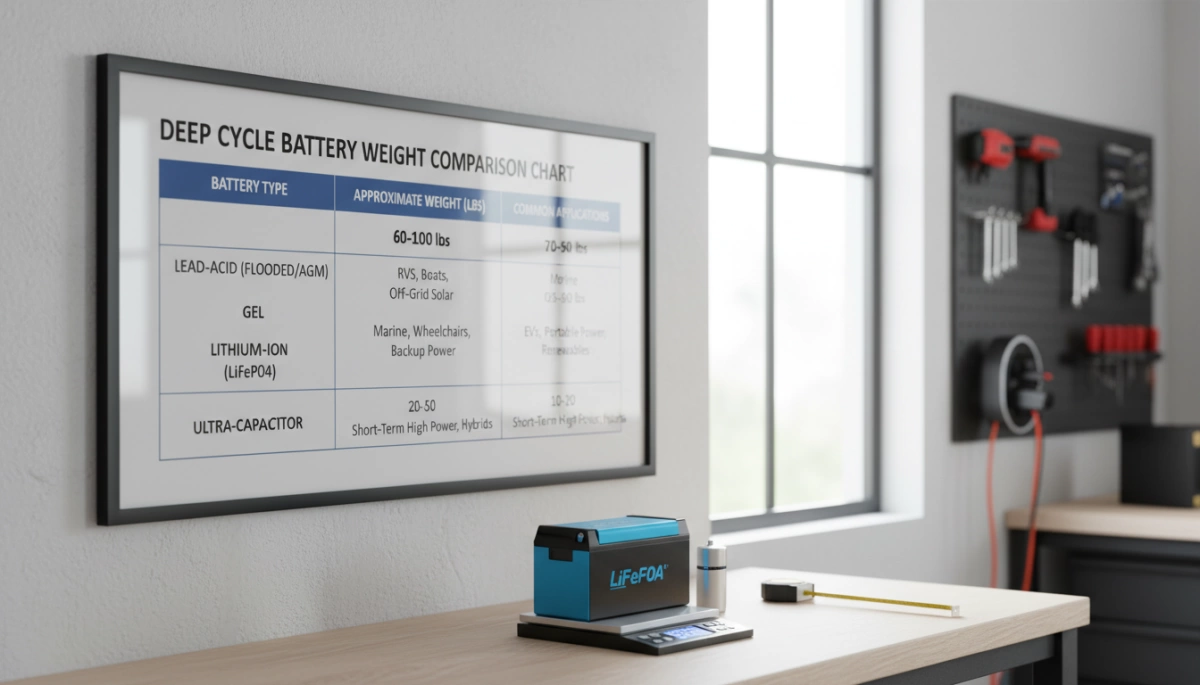
Deep Cycle Battery Weight Comparison Chart

When planning your power system, understanding the deep cycle battery weight chart is essential for staying within your vehicle’s payload limits. BCI group sizes (like 24, 27, and 31) standardize the physical dimensions, but the chemistry inside determines the final heft. Traditional lead-acid batteries are notoriously heavy, while our LiFePO4 technology slashes that weight significantly.

Weight Comparison by BCI Group Size and Type

Battery Type BCI Group Size Capacity (Ah) Approx. Weight (lbs)
Flooded Lead-Acid Group 24 75–85Ah 45–50 lbs
Flooded Lead-Acid Group 27 deep cycle weight 90–100Ah 54–62 lbs
AGM / Sealed Lead Group 31 battery weight 100–115Ah 65–75 lbs
Nuranu LiFePO4 Standard Case 100Ah battery weight 23–24 lbs
Nuranu LiFePO4 High Capacity 200Ah 48–52 lbs
Nuranu LiFePO4 Max Capacity 300Ah+ 65–72 lbs

Scaling Up: 100Ah to 300Ah+ Weights

As you increase capacity for off-grid or marine battery weight requirements, the difference becomes even more dramatic.

  • 100Ah Capacity: A single lead-acid Group 31 unit weighs about 66 lbs. Our LiFePO4 equivalent is just 23 lbs, offering the same energy at roughly 1/3 the weight.
  • 200Ah Capacity: Achieving 200Ah with lead-acid usually requires two heavy batteries totaling 130+ lbs. Our single-unit 200Ah LiFePO4 weighs only about 50 lbs.
  • 300Ah and Higher: For massive solar banks, switching to lithium saves hundreds of pounds, protecting your vehicle’s suspension and improving fuel efficiency.

Using our Grade A prismatic cells, we ensure that even our highest-capacity batteries remain manageable for DIY installations without sacrificing the 100% depth of discharge that lead-acid alternatives simply cannot match.

Lead-Acid vs. Lithium Deep Cycle Battery Weight Comparison

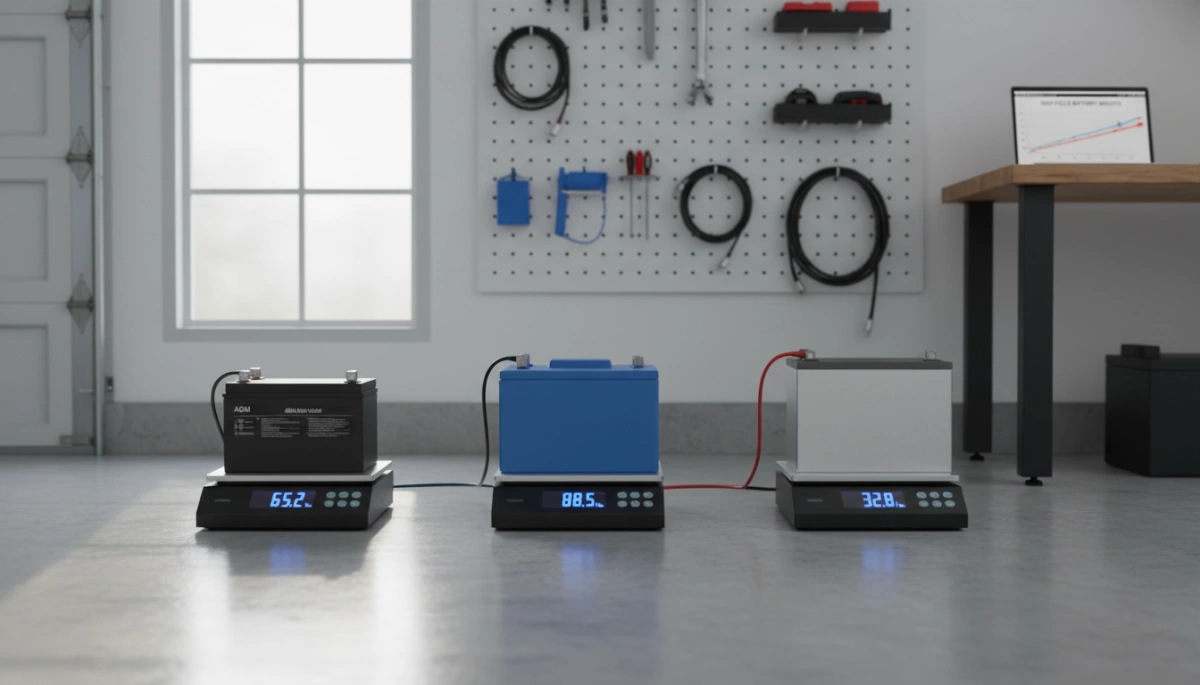
Deep Cycle Battery Weight Comparison

When comparing lithium vs lead acid battery weight, the physical difference is immediate and impactful. Our high-performance LiFePO4 batteries are designed to be 1/3 the weight of traditional lead-acid or AGM options. Switching to lithium allows you to achieve a 60-70% reduction in total weight, which is a game-changer for anyone managing a payload-sensitive RV or a speed-critical marine vessel.

Usable Capacity and Discharge Depth

Weight is only half the story; usable energy is the other. Traditional lead-acid batteries are limited to a 50% Depth of Discharge (DoD) to avoid permanent damage. In contrast, our LiFePO4 battery weight gives you more “bang for your buck” because:

  • 100% Depth of Discharge: You can use the full rated capacity without harming the cells.
  • Consistent Power: Voltage stays stable throughout the discharge cycle, unlike lead-acid which drops off quickly.
  • Efficiency: You can view our different battery by type options to see how specific configurations maximize energy density in a small, light footprint.

Long-Term Value vs. Upfront Costs

While a lead-acid battery is cheaper at the checkout, it is a heavy, short-term solution. Our lithium units are a long-term investment in your power system. By providing 4,000 to 6,000+ deep cycles, one Nuranu lithium battery outlasts ten lead-acid batteries. When you factor in the lifespan and the massive weight savings, the cost-per-cycle is significantly lower, making lithium the most economical choice for serious off-grid and marine applications.

Why Deep Cycle Battery Weight Matters in Real-World Use

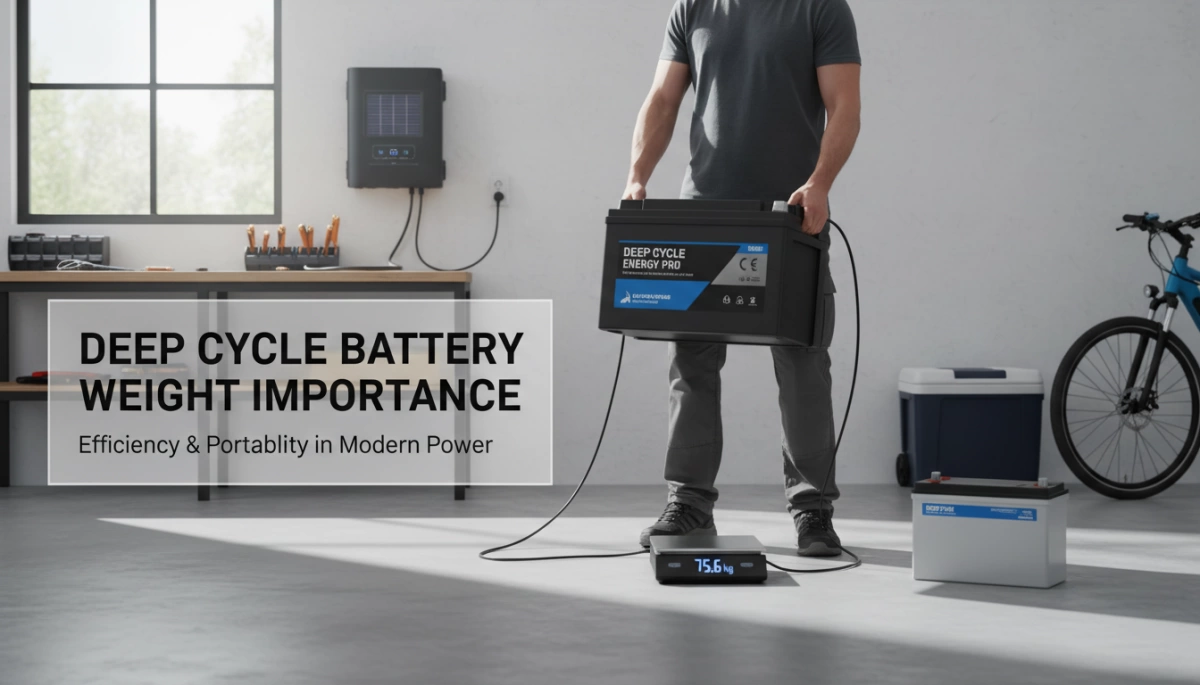
Deep Cycle Battery Weight Importance

Understanding how much is a deep cycle battery weight isn’t just about the number on the scale; it’s about how that weight impacts your daily setup and performance. Whether you are hitting the open road or the open water, every pound you carry affects your efficiency and safety.

RV and Van Life: Managing GVWR and Fuel Economy

For the American RVer, staying under the Gross Vehicle Weight Rating (GVWR) is a constant challenge. Traditional lead-acid batteries can easily eat up 200–300 pounds of your payload.

  • Payload Capacity: Switching to lightweight LiFePO4 options allows you to carry more gear, fresh water, or supplies without exceeding legal weight limits.
  • Fuel Savings: Reducing the total load on your engine improves miles per gallon (MPG), saving you money on long cross-country hauls.

Marine and Boating: Improving Trim and Speed

In the boating world, weight distribution is everything. A heavy battery bank in the stern can negatively affect your boat’s trim, making it harder to get on a plane and reducing top speeds.

  • Trolling Motor Efficiency: A lighter trolling motor battery weight allows your motor to work less to move the same vessel, extending your time on the water.
  • Better Handling: Lowering the overall weight improves maneuverability and reduces the draft, which is critical in shallow-water fishing.

Solar and Off-Grid: Easy Setup in Remote Locations

Setting up solar power in remote cabins or off-grid homesteads often requires carrying equipment by hand. While we offer a wide range of power solutions, including lithium battery packs for personal care and small electronics, our deep cycle units are designed to be portable.

  • Manual Transport: Carrying a 23-pound lithium battery to a remote site is significantly easier than lugging a 66-pound lead-acid equivalent.
  • Stackable Power: You can build a larger energy storage system without needing reinforced flooring to support thousands of pounds of lead.

Lifting Safety and Manual Handling

The physical strain of installation is often overlooked. Standard Group 31 lead-acid batteries are notorious for causing back injuries during DIY installs.

  • Single-Person Install: Most Nuranu LiFePO4 batteries are 1/3 the weight of lead-acid, making them safe for one person to lift and install in tight compartments.
  • M8 Bolt Terminals: Lightweight housing combined with easy-to-use M8 terminals ensures a quick, stress-free setup without the muscle fatigue.

Nuranu LiFePO4 Batteries: The Lightweight Solution

Since 2012, we have specialized in high-performance LiFePO4 technology to solve the weight and lifespan issues inherent in traditional power systems. Our mission at Nuranu is to provide reliable, high-density power that doesn’t weigh down your vehicle or vessel. We focus on Grade A prismatic cells and intelligent engineering to ensure our batteries are the lightest and most efficient on the market.

Nuranu 12V 100Ah LiFePO4 Weight Specifications

When people ask, “How much is a deep cycle battery weight?” they are often surprised by the massive difference between chemistries. While a traditional lead-acid battery of similar capacity typically weighs about 66 lbs, our lithium tech changes the math entirely.

  • Nuranu 12.8V 100Ah Weight: Approximately 10.5 kg to 11 kg (23–24 lbs).
  • Weight Reduction: Our batteries are specifically designed to be 1/3 the weight of Lead-Acid/AGM alternatives.
  • Casing: Compact, IP65-rated waterproof housing with durable M8 bolt terminals.

Built-In Intelligence and High Cycle Life

Our lithium ion battery solutions do more than just shed pounds; they integrate advanced technology to ensure safety and long-term value. Every unit we produce is equipped with a Smart Battery Management System (BMS) that monitors the health of the cells in real-time.

  • Longevity: Rated for 4,000 to 6,000+ deep cycles, offering a 10-year service life.
  • Safety Features: Protection against over-charging, over-discharging, short circuits, and thermal runaway.
  • Efficiency: Capable of 100% Depth of Discharge (DoD) without damaging the internal chemistry.

Easy Battery Upgrades for Your Setup

Switching to a lightweight deep cycle battery from Nuranu is the most effective way to optimize your mobile power system. Because our batteries provide more usable energy at a fraction of the weight, you can either increase your total power bank capacity without exceeding your vehicle’s weight limit or simply enjoy the improved fuel economy and handling of a lighter rig. Our self-heating and Bluetooth-enabled series make these the perfect drop-in replacements for any RV, marine, or off-grid solar application.

Choosing the Right Deep Cycle Battery for Your Setup

Selecting the ideal battery requires balancing your power requirements against your vehicle’s physical constraints. When users ask “How much is a deep cycle battery weight?” it is often because they are managing a strict Gross Vehicle Weight Rating (GVWR) for an RV or trying to maintain the trim on a boat. We recommend a “power-first” approach to ensure your setup is both safe and efficient.

Assessing Power Needs and Weight Limits

Before purchasing, calculate your total Amp-hour (Ah) requirements. Once you know your capacity needs, compare the physical footprint:

  • Total Capacity: For a 100Ah requirement, a lead-acid battery adds roughly 66 lbs (30 kg) to your load. Our LiFePO4 equivalent weighs only 23–24 lbs (10.5 kg).
  • Payload Management: In van life and marine applications, switching to lithium can save hundreds of pounds, directly improving fuel economy and handling.
  • Space Constraints: Because we use high-density Grade A prismatic cells, you get more usable energy in a smaller, lighter package.

When to Upgrade to Lithium

While lead-acid batteries have a lower upfront cost, they are limited by a 50% Depth of Discharge (DoD) and a heavy physical profile. We suggest upgrading to our LiFePO4 series if you value:

  • Weight Efficiency: Achieving 1/3 the weight of traditional batteries.
  • Extreme Longevity: Getting 4,000 to 6,000+ cycles compared to just a few hundred.
  • Safety and Intelligence: Our built-in Smart BMS handles the heavy lifting by protecting against overcharging and short circuits.

Installation and Compatibility Check

Before installing, ensure your charging source (solar controller, alternator, or shore power) is compatible with lithium profiles. While our batteries are designed for easy integration with M8 terminals, environmental factors still matter. It is important to know what temperature is bad for lithium batteries to protect your investment, though our specialized self-heating series is built to tackle sub-zero charging head-on. Always verify that your mounting location can support the battery’s weight and provides enough ventilation for the Smart BMS to operate optimally.

Deep Cycle Battery Weight FAQs

Understanding the specifics of deep cycle battery weight helps you optimize your rig for better performance and safety. Here are the most common questions we get from owners looking to upgrade.

Does a fully charged battery weigh more?

Technically, yes, due to energy-mass equivalence, but the difference is so microscopic that no scale on earth can measure it. For all practical purposes in your RV or boat, the weight of your battery remains constant whether it is at 0% or 100% state of charge.

How much weight can I save switching to lithium?

You can expect to save 60% to 70% of your total battery weight. Traditional lead-acid setups are notoriously heavy, whereas our LiFePO4 technology is designed to be roughly 1/3 the weight. For a standard 100Ah setup, this means dropping from about 66 lbs to just 23 lbs.

What is the average weight for a 100Ah deep cycle battery?

The weight depends entirely on the chemistry:

  • Flooded Lead-Acid/AGM: Usually weighs between 60 and 70 lbs.
  • Nuranu LiFePO4: Weighs approximately 23 to 24 lbs (10.5–11 kg).

Are lighter batteries less durable?

Absolutely not. In fact, it is the opposite. While lead-acid batteries rely on heavy lead plates that degrade quickly, our lightweight LiFePO4 cells offer 4,000 to 6,000+ deep cycles. When comparing different lithium chemistries, our LFP lithium battery vs NMC battery analysis shows why LiFePO4 is the superior choice for stable, lightweight deep cycle power that lasts over a decade.

Common group size weights for marine and RV use

Battery weight scales with the BCI group size, which dictates the physical dimensions:

  • Group 24: 43–50 lbs (Lead-Acid) vs. 18–20 lbs (Lithium)
  • Group 27: 54–62 lbs (Lead-Acid) vs. 22–25 lbs (Lithium)
  • Group 31: 60–75 lbs (Lead-Acid) vs. 23–28 lbs (Lithium)

By choosing a lighter battery, you increase your vehicle’s remaining payload capacity, improve fuel efficiency, and make DIY installation significantly easier on your back.

Navigating the Pros and Cons of Lithium Iron Phosphate Batteries

Key Advantages of LFP Batteries

Choosing the right energy storage can be stressful. You want to know if your investment will last and, more importantly, if it’s safe for your home or vehicle. Lithium Iron Phosphate (LFP) batteries have become our gold standard for these exact reasons. They solve the biggest headaches of traditional power systems by offering a “set it and forget it” reliability.

Superior LFP Battery Safety and Stability

The most critical advantage of LFP is its chemical stability. Unlike other lithium chemistries, our LiFePO4 cells are inherently resistant to thermal runaway. They don’t catch fire or explode under extreme stress.

  • Integrated Smart BMS: Every unit features a Battery Management System (BMS) that monitors heat, voltage, and current in real-time.
  • Tier 1 Prismatic Cells: We utilize Grade A cells that handle high-demand loads without compromising safety.
  • Peace of Mind: This chemistry is virtually non-combustible, making it the safest choice for indoor solar storage and confined RV spaces.

Long Lifespan Lithium Batteries

When we talk about value, we look at the cycle life. While lead-acid batteries might last two or three years, LFP is built for the long haul.

  • 6000+ Deep Discharge Cycles: This translates to 10–15 years of daily use.
  • Durability: The structural integrity of the iron phosphate remains intact through thousands of charge and discharge events.
  • High ROI: Though the initial cost is higher, the cost per cycle is significantly lower than any lead-acid alternative.

100% Depth of Discharge and Efficiency

One of the most frustrating parts of lead-acid batteries is only being able to use 50% of the capacity to avoid damage. With deep cycle lithium batteries, you get the full power you paid for.

  • Usable Capacity: You can safely discharge these units to 100% Depth of Discharge (DoD) without ruining the cells.
  • Consistent Power: Voltage remains stable throughout the discharge cycle, ensuring your appliances run efficiently until the battery is nearly empty.
Feature LFP (LiFePO4) Advantage
Cycle Life 6000+ Cycles (Grade A Cells)
Safety Rating Highest; No Thermal Runaway
Maintenance Zero; Maintenance-Free
Usable Capacity 100% Depth of Discharge
Environmental Impact Cobalt-Free & Eco-Friendly

Lightweight Design and Maintenance-Free Operation

We design our systems to be user-friendly and efficient. LFP batteries offer a massive weight reduction, which is a game-changer for marine and RV applications.

  • Weight Savings: Typically 50-70% lighter than lead-acid batteries of the same capacity.
  • Zero Upkeep: There is no need for watering, venting, or cleaning terminal corrosion. Once installed, the Smart BMS handles the balancing and health of the cells.

Cobalt-Free Batteries and Eco-Benefits

Sustainability matters to our customers. LFP is the most environmentally and ethically responsible lithium technology available today.

  • No Toxic Heavy Metals: Our batteries are cobalt-free and nickel-free, eliminating the ethical concerns associated with mining those materials.
  • Abundant Materials: Iron and phosphate are more naturally abundant and easier to source responsibly.
  • Recyclability: The chemistry is easier to process at the end of its life, reducing the total environmental footprint of your power system.

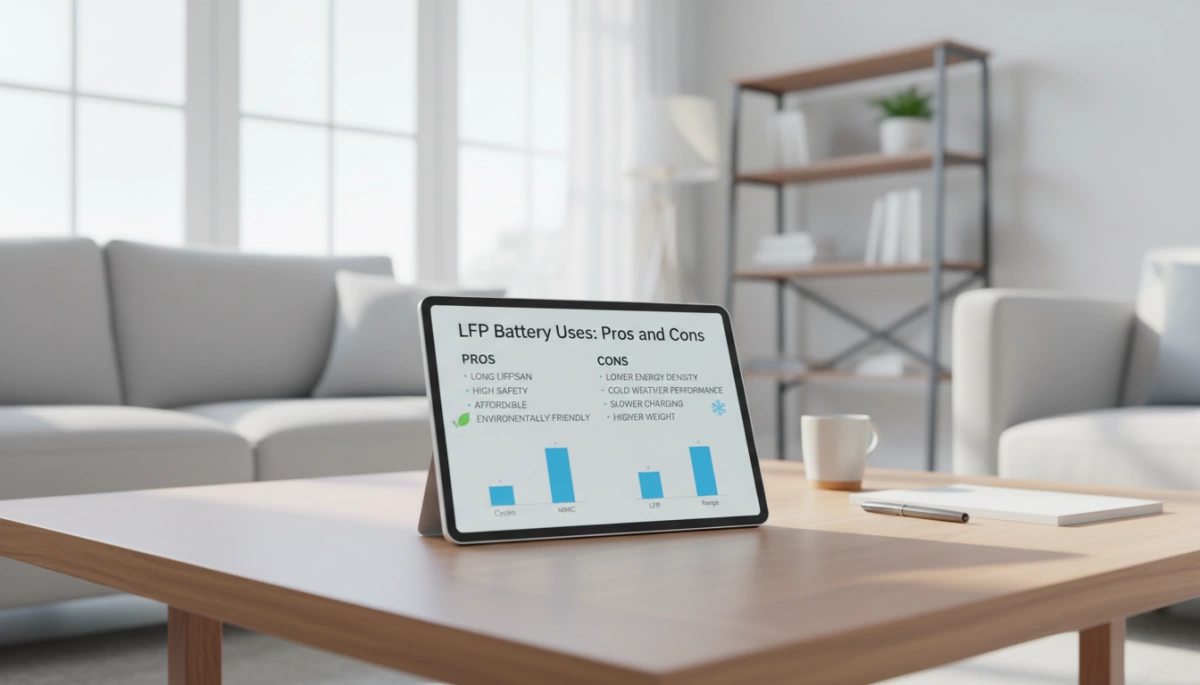
Notable Drawbacks of LFP Batteries

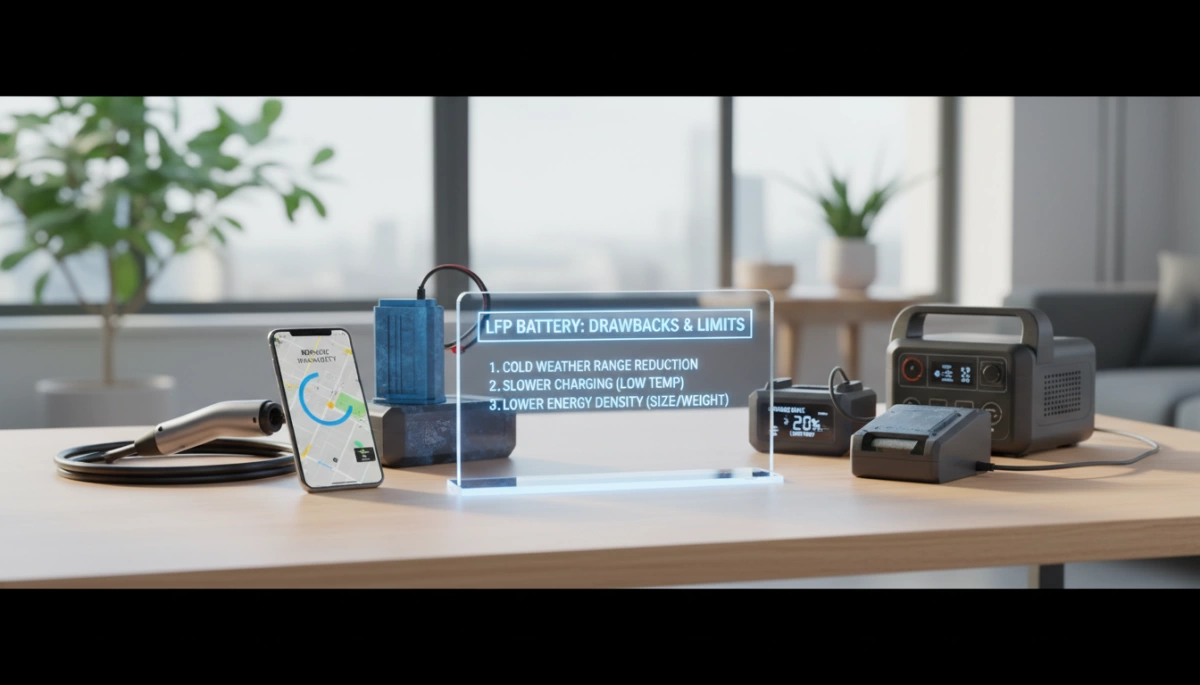
LFP Battery Drawbacks and Performance Limits

While LiFePO4 technology offers unmatched safety, there are specific trade-offs to consider when planning your power system. Understanding these limitations ensures you select the right configuration for your specific environment.

  • Higher Initial Cost: The upfront price tag for LFP is higher than traditional lead-acid options. While the long-term ROI is superior due to the 6,000+ cycle life, the initial investment can be a hurdle for budget-focused projects.
  • Lower Energy Density: In the LFP vs NMC comparison, LFP comes in heavier and bulkier. Because it holds less energy per pound than Nickel Manganese Cobalt chemistries, it may not be the best fit for weight-sensitive applications like high-performance electric racing or ultra-compact handheld devices.
  • Cold Temperature Performance LFP: Charging efficiency drops significantly when temperatures dip below freezing. While our integrated battery management system (BMS) prevents damage by cutting off charging in extreme cold, users in northern climates often need to plan for insulated battery boxes or internal heaters.
  • Voltage Characteristics: LFP cells have a nominal voltage of 3.2V, which is lower than the 3.6V or 3.7V found in other lithium-ion types. This requires different string configurations to reach standard 12V, 24V, or 48V system requirements.

Despite these factors, our 26650 LiFePO4 battery cells and modular rack systems are engineered to mitigate these cons through smart design. We use high-quality Grade A cells and robust housing to ensure that the bulkiness is managed through efficient, stackable layouts that maximize your available footprint. For most stationary energy storage and deep-cycle marine or RV setups, the safety and longevity far outweigh the slight increase in size or initial cost.

Comparing LFP vs. Lead-Acid and NMC Batteries

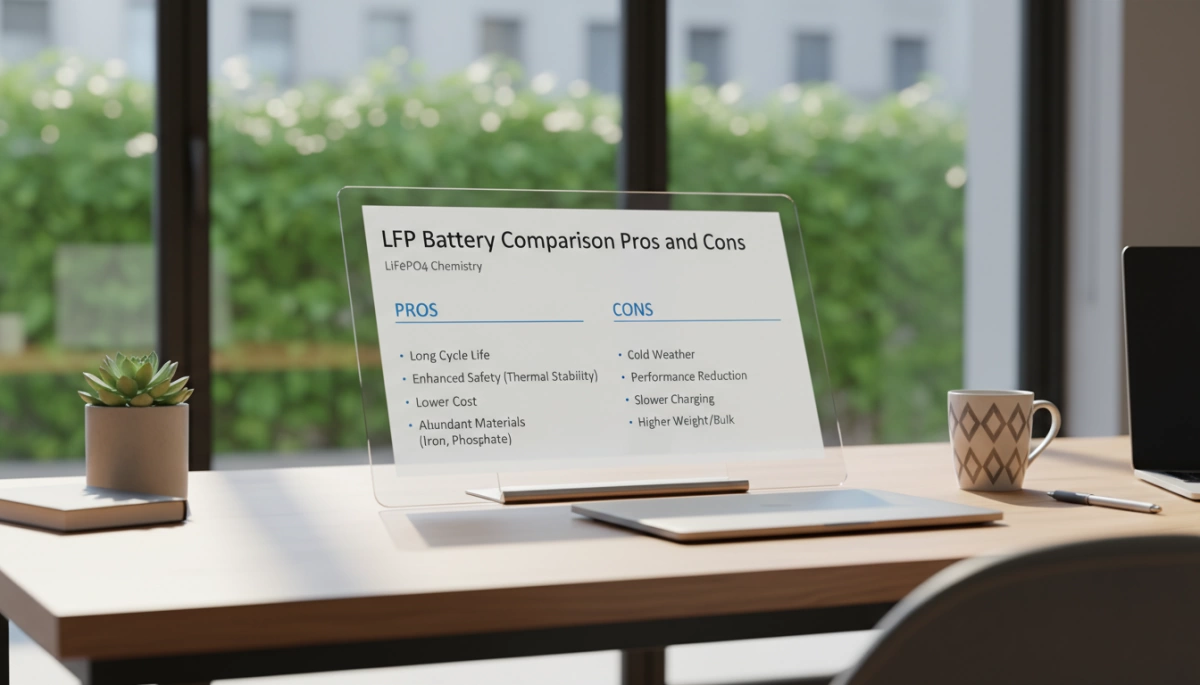
LFP Battery Comparison Pros and Cons

When we look at the data, LiFePO4 batteries consistently outperform older technologies in long-term value. In a direct LFP vs lead acid matchup, the differences are night and day. Lead-acid batteries are heavy, require constant maintenance, and only let you use about 50% of their capacity. Our LFP solutions allow for a 100% depth of discharge, giving you more usable power in a package that weighs 60% less.

In the LFP vs NMC comparison, the focus shifts to safety and longevity. While NMC (Nickel Manganese Cobalt) offers higher energy density for compact gadgets, LFP is the clear winner for stationary storage and RVs. The chemical structure of LFP is inherently stable, virtually eliminating the thermal runaway risk associated with other lithium chemistries. When you consider how long do truck batteries last compared to the 10+ year lifespan of our Grade A LFP cells, the total cost of ownership for LFP is significantly lower.

Quick-Reference Comparison Table

Metric LFP (LiFePO4) Lead-Acid NMC (Lithium)
Cycle Life 6,000+ Cycles 300 – 500 Cycles 1,000 – 2,000 Cycles
Safety Rating Ultra-High Moderate Moderate (Heat Sensitive)
Weight Savings High None (Very Heavy) Highest
Usable Capacity 100% DoD 50% DoD 80% – 90% DoD
Maintenance Zero High (Venting/Water) Zero

Key Takeaways for Your System

  • Safety First: LFP is chemically incapable of catching fire under normal failure conditions, making it the safest choice for indoor installations.
  • Long-Term Savings: You would need to replace a lead-acid bank nearly 10 times to match the lifespan of one LFP unit.
  • Efficient Charging: LFP accepts a higher current, meaning they charge faster and more efficiently than traditional deep-cycle options.

Real-World Applications: Where LFP Excels

LFP Battery Uses Pros and Cons

When navigating the pros and cons of Lithium Iron Phosphate (LFP) batteries, it becomes clear that this chemistry is built for endurance and safety rather than extreme weight savings. For most stationary and deep-cycle needs, LFP is the industry gold standard.

Ideal Scenarios for LFP Technology

LFP batteries dominate in environments where reliability and long-term ROI are the primary goals. Our Grade A cell configurations are specifically designed for:

  • Solar Energy Storage Batteries: LFP is the top choice for residential and commercial ESS. Because these systems stay in one place, the slightly lower energy density compared to NMC doesn’t matter, but the 6,000+ cycle life definitely does.
  • RV and Marine Deep-Cycle Use: For life on the road or at sea, RV marine lithium batteries provide a massive advantage. They handle 100% depth of discharge, meaning you get every amp-hour you paid for without damaging the internal chemistry.
  • Off-Grid Independence: In remote setups where maintenance is difficult, the stability of LFP ensures the system runs for over a decade without intervention. Choosing the right LiFePO4 battery manufacturer ensures you get the prismatic cell quality needed for these demanding environments.

Where LFP May Not Fit

While LFP is incredibly versatile, there are specific niches where other lithium chemistries might be preferred:

  • High-Performance EVs: For electric vehicles where maximum range and minimum weight are the only priorities, NMC (Nickel Manganese Cobalt) is often used to keep the car light.
  • Compact Consumer Electronics: Devices like smartphones or ultra-thin laptops require the highest energy density possible, making LFP a bit too bulky for those specific form factors.

For heavy-duty applications like backup power and mobile living, the safety profile and “set it and forget it” nature of deep cycle lithium batteries make them the most logical investment for the American market.

Factors for Choosing LFP Batteries

When you are navigating the pros and cons of Lithium Iron Phosphate (LFP) batteries for your setup, look beyond the sticker price. We focus on the long-term ROI. A high-quality LiFePO4 battery with Grade A cells provides a long lifespan of 6,000+ cycles, meaning it lasts over a decade with daily use. This makes the total cost of ownership significantly lower than lead-acid or even NCM alternatives.

Integration is where the magic happens. You need a setup with a Smart Battery Management System (BMS) to handle cell balancing and protection. Understanding what is optimized battery charging is critical to ensuring your LFP battery stays healthy, especially when managing cold temperature performance LFP limitations. We use modular designs—like server racks or wall-mounted units—to solve the energy density gap, making them perfect for solar energy storage batteries.

Keep these factors in mind for a successful transition:

  • System Compatibility: Ensure your inverter communicates effectively with the battery through RS485 or CAN protocols.
  • Voltage Mapping: Knowing the relationship between lithium battery voltage and power capacity is vital for accurately monitoring your energy levels via LCD screens.
  • Scalability: Choose modular LFP units that allow you to stack or connect batteries in parallel as your power needs grow.
  • Safety Standards: Always prioritize cobalt-free, Tier 1 prismatic cells to eliminate thermal runaway risk and ensure ethical sourcing.

The market is moving fast. While LFP has traditionally been bulkier, emerging trends in cell manufacturing are packing more power into smaller footprints. For residential solar, RV, and marine deep-cycle use, the stability and safety of LFP now far outweigh the higher initial investment. Consistent performance and zero maintenance make it the most reliable choice for American homeowners and off-grid enthusiasts alike.

Gel vs Lithium Battery Showdown Best Choice for Deep Cycle Power

Understanding the Basics: What Are Gel and Lithium Batteries?

When I consult with clients on energy storage, the conversation always starts with the two industry leaders: Gel and Lithium. While both are vast improvements over traditional flooded lead-acid batteries, they serve different operational needs. My goal is to ensure you understand the internal mechanics before you invest in your power bank.

Gel Batteries: VRLA with Silica-Gel Electrolyte

My Deep Cycle Gel batteries utilize a specialized Valve Regulated Lead Acid (VRLA) design. Instead of a liquid electrolyte, these batteries use a silica-gel to suspend the acid. This creates a thick, paste-like consistency that offers several distinct advantages:

  • Maintenance-Free: Completely sealed design means you never have to check water levels.
  • Vibration Resistance: The gelled electrolyte protects internal plates, making them ideal for rugged industrial or marine environments.
  • Temperature Resilience: They excel in harsh climates where other batteries might fail.

Lithium Batteries: LiFePO4 as the Deep-Cycle Standard

For high-performance applications, I recommend Lithium Iron Phosphate (LiFePO4) technology. This is the “Smart” choice for modern energy systems, offering a level of control and efficiency that legacy technologies cannot match.

  • Integrated Smart BMS: Every unit features a Battery Management System (BMS) that monitors voltage and temperature in real-time.
  • High Energy Density: You get significantly more power in a footprint that is often 1/3 the weight of a Gel equivalent.
  • Extreme Longevity: Engineered for thousands of cycles, making them a “set-and-forget” solution for solar and off-grid setups.

Key Chemical Differences and Storage Capabilities

The fundamental difference lies in how these batteries handle energy. Gel batteries rely on a chemical reaction within a stable gel matrix, while Lithium batteries move ions rapidly for high-discharge capabilities.

Feature Nuranu Deep Cycle Gel Nuranu LiFePO4 Lithium
Electrolyte Type Silica-Gelled Acid Lithium Phosphate
Weight Profile Heavy / Robust Ultra-Lightweight
Safety Features Spill-proof / Sealed Built-in Smart BMS
Best Application Standby & Harsh Temp High-Cycle Solar / RV
Maintenance Zero Maintenance Zero Maintenance

In my experience, choosing between them depends on your specific environment. While Gel is a rugged, budget-friendly workhorse for backup power, LiFePO4 is the undisputed king of efficiency and long-term performance.

Comparing Nuranu Gel and Lithium Performance

To understand the Gel vs Lithium battery showdown, we need to look at the raw data. While both serve critical roles in energy storage, the technical gap in efficiency and longevity is significant. We’ve engineered our LiFePO4 and Deep Cycle Gel batteries to meet specific industrial and recreational demands, ensuring reliability across the board.

Technical Breakdown: LiFePO4 vs Gel Battery

The following table highlights the performance differences between our two primary technologies. When you evaluate the total cost of ownership, these specs tell the real story.

Feature Nuranu Deep Cycle Gel Nuranu LiFePO4 (Lithium)
Cycle Life 500 – 1,000 Cycles 6,000+ Cycles
Depth of Discharge (DoD) 50% Recommended Up to 100% Usable
Weight Heavy (Standard Lead-Acid) 1/3 the Weight of Gel
Charging Efficiency ~85% ~98%
Maintenance Maintenance-Free Maintenance-Free + Smart BMS
Lifespan 3 – 5 Years 10+ Years

Cycle Life and Energy Density Comparison

The most striking difference lies in the battery cycle life. Our Lithium units offer up to 10 times the cycles of traditional Gel options. This makes Lithium the superior choice for high-frequency use, such as off-grid solar or daily RV living. Furthermore, the weight savings with lithium are a game-changer for mobile applications. You can essentially triple your energy capacity without adding extra pounds to your vehicle or vessel.

Visualizing the Efficiency Gap

In terms of depth of discharge (DoD), Gel batteries are typically limited to 50% to prevent permanent damage. Our Lithium batteries allow for nearly 100% discharge, meaning a 100Ah Lithium battery provides twice the usable energy of a 100Ah Gel battery. Because we focus on high-quality manufacturing, choosing a reputable LiFePO4 battery manufacturer ensures that these efficiency gains are backed by Grade A cell reliability and integrated safety systems.

  • Higher Energy Density: More power in a smaller, lighter footprint.
  • Faster Charging: Lithium accepts higher current, utilizing solar power more effectively.
  • Voltage Stability: Lithium maintains a flat discharge curve, providing consistent power until nearly empty.
  • Durability: Gel remains the go-to for extreme temperature resilience and standby backup where discharge is infrequent.

Key Performance Metrics: Gel vs Lithium Battery Showdown

Gel vs Lithium Battery Comparison Metrics

When comparing LiFePO4 vs gel battery technologies, the performance gap becomes obvious once you look at the raw data. Our Nuranu power solutions are designed to push the limits of what deep-cycle storage can do, whether you are running a remote cabin or a high-end marine setup.

Cycle Life and Longevity: 500-1,000 vs 6,000+ Cycles

The biggest differentiator is the battery cycle life. A standard deep cycle battery comparison shows that Gel batteries typically handle 500 to 1,000 cycles before performance drops significantly. In contrast, Nuranu LiFePO4 technology is rated for 6,000+ cycles.

  • Gel: 2-5 years of occasional use.
  • Lithium: 10+ years of daily deep cycling.

Depth of Discharge (DoD): 50% Recommended vs 100% Usable Capacity

The Depth of Discharge (DoD) determines how much of your battery’s energy you can actually use.

  • Gel Batteries: To prevent permanent damage, you should only discharge them to 50%. If you have a 100Ah Gel battery, you only have 50Ah of “real” power.
  • Lithium Batteries: You can safely utilize up to 100% of the rated capacity without hurting the chemistry. This makes lithium far more efficient for off-grid solar batteries.

Weight and Energy Density: The 1/3 Weight Advantage

For mobile applications like RV marine battery upgrades, weight is everything. Lithium offers a massive energy density comparison advantage, weighing roughly one-third of a comparable Gel battery. This allows for more power in a smaller footprint and better fuel economy for vehicles.

Charging Efficiency and Faster Solar Utilization

Battery charging efficiency is critical when you rely on the sun. Lithium batteries accept current much faster than Gel, reaching a full charge in a fraction of the time. While Gel batteries require a slow, multi-stage “soak” to reach 100%, Lithium stays hungry for power until it’s nearly full. If you are building a custom setup, you might wonder does 18650 lithium ion battery belong to LiFePO4 chemistry; while they share lithium roots, our LiFePO4 blocks are specifically stabilized for the highest safety in these high-demand scenarios.

Voltage Stability and Consistent Discharge Performance

  • Lithium: Maintains a flat voltage curve. Your lights won’t dim and your inverter won’t trip as the battery drains.
  • Gel: Voltage drops steadily as the battery is used, which can cause sensitive electronics to struggle toward the end of the cycle.

Temperature Tolerance in Extreme Weather Conditions

While Lithium is the king of efficiency, Nuranu Deep Cycle Gel batteries have a specific advantage in extreme cold. Gel electrolytes are naturally more resistant to freezing and perform reliably in unheated environments where Lithium might require a built-in heater to accept a charge. However, for most standard climates, the weight savings lithium provides remains the top priority.

Safety, Maintenance, and Durability

When it comes to the Gel vs Lithium battery showdown, safety and upkeep are where these two technologies truly diverge. I prioritize reliability in our designs, ensuring that whether you choose the rugged simplicity of Gel or the high-tech precision of Lithium, your power system remains secure and functional under pressure.

BMS Protection vs. Spill-Proof Reliability

The safety profiles of these batteries are built on entirely different foundations:

  • Nuranu Lithium (LiFePO4): These units are governed by a sophisticated Battery Management System (BMS). This internal “brain” actively monitors voltage, current, and temperature to prevent overcharging or deep discharge. For those looking for smaller, high-performance cells, our 26650 LiFePO4 battery options demonstrate this same commitment to stable, safe chemistry.
  • Deep Cycle Gel: These rely on physical construction for safety. The silica-gel electrolyte creates a spill-proof design that is inherently resistant to leaks and heavy vibrations, making them a “set-and-forget” choice for industrial environments.

Maintenance-Free Operation and Long-Term Durability

Both options qualify as maintenance-free batteries, meaning you’ll never have to top off water or check acid levels. However, their durability over time differs:

  • Resistance to Sulfation: Lithium is immune to sulfation, a common issue where lead-acid and gel batteries lose capacity if left in a partial state of charge.
  • Smart Recovery: If a Lithium battery enters a protective state due to low voltage, knowing how to activate the 18650 lithium battery sleep mode or similar BMS protocols is essential for maintaining long-term health.
  • Gel Durability: Gel batteries are exceptionally robust in standby roles, offering a longer shelf life compared to traditional lead-acid without the risk of drying out.

Environmental Resilience and Operational Flexibility

Environmental factors play a massive role in which battery comes out on top for your specific setup. Nuranu Deep Cycle Gel batteries are legendary for their performance in extreme temperatures, maintaining stability in both high heat and freezing cold. LiFePO4 technology, while preferred for its high energy density and lightweight frame, offers superior operational flexibility for high-use cycles in RVs and solar arrays where weight and space are at a premium. Both types provide a reliable path to green energy, but your choice depends on whether you value the “smart” protection of a BMS or the physical toughness of a sealed gel unit.

Gel vs Lithium Battery Showdown: Cost Analysis

Initial Budget Savings with Gel Batteries

For many users in the United States, the entry price is the deciding factor. Deep cycle gel batteries offer a significantly lower upfront cost, making them the preferred choice for budget-conscious projects or emergency backup systems that rarely see deep cycling. If you need immediate, reliable power without a large capital investment, our Gel range provides the best “price-to-plug” ratio.

Total Cost of Ownership and Long-Term ROI

When comparing the total cost of ownership (TCO), the math shifts in favor of lithium. A LiFePO4 vs gel battery comparison reveals that while lithium is more expensive on day one, it lasts up to 10 times longer.

  • Gel Cost Structure: Low initial price, but requires replacement every 2–3 years in high-use scenarios.
  • Lithium Cost Structure: Higher initial investment, but lasts 10+ years with zero maintenance.
  • Cost Per Cycle: Lithium eventually costs a fraction of Gel because you aren’t paying for labor and shipping on multiple replacement units over a decade.

Warranty Value and Grade A Cell Reliability

We stand behind our power solutions with robust warranties that reflect the quality of our components. We use only Grade A cells in our lithium builds to ensure maximum efficiency and safety. Investing in high-quality cells is critical because the service life of lithium batteries is the primary driver of your long-term ROI. By choosing premium internal hardware, you avoid the hidden costs of early failure and system downtime.

Real-World Applications: Gel vs Lithium Battery Showdown

Gel vs Lithium Battery Comparison for Off-Grid Power

Choosing between these two technologies isn’t about which is “better” in a vacuum, but which fits your specific power profile. We see the differences most clearly when putting our Nuranu batteries to work in demanding American environments, from Texas off-grid cabins to Florida marine setups.

Off-Grid Solar and Home Energy Systems

For residential solar, the LiFePO4 vs gel battery debate usually ends with Lithium taking the crown. Off-grid users need a battery that can handle daily cycling without breaking a sweat.

  • Daily Use: Lithium’s 100% usable capacity means you need fewer batteries to power your home overnight.
  • Efficiency: Our Lithium units capture and store solar energy with much higher efficiency than Gel, ensuring no sunlight goes to waste.
  • Scale: For those building larger systems, our specialized battery packs provide the density needed for high-capacity storage in tight spaces.

RV and Marine Battery Upgrades

In mobile applications, weight and space are your biggest enemies. This is where the RV marine battery upgrade to Lithium becomes a game-changer.

  • Weight Savings: Switching to Nuranu Lithium offers a 1/3 weight saving compared to Gel, improving fuel economy and vehicle handling.
  • Fast Charging: Lithium accepts higher current, meaning you can top off your bank much faster via an alternator or shore power.
  • Safety First: Because these batteries live in confined spaces, safety is a priority. Many users ask are LiFePO4 batteries safe for indoor use, and the answer is yes; their stable chemistry and built-in BMS make them ideal for living quarters.

Backup and Standby Power Solutions

While Lithium dominates daily use, Nuranu Deep Cycle Gel batteries remain a top-tier choice for standby applications.

  • Emergency UPS: If your battery spends 99% of its life waiting for a power outage, Gel is a cost-effective, reliable solution.
  • Low Maintenance: These are truly maintenance-free, spill-proof, and can sit on a float charge for extended periods without the sophisticated management Lithium requires.
  • Temperature Ruggedness: Gel is highly resilient in unheated garages or sheds during extreme winter freezes.

High-Demand Scenarios and Inverter Performance

When you’re running high-draw appliances like microwaves, power tools, or AC units, the deep cycle battery comparison highlights a major difference in voltage stability.

  • No Voltage Sag: Lithium maintains a consistent voltage even under heavy load, keeping your inverter from tripping due to low voltage.
  • High Discharge: Our Lithium BMS allows for high-burst discharge rates that would cause a Gel battery’s voltage to plumment.
  • Recovery: Lithium recovers instantly from high-demand surges, whereas Gel requires more time to stabilize after a heavy draw.

The Verdict: Which Battery Comes Out on Top?

In the Gel vs Lithium battery showdown, the winner depends entirely on your specific energy goals and budget. While both technologies are leagues ahead of traditional flooded lead-acid options, they serve different masters. For the majority of modern users, LiFePO4 technology is the gold standard for efficiency and longevity. However, Gel remains a reliable, cost-effective choice for specific standby roles.

Why LiFePO4 Dominates for Most Modern Users

For anyone building a serious solar array, an RV power system, or a marine setup, Lithium is the undisputed champion. The total cost of ownership is significantly lower because a single Nuranu LiFePO4 battery can outlast ten Gel batteries.

  • Superior Cycle Life: Get 6,000+ cycles compared to the 500–1,000 found in Gel.
  • Full Power Utilization: You can use 100% of the capacity without damaging the cells.
  • Smart Protection: Our built-in Battery Management System (BMS) prevents overcharging and overheating automatically.
  • Weight Efficiency: At roughly 1/3 the weight of Gel, it’s the only choice for mobile applications.

Niche Scenarios Where Gel Still Makes Sense

Despite the lithium battery pros cons often leaning toward LiFePO4, maintenance-free Gel batteries are still relevant. They are the ideal choice for budget-conscious backup systems where the battery sits in standby mode most of its life. Because they handle extreme temperature fluctuations well and require zero upkeep, they are excellent for remote telecommunications or basic emergency lighting. If your project has a strict upfront budget and won’t be cycled daily, our Deep Cycle Gel range provides the durability you need without the premium price tag.

Choosing a Reliable High-Performance Power Source

The final choice comes down to how you plan to use your power. If you are cycling your system daily—such as in off-grid solar batteries setups—Lithium is the only way to go. It offers faster charging and consistent voltage until the battery is nearly empty. For those focusing on sustainable energy for solar lighting or industrial backup, selecting a battery with Grade A cells and a proven track record is vital. We provide both technologies to ensure you have the right tool for the job, backed by high-discharge capabilities and rugged construction.

Frequently Asked Questions

Can I Directly Replace Gel with Lithium?

In most setups, yes. You can swap a deep cycle Gel battery for a Nuranu LiFePO4 battery because they share similar voltage platforms. However, you must ensure your cables can handle the higher current lithium provides. While the swap is physically straightforward, always verify that your charging profile matches the needs of lithium chemistry to maximize your investment.

Are Lithium Batteries Worth the Premium Price?

The upfront cost of Lithium is higher, but the total cost of ownership is significantly lower. A Nuranu Lithium battery delivers over 6,000 cycles compared to the 500–1,000 cycles typical of Gel. When you factor in that you won’t be replacing the battery every few years, Lithium is the more economical choice for long-term power.

  • Longevity: Lasts up to 10 times longer than Gel.
  • Usable Power: 100% Depth of Discharge (DoD) vs 50% for Gel.
  • Weight: 60% lighter, making it ideal for RV and Marine use.

How to Transition Your Charging System from Gel to Lithium

Transitioning requires adjusting your charger to a Lithium-specific profile. Lithium batteries require a constant current/constant voltage (CC/CV) charge curve without a “desulfation” or “equalization” stage, which can damage the cells. Most modern solar controllers have a toggle for this. Understanding how to charge a 32650 battery or larger LiFePO4 packs correctly is vital to ensure the built-in Battery Management System (BMS) stays healthy and the battery reaches its full decade-plus lifespan.

  • Check Voltage: Ensure the charger hits 14.4V–14.6V for 12V systems.
  • Disable Equalization: Never use lead-acid maintenance modes on Lithium.
  • Monitor Temps: While Nuranu batteries are rugged, charging in extreme sub-zero temperatures requires a charger with a low-temp cut-off.

How Long Do Lithium Batteries Last Expert LiFePO4 Manufacturer

Are you wondering if the “10-year lifespan” promise for lithium batteries is actual science or just marketing hype?

Choosing the right power solution can make or break your project’s long-term ROI. As a professional lithium battery manufacturer vendor, Nuranu has been engineering high-performance LiFePO4 rechargeable batteries since 2012. We know exactly what distinguishes a battery that fails early from one that stands the test of time.

In this post, we are unveiling the truth: how long do lithium batteries last?

You’re going to learn the real-world variables behind lithium battery cycle life, the critical importance of Grade A lithium cells, and how a smart battery management system (BMS) protects your investment. Whether you are sourcing for solar, marine, or industrial applications, this guide is for you.

Let’s dive right in.

Understanding Lithium Battery Lifespan

When you invest in energy storage, the most pressing question is always: “How long will this battery actually last?” To understand the longevity of our power solutions, we have to look at two distinct metrics: cycle life and calendar life.

  • Cycle Life: This refers to the number of full charge and discharge cycles a battery can complete before its capacity drops below a certain percentage (usually 80%). At Nuranu, our LiFePO4 battery lifespan is engineered for 6000+ deep cycles at 80% Depth of Discharge (DOD).
  • Calendar Life: This is the elapsed time a battery remains functional, regardless of how many times it is used. Our batteries are designed with a 10-year design life, ensuring long-term reliability for home and industrial applications.

LiFePO4 Chemistry Advantages

We focus exclusively on Lithium Iron Phosphate (LiFePO4) because it is the gold standard for safety and durability. Unlike other chemistries, LiFePO4 is chemically stable and resistant to thermal runaway, making it the superior choice for high-performance energy storage.

Feature LiFePO4 (Nuranu) NMC Lithium Lead-Acid
Cycle Life 6000+ Cycles 500 – 2,000 Cycles 300 – 500 Cycles
Safety Extremely High Moderate Low (Off-gassing)
Service Life 10+ Years 3 – 5 Years 2 – 3 Years
Maintenance Zero Minimal High (Watering/Cleaning)

In the lithium vs lead acid comparison, the winner is clear. While lead-acid batteries are cheaper upfront, they fail quickly under heavy use. By using Grade A lithium cells, we ensure our batteries provide a much lower cost-per-cycle over their decade-long lifespan. Even compared to NMC (Nickel Manganese Cobalt) batteries commonly found in phones or cars, LiFePO4 offers significantly more lithium battery cycle life, making it the ideal candidate for solar ESS, RVs, and marine environments.

Factors Affecting Lithium Battery Longevity

While our LiFePO4 batteries are engineered for a 10-year design life, the actual LiFePO4 battery lifespan depends on environmental conditions and usage habits. Even with 6000+ cycles available, how you manage the discharge and temperature will determine the total return on your investment.

Depth of Discharge (DoD) and Cycle Life

The depth of discharge DoD is the most significant factor impacting lithium battery cycle life. While our Grade A cells are built for deep cycling, there is a direct correlation between discharge depth and total longevity:

  • 80% DoD: This is the “sweet spot” for our batteries, allowing for maximum cycles (6000+) while providing ample power for solar and RV needs.
  • 100% DoD: Frequently draining the battery to 0% increases internal stress and may shorten the overall calendar life compared to partial cycling.
  • Shallow Cycles: Discharging only 20-30% before recharging can significantly extend the cycle count beyond the rated specifications.

Temperature and Environmental Impact

Temperature effects on batteries can make or break your system’s performance. Lithium chemistry is sensitive to thermal extremes. High heat accelerates chemical breakdown, while charging in freezing temperatures without a proper heater can cause permanent cell damage. We recommend keeping batteries in a climate-controlled area or a ventilated enclosure to ensure solar battery longevity in hot or cold regions of the US.

Charging Practices and Storage

Proper charging is non-negotiable for maintaining cell health. Using a charger specifically programmed for LiFePO4 ensures that the overcharge protection lithium features within our Smart BMS are not constantly being stressed.

  • Avoid Trickle Charging: Unlike lead-acid, lithium does not need a constant trickle.
  • Storage Levels: If storing for the winter, keep the battery at 40-60% charge.
  • Maintenance: If a battery sits idle for too long and drops below a certain voltage, it may enter a protection state. Knowing how to activate the 18650 lithium battery sleep mode is essential for users dealing with small-scale backup or monitoring devices that have been dormant.

Usage Patterns in Solar and Backup

In the United States, residential solar and off-grid RVing are the most common applications for our high-capacity packs. Constant daily cycling in a solar setup requires a robust BMS to balance cells every single day. For backup power, where the battery may sit idle for months, the low self-discharge rate of our LiFePO4 chemistry ensures it is ready when the grid goes down, provided it is kept at a stable state of charge.

The Smart BMS: Guardian of LiFePO4 Battery Lifespan

At Nuranu, we don’t just assemble cells; we integrate a sophisticated Battery Management System (BMS) that acts as the “brain” of every unit. If you want to know how long lithium batteries last, the answer usually lies in the quality of the BMS. This internal circuitry monitors the health of each individual Grade A lithium cell, ensuring the pack operates within safe electrical and thermal limits at all times.

How a Smart BMS Protects Your Investment

A high-quality BMS is non-negotiable for achieving a 6000+ cycle life. It prevents the common killers of lithium chemistry by providing active monitoring and automated defenses:

  • Overcharge Protection: Stops the charging process when cells reach peak capacity, preventing chemical instability.
  • Over-discharge Protection: Cuts off power before the battery drains to a point that could cause permanent capacity loss.
  • Cell Balancing: Automatically redistributes energy to ensure every cell stays at the same voltage level, maximizing usable energy.
  • Short Circuit & Thermal Monitoring: Instantaneously shuts down the system if it detects irregular heat or wiring faults.

By maintaining precise control over the 32650 LiFePO4 battery charging voltage and other critical parameters, our integrated BMS significantly reduces stress on the hardware. As a professional lithium battery manufacturer vendor, we prioritize these smart protections to guarantee a 10-year design life.

Without a robust BMS, even the best cells would degrade prematurely due to minor voltage imbalances or environmental stress. It is the single most important component for ensuring consistent, long-term performance in your solar energy storage or home backup systems. This intelligent management is what allows us to deliver the lithium battery cycle life that modern industrial and residential applications demand.

Unveiling the Truth: How Long Do Lithium Batteries Last vs. Lead-Acid?

Lithium vs Lead-Acid Battery Comparison

When comparing energy storage options, the Lithium vs lead acid comparison is often where the real value of your investment becomes clear. Traditional lead-acid batteries are outdated technology that usually fails within 2 to 3 years under heavy use. In contrast, our LiFePO4 battery systems are engineered for a 10-year design life, offering a level of durability that lead-acid simply cannot match.

Performance and Efficiency Comparison

Feature LiFePO4 (Nuranu) Lead-Acid (Traditional)
Cycle Life (80% DoD) 6000+ Cycles 300 – 500 Cycles
Efficiency 98% ~85%
Maintenance Zero Maintenance Periodic Watering & Cleaning
Weight 70% Lighter Heavy and Bulky
Depth of Discharge Up to 100% Recommended 50% Max

Cost-Per-Cycle Analysis

Don’t be fooled by the lower upfront price of lead-acid. To understand the true value, you must look at the cost per cycle lithium offers. While a lead-acid battery might cost less today, you will replace it five to ten times during the lifespan of a single Nuranu lithium unit. When you factor in the replacement costs, labor, and downtime, lithium is the more economical choice for any serious solar or marine application.

Environmental and Operational Impact

  • Maintenance-Free: No more checking acid levels or cleaning terminal corrosion.
  • Eco-Friendly: Our lithium iron phosphate chemistry is non-toxic and stable, unlike the heavy metals and acids found in older tech.
  • Fast Charging: Lithium accepts current much more efficiently, cutting down on generator or solar charge times significantly.

By choosing a professional manufacturer, you ensure that the LiFePO4 battery lifespan promises are backed by Grade A cells and integrated protection, rather than empty marketing specs. For high-performance energy storage, the choice is clear: lithium delivers more power, for more years, at a lower total cost.

Real-World Lifespan in Common Applications

Lithium Battery Lifespan for Solar and RV Use

Unveiling the truth: How long do lithium batteries last? – Professional lithium battery manufacturer vendor data shows that the environment and application are the biggest factors in real-world performance. While our batteries are designed for a 10-year life, how you use them in the field determines if you hit that 6000+ cycle mark.

Solar Energy Storage Performance

In residential and industrial solar setups, solar battery longevity is the ultimate goal. Because these systems typically cycle once per day, our LiFePO4 units are built to provide 10 to 15 years of continuous service. Unlike lead-acid, which degrades quickly under daily deep cycling, our Grade A cells maintain high capacity even after a decade of sun-up and sun-down usage.

RV and Marine Durability

Mobile applications demand ruggedness. RV lithium battery life and marine lithium battery cycles are often tested by extreme vibrations and varying temperatures.

  • Vibration Resistance: Our internal construction is solid-state compared to the liquid and lead plates in older tech, making them perfect for rough roads and heavy seas.
  • Deep Cycling: You can run your AC or trolling motor longer without worrying about “killing” the battery, as our BMS manages the discharge curve perfectly.

Golf Carts and Off-Grid Systems

For golf carts and remote off-grid cabins, the focus is on consistent power delivery. To get the most out of your setup, it is crucial to size your bank correctly. Knowing how to calculate battery capacity ensures you don’t undersize your system, which prevents excessive depth of discharge and extends the overall life of the pack. Our batteries provide a flat discharge curve, meaning your golf cart won’t slow down as the battery gets lower, providing full power until the very last amp-hour.

Choosing a Professional Lithium Battery Manufacturer Vendor

When we talk about unveiling the truth: how long do lithium batteries last?, the answer starts with the manufacturing source. At Nuranu, we have been a dedicated high-tech enterprise since 2012, specializing in the R&D and production of high-performance rechargeable batteries. Sourcing directly from a professional lithium battery manufacturer vendor like us ensures you get hardware engineered for a 10-year design life, rather than generic alternatives that fail prematurely.

The Nuranu Quality Standard

We utilize only brand-new Grade A lithium cells in every build. This is the foundation of our 6000+ deep cycle promise. By managing the entire production line, we guarantee that our LiFePO4 chemistry and Smart BMS work in harmony to prevent the degradation commonly seen in lower-tier products. We also ensure safety through rigorous testing, helping customers understand critical differences like protected 18650 batteries vs unprotected 18650 batteries for various industrial and consumer applications.

Direct Factory Advantages vs. Third-Party Resellers

Feature Nuranu Factory Direct Standard Retailer
Cell Quality Grade A (Certified New) Often Grade B or Surplus
Cycle Life 6000+ Cycles @ 80% DoD 1,000 – 2,000 Cycles
Customization Full OEM/ODM Support Off-the-shelf only
Certifications CE, UN38.3, MSDS Limited or None
Expertise In-house R&D since 2012 General Sales Staff

By eliminating the middleman, we provide factory-direct pricing and technical transparency. Our commitment to high energy density and integrated safety protocols means our batteries don’t just last longer—they perform more reliably in demanding environments like solar ESS, marine setups, and off-grid RV systems. Choosing a professional manufacturer ensures your investment is backed by genuine technical specs and global shipping reliability.

Tips to Maximize Your Lithium Battery Life

Unveiling the Truth: How Long Do Lithium Batteries Last? As a Professional Lithium Battery Manufacturer Vendor, we know that hitting those 6000+ cycles depends heavily on your maintenance routine. While our Grade A LiFePO4 cells are built for endurance, following these professional guidelines ensures you maximize your solar battery longevity and RV lithium battery life.

Best Charging Habits and Compatible Chargers

To maintain optimal lithium battery cycle life, avoid “deep cycling” the battery to 0% regularly.

  • Partial Charging: Keep the state of charge (SoC) between 20% and 80% for daily operations to reduce stress on the cells.
  • Dedicated Equipment: Use only chargers specifically programmed for LiFePO4 profiles. These ensure the correct voltage is applied, preventing the Smart BMS from having to frequently trigger overcharge protection.
  • Avoid Fast Charging: While our batteries handle high currents, slower charging typically yields a better cost per cycle lithium ratio by reducing internal heat.

Proper Storage and Maintenance Routines

If you are storing your batteries for the off-season, proper care prevents permanent capacity loss.

  • Temperature Control: Store batteries in a cool, dry environment. Extreme heat accelerates battery calendar life degradation.
  • Storage SoC: Never store a lithium battery at 0%. Aim for approximately 50% charge before long-term storage and disconnect all loads to prevent parasitic draw.
  • Routine Checks: For mobile units, following the use and maintenance of electric vehicle lithium batteries ensures that vibrations haven’t loosened connections, which can cause resistive heating.

Signs of Degradation to Watch For

Even the best batteries eventually age. Being able to spot the signs of wear helps you plan for replacements before a failure occurs.

  • Capacity Loss: A noticeable decrease in how long the battery powers your equipment.
  • Voltage Sag: If the voltage drops significantly under a normal load, the internal resistance is likely increasing.
  • Physical Changes: Any swelling or bloating of the case is a sign that the battery has reached the end of its safe operational life and must be recycled.
  • BMS Alerts: Frequent tripping of the protection circuit during normal use usually indicates unbalanced cells or aging chemistry.

RV Battery Sizing Guide for Reliable Off Grid Power

Ever been stuck in the middle of nowhere with a dead house battery and no way to run your lights or fridge? It’s a nightmare every RVer wants to avoid.

Getting your RV battery sizing right isn’t just about technical specs—it’s about the freedom to stay off-grid without “power anxiety.” Whether you are planning your first boondocking trip or upgrading to high-efficiency LiFePO4 technology, you need a system that actually keeps up with your lifestyle.

In this guide, I’m going to show you exactly how to perform a power audit and calculate your RV lithium battery capacity step-by-step.

I’ve simplified the math so you can stop guessing and start adventuring.

Let’s dive right in.

Lithium vs Lead Acid RV Batteries

When I first started upgrading rigs, I realized the heart of every off-grid setup is the house battery. Choosing between traditional lead-acid and modern lithium isn’t just about price; it’s about how much frustration you’re willing to tolerate while camping.

Flooded, AGM, and Gel Limitations

Traditional deep cycle battery for camper setups usually rely on lead-acid technology. While budget-friendly upfront, they come with significant baggage:

  • Flooded Lead-Acid (FLA): Requires regular fluid checks and upright mounting to prevent acid leaks. They must be vented to prevent gas buildup.
  • AGM and Gel: These are “maintenance-free” and spill-proof, but they remain incredibly heavy and sensitive to overcharging.
  • The 50% Rule: You can only use half of their rated capacity. Discharging them further causes permanent chemical damage, effectively doubling the weight and size you need to carry.

LiFePO4: The Superior Choice for RVs

In my experience, switching to LiFePO4 RV battery sizing is the single best upgrade you can make. Lithium Iron Phosphate is the gold standard for safety and performance in the US market.

Feature Lead-Acid (AGM/Flooded) Keheng LiFePO4
Usable Capacity 50% 90% – 100%
Cycle Life 300 – 500 cycles 3,000 – 7,000 cycles
Weight 60–80 lbs (Group 27) 25–30 lbs
Charging Speed Slow (hours of “bulk/absorb”) Rapid (accepts high current)
Voltage Drop Sags under heavy loads Constant, steady power

Depth of Discharge (DoD) Explained

Understanding depth of discharge RV batteries is critical for your power audit. It refers to how much energy you can pull out before needing a recharge.

  • Lead-Acid DoD: To keep a lead-acid battery healthy, you stop at 50%. If you have a 200Ah bank, you only have 100Ah of usable energy.
  • Lithium DoD: You can safely pull 90% to 100% of the capacity without damage. A 100Ah lithium battery provides more real-world power than a 200Ah lead-acid beast, with a fraction of the weight.

When I calculate RV lithium battery capacity, I look at the long-term value. Lithium provides a consistent voltage curve, meaning your lights won’t dim and your fans won’t slow down as the battery drains. It’s the difference between “managing” your power and actually enjoying your trip.

Mapping Your RV Appliance Power Draw

To get your RV Battery Sizing: The Ultimate Guide | Keheng strategy right, you have to know exactly what’s pulling power from your bank. We recommend starting with a clear RV appliance wattage chart to estimate your daily load. Small devices like LED lights or phone chargers pull very little, but heavy hitters like microwaves, hair dryers, and air conditioners require a battery bank capable of high continuous discharge.

Estimating Off-Grid RV Power Needs

Different appliances impact your amp hour calculation for RV planning in different ways. Some are constant draws, while others are “surge” loads:

  • Continuous Loads: 12V refrigerators, fans, and LED lights.
  • High-Power Bursts: Microwaves, coffee makers, and blenders.
  • Climate Control: Roof A/C units and space heaters (the biggest energy consumers).

Measuring Real-World Consumption

While charts provide a baseline, we suggest using a watt meter for precise measurements. This tool allows you to see the actual energy consumption of your specific devices, eliminating the guesswork that often leads to undersized systems. Because our LiFePO4 technology is designed for environment protection and extreme efficiency, knowing your exact draw ensures you aren’t carrying more weight than necessary.

Factoring in Efficiency and Phantom Loads

When calculating your needs, never assume 100% efficiency. You must account for:

  • Inverter Efficiency: Most inverters lose 10% to 15% of power during the conversion from DC to AC.
  • Phantom Loads: These are small, “hidden” draws from carbon monoxide detectors, appliance clocks, and standby electronics that run 24/7.
  • Voltage Sag: Traditional batteries suffer from voltage drops under load, but our LiFePO4 cells maintain a steady voltage, ensuring your appliances run efficiently until the battery is nearly empty.

Accurately mapping these draws is the only way to ensure your battery bank matches your lifestyle without leaving you in the dark.

How to Calculate Your RV Battery Capacity

RV Battery Sizing and Capacity Calculation Guide

Calculating the right size for your battery bank is the difference between enjoying a quiet night off-grid and waking up to a dead system. To get an accurate RV power audit guide, we follow a four-step process designed to ensure you never run out of juice. Unlike old-school lead-acid batteries that you can only drain halfway, our LiFePO4 RV battery sizing logic utilizes 100% usable capacity, allowing for a more compact and efficient setup.

Step 1: Conduct a Daily Power Audit

List every appliance you plan to run. For each item, multiply its wattage by the number of hours it will be used daily.

  • Lights (LED): 10W x 5 hours = 50Wh
  • Refrigerator: 60W x 24 hours (cycling) = 700Wh
  • Laptop/Phones: 100W x 3 hours = 300Wh
  • Total Daily Total: 1,050Wh

Step 2: Convert Watt-Hours to Amp-Hours

Most RV systems run on 12V, 24V, or 48V. To find the amp hour calculation for RV needs, divide your total watt-hours by the system voltage.

  • Formula: Total Watt-Hours / Volts = Amp Hours (Ah)
  • Example: 1,050Wh / 12.8V = 82Ah per day

Step 3: Determine Your Days of Autonomy

“Autonomy” refers to how many days you want to survive without any charging input (no solar, no alternator, no generator).

  • Weekend Trip: Usually 1-2 days of autonomy.
  • Serious Boondocking: 3+ days of autonomy recommended.
  • Calculation: 82Ah x 3 days = 246Ah total capacity needed.

Step 4: Applying Safety Buffers and Efficiency Factors

Inverters aren’t 100% efficient; they usually lose about 10-15% of energy as heat. We recommend adding a 20% safety buffer to your off-grid RV power needs to account for these losses and unexpected “phantom loads.”

  • Adjusted Sizing: 246Ah x 1.2 = 295Ah

Example Calculations for US RV Lifestyles

Lifestyle Daily Usage (Wh) Voltage Recommended LiFePO4 Capacity
Weekend Warrior 1,200Wh 12V 200Ah (Nuranu Standard)
Full-Time Off-Grid 3,500Wh 12V or 24V 400Ah – 600Ah
Heavy Tech/AC User 6,000Wh+ 48V 800Ah+

When using a RV battery bank calculator, remember that RV lithium battery capacity is superior because of the flat discharge curve. Our Grade A cells maintain steady voltage until they are nearly empty, ensuring your sensitive electronics and fans run at full speed until the very last amp is used. This efficiency means you can often install a physically smaller battery bank while getting significantly more runtime than a bulky, heavy lead-acid equivalent.

Physical Limits and Practical RV Battery Sizing

RV Battery Sizing and Configuration Guide

When we talk about RV Battery Sizing: The Ultimate Guide | Keheng, we have to look past the numbers and focus on the physical reality of your rig. Your battery compartment has fixed dimensions, often designed around standard BCI group sizes like Group 24, 27, or 31. The beauty of LiFePO4 RV battery sizing is that you get significantly more energy density in the same footprint, allowing you to swap a cramped lead-acid bank for a high-capacity lithium setup without cutting into your storage space.

Weight and GVWR Impact

For many US travelers, staying under the Gross Vehicle Weight Rating (GVWR) is a constant struggle. Traditional lead-acid batteries are incredibly heavy and eat into your cargo capacity. Our lithium solutions solve this instantly:

  • 1/3 the Weight: Switching to lithium can save hundreds of pounds.
  • Higher Capacity: Get more usable power without the physical bulk.
  • Fuel Efficiency: Lower tongue weight or rear-axle load improves handling and gas mileage.

Wiring and Temperature Resilience

Your RV battery weight considerations are just one part of the puzzle; how you wire them determines your system’s efficiency. Whether you are running a 12V parallel setup for standard needs or a series configuration for high-voltage 24V or 48V inverters, we ensure our batteries are built for the task. Because our cells are IP65/IP67 waterproof and maintenance-free, they can be mounted in any orientation—even in awkward spots where lead-acid would leak.

Operating temperatures are equally critical for off-grid RV power needs. Our batteries are designed to handle the extremes of the American landscape, from the desert heat to mountain chills, with an operating range of -20°C to 60°C. For specialized setups or unique installations, we offer a range of products for other applications to ensure your power system is as rugged as your destination.

Key Installation Factors

  • Orientation: Leak-proof design allows for flexible mounting.
  • BMS Protection: Built-in safeguards handle vibration and rough roads.
  • Durability: High-grade construction ensures a 10-year service life regardless of road conditions.

Charging and Solar Integration for RV Lithium Batteries

RV Battery Sizing and Smart BMS Integration

Correctly pairing your solar array with your battery bank is the only way to ensure you never run dry while boondocking. In my experience, a balanced RV solar battery bank size generally requires 200 Watts of solar panels for every 100Ah of LiFePO4 capacity to ensure a full recharge during peak daylight hours.

Optimizing Solar Output and Capacity

  • The 2:1 Ratio: Aim for 200W of solar per 100Ah of lithium to handle typical daily appliance draws.
  • Charge Efficiency:

Lithium vs. Lead-Acid RV Batteries: The Real Cost of Power

When it comes to Lithium vs lead acid RV batteries, the initial price tag is only one part of the story. Traditional lead-acid batteries, including AGM and Gel, are limited by a 50% Depth of Discharge (DoD). If you drain them further, you permanently damage the cells. Our LiFePO4 technology allows for 100% usable capacity, meaning a 100Ah lithium battery provides the same runtime as a 200Ah lead-acid bank.

Performance Comparison Table

Feature Traditional Lead-Acid (AGM/Gel) Nuranu LiFePO4 Lithium
Cycle Life 300 – 500 cycles 4,000 – 6,000+ cycles
Usable Capacity 50% (to avoid damage) 100% (Full discharge)
Weight Very Heavy (approx. 65-75 lbs) Ultra-light (approx. 25-30 lbs)
Service Life 2 – 3 years 10+ years
Maintenance Regular venting/checking needed Maintenance-free

Weight Savings and Charging Speed

One of the biggest advantages for your GVWR (Gross Vehicle Weight Rating) is the weight reduction. Lithium batteries are roughly 1/3 the weight of lead-acid. This allows you to increase your RV lithium battery capacity without adding hundreds of pounds to your chassis. Additionally, lithium accepts a charge much faster, cutting down your generator or solar charging time significantly.

Long-Term Cost-Benefit Analysis

While the upfront cost is higher, lithium is the more economical choice over time. Because our batteries last for over 4,000 cycles, you would need to buy and replace 10 lead-acid batteries to match the lifespan of a single Nuranu unit. When you factor in the zero-maintenance design and the integrated Smart BMS that prevents overcharging and short circuits, the investment pays for itself within the first few years of boondocking. Just as high-quality rechargeable batteries have replaced disposable options in small electronics, LiFePO4 is the permanent solution for the modern RVer.

  • Zero Voltage Sag: Maintain steady power until the battery is nearly empty.
  • Grade A Cells: Maximum reliability for off-grid living.
  • Temperature Resilience: Operating range from -20°C to 60°C.

Pro Recommendations for RV Battery Sizing: The Ultimate Guide | Keheng

Choosing the right RV lithium battery capacity depends entirely on your travel style and how long you plan to stay disconnected from shore power. Because our LiFePO4 technology offers 100% usable capacity and a 4,000 to 6,000+ deep cycle life, you can achieve much higher energy density in a smaller footprint than traditional lead-acid setups.

The Weekend Warrior (200Ah – 400Ah)

If you typically spend weekends at state parks with occasional overnight stops without hookups, a 200Ah to 400Ah bank is the sweet spot.

  • Best For: LED lighting, water pumps, charging mobile devices, and running a vent fan.
  • Standard Setup: Two to four 100Ah 12V LiFePO4 batteries.
  • The Benefit: At 1/3 the weight of lead-acid, this setup won’t eat into your cargo carrying capacity.

Serious Boondocking Requirements (400Ah – 600Ah)

For those who prefer remote BLM land or national forests for 3 to 5 days at a time, these boondocking battery requirements demand more robust storage.

  • Best For: Running a 12V compressor fridge, coffee makers, and laptops.
  • Standard Setup: A bank of 200Ah or 300Ah high-capacity units.
  • The Benefit: High efficiency and fast-charging capabilities mean you spend less time running a generator and more time enjoying the silence.

Full-Time Off-Grid Living (600Ah+)

When your RV is your primary residence, your 12V RV house battery sizing needs to account for residential-style living and heavy appliance use.

  • Best For: Powering air conditioners, microwave ovens, and induction cooktops through large inverters.
  • Standard Setup: High-capacity 12V systems or advanced 24V/48V configurations for larger motorhomes.
  • The Benefit: Zero maintenance and a 10-year service life ensure your home-on-wheels remains powered reliably year-round.

Common Sizing Mistakes to Avoid

  • Oversizing Based on Lead-Acid Logic: Many owners mistakenly double their capacity requirements because they are used to the 50% discharge limit of AGM batteries. With our LiFePO4 cells, you get 100% of the rated Ah.
  • Ignoring Peak Discharge: Ensure your battery’s continuous discharge rating (controlled by the BMS) matches your inverter’s maximum draw.
  • Forgetting Temperature Extremes: While our batteries operate from -20°C to 60°C, charging in freezing temperatures requires internal heaters or insulated compartments.
  • Poor Maintenance Habits: Proper use and maintenance of lithium batteries is essential to maximize the 6,000-cycle lifespan and ensure the built-in Smart BMS can effectively protect against over-discharge.

Whether you are building a custom RV battery bank or performing a simple swap, focus on your actual daily watt-hour consumption rather than just the available physical space. This ensures your off-grid RV power needs are met without carrying unnecessary weight.

How Many Batteries for a 3000 Watt Inverter Sizing Guide

Key Factors for 3000W Inverter Battery Sizing

Setting up a 3000W inverter only to have the low-voltage alarm scream the moment you turn on a microwave is a common frustration. To avoid system shutdowns, you must balance your battery bank’s voltage, chemistry, and capacity against the heavy current draw of a high-wattage inverter.

Understanding System Voltage (12V, 24V, or 48V)

The voltage of your battery bank dictates how much current (Amps) flows through your cables. A 3000W inverter pulling from a 12V source requires roughly 250 Amps of continuous current. This creates significant heat and requires massive cabling. Upgrading to a 24V or 48V system cuts that current in half or more, improving efficiency and reducing the stress on your battery’s internal components.

Battery Chemistry: LiFePO4 vs. Lead-Acid

The “type” of battery you choose is just as important as the quantity. Traditional lead-acid batteries suffer from significant voltage sag under heavy 3000W loads and should generally not be discharged past 50%. My Nuranu LiFePO4 (Lithium Iron Phosphate) batteries use Grade A cells that maintain a steady voltage and allow for 100% Depth of Discharge (DoD) without damaging the cells.

Feature Lead-Acid / AGM Nuranu LiFePO4
Usable Capacity 50% Up to 100%
Cycle Life 300–500 Cycles 4,000–6,000+ Cycles
Weight Very Heavy Lightweight & Compact
Voltage Stability Drops under load Stays consistent

Managing Runtime and 6000W Surge Requirements

A 3000W inverter doesn’t just pull 3000W; it often handles a 6000W peak surge when starting inductive loads like air conditioners or power tools.

  • Continuous Load: Your battery bank must be able to provide enough Amp-hours (Ah) to sustain your devices for the duration you need.
  • Surge Handling: The Smart BMS (Battery Management System) in your batteries must be rated to handle the massive momentary current spike of a surge without “tripping” the safety circuit.
  • Battery Count: For a 12V system, you generally need multiple batteries in parallel (e.g., three 100Ah or two 200Ah units) to safely provide the high discharge current required for a 3000W continuous load.

By choosing high-quality lithium with a robust BMS, you ensure your battery bank can actually deliver the power your 3000W inverter demands.

Calculating Battery Bank Size for a 3000W Inverter

Sizing Battery Bank for 3000W Inverter Use

Determining the exact number of batteries starts with a simple math formula to find your inverter current draw calculation. To find the Amps being pulled from your bank, use the formula: Watts / Volts = Amps.

For a 3000W inverter running at full capacity, the draw varies significantly based on your system voltage:

  • 12V System: 3000W / 12V = 250 Amps
  • 24V System: 3000W / 24V = 125 Amps
  • 48V System: 3000W / 48V = 62.5 Amps

Once you have the amperage, multiply it by your desired runtime to find the amp hours needed for 3000W inverter setups. If you want to run a 3000W load for one hour on a 12V system, you technically need 250Ah of usable capacity.

Accounting for Depth of Discharge (DoD)

The most critical step in 3000W inverter battery sizing is factoring in the depth of discharge (DoD). Traditional lead-acid or AGM batteries should only be discharged to 50% to avoid permanent damage. This means if you need 250Ah of power, you actually have to buy a 500Ah lead-acid bank.

With our LiFePO4 technology, you can safely utilize 100% of the rated capacity. This efficiency allows for a much smaller, lighter battery bank. While the internal chemistry of our large-format cells is optimized for these high draws, understanding cell standards like whether are 21700 batteries better than 18650 can help you appreciate the high-density Grade A cells we use in our larger power blocks to maintain steady voltage under these massive loads.

Standard Sizing Steps:

  • Step 1: Calculate continuous Amps (Watts ÷ Volts).
  • Step 2: Multiply Amps by hours of use (e.g., 250A x 0.5 hours = 125Ah).
  • Step 3: Divide by the DoD rating (1.0 for LiFePO4, 0.5 for Lead-Acid).
  • Step 4: Add a 15% safety margin to account for inverter conversion inefficiency.

Minimum vs. Recommended Battery Configurations

Battery configurations for 3000W inverter setups

Running a high-draw appliance on a 3000W inverter requires a battery bank that can handle massive current without overheating or shutting down. For a 12V system, a 3000W load pulls approximately 250 Amps. I never recommend running this on a single 100Ah battery, as the discharge rate would likely trigger the BMS protection. To handle this load safely, your battery bank for 3000 watt inverter should consist of at least three 100Ah batteries in parallel or two 200Ah Nuranu units.

12V vs 24V vs 48V Inverter Setup

The efficiency of your system depends heavily on your chosen voltage. Higher voltage reduces the amperage, which allows for thinner cables and less energy loss through heat.

  • 12V Systems: Common in smaller RVs and vans. Requires 4/0 AWG cables to manage the 250A draw. You must use a parallel vs series connection strategy to increase capacity to at least 300Ah-400Ah for stability.
  • 24V Systems: Cuts the current draw in half to about 125A. This is much more efficient for a 3000W load, offering a balanced middle ground for most off-grid builds.
  • 48V Systems: The preferred choice for large-scale installations. The current drops to roughly 62.5A, significantly improving safety and reducing the physical footprint of your wiring.

Choosing the Right Configuration

When building your solar battery bank sizing strategy, you must decide between increasing capacity or voltage. Using our high-performance lithium-ion battery packs, you can easily scale your system.

System Voltage Approx. Amperage (3000W) Recommended Nuranu Config
12V 250A 3x 100Ah (Parallel)
24V 125A 2x 100Ah (Series)
48V 62.5A 4x 100Ah (Series)

For any 3000W application, I suggest prioritizing a 24V or 48V setup. This reduces the stress on the internal components of your batteries and ensures your inverter operates at peak efficiency during high-surge moments. Always ensure your parallel vs series connection points are clean and tight to prevent voltage drops.

LiFePO4 vs. Lead-Acid: Real-World Comparisons

When deciding how many batteries do you need for your 3000 Watt inverter, the chemistry you choose changes everything. Traditional lead-acid batteries are heavy and inefficient under high loads, whereas our LiFePO4 batteries for inverter setups provide consistent voltage and significantly more usable energy.

Performance and Discharge Capability

A 3000W load puts immense stress on a battery bank. Lead-acid batteries suffer from the “Peukert Effect,” meaning their effective capacity drops as the discharge rate increases. In contrast, high discharge rate batteries like our LiFePO4 units maintain a stable voltage curve, ensuring your inverter doesn’t shut down prematurely due to voltage sag.

Feature Nuranu LiFePO4 Lead-Acid / AGM
Depth of Discharge (DoD) 100% (Recommended 80-90%) 50% (To avoid damage)
Cycle Life 4,000 – 6,000+ Cycles 300 – 500 Cycles
Weight ~1/3 of Lead-Acid Extremely Heavy
Lifespan 10+ Years 2 – 3 Years
Efficiency >95% ~75% – 85%

Why LiFePO4 Allows for Smaller Battery Banks

Because of the superior depth of discharge inverter batteries offer in the lithium category, you can actually install a smaller physical bank to achieve the same results. To safely run a 3000W load:

  • Lead-Acid: You need a massive bank because you can only use half the rated amp-hours without damaging the cells.
  • Nuranu LiFePO4: You get nearly the full rated capacity. This allows for a lightweight and compact setup that saves space in RVs, vans, or off-grid cabins.

Our Grade A LiFePO4 cells and integrated Smart BMS protect against the thermal issues and over-discharge common in lead-acid systems. By switching to lithium, you eliminate the need to over-purchase batteries just to compensate for poor discharge limits, making your 3000W system more reliable and easier to manage.

Real-World 3000W Inverter Runtime Scenarios

The 3000W inverter runtime calculation varies significantly based on what you are powering. Because Nuranu LiFePO4 batteries support a 100% Depth of Discharge (DoD), we can provide much more reliable runtimes compared to traditional lead-acid banks.

Emergency Home Backup: Fridge and Lights

During a power outage, your main goal is usually preserving food and maintaining visibility. A standard refrigerator pulls about 150W to 200W once running, but it requires a high surge to start.

  • Battery Recommendation: Two Nuranu 12V 200Ah LiFePO4 batteries.
  • Expected Runtime: This 400Ah battery bank for 3000 watt inverter setups provides roughly 5.12kWh of energy, enough to keep a fridge and several LED lights running for 24 to 30 hours.
  • The Advantage: Our high-performance BMS handles the fridge’s compressor startup surge without tripping the circuit.

RV and Van Life: Air Conditioners and Microwaves

Mobile living demands high power for climate control and cooking. A 13,500 BTU RV air conditioner typically draws 1,200W to 1,500W.

  • Battery Recommendation: At least three Nuranu 12V 200Ah batteries in parallel (600Ah total).
  • Expected Runtime: This setup offers approximately 4 to 5 hours of continuous AC use. For a 1500W microwave, you can run it for several minutes at a time without significantly impacting your total capacity.
  • Weight Savings: Using LiFePO4 batteries for inverter applications in an RV cuts hundreds of pounds off your vehicle’s payload compared to AGM batteries.

Off-Grid Cabin: Power Tools and Appliances

If you are running a remote cabin, you likely use heavy-draw items like well pumps or circular saws. These tools demand a robust solar battery bank sizing strategy to handle the high inverter current draw calculation.

  • Battery Recommendation: One or two Nuranu 48V 100Ah battery modules.
  • Expected Runtime: A 48V 100Ah unit provides 4.8kWh of storage. This is ideal for intermittent tool use throughout a workday or running a small cabin’s water pump and electronics for 48+ hours.
  • System Health: While our BMS provides elite protection, knowing how to revive lithium-ion battery systems that have entered “sleep mode” due to extreme discharge is a vital skill for off-grid owners.

Quick Reference Runtime Table

Load Type Total Watts Suggested Nuranu Bank Estimated Runtime
Critical Backup 300W 200Ah (12V) 8-9 Hours
Full RV Load 1500W 400Ah (12V) 3.5 Hours
Heavy Off-Grid 2500W 200Ah (48V) 3.8 Hours

Safety and Common Mistakes for 3000W Inverter Setups

Safety is the most important factor when building a high-draw power system. Cutting corners on your battery bank for a 3000 watt inverter leads to equipment failure, blown fuses, or even fire hazards. You must ensure every component is rated for the massive current a 3000W load demands.

Proper Cable Sizing to Prevent Voltage Drop

Voltage drop is the silent killer of efficiency. For a 12V system, a 3000W inverter can draw over 250 Amps. Using thin cables will cause them to overheat and drop the voltage before it even reaches the inverter, causing “Low Voltage” alarms.

  • Use 4/0 AWG cables for 12V setups to handle the current safely.
  • Keep cable runs short (under 5 feet) to minimize resistance.
  • Maintain clean connections to prevent arcing; regularly learning how to clean battery contacts ensures your high-current paths remain efficient and cool.

The Risks of Undersized Battery Banks

Attempting to run a 3000W load on a single 100Ah battery is a common mistake. Even if the capacity seems okay for a few minutes, the high discharge rate will likely exceed the battery’s BMS limits. This causes the BMS to “trip” to protect the cells, resulting in an instant power loss. For a 3000W inverter battery sizing plan, you need a bank that can sustain continuous discharge without hitting 100% of its rated limit.

Why Advanced BMS Protection is Non-Negotiable

Every Nuranu LiFePO4 battery is equipped with an Advanced Smart BMS. This system is your last line of defense against over-discharge, short circuits, and thermal runaway. When dealing with high-wattage LiFePO4 batteries for inverters, the BMS ensures that if a fault occurs, the battery disconnects itself before permanent damage happens. If your system shuts down due to an overload, knowing how to fix a lithium-ion battery that won’t charge can help you troubleshoot whether the BMS is simply in protection mode or if there is a deeper hardware issue.

Common Safety Checklist:

  • Fuse Everything: Install a high-quality 300A to 350A fuse between the battery and the inverter.
  • Check Temperature: Ensure your battery bank has adequate ventilation, as high discharge generates heat.
  • Verify Voltage: Never mix old and new batteries or different chemistries in the same bank.

Choosing the Best System Voltage for Your 3000W Inverter

When deciding how many batteries do you need for your 3000 Watt Inverter, the system voltage is the most critical factor. Higher voltage setups significantly reduce the current (amperage) flowing through your wires, which minimizes heat and improves overall energy efficiency.

12V vs. 24V vs. 48V Comparison

For a 3000W load, the physical size of your battery bank remains similar in total energy capacity, but the configuration changes how the power is delivered.

System Voltage Approx. Current at 3000W Recommended Use Case Efficiency Level
12V Setup ~250 Amps Small RVs, Vans, Boats Moderate (High heat)
24V Setup ~125 Amps Off-grid cabins, Work trucks High
48V Setup ~62.5 Amps Whole-home backup, Solar arrays Maximum

When to Upgrade Your System Voltage

While 12V is a standard for many DIY vehicle builds, pushing 3000W through a 12V system requires massive, expensive 4/0 AWG cabling to prevent dangerous voltage drops. If you are designing an off-grid power system battery bank for high-draw appliances, upgrading to 24V or 48V is the smarter choice.

  • Move to 24V: If your daily loads consistently exceed 2000W. It cuts your current in half, making it easier for the BMS to manage thermal loads.
  • Move to 48V: If you plan on expanding your solar battery bank sizing in the future. It is the most efficient way to run a 3000W pure sine wave inverter without wasting energy as heat.

Using high-quality LiFePO4 batteries allows you to easily scale these voltages by connecting units in series. A higher voltage 12V vs 24V vs 48V inverter setup ensures your system runs cooler, lasts longer, and requires thinner, more manageable wiring.

Nuranu Recommendations for 3000W Inverter Setups

When you are running a high-demand 3000W system, the quality of your power source determines the reliability of your entire off-grid or backup setup. We recommend using Grade A LiFePO4 cells to ensure your battery bank can handle the heavy current draw without significant voltage sag or safety risks. For a 3000W load, our high-capacity LiFePO4 batteries are designed with an advanced Smart BMS to manage the continuous discharge rates required to keep your appliances running smoothly.

Best LiFePO4 Battery Packs for 3000W Loads

To meet the high discharge requirements of a 3000W inverter, we suggest the following Nuranu configurations:

  • 12V Systems: At least two 200Ah units or three 100Ah units connected in parallel. This distributes the ~250A load, ensuring you don’t exceed the discharge limits of a single battery’s BMS.
  • 24V Systems: Two 24V 100Ah (or one 200Ah) units. This is a more efficient setup that reduces heat and cable thickness requirements.
  • 48V Systems: A single 48V 100Ah Nuranu battery can often handle the load, but we recommend a larger bank for extended runtime and better system longevity.

Using our reliable lithium technology ensures your system remains lightweight and compact while providing a 10+ year lifespan. Understanding what is 32650 LiFePO4 battery technology and why it is safe can help you appreciate the stability and protection integrated into our high-performance power solutions.

Pairing Batteries with Pure Sine Wave Inverters

A 3000W inverter is only as good as the power it receives. We prioritize pairing our battery banks with Pure Sine Wave Inverters to guarantee that sensitive electronics—like laptops, medical equipment, and modern kitchen appliances—receive clean, stable energy.

Why this pairing matters:

  • BMS Synchronization: Our Smart BMS is tuned to handle the surge currents often seen when a 3000W inverter starts up heavy motors or compressors.
  • Efficiency: Pure Sine Wave output minimizes energy waste, ensuring your battery bank provides the maximum possible runtime.
  • Safety: The combination of Nuranu’s thermal protection and the inverter’s internal safety features creates a “worry-free” power environment.

For those maintaining smaller secondary packs for portable tools or equipment, knowing if you can trickle charge a lithium battery pack is essential for keeping your entire energy ecosystem ready for use alongside your primary 3000W installation. For the best results, always use high-gauge copper cabling to connect your Nuranu batteries to your inverter to prevent power loss and overheating.

Common Questions About 3000W Inverter Battery Sizing

Can I run a 3000W inverter on one 100Ah battery?

In short, no. A 3000W load on a 12V system pulls approximately 250 Amps. Most single 100Ah LiFePO4 batteries feature a BMS limited to 100A or 150A of continuous discharge. Trying to pull 250A will trigger the Advanced Smart BMS protection and shut the system down. To safely handle a 3000W inverter current draw calculation, you generally need at least three 100Ah batteries in parallel or two 200Ah units.

How long will 400Ah last at full load?

At a continuous 3000W draw on a 12V setup (~250A draw), a 400Ah battery bank will last roughly 1.6 hours. One of the main advantages of our LiFePO4 technology is the 100% depth of discharge (DoD), allowing you to use the full 400Ah without the voltage drop-off common in lead-acid batteries.

Is 24V better than 12V for high wattage?

Yes, 24V and 48V systems are significantly more efficient for high-wattage applications. Increasing the voltage reduces the amperage by half (at 24V) or three-quarters (at 48V). This reduction in current means:

  • Less heat generation in the wires and components.
  • Thinner cable requirements, saving money and space.
  • Improved inverter efficiency during high-draw tasks.

When designing these high-output systems, it is critical to choose a reliable LiFePO4 battery manufacturer that provides Grade A cells capable of sustaining these high discharge rates over thousands of cycles.

Selecting the right cable size for 3000W

Cable sizing is a safety priority. For a 12V battery bank for 3000 watt inverter use, you must use 2/0 AWG or 4/0 AWG pure copper cables. Undersized cables will cause a massive voltage drop, making the inverter alarm trigger prematurely and creating a serious fire risk due to overheating.

Quick Reference for 3000W Setup

System Voltage Approx. Current Draw Recommended Min. Capacity Suggested Cable Size
12V 250A 300Ah – 400Ah 4/0 AWG
24V 125A 200Ah 1/0 AWG
48V 62.5A 100Ah 4 AWG

Measuring Battery Frequency A Comprehensive EIS Guide

If you’re still relying solely on DC resistance to monitor performance, you’re missing the most critical data points. Measuring battery frequency is the professional gold standard for uncovering hidden internal degradation that traditional methods simply cannot detect.

By leveraging Electrochemical Impedance Spectroscopy (EIS) and AC impedance testing, you can map a battery’s unique “fingerprint” to accurately assess State of Health (SoH), State of Charge (SoC), and long-term longevity. Whether you are managing EV diagnostics, UPS systems, or renewable energy storage, mastering the frequency-dependent response is the key to predictive maintenance and system reliability.

In this comprehensive guide, you’ll learn exactly how to implement these advanced diagnostic techniques to get lab-grade results in the field.

Let’s dive right in.

Understanding Battery Impedance and Frequency Response Basics

Measuring battery frequency is the foundation of modern diagnostics. When we talk about “frequency” in a battery context, we aren’t referring to the AC output of an inverter. Instead, we are looking at how a battery’s internal chemistry responds to signals across a spectrum. This is measured through battery impedance, which is the total opposition a circuit offers to the flow of alternating current (AC).

Core Concepts: Resistance vs. Reactance

To accurately assess a battery, we must distinguish between simple resistance and complex impedance:

  • Internal Resistance: The physical opposition to current flow within the battery (tabs, collectors, and electrolyte).
  • Reactance: The “lag” caused by chemical processes and electrical storage effects (capacitance) or magnetic fields (inductance).
  • Impedance (Z): The combination of both. By measuring how impedance changes at different frequencies, we can “see” inside the cell without opening it.

Why Frequency Matters for Battery Health

Different physical and chemical processes inside a battery occur at different speeds. By measuring battery frequency, we can isolate specific issues:

  • High Frequencies (kHz): Reveal the health of physical connections and electrolyte conductivity.
  • Low Frequencies (mHz): Expose deep chemical trends, such as charge transfer resistance and ion diffusion.

AC vs. DC Internal Resistance Testing

While both methods aim to measure internal health, they offer different levels of insight:

  • DC Internal Resistance (DCIR): Uses a heavy current pulse. It is useful for power delivery stats but can be slow and potentially invasive to the cell chemistry.
  • AC Internal Resistance (ACIR): Uses a small, non-destructive AC signal. It provides a more nuanced “fingerprint” of the battery’s internal state.

The 1 kHz Industry Standard

In the battery world, the 1 kHz impedance test is the gold standard for rapid health checks. It is the most common frequency used for:

  • Sorting and Grading: Quickly identifying “weak” cells in production.
  • Quality Control: Verifying that internal connections are secure.
  • Field Diagnostics: Providing a fast snapshot of battery health testing in the field without the need for a full lab sweep.

At Nuranu, we leverage these frequency-dependent insights to provide high-precision diagnostics that move beyond simple voltage checks, ensuring every cell in your system performs at its peak.

Electrochemical Impedance Spectroscopy (EIS) for Battery Analysis

Electrochemical Impedance Spectroscopy (EIS) is the most effective method for measuring battery frequency responses across a wide spectrum. By applying small AC signals at varying frequencies—from millihertz (mHz) to kilohertz (kHz)—we can capture a detailed map of a battery’s internal electrochemical behavior. This process allows us to separate different physical phenomena, such as ohmic resistance, charge transfer, and ion diffusion, which are otherwise lumped together in standard DC tests.

Using EIS creates a digital “fingerprint” of the cell. This high-resolution data provides deep insights into the battery’s internal state, specifically:

  • Electrolyte Resistance: Identifying how the conductivity of the electrolyte changes over time.
  • SEI Layer Growth: Monitoring the Solid Electrolyte Interphase, which is one of the two major reasons affecting the service life of 18650 lithium batteries.
  • Charge Transfer Resistance: Measuring the efficiency of the chemical reactions at the electrode-electrolyte interface.
  • Mass Transport/Diffusion: Understanding how ions move through the active materials (Warburg impedance).

For advanced R&D and quality control, battery AC impedance data is indispensable. It offers a non-destructive way to evaluate battery packs and individual cells under real-world conditions. By analyzing the frequency response, we can identify battery degradation indicators long before they result in a total failure. This precision makes EIS the primary tool for high-level SoC SoH estimation and ensures that every cell in a system meets rigorous performance standards.

Essential Equipment for Measuring Battery Frequency

High-Precision Battery Frequency Measurement Tools

To get accurate data, you need the right gear. For basic field checks, handheld battery testers provide a quick snapshot of internal resistance measurement. However, for a complete health profile, we rely on high-precision frequency response analyzers capable of full Electrochemical Impedance Spectroscopy (EIS) sweeps. These tools allow us to look beyond a single data point and see the entire chemical state of the cell.

Choosing the Right Diagnostic Tools

Feature Handheld Tester EIS Impedance Analyzer
Primary Use Field maintenance & quick checks R&D and detailed diagnostics
Frequency Range Fixed (usually 1 kHz) Wide-band (mHz to kHz)
Precision Standard resolution Micro-ohm resolution
Data Output Simple ohmic value Comprehensive Nyquist/Bode plots

Precision Features and Kelvin Probes

We always use 4-terminal Kelvin probes for frequency-dependent testing. This setup is non-negotiable because it eliminates the resistance of the test leads themselves, ensuring the measurement comes strictly from the battery chemistry. High-precision equipment with micro-ohm resolution is essential when we are testing a 3.7v 1.8ah 18650 lithium battery pack where small changes in impedance signal the start of degradation.

Laboratory vs. Field Use

Portable EIS units are now the gold standard for onsite battery diagnostics. They offer the portability of a handheld device with the data depth of laboratory equipment. This is vital when monitoring a 7.4v 5ah 18650 lithium battery for environmental data collectors in remote locations. While labs use stationary benches for long-term characterization, field-ready analyzers allow us to perform a 1kHz impedance test or a full frequency sweep without removing the battery from its application.

Step-by-Step Guide to Measuring Battery Frequency

Battery Frequency Measurement Techniques

Measuring battery frequency through Electrochemical Impedance Spectroscopy (EIS) requires a blend of precision hardware and systematic execution. Whether you are analyzing a single cell or a high-voltage pack, the process must be non-destructive and highly accurate to yield actionable health data.

1. Safety and Preparation

Before starting any internal resistance measurement, ensure you are equipped with appropriate PPE for high-voltage handling. Our diagnostic platforms are built for safety, but you must verify that the battery terminals are clean and free of corrosion. For those working with specific setups, such as choosing an 18650 lithium battery or a lithium-polymer battery for your electric vehicle, understanding the specific voltage limits of your pack is the first step in a successful test.

2. Eliminating Lead Resistance with Kelvin Clips

To get a true reading of a battery’s internal chemistry, you have to eliminate the resistance of the test leads themselves. We use 4-terminal Kelvin probes (Kelvin clips) to separate the current-carrying wires from the voltage-sensing wires. This setup ensures that the frequency response you measure reflects the battery’s internal state, not the quality of your cables.

3. Selecting the Frequency Range

Choosing the right range is critical for accurate battery health testing.

  • Low Frequencies (mHz range): Best for capturing mass transport and diffusion characteristics.
  • Mid-to-High Frequencies (Hz to kHz range): Ideal for measuring charge transfer resistance and ohmic resistance.
  • Wide-Band Analysis: For a complete “fingerprint,” we recommend a sweep across the entire spectrum to capture the full Nyquist plot.

4. Single-Frequency vs. Full EIS Sweeps

  • Single-Frequency (1 kHz): A “quick check” method often used for rapid sorting or basic AC internal resistance checks. It provides a snapshot but misses the deeper chemical insights.
  • Full EIS Sweeps: This is our gold standard. By sweeping through a broad frequency spectrum, we can identify specific degradation markers like SEI layer growth or electrolyte depletion.

5. Data Acquisition and Integration

Once the measurement is initiated, our high-precision hardware captures the impedance data in real-time. This raw data is fed into our cloud-based software, which automates the complex math required for SoC and SoH estimation. The result is a clear, diagnostic report that tells you exactly how much life is left in your battery and where the bottlenecks are.

Interpreting Results: Analyzing Battery Frequency Data

Once the data is collected, we translate the raw frequency response into a clear picture of battery health. Measuring battery frequency through Electrochemical Impedance Spectroscopy (EIS) provides two primary visual tools: the Nyquist plot and the Bode plot. These aren’t just graphs; they are the “internal fingerprints” of your energy storage system.

Understanding the Nyquist Plot

The Nyquist plot is the most common way to visualize battery impedance. It plots the imaginary impedance against the real impedance across the frequency spectrum.

  • The High-Frequency Intercept: This shows the purely ohmic resistance (electrolyte and current collectors).
  • The Semicircle: This represents the charge transfer resistance and the SEI layer. A widening semicircle over time is a clear indicator of aging or degradation.
  • The Warburg Tail: The 45-degree line at low frequencies indicates ion diffusion. If this tail shifts significantly, it often points to mass transport issues within the cell.

Bode Plots for Phase Analysis

While the Nyquist plot is great for a quick visual health check, Bode plot analysis is essential for precision. It maps impedance magnitude and phase shift against frequency. This allows us to pinpoint exactly at which frequency the battery transitions from resistive to capacitive behavior, which is critical for fine-tuning a Battery Management System (BMS).

Linking Data to SoC and SoH Estimation

We use these metrics to move beyond simple voltage checks. By analyzing frequency shifts, we can achieve high-accuracy SoC SoH estimation. For example, when testing a standard 18650 lithium-ion battery, a shift in the semicircle diameter directly correlates to a loss in power density, providing a more reliable battery state of health metric than traditional discharge tests.

Troubleshooting Common Anomalies

Data isn’t always perfect. When interpreting results, we look for these common “red flags”:

  • Inductive Loops: Often caused by long cables or poor connections, appearing as points below the x-axis at high frequencies.
  • Scatter/Noise: Usually suggests electromagnetic interference (EMI) or a battery that hasn’t reached chemical equilibrium.
  • Shifted Intercepts: Typically indicates a loose terminal or a failing connection rather than internal cell degradation.

By mastering these plots, we turn complex electrochemical signals into actionable maintenance and replacement schedules.

Real-World Applications of Measuring Battery Frequency

Battery Frequency Measurement in Energy Systems

We apply frequency-based diagnostics across diverse industries to ensure power reliability and safety. By analyzing how a battery responds to specific frequencies, we move beyond simple voltage checks to a deeper understanding of internal health.

Critical Infrastructure and Data Centers

In environments like data centers and Uninterruptible Power Supply (UPS) systems, failure is not an option. We use battery diagnostics EIS to perform non-destructive field testing. This allows us to identify high-resistance cells in a string without taking the entire system offline. If a backup system fails a frequency sweep, knowing how to tell if your battery is dead becomes the critical first step in preventing a total facility blackout.

EV and Energy Storage System (ESS) Diagnostics

For Electric Vehicles and large-scale grid storage, measuring battery frequency is the most efficient way to track degradation.

  • Rapid Grading: We use frequency response to quickly sort “second-life” batteries for repurposing in ESS.
  • Traction Pack Monitoring: Identifying internal defects like lithium plating or dendrite growth before they become safety hazards.
  • Efficiency: EIS provides faster data acquisition than traditional charge/discharge cycling.

BMS Integration and Compliance

Modern Battery Management Systems (BMS) are increasingly incorporating frequency measurement for ongoing monitoring. This integration allows for real-time SoC SoH estimation, giving fleet managers precise data on remaining life. To ensure our data is globally recognized, our measurement protocols align with IEC standards, providing a standardized framework for internal resistance and health metrics. This professional approach ensures that every diagnostic we run meets the rigorous demands of the United States energy and transportation markets.

Advanced Strategies for Measuring Battery Frequency

To get the most out of measuring battery frequency, we have to look beyond basic readings and focus on the nuances of different chemistries and environmental factors. Our approach to Electrochemical Impedance Spectroscopy (EIS) varies depending on whether we are analyzing lithium-ion or lead-acid systems, as each has a unique chemical signature.

Frequency Selection by Battery Type

Choosing the right frequency range is critical for accurate battery health diagnostics.

  • Lithium-Ion: We typically run wide-band sweeps from millihertz (mHz) to kilohertz (kHz). This helps us see the full picture, from electrolyte resistance to charge transfer at the electrodes. For example, when evaluating which is better, an 18650 or a 21700 lithium battery, we use specific frequency responses to identify how the larger form factor affects internal resistance and heat dissipation.
  • Lead-Acid: These batteries often require lower frequency focuses to detect issues like sulfation or plate degradation, which happen at a slower chemical pace than lithium-ion reactions.

Overcoming Measurement Noise and Temperature

Battery EIS is highly sensitive. To ensure the data is reliable, we follow strict best practices to manage external interference:

  • Temperature Control: Internal resistance fluctuates with temperature. We always normalize our data to a standard temperature (usually 25°C) to prevent skewed SoH (State of Health) results.
  • Noise Reduction: High-voltage environments, like EV packs or grid storage, create significant electrical noise. We use shielded cabling and advanced filtering software to keep the signal clean.
  • Connection Integrity: A loose clip can add milliohms of “fake” resistance. We use high-precision 4-terminal Kelvin probes to bypass lead resistance entirely.

The Future: Embedded Smart Battery EIS

The next frontier in measuring battery frequency is moving away from external lab gear and toward embedded EIS. We are integrating these diagnostic capabilities directly into the Battery Management System (BMS). This allows for:

  • Real-time monitoring of degradation without taking the system offline.
  • Early warning signs of internal shorts or dendrite growth before they become safety hazards.
  • Improved SoC (State of Charge) estimation by constantly updating the battery’s impedance model.

By combining frequency measurement with traditional diagnostic tests, we create a robust profile of battery performance that standard voltage checks simply can’t match.